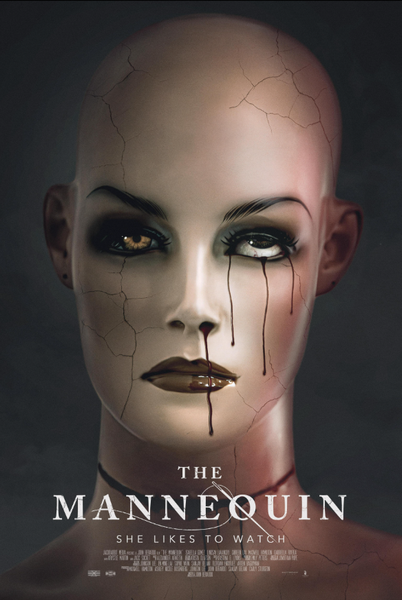
Jon Berardo’s THE MANNEQUIN is a supernatural horror film that understands the value of atmosphere, discipline, and formal control. While it occasionally hints at a larger visual ambition than it fully realizes, the film succeeds by grounding its genre mechanics in thoughtful craft—particularly in its use of sound, space, and period contrast.
A film that’s hauntingly bloody with supernatural goodness and more than a tinge of noir, writer/director Jon Berardo gets a bit bloody, a bit supernaturally creepy, and a bit mysterious as he transports us through time from a glorious black and white prologue to a grisly exorcism.
Written and directed by Jon Berardo, THE MANNEQUIN stars Isabella Gomez, Lindsay Lavanchy, Shireen Lai, Maxwell Hamilton, Gabriella Rivera, with Krystle Martin and Jack Sochet.
The story centers on Liana Rojas, a creatively stalled stylist assistant who returns to the downtown Los Angeles factory building where her fashion designer sister died under mysterious circumstances. What begins as grief and unfinished business soon reveals a darker history: the building is haunted by the ghost of a serial killer who once posed as a headshot photographer, murdering and dismembering his victims decades earlier. As Liana and her friends begin to uncover the truth, the film draws a clear line between past and present, binding them through violence, memory, and physical space.
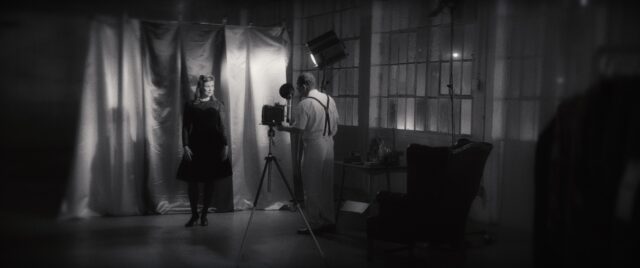
The story is fresh, and its structure is solid and cohesive as Berardo opens the film with a striking black-and-white prologue set during a 1940s photo session, establishing tone, period, and menace with economy and precision. The decision to introduce color primarily through red—specifically blood—signals the film’s visual thesis early on, and it pays dividends once the narrative shifts into the present day. The transition is clean and purposeful; the groundwork of history and horror is laid before the contemporary story accelerates.
Visually, THE MANNEQUIN benefits greatly from its limited locations. Set primarily in a cavernous loft and a more intimate house, the film uses contrast rather than scale to generate tension. Cinematographer Jonathan Pope and Berardo lean into the age of the loft itself, allowing light from its tall windows to spill, flare, and bounce naturally through the space. The building feels lived-in, haunted not by overt effects but by texture—wooden floors, cement stairs, and the echo of movement.
Production designer Emily Peters contributes to this effect through carefully designed corners and nooks that introduce a vintage, almost Art Deco sensibility. These smaller spaces provide moments of privacy and unease within the openness of the loft, though this is one area where the film occasionally feels restrained; the production design is strong, but there are moments where it could have been pushed further to deepen the visual mythology.
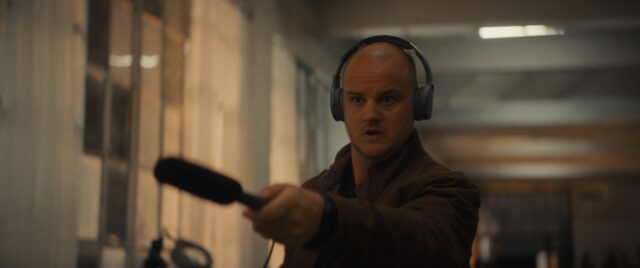
Sound design, however, is where THE MANNEQUIN truly distinguishes itself. David Eichhorn’s work is meticulous and expressive, particularly in his treatment of silence and ambient noise. Footsteps on wood, the resonance of open space, and the subtle intrusion of static become storytelling tools rather than background texture. The recurring static-radio effect—often paired with flickering light—functions as both an auditory motif and a signal of encroaching danger. It’s an elegant device, used sparingly enough to retain its impact.
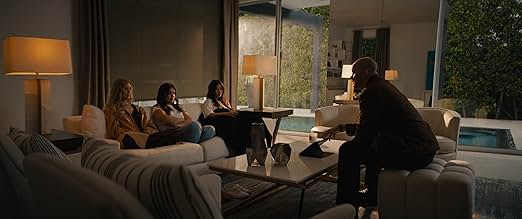
The contrast between the loft and Nadine’s house is equally well-considered. The house is warmer, more intimate, bathed in golds and softer lighting during social scenes, then gradually overtaken by darker hues and negative space as the threat escalates. Berardo visually links the two locations through windows, reinforcing the sense that danger is both external and inescapable, while also creating a metaphorical divide between perceived safety and actual vulnerability.
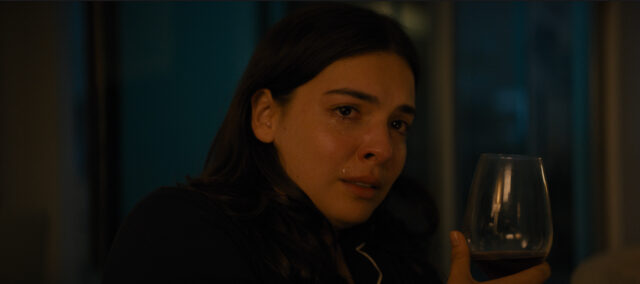
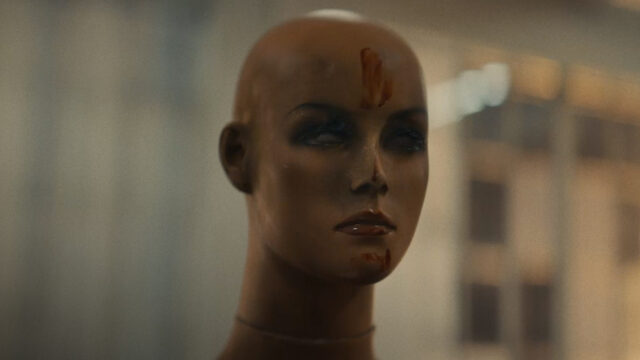
The film’s makeup work, led by Allie Shehorn, further reinforces its temporal and tonal shifts. Period-perfect looks—particularly the bold Max Factor red lips of the earlier era—contrast sharply with the more aggressive horror makeup of the third act. The transformation is effective, especially in how the mannequin themselves are revealed and recontextualized as instruments of terror.
Performance-wise, Berardo assembles a confident ensemble, reuniting with several actors from Initiation. Lindsay LaVanchy, Isabella Gomez, Shireen Lai, and others deliver grounded, credible performances that benefit from clear character relationships. Maxwell Hamilton stands out in the third act, where his performance sharpens the film’s emotional and psychological stakes.
Kristina Lyons’ editing keeps the film moving at a steady, controlled pace, punctuated by well-timed reveals and jump scares. While the film doesn’t rely heavily on shock for its effect, when it does deploy a scare—particularly around the midpoint—it lands with precision.
THE MANNEQUIN may not reinvent supernatural horror, but it doesn’t attempt to. Instead, it demonstrates a confident understanding of how sound, space, and restraint can elevate familiar genre elements. Berardo proves himself a director attentive to craft and cohesion, delivering a film that is unsettling not because it overwhelms, but because it knows exactly when—and how—to apply pressure.
by debbie elias, 10/12/2025