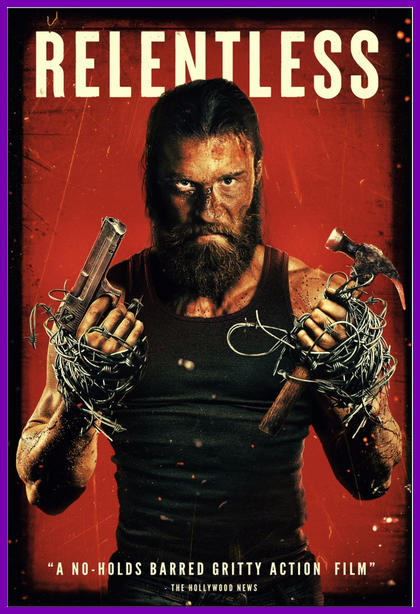
RELENTLESS is not simply a brutal film—it is a confrontational one. It is a film that understands something deeply unsettling about modern audiences: how quickly we decide who deserves our sympathy, and how rarely we interrogate why.
Written, directed, and edited by Tom Botchii, RELENTLESS begins by offering us the most familiar of social equations—poverty equals threat, wealth equals victim—and then systematically dismantles it. This is a moral pressure cooker that forces the audience to confront how quickly—and how lazily—we assign guilt.
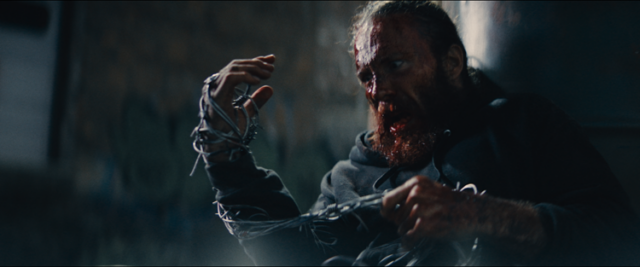
At the outset, alignment feels inevitable. Teddy (Jeffrey Decker) is homeless, unhinged, violent. Jun (Shuhet Kinoshita) is successful, affluent, composed. When Teddy launches a savage home invasion, the film doesn’t pause for context or explanation because it doesn’t need to. The audience fills in the blanks automatically. We recognize the space, the status markers, the visual shorthand of class—and we choose sides without a second thought.
Botchii relies on that reflex.
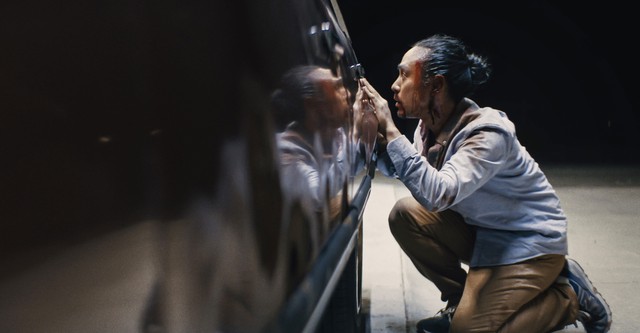
For nearly half the film, RELENTLESS withholds dialogue almost entirely, forcing the audience to engage through action alone. This silence is not minimalism for its own sake; it is a trap. Without words, we default to cultural bias. Who owns the house? Who sleeps in a car? Who has the laptop, the money, the control? In the absence of explanation, class becomes character.
And we accept it gladly.
The film’s early brutality functions as a kind of moral anesthesia. The violence is relentless enough that we stop asking questions and focus solely on survival—just get away from this man. Teddy becomes an embodiment of chaos, Jun a stand-in for order. It’s an alignment that feels natural because it mirrors how power is read in the real world: stability equals legitimacy; desperation equals danger.
Then RELENTLESS turns on us.
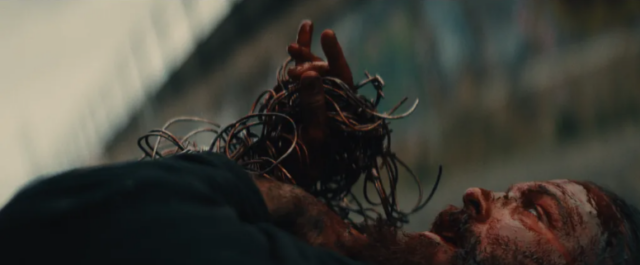
As the film enters its third act, dialogue finally arrives—not to clarify, but to indict. Motives surface that complicate the clean narrative we’ve been carrying. Jun’s composure begins to fracture. Teddy’s rage sharpens into something more specific—and more troubling. Brutality becomes savage, even barbaric and primal. The power dynamic shifts, not cleanly, but corrosively. Neither man emerges as a moral anchor.
This is where class stops functioning as shorthand and starts revealing its violence.
Jun’s wealth and control no longer read as innocence; they suggest insulation, authority, the ability to inflict harm quietly and systemically. Teddy’s homelessness no longer reads as pure victimhood either; it becomes entangled with obsession, vengeance, and the dangerous certainty of self-appointed justice. RELENTLESS refuses to crown either man as righteous. Instead, it exposes how both are operating within—and perpetuating—cycles of harm shaped by power imbalance.
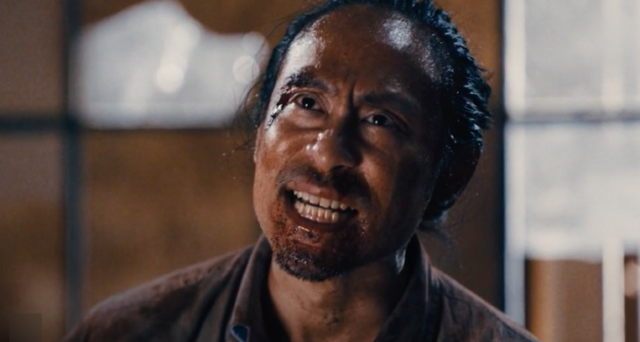
Crucially, the film never lets the audience off the hook for its early assumptions. The discomfort comes not from discovering that one man is “worse” than the other, but from realizing how eagerly we accepted a false moral hierarchy in the first place. RELENTLESS implicates the viewer by design. Our initial alignment wasn’t earned—it was conditioned.
Botchii reinforces this complicity through craft. The action is deliberately ugly and exhausting, denying the audience the pleasure of stylized violence. Each set piece—home invasion, car fight, car wash, final confrontation—tightens the vise rather than releases it. Even when the filmmaking becomes formally inventive, it never aestheticizes suffering enough to make it feel safe.
Sound design deepens this ethical unease. Early scenes overwhelm with motion and impact, pulling us into the chaos. Later, sound is stripped away—no score, minimal noise, just breath and ticking clocks. The violence becomes psychological, internalized. The shift mirrors the film’s moral turn: once the physical blows stop being the point, what remains is culpability.
What RELENTLESS ultimately asks is not who started this, but who benefits from believing they’re justified. When guilt is assigned by perception rather than process—when justice becomes personal rather than collective—where does it end? The film offers no resolution because resolution would be dishonest. Cycles of blame do not conclude neatly; they expand.
By the time RELENTLESS reaches its final moments, the question is no longer whether Teddy or Jun is right or wrong. It’s whether the audience can sit with the discomfort of having been so confident, so quickly—and so incorrectly. The film doesn’t punish us with answers. It punishes us by refusing them.
RELENTLESS is brutal, yes—but its true savagery lies in how it exposes the ease with which we confuse power with innocence and desperation with guilt. It is a film that understands violence not just as an act, but as a belief system. And once that system is activated, it rarely knows when to stop.
Written and Directed by Tom Botchii
Cast: Jeffrey Decker and Shuhet Kinoshita
by debbie elias, 01/10/2026
RELENTLESS is available on Digital and On Demand.