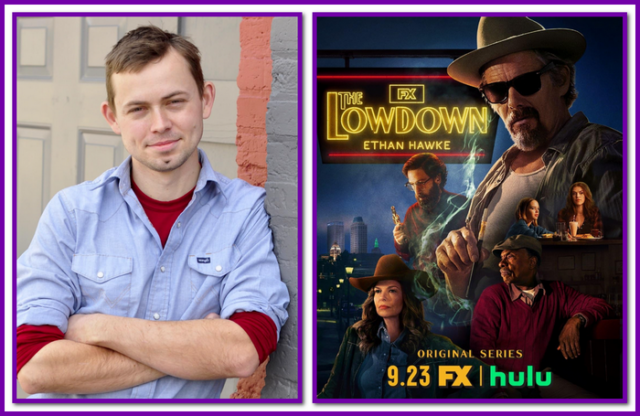
Stunt Coordinator ANDY RUSK talks practical gags, 1970s car-chase DNA, Ethan Hawke’s physical instincts, and why nobody in FX’s Tulsa noir is especially good at violence.
On paper, THE LOWDOWN sounds like it might be built for swagger. A Tulsa-set crime drama with noir flavor, corruption, white supremacy, stolen art, and an investigative undercurrent anchored by Ethan Hawke and Keith David would seem to invite the kind of polished, hard-charging action that turns every punch into mythmaking. But according to stunt coordinator Andy Rusk, that was never really the point.
Instead, what makes the series’ stunt work so memorable is how grounded it remains in character. The violence in THE LOWDOWN does not unfold like fantasy. It is messy, awkward, abrupt, and often self-defeating. Even when the show leans into action, it never loses sight of the fact that these are not superheroes or invincible operators. They are flawed people making bad choices, panicking in real time, and trying to survive consequences they are not fully equipped to handle.
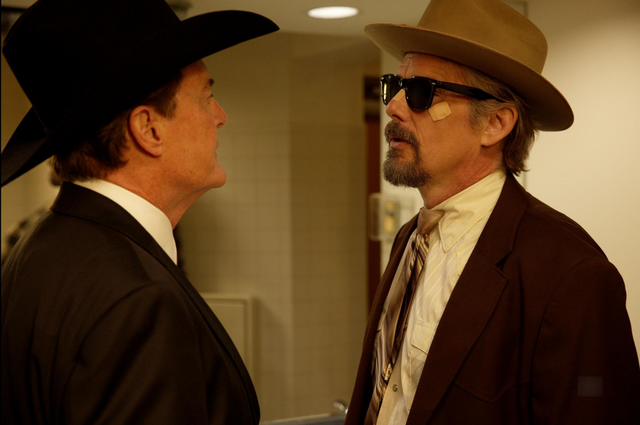
For Rusk, that was part of the appeal from the beginning.
“The first thing that appeals to you is the job,” he said with a laugh, speaking candidly about the freelance reality of stunt work. “Stunt men and women, stunt coordinators, we’re all kind of just terminal day players, right? We’re all going from one job to the next.” But beyond simple gratitude for the opportunity, Rusk had genuine admiration for the creative world that creator Sterlin Harjo had built, particularly after seeing Reservation Dogs. He saw in Harjo’s work some of the same place-driven, slightly heightened storytelling he had responded to while working on Atlanta. “The location is another character in the show,” Rusk said, noting the thread of magical realism that gives those stories their distinct texture.
That appreciation made THE LOWDOWN especially attractive: a detective story with a singular tone, rooted in Tulsa, but alive with tonal shifts that allow humor, menace, and absurdity to coexist. For Rusk, who has a strong comedy background and had recently worked on Chad Powers, the opportunity to step into something darker, stranger, and more noir-inflected was a welcome shift.
It also gave him a cast built for the kind of stunt work that depends less on flashy mechanics than on performance.
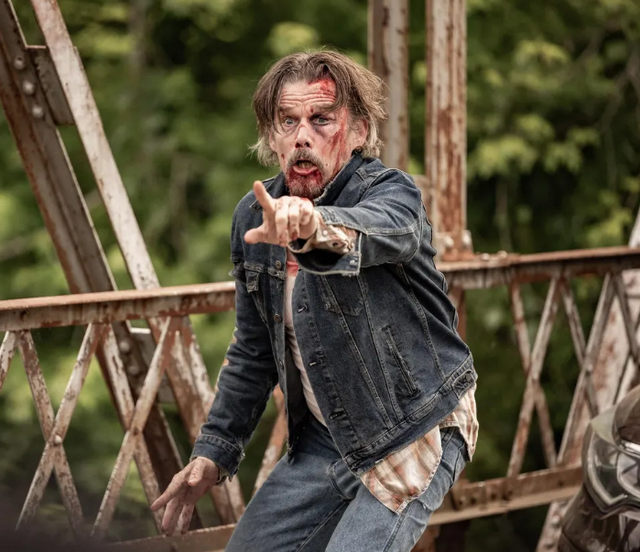
“Ethan Hawke has been losing fist fights on camera for like 30 years,” Rusk said, half admiringly and half amused. It is a line that says everything about how he views Hawke’s value in this series. Rusk is not talking about toughness for toughness’ sake. He is talking about an actor who understands how to take a hit, how to sell pain, how to let physical vulnerability become part of character.
That makes a difference. Rusk noted that while he is one of several people who doubled for Hawke’s Lee Raybon, Hawke himself does the bulk of the physical work. “By far, Ethan does the most work,” he said. And because THE LOWDOWN is as interested in comic beats and honest reactions as it is in action, that matters. “It’s going to be more interesting to see Ethan or Keith, or one of our other characters do their version of the gag, so we get an honest reaction on their faces, than it is to cut to the back of a stuntman’s head.”
That philosophy runs through all of Rusk’s approach on the series. Again and again, he returns to the same idea: stunt work is not an end in itself. It exists to support story and character. “The choreography has to be grounded in what’s in the script,” he said, “but it also has to be grounded in what these characters will do.”
With a cast as seasoned and instinctive as this one, that means collaboration is not optional—it’s essential.
“With a show like this, it’s very character-driven, with a cast that’s this talented,” Rusk explained. “I’m not going to let Scott Shepherd crash his own truck. I’m going to put Dawson Towery in to do that, because I need a guy who will drive a truck at 40 miles an hour into parked cars. I would never dream of putting an actor in harm’s way like that. But for any time we have fight stuff, the actors all have a say, because they’re more responsible for playing these characters.”
That balance—between safety, performance, and storytelling—is where Rusk’s work becomes most nuanced. He may arrive with choreography in mind, but he knows better than to lock it in too tightly.
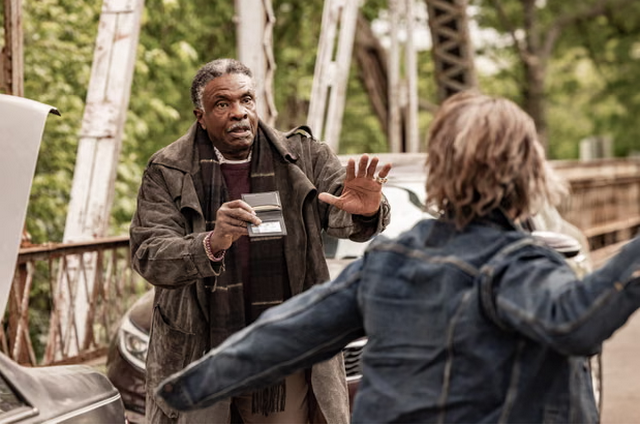
“I can visualize choreography fairly quickly,” he said. “But nobody has a better idea of what Lee might do in a fight than Ethan. So I try to come to set with options. If the story says we need to wound somebody in the left arm, I’ll come up with different ways to get there. But it’s always a work in progress until we get out there with the actors and Sterlin and start muscling it out—what does this actually look like?”
That flexibility extends to the mechanics of the stunt itself—what can be done safely by the actor, what needs to be handed off, and how to “fool the camera” without compromising performance. “If I can hide a pad, then Ethan can probably do the gag,” Rusk said. “If not, I might have to put the hat on and do it myself. But ultimately, it’s all in service of the story.”
And that, more than anything, defines Rusk’s approach. No matter how elaborate the setup or how dangerous the execution, the goal is never to showcase the stunt—it’s to serve the moment. “I have to show up on the day expecting to change my plans,” he said. “To honor the story.”
Nowhere is that philosophy more evident than in one of the season’s standout sequences: the episode eight car chase. It’s a meticulously crafted set piece that feels both thrilling and slightly off-kilter, building toward what appears to be a classic action payoff—only to subvert it at the last moment.
“Lee Raybon, it’s a moment wherein he thinks, or he feels like he can be an action hero,” Rusk said. “But the Dodge van says otherwise.”
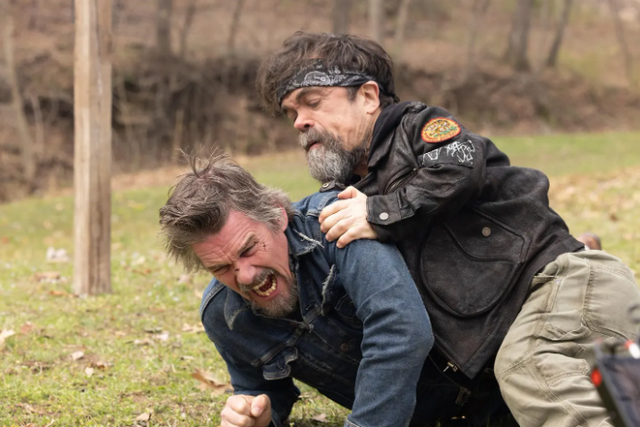
The sequence was designed with a deliberate nod to 1970s detective cinema. Rusk and his collaborators resisted modern over-stabilization, instead embracing the “body roll” of older American vehicles—the way they lean and sway through hard turns—to give the chase a tactile urgency reminiscent of films like Bullitt and The French Connection. It’s a subtle but powerful choice, one that grounds the action in a specific cinematic lineage while reinforcing the show’s offbeat tone.
If the car chase represents controlled chaos, the death of Scott Shepherd’s Alan—culminating in a high-impact truck crash—is a masterclass in practical, collaborative filmmaking.
“The way we did the gunshot is that, you know, all of these things that we do are a synthesis of all of the departments working together,” Rusk said. “At the end of the day, a kid named Dawson Towery put his mouthpiece in and his knee pads on and buckled on his five-point harness and drove that truck at 40 miles an hour into a line of parked cars. That was a stuntman doing a stunt, and he deserves his flowers for that. But that whole sequence involving special effects and special makeup effects and the camera team, by gosh, we ran so many cameras on that crash, and cameras everywhere, and sound and the picture cars guys that did everything in their power to set up that crash truck so that it would be safe, and even production for finding the time and the day to allow us to do that—and to give us the resources we needed to do it safely.”
It’s the kind of moment that underscores just how much invisible labor goes into a single on-screen beat. Rusk is quick to credit Towery, who executed the crash, but equally quick to expand that credit to the hundreds of hands involved. “That round of applause was for all of us,” he said. “For all 200-plus people that made that whole sequence possible.”
That sense of shared ownership—and shared responsibility—extends to safety, something Rusk takes seriously without ever romanticizing risk. The goal, he says, is not to court danger, but to create the illusion of it. “All we really have to do is fool the camera,” he said, pointing to the long tradition of stunt work that prioritizes ingenuity over brute force.
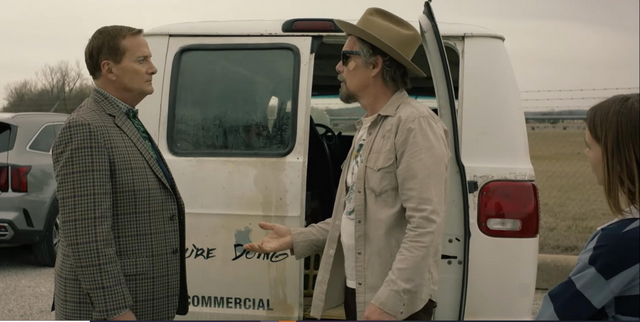
For Rusk, one of the greatest privileges of the job is the ability to bring in the right people to execute that illusion. Working in Oklahoma, he made a point of hiring local stunt performers whenever possible, many of whom come from rodeo and ranching backgrounds. “They’re tough and brave and friendly,” he said. “That’s just the biggest honor in my life, is to be able to hire so many talented people.”
As for what comes next, Rusk acknowledges that directing may be somewhere down the line—he already dabbles in previs and shaping action from a directorial perspective—but he’s equally candid about wanting a quieter future. “In 10, 15 years,” he said, “I’d like to retire with my wife and my horse and my dog.”
For now, though, THE LOWDOWN stands as a testament to what thoughtful, story-driven stunt work can achieve. Rusk’s approach is muscular without being macho, inventive without being showy, and always grounded in the messy, unpredictable humanity of the characters it serves.
In a world where no one is quite as good at violence as they think they are, Andy Rusk makes every hit, miss, and crash count.
By debbie elias, exclusive interview 04/10/2026
Season One of THE LOWDOWN is available on HULU and Disney+