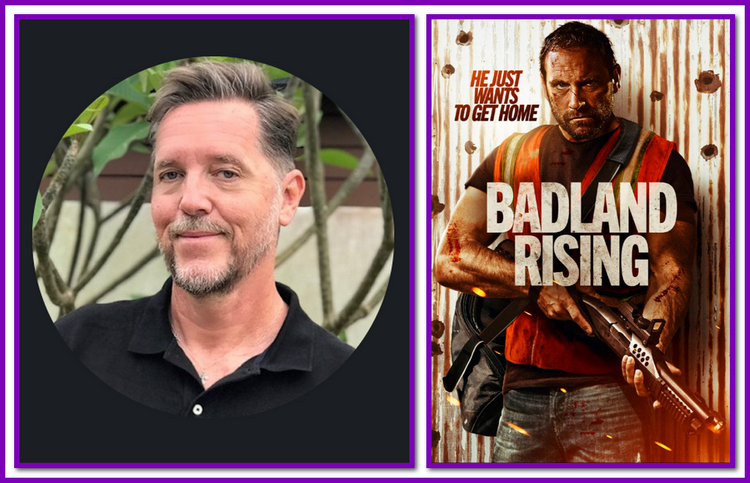
For Dave, home is nineteen hours away. That should be little more than a long drive across Queensland. Instead, it becomes a forty-eight-hour odyssey involving a botched heist, a bag full of mob money, desperate criminals, corrupt law enforcement, the Russian mafia, and a trail of violence stretching across some of Australia’s most striking landscapes.
But according to director and co-writer Blair Moore, BADLAND RISING was never conceived as a traditional action movie.
“With the films that we make, they’re character-driven, but they’ve got action. They’re not an action-action movie like a lot of people think. Oh, is it an action movie? No. It’s a character-driven film with complementary action that suits those characters.”
That distinction lies at the heart of BADLAND RISING.
While the film delivers its share of violence, pursuit, and escalating danger, Moore’s primary interest was always the people caught in the middle of the chaos. “It’s a wild ride. It’s over 48 hours. It’s a wild ride. The boys chasing Jake.”
And that’s exactly what BADLAND RISING delivers—a relentless pursuit thriller where character drives the action rather than the other way around.
Building a 48-Hour Road Thriller
The origins of BADLAND RISING can be traced back to a conversation between Moore and co-writer Dru Brown. At the time, Moore was immersed in writing another project, the upcoming VELVET BLU, a far more complex narrative undertaking. “I was actually writing another film that I’m making now, which is VELVET BLU. It’s quite a complex film.”
While discussing potential collaborations with Brown, however, the pair found themselves drawn toward something considerably leaner and more direct. “Dru and I always wanted to do something together.” What emerged was a shared appreciation for a particular style of thriller.
“We both love all those road movies. THE HITCHER and RACE WITH THE DEVIL—they’re old movies, I don’t know if anyone remembers those movies—but ROAD GAMES was an Australian film with Stacey Keach.”
Rather than constructing an elaborate crime saga, Moore and Brown deliberately embraced simplicity. “We thought, let’s just do a road movie. Let’s make it a really simple story. Like a heist gone wrong and a guy that’s just trying to get home, and he’s stuck in the middle of all this.” That straightforward premise ultimately became the film’s greatest strength.
“It’s just a 48-hour period in the film. And it’s just the chaos that ensues in that 48 hours.”
The result is a thriller that continually escalates while never losing sight of its central objective: a man trying to make it home.
The Weight of the World
At the center of BADLAND RISING sits an intriguing narrative balancing act.
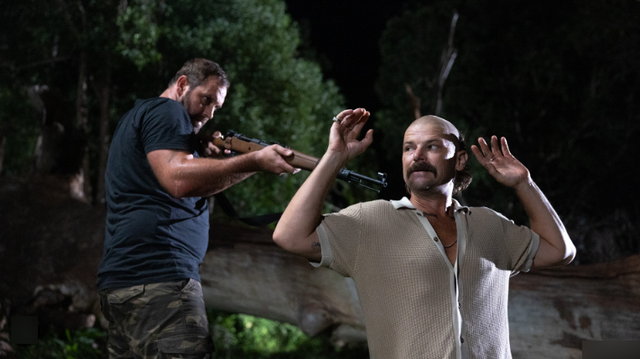
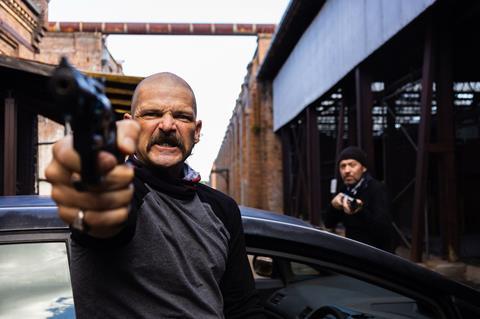
While Dave functions as the emotional anchor of the story, Moore intentionally created Mitch and Morgan as a contrasting force moving through the same landscape.
“I wanted Mitch and Morgan to be there in sort of a buddy-buddy situation. Which they are, but at the same time they’re extremely violent, and they sort of do really dumb things.”
That dynamic allows the film to continually shift between tension, humor, unpredictability, and outright danger.
More importantly, it provides a sharp contrast to Dave.
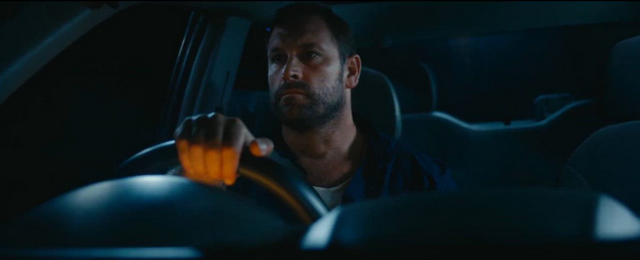
“He’s got the weight of the world on his shoulders. He’s just been fired from his job. He’s trying to save his farm.”
Initially, Dave’s journey appears completely separate from the chaos surrounding the botched robbery. Then comes the discovery that changes everything.
“He doesn’t know he’s got the money until halfway through the film. Suddenly, he realizes that all his problems are solved financially. They’re in that bag.”
But the money creates a new dilemma. “What do you do if you find a bag full of money that’s going to pay your mortgage out, put you back on track, and probably set you up for life? You know it’s bad money, but what do you do?”
The money represents salvation. It also represents danger. “He realizes that he’s also being chased, which makes it even worse. His family’s at risk.”
As the story unfolds, every narrative thread converges. The Russians are chasing Mitch and Morgan. Law enforcement has its own agenda.
Dave simply wants to get home.
“It’s sort of a twisted tale of all of them heading towards Jake, who is Dave. And chaos ensues.”
Casting Character
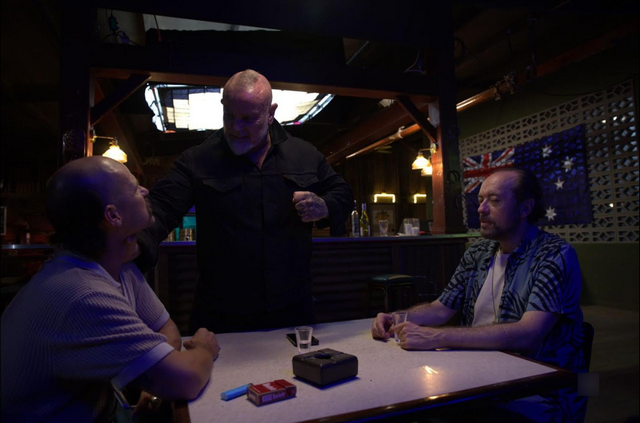
For Moore, assembling the cast was less about filling roles and more about finding performers capable of grounding the film’s escalating chaos in authentic human behavior.
“Jeremy’s [Lindsay Taylor] a movie star. He’s amazing.” Many of the cast members were already people Moore knew and trusted. “I’m good mates with Jake [Ryan] and Nathan [Phillips] and everyone else.”
Others arrived through recommendations and creative relationships. “Dru brought in Steve Mouzakis. He’s amazing. He’s a stage actor as well and does international films.”
One key addition came through Jeremy Lindsay Taylor. “Jeremy actually introduced me to Aaron [Glenane].” That introduction proved invaluable.
“Aaron was amazing. His switch from being sort of this rookie cop to—without giving it away – [having] chops and quite ruthless. I was like, ” Wow, there’s something there.”
Moore’s admiration extends equally to Hannah Levien. “Hannah was amazing.”
Looking back, he sees the casting process much like independent filmmaking itself.
“I think every film, when they’re supposed to happen, that snowball effect. It’s really hard at first, and then you push and push and push, and sometimes you think, ‘Is it ever going to happen?’ Then suddenly something happens, and it snowballs, and it sort of spins up, and it comes together very fast.”
Visual Grammar and the Queensland Landscape
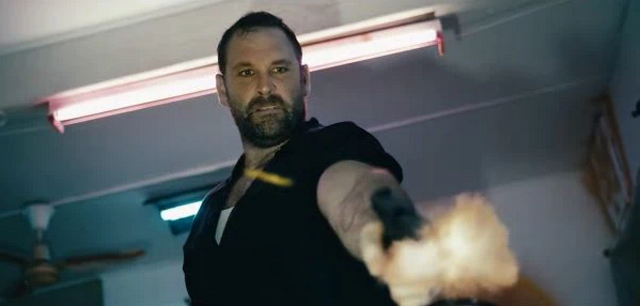
From its opening frames, BADLAND RISING embraces a distinctly cinematic visual language. “With the style of the shoot, I think it’s very important to be cinematic.”
For Moore, simply capturing action wasn’t enough. “We wanted to have our own style as well.”
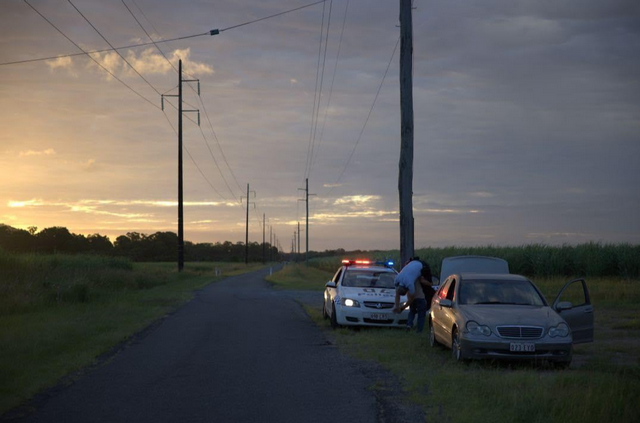
Working with cinematographer Tim Carr and his camera team, Moore developed a visual approach designed to immerse audiences in the unique geography of Queensland. “We really wanted to show that landscape.”
The film’s drone photography became a key storytelling tool, establishing geography, isolation, and scale. Among Moore’s favorite images are the aerial shots captured above the cane fields. “It’s amazing when those drones are up above those cane fields, and the wind hits that cane. You see that ripple through the cane.”
Yet one image stands above all others.
“I think my favorite money shots of the film are probably the drone shots, the aerial shots with the fog, where it’s way up above the fog and over the fields. Absolutely breathtaking.”
The remarkable footage came almost by accident. “Josh from Cine Studios got that shot. By all chance, he was driving to Melbourne, and it was very foggy.” Curiosity took over. “‘I wonder what it looks like on a drone?’ He flew that drone up, and bingo—shot.”
Nature itself became an unpredictable collaborator throughout production. “We’re in the tropics, so you can have the four seasons in one day.” Maintaining continuity amid rapidly changing conditions required flexibility from the entire camera department. “The camera guys were all amazing. Josh [Horeau] and Milan.”
Moore singles out Steadicam operator Milan Holec in particular. “Milan was just a legend.”
The resulting imagery gives BADLAND RISING a visual identity that continually reinforces the story’s themes of pursuit, isolation, and the long journey home.
Grounded Violence
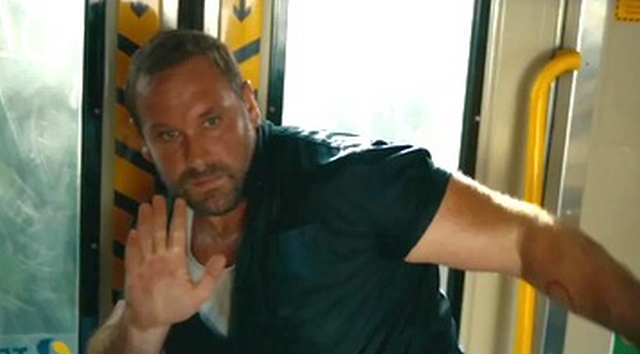
That same commitment to authenticity extended into the film’s action sequences. “The stunt team’s pretty amazing.”
More importantly, the actors were willing to do the work. “Most of the fight stuff they’re doing themselves.”
Moore intentionally avoided highly stylized combat. “One of the things that we wanted to do with all the fight scenes is we didn’t want to go there with glorified martial arts type stuff.” The decision is particularly notable given Moore’s own background. “My background is actually in combat sports.”
Yet rather than showcase technical fighting skills, he moved in the opposite direction. “Most of those sorts of fights are just brutal fights.” Moore looked toward the reality of street violence.
“If you watch videos of people having street fights, they’re just punch-ons. They always end up on the ground.”
That realism became a guiding principle. “We didn’t want to glorify the violence. We wanted to show it as it is.”
The climactic confrontation on the farm embodies that philosophy. “We just wanted to show the brutality of it.”
Ultimately, the action exists to support character. “Complementing the action with the characters, I think, is very important.” Because, as Moore notes, the moment the fights became overly stylized, the story would have suffered.
Finding the Film in the Edit
For Moore, editing represents the next stage of writing. “I do the assemblies myself.” After taking a brief break following production, he spends weeks building the first version of the film.
“I spent about a month putting it all together.” Only then does he turn it over to editor Stephanie Liquorish and the team at Chop Shop.
“Steph just makes it beautiful. She takes my wonky wheel and turns it into something amazing.” The collaboration is built on trust.
“I was very comfortable in the fact that I could leave it be and she would come back with some really amazing ideas.”
For Moore, the difference lies in working with editors who are filmmakers themselves. “She’s a filmmaker too.” That perspective changes everything.
“A creative editor is very important. They can see things that you might not see.” Sometimes those discoveries emerge from the smallest details. “They might say, this clip will work here, and it might have been from a completely different scene.”
For Moore, that’s the magic of post-production. “I think that’s an amazing process.”
Sustaining Tension Through Music
Just as the editing maintains momentum, the score helps sustain tension throughout Dave’s increasingly desperate journey. Having previously collaborated on KANE, Moore immediately turned to composer Ronnie Minder. “Ronnie’s amazing.”
The pair share a creative shorthand. “He sort of understands what I’m trying to do.” Rather than dictate specific musical choices, Moore gives Minder room to explore. “I sort of let him off his leash.” That trust allows Minder to approach the film as a storyteller. “He visually watches the film and then feels like, okay, it should be this.”
The objective was simple. Maintain tension.
“A lot of people were saying that the composition kept you tense right through the whole film.” That response was exactly what Moore hoped to achieve. “That was the idea—to have that tension right through the whole film so that you don’t really have a chance to breathe.” The film’s musical identity extends beyond Minder’s score.
Moore also enlisted local Australian band Rattlesnake for the opening and closing songs after a recommendation from Jake Ryan. “Jake said, ‘You should listen to these guys.'” Moore did. “And I went, it actually fits really well.”
Keep Learning
For Moore, filmmaking remains a constant education. “I think you’re constantly learning.”
It’s a philosophy that guides every aspect of his work. “No one’s a master.” In fact, he sees curiosity as essential to both filmmaking and life. “I think if you stop learning, you die.”
That outlook naturally extends to one of the industry’s hottest topics: artificial intelligence.
While Moore acknowledges AI’s growing importance, he views it as a tool rather than a replacement for human creativity. “I think AI is a very good tool.” But he remains unconvinced that technology can replicate emotional truth.
“Stuff I’ve seen anyway that’s AI, it lacks soul.” That doesn’t mean he dismisses it. Far from it.
Moore sees tremendous value in AI-assisted visual effects, storyboarding, post-production workflows, and production efficiency. “It can speed up the process.” But storytelling still requires human instinct. “It still needs that human touch.”
For Moore, the future isn’t about replacing filmmakers. It’s about giving filmmakers better tools. “Use it as a tool and embrace it as a tool.” Just don’t confuse the tool with the craft. “If you can’t make a movie practically, then you’re not going to be able to really make a movie with AI that’s going to be any quality.”
Moore remains unapologetically committed to practical filmmaking whenever possible. That philosophy is already influencing future productions.
Faced with the choice between creating a car rollover digitally or doing it for real, the answer came quickly. “We’re really rolling a car.”
For Moore, technology should enhance reality, not replace it. At the end of the day, every camera, every lens, every edit, every stunt, every visual effect, and every technological innovation serves the same purpose. “It’s sort of that storytelling at the end of the day.”
And for Blair Moore, that’s the lesson that never changes. Keep learning. Keep evolving. Keep telling stories.
by debbie elias, exclusive interview 06/03/2026
BADLAND RISING is available On Digital and On Demand on June 12, 2026.