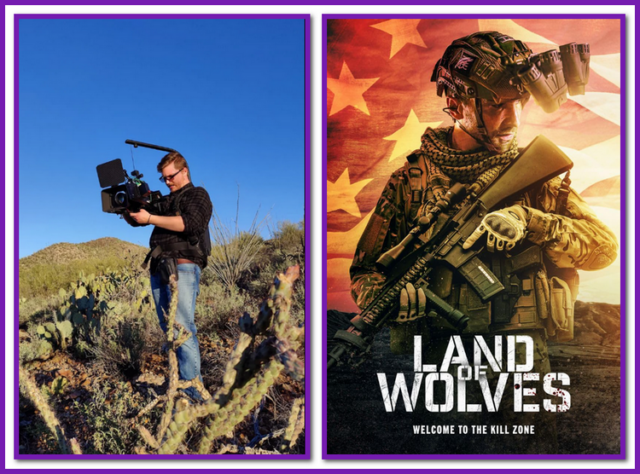
The blood starts early in LAND OF WOLVES and never really lets you breathe.
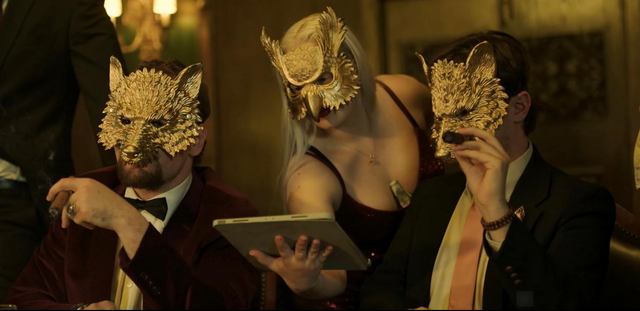
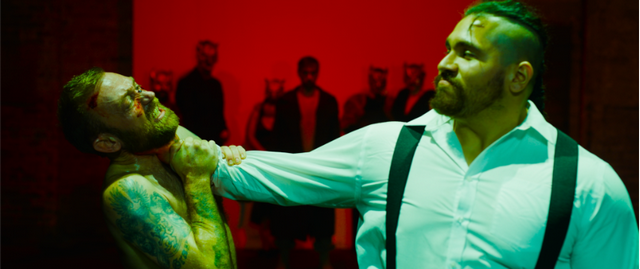
Inside a red-washed, makeshift arena, Navy SEALs are reduced to gladiators, pummeling one another into pulp while cigar-chomping billionaires in gold wolf masks howl for more. Blood splatters the lens again and again until the frame itself feels contaminated, as if the brutality has reached through the screen and landed on the viewer.
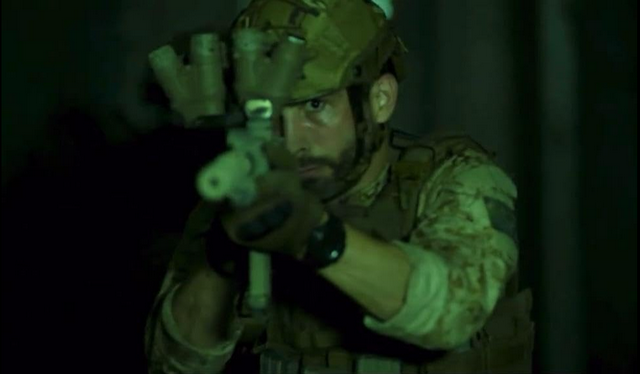
Sent by Commander Anderson on a covert mission to rescue Knox, a soldier who vanished years earlier on her watch, four elite Navy SEALs — Marcus, Briggs, Wade, and Jace — are captured and thrown into an underground death match. Watched live and via livestream by depraved power brokers betting on who will live and who will die, the men are forced to fight in a brutal, illegal tournament where survival depends on training, instinct, and whatever remains of their brotherhood.
But for writer-director-cinematographer-editor-producer-VFX craftsman TOMMY JACKSON, the violence isn’t the point. It’s the evidence.
“I wanted this to be uncomfortable to watch,” Jackson tells me. “I wanted it to feel as grounded as possible… something that you kind of look at and squint up your face, and you’re like, man, this is intense.”
That intensity is not incidental. Jackson refuses to romanticize the carnage or soften its consequences. “I didn’t want to make a film about such a cruel… disgusting world and situation and make it romanticized,” he says. “I wanted to show that there are consequences, real consequences.”
Violence Has Consequences
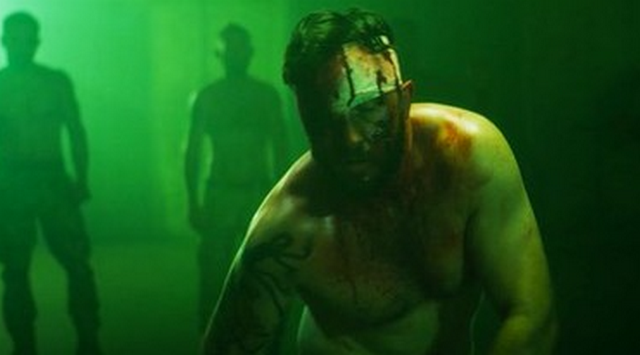
In LAND OF WOLVES, those consequences are written on bodies. Faces swell, split, and stay bloody. Fighters do not walk away from punishment magically restored for the next scene. Every blow leaves a mark. Every death matters. Jackson is not interested in comic-book invincibility or bloodless action spectacle. He wants the audience to feel the damage.
That is where the blood on the lens becomes more than an effect. It becomes a statement.
“I wanted the audience to feel that they couldn’t escape what they’re seeing,” Jackson says. “They can’t sit back behind their TV screen and say, oh, I am nowhere near this… I’m safe. I wanted it to feel like even through their TV screens, they can’t get away.”
The choice pays off. Watching Marcus (James William Clark) grind his opponents into the mat, the blood does not merely stain the arena floor. It streaks the camera until the act of watching feels complicit. The billionaire spectators may be physically close to the violence, masked and cheering from the edge of the pit, but Jackson makes sure the rest of us are not spared either.
“I wanted you to feel like you got to go shower after,” he says.
That complicity runs through the film. The so-called Illuminati bettors in LAND OF WOLVES are grotesque, theatrical, and deliberately excessive, but they are not the only ones feeding on the spectacle. Jackson places the viewer in uneasy proximity to the same brutality they consume. The wolf masks may belong to the billionaires, but the appetite for violence is broader, uglier, and harder to dismiss.
The Worldview
As the film pushes deeper into its third act, that appetite widens into a broader meditation and larger indictment of corrupted systems — military, intelligence, financial, and political. Through Knox, the film’s missing man and moral detonator, LAND OF WOLVES turns from survival thriller into something more venomous: a howl against institutions that use soldiers, discard them, and then dress exploitation in the language of honor. The arena may be filled with blood and broken bodies, but Jackson is ultimately more interested in the systems that built it.
For Jackson, that perspective grew out of the freedom of working independently.
“It comes from an unfiltered voice,” he says. “There’s no studio, there’s no backer, investor, or even producer basically trying to dictate what’s marketable, what isn’t. Don’t go this way, don’t go that way, this is too political.”
Rather than framing the story through a partisan lens, Jackson says he wanted to present what he sees as a cycle of institutional corruption, allowing audiences to arrive at their own conclusions.
“Yeah, it does say look at the corruption, especially in the military, especially in regards to the way the world handles violence,” he admits.
The result plays less like a polished think piece than an unfiltered howl. LAND OF WOLVES imagines a world where the powerful build the arena, soldiers are fed into it, and everyone watching becomes part of the bloodletting.
Once the wolves are allowed to run the room, the only honest ending is that everyone bleeds.
That philosophy also resonated with several members of his cast, many of whom brought military experience to the production. Jackson credits those performers not only with lending authenticity to the tactical aspects of the film, but with embracing the larger questions the story raises about loyalty, power, and the cost of violence.
Building the World
If Jackson’s worldview fuels LAND OF WOLVES, its production is powered by something equally formidable: ambition.
Long before the first punch was thrown or the first gallon of fake blood splattered across the lens, Jackson had set himself an objective that many independent filmmakers would have dismissed outright.
“I wanted to make a blockbuster film that everyone would say was impossible to make.”
The challenge wasn’t simply scale. It was figuring out how to create that scale with resources he already knew he could control.
Jackson’s solution began with a location.
Years earlier, he had filmed inside a former Chicago church whose maze-like corridors and cavernous interiors never left his imagination. Rather than searching for expensive sets, he began designing the film around spaces he already understood, transforming the building into an underground labyrinth where every staircase, hallway, and shadow heightened the growing sense of unease.
“I had filmed in that exact location… years previously,” he recalls. “I started thinking of a large concept… something I would want to watch, but something I could actually follow through with.”
To expand the world beyond those walls, Jackson looked west.
Chicago supplied virtually all of the film’s interiors, while three days in the Arizona desert provided the exterior photography that convincingly doubles for Mexico. Combined with Jackson’s own visual effects work—including the massive industrial complex looming over the desert landscape—the result creates a production footprint that feels considerably larger than its independent roots would suggest.
That illusion of scale wasn’t accidental.
Every location, every visual effect, and every production decision served the same goal: convincing audiences they were watching a film that should have cost far more than it did.
It’s exactly the kind of logistical puzzle Jackson relishes solving.
Building a Company of Collaborators
Building an “impossible blockbuster” requires more than ambition. It requires people willing to believe in the vision.
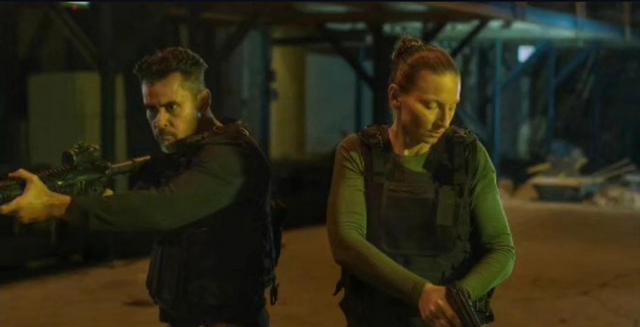
Although Jackson serves as writer, director, cinematographer, editor, producer, and visual effects artist on LAND OF WOLVES, one of the film’s greatest strengths lies in the collaborators he assembled along the way—and his willingness to let them help shape the world he envisioned.
That collaboration begins with Ivana Cipurko.
Originally joining the production as makeup artist, Cipurko quickly became far more than a department head, stepping into producing, wardrobe, location logistics, and creative collaboration as the production expanded. For Jackson, independent filmmaking demands flexibility, and LAND OF WOLVES became as much a partnership as a personal endeavor.
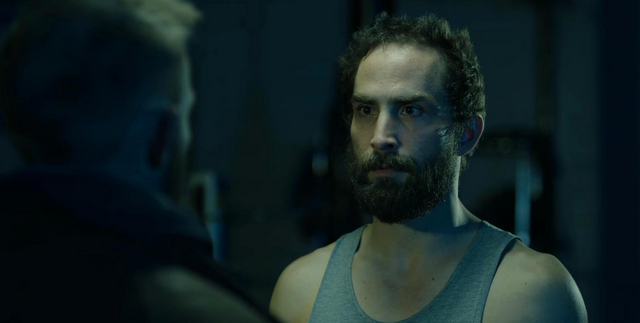
On screen, authenticity starts with Matthew Gray’s quietly commanding performance as Briggs. A fifteen-year veteran of the Australian Army, Grey naturally brought military knowledge and tactical realism to the production. More importantly, he infuses Briggs with an understated ambiguity that subtly unsettles the audience from his very first appearance. His confidence inspires Marcus to join the rescue mission, yet there is an unmistakable undercurrent suggesting that Briggs may not be everything he appears to be. That quiet uncertainty becomes one of the film’s most effective dramatic threads, rewarding viewers as the story gradually reveals its deeper intentions.
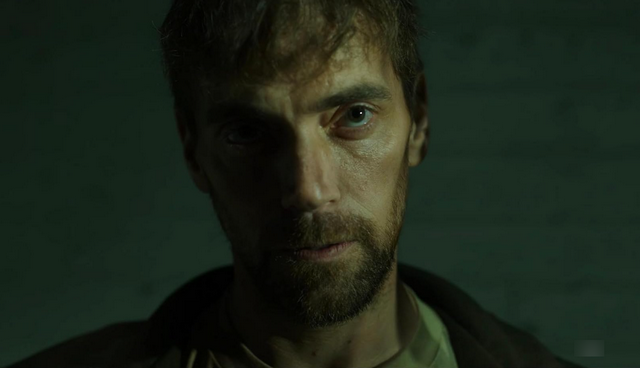
Russell Shealy provides an equally memorable presence as the mysterious Knox. Long before the character physically emerges, Jackson teases his arrival through voice, shadow, and carefully controlled negative space, allowing Knox to haunt both Marcus and the audience. By the time Shealy finally steps from the darkness, the performance carries an almost mythic weight, making Knox less a missing soldier than the embodiment of the questions driving the film’s final act.
Jackson’s collaborative philosophy perhaps finds its fullest expression in Felix Alexander’s unforgettable turn as The Butcher.
“One thing I do with my actors,” Jackson explains, “especially when you’re working in the indie world where you don’t have a studio funding you for every little thing… you go to the actor and you say, ‘What can you bring to the table?'”
Alexander brought plenty.
Already immersed in Roman history and gladiatorial culture outside of acting, he arrived with costume ideas that immediately captured Jackson’s imagination, even contributing the replica Roman sword that becomes one of The Butcher’s defining visual signatures. Rather than dictating every creative decision, Jackson embraced the collaboration, allowing Alexander’s own passions to deepen the character’s imposing presence.
That same spirit extended throughout the production. Military veterans contributed firsthand experience. First-time performers embraced demanding roles with surprising confidence. Actors became creative partners rather than simply performers.
For a filmmaker often described as wearing every hat on set, Jackson’s greatest directorial strength may be knowing when to hand one of those hats to someone else.
Designing the Arena
If LAND OF WOLVES succeeds anywhere beyond its ambitious premise, it is in the meticulous construction of its visual world. Every creative decision—from production design and makeup to lighting, color, and camera placement—serves a single purpose: making the audience feel trapped inside the arena.
Jackson understands that confinement is as much psychological as physical.
Working within the narrow corridors, stairwells, and compact rooms of his Chicago location, he transforms limited space into a dramatic asset rather than a production obstacle. Instead of fighting the architecture, he embraces it, allowing every hallway to tighten the tension while carefully composed negative space creates unease where none should exist.
The finest example comes inside Marcus’s prison cell.
One corner of the room remains almost defiantly empty, drawing the eye again and again until Knox slowly announces himself first as a disembodied voice before gradually emerging from the darkness. Jackson withholds Russell Shealy’s physical presence for as long as possible, allowing the performance to materialize almost ghost-like from the shadows. Coupled with Marcus’s mounting physical trauma, the moment quietly invites the audience to question whether Knox is truly standing there—or whether Marcus is simply succumbing to exhaustion, concussion, and the psychological toll of survival.
That deterioration was intentional.
“Brain damage is a big thing,” Jackson explains. “I wanted these guys to look so fucked up through the whole movie. I didn’t want shots after a fight where time moves on and they’re all pretty again.”
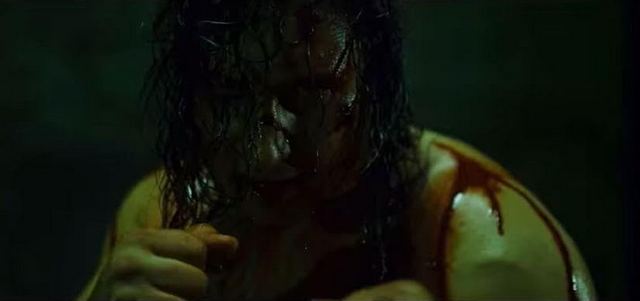
The makeup never resets. Cuts remain open. Blood dries. Bruises deepen. Every injury accumulates, reinforcing the physical and emotional cost of every fight rather than treating violence as disposable spectacle.
The film’s visual identity is equally disciplined.
Red. Green. Gold.
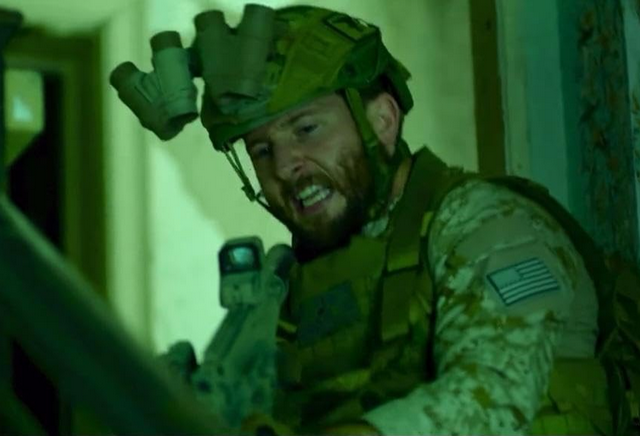
Those three colors dominate nearly every frame, each serving both an emotional and narrative purpose. Red fuels the brutality of the arena. Green reinforces the military world while simultaneously casting an almost sickly pall over the proceedings. Gold crowns the wolf masks worn by the billionaire spectators, visually linking wealth, power, and corruption into a single unsettling image.
“It’s very straightforward,” Jackson says. “I wanted it to be saturated… I wanted that hard, aggressive red… and then have that intense green just covering them in filth.”
Rather than chasing the muted palette often associated with contemporary action films, Jackson embraces bold, highly saturated color that amplifies every punch, every wound, and every drop of blood. The result is a visual language that refuses to soften the brutality unfolding before the audience.
Every artistic decision inside LAND OF WOLVES ultimately points toward the same destination. The arena is more than the setting for the story—it becomes another character altogether, silently manipulating both the combatants trapped inside it and the audience watching from outside the ropes.
Shooting, Rewriting, and Editing
Most filmmakers complete principal photography before discovering what they actually have in the editing room. Jackson approached LAND OF WOLVES differently.
Rather than treating production and post-production as separate stages, he turned editing into an extension of the creative process itself.
The self-funded production unfolded over multiple shooting blocks spread across several months, beginning with the military infiltration sequences in Chicago before eventually moving to Arizona for the film’s exterior photography. Between each stage, Jackson stepped into the editing room—not simply to assemble footage, but to evaluate what the film still needed.
“I started cutting it together,” he recalls, “seeing what I got, seeing what else I might need.”
That process often reshaped the production itself.
Rather than rigidly adhering to the original screenplay, Jackson allowed the evolving edit to influence subsequent shooting days. New ideas emerged. Existing scenes changed. Additional coverage was captured. The edit became another draft of the screenplay, informing each return to production.
“We started shooting August 2023,” he says, “and then… I would edit, shoot again, edit until finally everything was there… and then it was all about just polishing.”
It’s an approach more commonly associated with problem-solving than post-production, but for an independent filmmaker balancing creative ambition against practical limitations, it proved invaluable.
Instead of discovering missing pieces after principal photography had wrapped, Jackson discovered them while there was still time to solve them.
By the time LAND OF WOLVES reached its final edit, much of the film had already evolved through months of continuous refinement. The finishing process became less about finding the movie than polishing one that had been rewritten, reshaped, and rebuilt throughout production itself.
Behind the Lens
For much of our conversation, Jackson speaks as a writer, director, and producer. Mention cameras, however, and another side of the filmmaker immediately appears.
LAND OF WOLVES was photographed entirely on Blackmagic cameras paired with Sigma Art lenses, a combination Jackson chose for both image quality and efficiency. Rather than constantly changing lenses, he often swapped camera bodies, allowing multiple focal lengths to remain ready for immediate use—an approach that proved especially valuable on a production where time and resources were at a premium.
“I love Blackmagic,” Jackson says without hesitation.
It’s an enthusiasm shared by many independent filmmakers. Blackmagic’s color science, flexibility, and accessibility have quietly transformed independent production over the past decade, allowing ambitious filmmakers to achieve increasingly cinematic images without blockbuster budgets.
For Jackson, the camera was never the story. It was another tool helping him realize an ambitious vision with practical means. Like every other production decision on LAND OF WOLVES, the technology served the filmmaking—not the other way around.
Betting on Himself
Every filmmaker finishes a project having learned something about the craft.
Jackson finished LAND OF WOLVES, having learned something equally important about himself.
“I am capable of whatever I think I can do,” he says.
It isn’t a statement of certainty so much as one earned through experience.
Every logistical obstacle—locations, scheduling, financing, casting, visual effects, editing, and ultimately distribution—forced Jackson to solve problems that many first-time filmmakers never encounter until much later in their careers. Rather than waiting for opportunity, he created one.
That may be the film’s most lasting lesson.
Whether audiences embrace LAND OF WOLVES, debate its themes, or simply appreciate its ambitious craftsmanship, the production itself stands as proof of what determination, adaptability, and creative problem-solving can accomplish on an independent scale.
For Jackson, LAND OF WOLVES was never simply about making a feature film.
It was about proving—to himself more than anyone else—that he could build one.
by debbie elias, exclusive interview 06/18/2026
LAND OF WOLVES is available On Digital and On Demand.