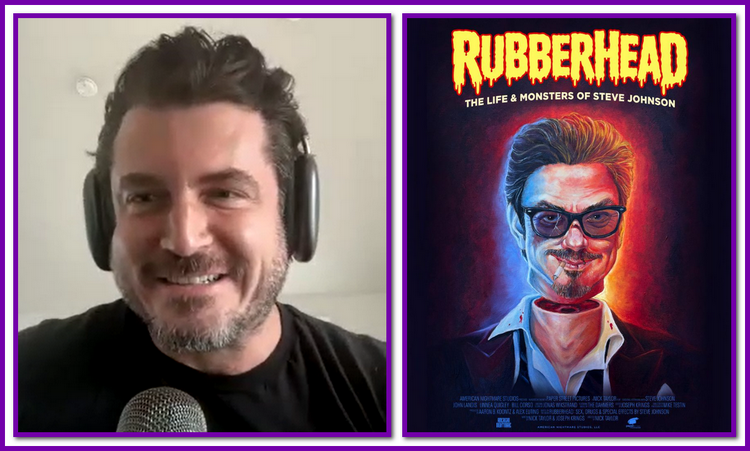
As the daughter of a man who loved the Universal Monsters and introduced me to everything from Lon Chaney forward, (as well as going backward to the earlier works of Max Schrek and Murnau), and someone who, over the decades, has known more than a few of the artists responsible for creating the creatures and practical effects that have populated our cinematic nightmares, RUBBERHEAD: THE LIFE & MONSTERS OF STEVE JOHNSON was always going to pique my interest.
But director and co-writer NICK TAYLOR does far more than simply pique it.
An endlessly fascinating, wildly entertaining, often hilarious, sometimes heartbreaking, and ultimately moving portrait of acclaimed creature creator and special effects master Steve Johnson, RUBBERHEAD chronicles not only one man’s extraordinary career but a pivotal era in filmmaking when imagination, ingenuity, latex, rubber, mechanical engineering, chemicals, sheer determination, and, apparently, copious amounts of cocaine could bring monsters to life.
Known for his intense work ethic, perfectionism, and obsession with breaking new ground, Johnson’s career touched some of the most iconic genre films of the 1980s and beyond, including THE HOWLING, AN AMERICAN WEREWOLF IN LONDON, GHOSTBUSTERS, FRIGHT NIGHT, BIG TROUBLE IN LITTLE CHINA, PREDATOR, THE ABYSS, and countless others.
But RUBBERHEAD is not merely a celebration of the monsters Johnson created. It is the story of the man who created them.

And, as the film makes abundantly clear, Steve Johnson’s greatest monster may ultimately have been himself.
For Taylor, however, Johnson was once something very different. He was a lifeline.
“I was a horror fan. I loved monster movies and special effects makeup and all this weird stuff, and I didn’t have too many friends who were into it also. So I kind of felt like a little bit of a misfit and an outsider because of that.”
Then young Nick Taylor saw Steve Johnson. Here was a “cool, strapping, handsome guy” at the top of the special effects industry, creating monsters and gore effects for major movies and building an enviable life doing the very things Taylor loved.
“I felt validated by him at a young age. He kind of made me feel less lonely.”
Johnson showed Taylor that this strange world he loved could be more than an obsession. “This is a living. This is a dignified life. This is cool.”
Taylor describes Johnson as something of a “spiritual mentor” during those formative years, although the two had never met. That changed years later at Monsterpalooza.
Once Taylor began talking with Johnson and hearing the stories behind his extraordinary career, a light bulb went on.
The movies were legendary.
The stories were insane.
And Steve Johnson was one hell of a storyteller.
“Every story involved drugs and debauchery and insanity.”
Taylor found himself revisiting movies he had loved since childhood, now seeing them through the eyes of someone who had actually been there. Johnson’s career seemed almost impossibly positioned at the center of one iconic production after another. He worked for Rob Bottin on THE HOWLING, moved on to Rick Baker and AN AMERICAN WEREWOLF IN LONDON, and then continued through a seemingly endless succession of landmark genre films.
“His life, I just thought, was incredible, and he is such a good storyteller and so engaging and so much fun that I just thought this would make a sensational movie.”
And Taylor knew who should make it. “I’m the one to do it.”
He was right.
But making a documentary about four decades of one man’s life and work proved far more complicated than Taylor anticipated.
RUBBERHEAD is beautifully constructed as a chronology, taking us year by year and film by film through Johnson’s life without ever becoming a dry recitation of credits. Archival footage, photographs, home movies, behind-the-scenes materials, film clips, and interviews are woven together with an energy that reflects Johnson himself.
Editor and co-writer Joseph Krings is instrumental in making that work.
Taylor describes documentary editing as assembling a puzzle—except this particular puzzle came with a significant complication. “The pieces you’re pulling from are from four different puzzles poured into the same pile, and you’re not sure at any given moment which puzzle you’re putting together or if you’re putting together the right one.”
Unlike a narrative feature, where a screenplay provides at least a structural road map, a documentary continually changes as new interviews are conducted, new archival material surfaces, and unexpected stories open entirely new avenues.
“You shoot all this stuff, you find all of this stuff, you constantly are uncovering new pieces of archival, and you just have to figure out how it all fits together.”
Fortunately, Johnson had saved approximately 40 years of personal archival material, giving the filmmakers an extraordinary treasure trove from which to work. Rights and licensing remained complicated—as they inevitably do when dealing with this many movies and decades of Hollywood history—but Johnson’s own archive became one of RUBBERHEAD’s greatest assets.
Then there were the interviews with Johnson himself. Six or seven of them. Approximately four hours each.
Only a fraction would ever make it into the finished film, but Taylor needed the whole story before he and Krings could determine what the story actually was.
“You need to know everything, so you figure out where your story is.”
And with Steve Johnson, one story invariably led to another.
“He would tell some new story that would uncover this whole other potential narrative, so you’re just constantly chasing these little threads.”
At one point, RUBBERHEAD existed almost entirely as Steve Johnson telling the story of Steve Johnson.
Taylor and Krings considered following the model of THE KID STAYS IN THE PICTURE, in which legendary producer Robert Evans narrates his own life with the audience knowingly accepting that the truth may occasionally be embellished in service of a good story. Johnson could certainly have carried that approach. But it would not have told the whole story.
“We realized he’s far too dimensional of a character. There are far too many sides of him, and we wanted to know other people’s side of the story, too.”
That decision gives RUBBERHEAD much of its emotional and historical depth.
Rather than filling the film with detached experts, Taylor sought people who actually knew Johnson and had worked or lived alongside him. Bill Corso. Richard Edlund. Tom Holland. John Landis. Linnea Quigley. Each brings another perspective. Each adds another dimension.

And in the case of Landis, Taylor could apparently have kept the camera rolling indefinitely.
“He was so much fun to talk to. I got to go to his house, and he gave me a tour, and he owns all of his cool little fun figurines and statues and memorabilia. It was a real rare treat to get to know him and talk to him.” Even after the cameras stopped, the Hollywood stories kept coming.
But perhaps no voice is more important to the personal side of Johnson’s story than Linnea Quigley. Her presence helps move RUBBERHEAD beyond professional history and into the far more complicated territory of the man behind the monsters.
And Taylor does not sanitize that man. Not remotely.
Drugs. Alcohol. Addiction. Debauchery. Self-sabotage. It’s all here.
So is one rather infamous Halloween party that both Taylor and I initially wished we had attended. Then, after further consideration: Maybe not.
Johnson himself is remarkably self-effacing about the excesses of his life, and Taylor understood that removing or softening them would mean removing an essential part of both the man and his art. “We couldn’t tell this story without really getting into it, because it is a part of him as a person, and it’s part of him as an artist.”
Taylor sees a “gonzo energy” in Johnson’s work, a manic quality visible in creations ranging from FRIGHT NIGHT and BIG TROUBLE IN LITTLE CHINA to the creatures and effects that emerged from a particularly freewheeling era of Hollywood.
“There is kind of a Hunter S. Thompson drug-fueled energy.” RUBBERHEAD neither condemns nor glamorizes it.
That balance is important because Johnson can speak fondly and hilariously about the insanity while the larger arc of his life demonstrates the cost. “If you are doing that many drugs that often, good things don’t seem to happen.”

The film’s visual language even has some fun with the sheer quantity of cocaine involved, punctuating portions of the story with $100-bill cocaine interstitials that make the point impossible to miss. As Taylor put it, they wanted to hit audiences over the head with one simple message: “Yep. A lot of drugs being done here.”
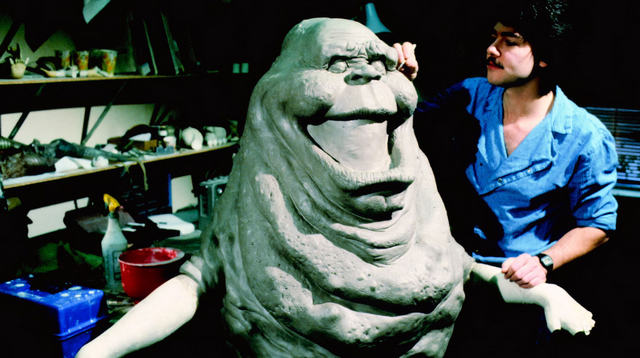
Apparently, the creation of Slimer alone may have required enough cocaine to finance a small independent film.
Taylor ultimately describes the second half of Johnson’s story as “THE WOLF OF WALL STREET and ’80s horror.” That is one hell of a combination. It is also what prevents RUBBERHEAD from becoming merely another nostalgic documentary about the glory days of practical effects.
The nostalgia is certainly there, as are the glorious stories behind some of cinema’s most memorable creatures. But Taylor and Krings are equally interested in the cost of Johnson’s relentless ambition and the way genius, obsession, addiction, ego, creativity, and self-destruction can become frighteningly intertwined. And what stories there are.
The creation of Slimer.
GHOSTBUSTERS.
The early development of PREDATOR and Jean-Claude Van Damme’s involvement with the original creature concept.
FRIGHT NIGHT.
And then there is THE ABYSS.
Johnson’s incredulity over being hired by James Cameron is priceless. Stan Winston had worked with Cameron before, so why was Cameron coming to him? The answer, at least as Johnson tells it, was essentially that Winston was smart enough to say what Cameron wanted was impossible. Steve Johnson, on the other hand, was apparently willing to try the impossible.
As Johnson recounts his experience with Cameron, RUBBERHEAD does something wonderfully playful with the sound. Cameron’s voice becomes almost the voice of God, with a slight reverberation and deeper resonance that elevates him to a near-mythic presence within Johnson’s recollection.
I noticed.
Taylor was delighted.
“We wanted, as Steve tells the story, people to feel like they were there.”
Supervising sound editor and re-recording mixer Mike Frank helps make that happen, using sound not merely as technical polish but as another storytelling tool capable of putting us inside Johnson’s memories. That same attention to craft is evident throughout RUBBERHEAD.

The interviews are visually engaging rather than a monotonous parade of people planted in chairs staring into a camera. Mike Testin’s cinematography gives the contemporary material polish and personality, while Krings’ editing continually finds new ways to integrate the extraordinary volume of archival and behind-the-scenes material.
Then there is the music. Wow.
Composer Jonas Wickstrand creates a score infused with the sonic energy of the 1980s without making the film feel like a parody of the period. Synth textures evoke the era while remaining cinematic and contemporary.
“We wanted to integrate ’80s synth sounds in a way that felt cinematic and not anachronistic, but also kind of modern, but also paid homage to the time periods.”
Adding another explosive layer are needle drops from Swedish punk band The Dahmers. Taylor, a devoted Misfits fan, describes The Dahmers as something of a meeting between the Misfits and The Cure. “There is this hard punk rock edge, but there’s also a real softness and sweetness.” That juxtaposition made the band ideal for RUBBERHEAD.
“They had this sort of gonzo garage-punk energy to them.” For Taylor, the recognition was immediate. “That’s it. That’s RUBBERHEAD.”
The Dahmers can be emotional. They can be sweet. And they can go completely insane.
So can Steve Johnson.
What is particularly impressive is how seamlessly Wickstrand’s original score and The Dahmers’ existing songs coexist. The needle drops were not custom-written for the documentary, requiring Wickstrand to consider the soundtrack as a complete sonic landscape and compose accordingly. “The left hand knew what the right hand was doing.” The result is music that doesn’t merely accompany the film. It helps define its personality.
But if Taylor’s love for Steve Johnson gave RUBBERHEAD its initial spark, that same love created a potential danger.
Taylor is a horror fan.
An effects fan.
And a massive Steve Johnson fan.
Joseph Krings is not.
And that turned out to be invaluable.
Krings had not grown up immersed in the same films and mythology. He approached the material with a degree of objectivity Taylor could not possibly have possessed. “He was able to make sure I didn’t make a fan documentary, which I potentially could have.”
Taylor knew the story he wanted to tell. But inevitably, there were scenes and stories he loved simply because he found them fascinating. Krings could ask the harder question: “It’s cool, but does it really serve the narrative? Does it serve the edit?”
For a first-time feature director, that relationship taught Taylor one of the most valuable lessons of filmmaking.
Trust your instincts. And surround yourself with people who will save you from them.
“I definitely learned a lot about trusting my own intuition, but also having really good collaborators who can keep me objective.”

For Taylor, there is a balance. “You can get lost in your own voice, but you need to learn to listen to it. But you also need to have people around you that you trust creatively, cinematically.”
He now sees that as part of the director’s job. “To have people around you who will save you from yourself.”
There is something wonderfully appropriate about that lesson emerging from a film about Steve Johnson.
RUBBERHEAD is, after all, a portrait of a man whose extraordinary drive and obsessive creative instincts helped him break boundaries, develop new techniques, and create some of cinema’s most memorable monsters. Those same qualities could also consume him.
Nick Taylor clearly loves Steve Johnson. But because he trusted Joseph Krings and his other collaborators enough to look beyond that love, RUBBERHEAD does not become hagiography. It celebrates Johnson’s artistry without ignoring his failures. It revels in the outrageous stories without pretending there were no consequences. It honors the monsters without losing sight of the man who made them.
And that is what makes the documentary so compelling.
RUBBERHEAD: THE LIFE & MONSTERS OF STEVE JOHNSON is an historical journey through the glory days of practical effects. It is a celebration of creativity and ingenuity. It is a treasure trove of behind-the-scenes Hollywood stories. It is funny as hell.
But it is also the story of talent, ambition, addiction, destruction, survival, and the dangerous line between being driven by your demons and being devoured by them.
As for Nick Taylor, he may have begun this film as the young horror fan who once looked at Steve Johnson and thought, “There is a guy who does all the stuff I love. This can be a life”. He emerged from RUBBERHEAD as a filmmaker who learned that loving your subject is only the beginning.
You also have to know when to question it. When to cut it. When to listen to the people around you. And, perhaps most importantly, when to let someone save you from yourself.
Now Taylor wants to move into narrative indie horror.
After seeing what he accomplishes with RUBBERHEAD, I have only one thing to say: Stay tuned. I certainly will.
by debbie elias, exclusive interview 07/09/2026
RUBBERHEAD: THE LIFE AND MONSTERS OF STEVE JOHNSON makes its World Premiere at Fantasia Fest 2026.