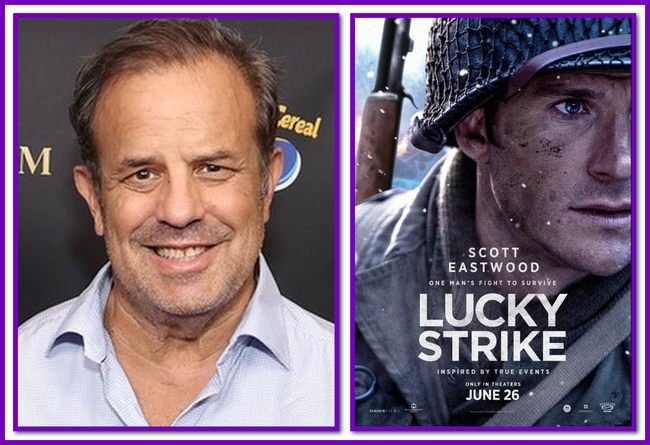
The first thing LUCKY STRIKE does is take away your safe distance. You’re not watching the Battle of the Bulge from a hill or a war room. You’re in the steel gut of a tank, in the cramped corners of a Belgian farmhouse, face-down in a field of dead bodies—wherever Castle (Scott Eastwood) is, you are.
That’s not stylistic flair; it’s the film’s core commandment.
“Everything in the film, except for the opening, is subjectively told from his point of view,” writer-director ROD DAVIS LURIE says. “It’s very much in Scott’s first person.”
Across two conversations, Lurie returns again and again to that mantra: first-person POV as the engine for image, sound, editing, and story. It’s also fused with something deeply personal—his grief for his late son Hunter and a promise born from that loss to make films that carry meaning.
“I continue to feel obligated to capture the truth as much as possible,” he says. “And I’m trying on every film right now to do something new. I just love this business so much that I want to do everything I can in it.”
LUCKY STRIKE becomes where those impulses converge: first-person immersion, personal loss, historical memory, and the restless curiosity of a filmmaker still looking for ways to challenge himself, all delivered through lensing, sound, design, and a defiantly old-fashioned movie hero.
The Rule of First Person
Lurie lights up when I use the phrase “first person” about the film.
“You’re using a term there that I used all the time that no other critic has picked up on, which is first person,” he says, delighted, in our first conversation. “That was [editor] Christal’s mission as well… we violated that a couple of times, but we tried that everything in the film, except for the opening, is subjectively told from his point of view.”
The rule is simple and ruthless. Camera placement, cutting, sound, subtitles, even what the audience is allowed to know—everything is filtered through Castle.
That’s why there are no subtitles for the Belgian family or the Germans. “Because if he doesn’t understand it, why should we, right?”
It’s pure first-person logic. If Castle can’t parse the language, neither can we. When he’s disoriented, we’re disoriented. When he can’t see beyond the fog in front of him, all we get is fog.
Editor Christal Khabib, whose first job for Lurie was on “Commander in Chief,” locked into the philosophy immediately.
“She’s a genius editor,” he says. “She understood the mission right away… she’s a super intellectual woman, and it was just a delight to be in the editing room with her.”
Building a War from the Inside Out
If the philosophy is first person, the execution is tactile. LUCKY STRIKE is built from the inside out—tanks, tents, farmhouses, outposts—rather than relying on digital shortcuts.
Even the claustrophobic tank interior that opens the film had to be physically created.
“We had a working tank, but not one that we could shoot out of,” Lurie explains. “In the working tanks, they’re so small on the inside that it’s almost impossible.”
So the production built the tank interior and mounted it on a gimbal, allowing the camera and actors to be violently tossed with the machine while still preserving the intimate perspective of the men trapped inside it.
“We not only had to create a gimbal, we had to build the inside of that tank,” he says. “That was not easy to do.”
Much of that physical world falls to production designer Erik Carlson.
“I like that you’re giving credit to Erik Carlson. He did a beautiful job,” Lurie says. “There are several interiors in the film during the battle: one is the tent in the beginning, then you’ve got the home where the French family is—or Belgian family is—and then you’ve got the place where the Nazis are hiding out, and he built all those… he built the entire building.”
Lurie is as admiring of Carlson’s resourcefulness as of his artistry.
“Where this guy is like a genius is getting it exactly right—period perfect—but doing it at an incredible budget,” he says. “It’s something to behold. I owe him a great deal.”
Carlson was hardly the only veteran of Lurie’s previous war film to return.
Working once again out of Nu Boyana Studios in Sofia, “I brought over, I would say, 80% of ‘The Outpost’ team on this film, because why wouldn’t I?” he says. “They did such a great job, and certainly, if I shoot in Eastern Europe, all those guys will be coming back if they’ll come back.”
The Bulgarian crews Lurie came to love while making “The Outpost” delivered again, this time in forests and mountains perfectly suited to the Battle of the Bulge but logistically brutal.
“It’s very difficult because getting equipment in and out, not to mention a fucking tank, is extremely difficult,” he says. “And terrain aside, it was unbelievably cold. It was really brutally cold.”
That cold became another test of character, particularly for Eastwood.
“That’s where Scott was a real champ, because, unlike almost every other actor I know, he never went into his trailer even once,” Lurie recalls. “He stayed out with me and the crew in the cold. It was really something.”
Grief in the Trenches
Under the craft talk is something that never quite leaves Lurie’s voice: grief.
During prep on “The Outpost,” his son Hunter died in front of him. The loss reoriented Lurie’s sense of purpose.
“When Hunter died, when I was in prep on ‘The Outpost,’ he died literally in front of my eyes,” Lurie tells me. “His life was going away from him, second by second, and I promised him that I would only do things that I thought had some level of meaning.”
Hunter, he says, has subsequently “been a part of every one of my films.”
LUCKY STRIKE is no exception.
There is even a fleeting moment during Castle’s final firefight when he cries out Hunter’s name before Lurie cuts to Castle’s wife and young son—a boy who, for the director, bore a startling resemblance to Hunter at that age.
“Everybody was wondering why I was sort of quietly losing it while we shot that sequence,” Lurie recalls. “I didn’t share with anybody, but it literally looked like Hunter. Very deep. It was very, very deep to me.”
The emotional spikes in LUCKY STRIKE aren’t found only in explosions and gunfire. They’re embedded in smaller, haunted moments that brush against death and memory.
Lurie is especially proud of the sequence where Castle lies face-down among the dead, one of the film’s most chilling and strangely intimate stretches.
“I’m very proud of it,” he says simply. “It’s a really good scene.”
He cites Edward Berger’s “All Quiet on the Western Front” as an influence on the sequence, but what stays with him most is not the staging. It’s the human detail.
“The actor playing the guy who wakes up, he just did a great job,” Lurie says, before offering an anecdote he hadn’t told anyone else.
“When we’re filming this guy, his eyes kept fluttering,” he remembers. “I needed to have them closed, and he couldn’t do it. So I asked him if he had a child. He goes, ‘I have a daughter. She’s one year old.’”
Lurie remembers the little girl’s name as Ava.
“As his eyes were closed, I said to him, ‘Please just envision in your mind right now Ava. Just imagine, think of Ava, Ava,’ and his eyes start fluttering. It was just really beautiful. He loved his child so much.”
It’s a small moment on set, but it lives in the finished film as that strange, suspended intimacy between life and death—a space Lurie knows all too well.
Sound as What Castle Hears
Visually, the camera stays with Castle. Aurally, the same rule applies.
Lurie describes the sound design in the clearest possible terms: “What he hears is what we hear.”
The sounds of tanks beyond the farmhouse, the heightened noises of combat, the things that would become exaggerated inside Castle’s head—all feed the same subjective experience.
That principle also extends into the score, where Lurie pushed himself into unfamiliar creative territory by sharing composing credit with longtime composer Larry Groupe.
“I’m co-credited in composing the score of this movie, and I’ve never done that before,” he says.
Lurie supplied the central melody while Groupe developed the larger tonal architecture.
“Basically, I came up with a melody, and he did everything else,” Lurie says. “I wanted to have a minimalistic score, a very identifiable melody.”
The repetitive musical language was conceived almost as something lodged inside Castle himself—sounds “ringing in Castle’s ears all the time,” pulling us deeper into his nervous system rather than sitting decoratively atop the action.
Even the compromises reveal how seriously Lurie takes tone.
“Unfortunately, we got priced out of being able to use ‘I’ll Be Home for Christmas’ over the opening,” he says. “We had to take it out, so we just scored there.” He laughs ruefully. “I mean, that was my idea. We never could afford it. I put it in, tried to convince the guys to spend the money on it, but guess what? There was just no money by the time we got there.”
The song survives elsewhere in the film, but not in the place Lurie had imagined as its most poignant use. “It was just a perfect way for me to begin the movie, but Larry’s score is really beautiful there, and it works really well.”
Lurie himself also wrote the end-title song, “Show Mercy to the Hero,” another expression of what he sees beneath Castle’s survival.
“Survival isn’t what it’s cracked up to be,” he says, echoing Castle’s own realization. “If you’re going to be a hero, you can only be a hero in the midst of tragedy, and that means that you have to exist within the tragedy.”
Visual Grammar: Newsreel, Memory, and Fog
LUCKY STRIKE’s visual grammar operates in three distinct modes: the monochrome objectivity of the opening, the rich color of homefront America, and the desaturated battlefields that define Castle’s journey.
Interestingly, the opening wasn’t definitively committed to black-and-white until after production.
“I always knew that we would,” Lurie explains. “I told Lorenzo [Senatore], prepare for that, but we, of course, never told the studio that we’re going to do anything in black and white, because if we had, they would have freaked.”
Once the footage was finished, he presented the concept. “When they saw it, I think that they really dug it.”
For the primary battlefield look, Lurie and cinematographer Lorenzo Sentore drew from a distinctly European visual lineage.
“In the case of the primary look of the film, which is… the Battle of the Bulge sequences, I was very influenced by a movie called ‘Army of Shadows’ by Jean-Pierre Melville,” Lurie says, citing cinematographer Pierre Lhomme and noting the influence he believes that film subsequently had on Janusz Kaminski’s work in “Saving Private Ryan.”
“And so you know, I steal more than I create,” Lurie laughs. “It’s just easier to look at the genius of others.”
But inspiration still had to serve first person.
The opening exists without Castle and is therefore deliberately objective, presented in the visual language through which generations have known archival footage of the Battle of the Bulge: black-and-white.
“The beginning of the movie, there’s no Castle,” Lurie explains. “That entire scene is meant to be very objective and not from anyone’s point of view, really.”
Then Castle enters.
“The minute that we get into Castle’s eyes, we switch to color, because color is what we see in.”
Returning to black-and-white after that point would violate the central rule.
“To me, black-and-white with his section would be a violation of the first person.”
The world may drain of saturation. It may shake, blur, and disappear into mist. But once Castle owns the film, the camera does not retreat into the distancing aesthetic of newsreel.
One of LUCKY STRIKE’s most potent visual tools is fog. And none of it was created in post.
“Not one drop is in post,” Lurie insists. “The fog was either already there or we used a fog machine.”
The decision was less about atmosphere than perspective.
“I thought it would be very interesting that you see nothing but fog ahead of you, and then you see muzzle flashes from the fog.”
During the opening tank attack, those flashes become the final image of a man’s life.
“They surprise you, not just because that guy was surprised by a surprise sound, but by a surprise visual,” Lurie says. “These muzzle flashes that are all of a sudden in front of him. The last thing he ever saw in life were these muzzle flashes.”
It’s a perfect intersection of theme and technique: death as an abstract concept reduced, in a soldier’s final instant, to a handful of white-hot bursts in the fog.
Faces of War, Moral Clarity, and the White Horse
The first-person approach also informs how Lurie presents the enemy.
The American soldiers have the faces of ordinary men—“every man Joes,” as I described them to him—while the SS possess a deliberately harder, more immediately identifiable physicality.
“The SS were often picked performatively,” Lurie explains. “They had a certain look, they certainly had a certain haircut, and many of them had scars on their face that were put on there on purpose, as a matter of historical truth.”
Casting them, he says, was hardly difficult. “You know an SS face when you see one. Let’s put it that way.”
That visual clarity dovetails with a tonal clarity Lurie rarely permits himself.
Films such as “The Last Castle” and “The Outpost” wrestle with leadership, power, morality, and ambiguity. LUCKY STRIKE deliberately occupies different territory.
“World War Two is the only war you can do [a big piece of entertainment] with,” Lurie says. “‘The Outpost’ is not a movie people should eat popcorn with, you know, but they do with this, and there’s a very simple reason, which is that the good guys and bad guys are completely unambiguous.”
His formulation is characteristically blunt.
“Kill a Nazi, no problem. There’s no nuance, there’s no regret… especially if it’s the SS.”
He points to “Raiders of the Lost Ark,” where Nazis can be shot, incinerated, and even melted within the grammar of a mass-audience adventure film because the audience is never asked to question where evil resides.
That clarity gave Lurie permission to embrace a tradition of muscular WWII entertainment he had never before explored.
“You can have these super entertaining films like ‘The Guns of Navarone’ or ‘Von Ryan’s Express,’” he says. “This is sort of where I took my cue from, in terms of the tone of the film.”
And at its center, “[Castle]’s an old-fashioned movie hero, and I just love that. I’ve never done a movie like that before, and I loved doing it.”
Threaded through that muscular filmmaking, however, is one of LUCKY STRIKE’s quietest and most mythic images – a white horse appearing at key moments in Castle’s journey.
Initially, the horse was intended for a single appearance overlooking a ridge. Then the weather changed.
“On that same day it just started snowing, and I rushed to get Scott back onto set, and I rushed to get the horse there,” Lurie recalls.
Knowing a larger snowstorm would eventually alter the landscape and create a continuity issue, Lurie seized the moment.
“I said, ‘I want you to put your hand out as if it’s just beginning to snow.’”
And since the horse was there, “Let’s put the horse here, so it’s like this rare moment of beauty within all this existential turmoil.”
The result feels almost like grace.
But the symbolism carries a darker shadow.
“The horse is more meant to represent the pale horse from the Book of Revelation,” Lurie says, paraphrasing from memory the biblical image of Death riding the pale horse and pointing as well to the influence of “Come and See.”
Beauty and death occupying the same frame.
Again.
The Rule-Breaker and the Lifelong Student
For all his strictures about first person, Lurie is honest about occasionally breaking his own rule—in farmhouse moments, a shaving scene, a handful of shots where he temporarily steps outside Castle’s literal eyeline.
But even then, he tries to preserve either Castle’s visual or auditory frame of mind.
What emerges is a paradoxical war film, rigorously subjective and deeply personal, yet unapologetically entertaining and morally clear. It’s a story of tanks and fog and Nazis, yes, but also of survival and its cost, of a father carrying his son with him, and of a filmmaker who remains almost obsessively concerned with historical truth.
So obsessively, in fact, that one tank continues to irritate him.
“The tank you see is what you call a Panzer III tank, and there were very few Panzer III tanks in the Battle of the Bulge, and mostly Panzer IVs,” he says. “Now this is stuff that only the most seasoned veteran could get, but it drives me crazy.”
That may say as much about Lurie as anything.
“I’m pretty seasoned at this now, and there’s very little that can be thrown at me that I hadn’t experienced before,” he says. “But what I am trying to do on every film right now, though, Debbie, is to do something new.”
On LUCKY STRIKE, that meant helping compose the score. “On the next one I’m going to edit it,” he says. “I just love this business so much that I want to do everything I can in it.”
Then comes the inevitable Rod Lurie qualifier.
“I don’t think I’ll ever be a good costume designer, but everything else I’m completely game.”
As he races off to yet another interview—on a Sunday, no less—he leaves me with one last burst of candor and warmth.
“I have to do these interviews now because of my movies, so I have to do it on Sundays,” he laughs. “But Debbie, you are just so much fucking fun. I can’t begin to tell you.”
Thirty-plus years in, the feeling is mutual.
by debbie elias, exclusive interviews 06/08/2026 & 06/14/2026
LUCKY STRIKE is now available On Digital and On Demand with DVD release on September 15, 2026