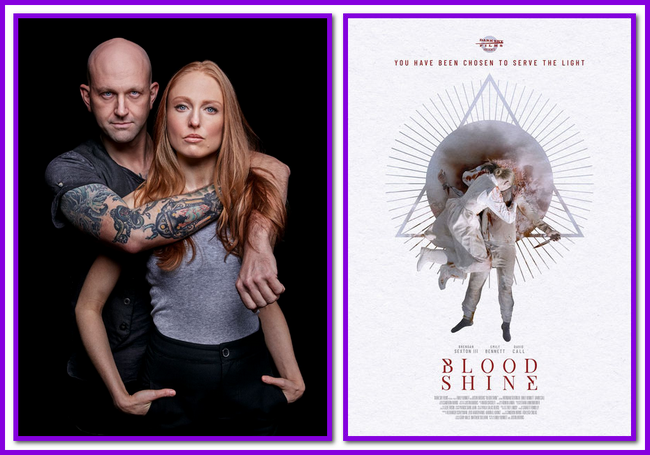
Beautiful.
Not terrifying. Not disturbing. Not grotesque. Not bloody—although BLOOD SHINE is certainly all of those things.
Beautiful.
After more than 45 years of watching and writing about films, it isn’t a word I readily attach to horror. Yet within minutes of EMILY BENNETT and JUSTIN BROOKS’ BLOOD SHINE, it was the first word that came to mind. And it became increasingly difficult to shake as Brooks, who serves not only as co-writer and co-director with Bennett but also as cinematographer, bends, shapes, softens, and seemingly worships light itself.
How appropriate for a film about the Children of Light.
Set against the desolate beauty of upstate New York, BLOOD SHINE centers on Clara, played by Bennett, a devout zealot whose solitary sacred rituals are rooted in an unwavering worship of light. Enter Brighton West, wonderfully played by David Call, a troubled horror filmmaker who retreats upstate in hopes of completing his latest screenplay. A chance encounter with Clara soon entangles Brighton in something far more consuming as she draws him into increasingly extreme rituals of faith, flesh, blood, and transcendence.
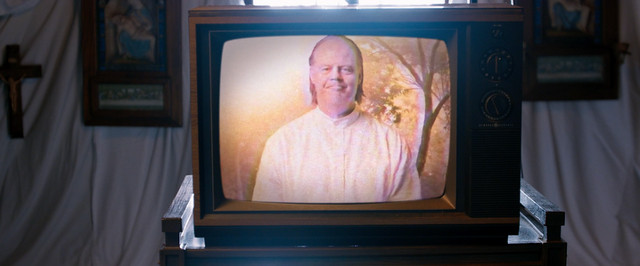
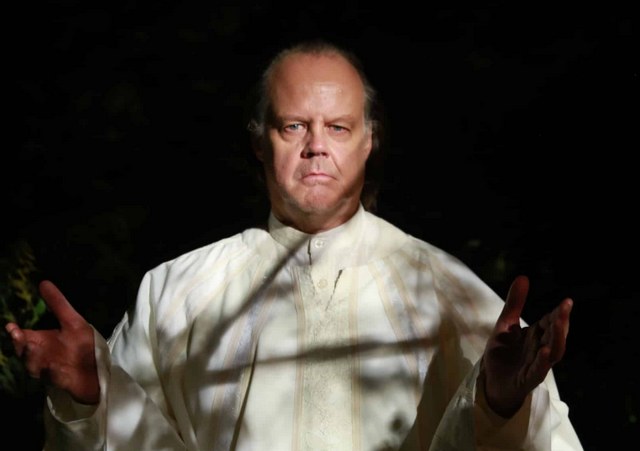
But before Clara or Brighton even have an opportunity to take hold, Bennett and Brooks establish the world of the Children of Light with none other than indie horror icon Larry Fessenden, appearing almost prophetically in an analog presentation as the group’s leader. His presence immediately gives the religion a sense of history and credibility beyond Clara and her isolated practices.
For Bennett, getting Fessenden required little persuasion.
“Larry, you basically just play yourself because we all worship you anyway,” she laughs of approaching their friend for the role.
That idea of worship—who or what we worship and why—courses through every aspect of BLOOD SHINE.
The film itself was born rather innocuously over lunch as Bennett and Brooks discussed what kind of character she wanted to play next. Raised in the Bible Belt and surrounded by a deeply religious community, Bennett was intrigued by the prospect of playing a woman possessing “deep, unshakable faith,” but she didn’t want that faith to be Christian. She wanted to explore another belief system and then challenge that devotion by giving Clara “an opponent that was worthy of torturing her right back.” From there, Bennett and Brooks began constructing not only Clara, but an entire spiritual world around her.
Their writing process is organic and deeply collaborative, typically beginning in Bennett’s office as the pair break the story together and she records their ideas. “We share pages 50/50,” Bennett explains. An early-morning writer, she often begins around 5 a.m. and works as long as she can before the two begin trading material. “He will rewrite mine. I will rewrite his.”
Research was similarly divided according to their individual interests and strengths.
For Bennett, that meant drawing on childhood memories of religious VHS tapes while delving into Manichaeism, the ancient religion whose cosmology is rooted in a struggle between Light and Darkness. Although the peaceful historical religion bears little resemblance to the violent practices invented for BLOOD SHINE, the research provided Bennett with a theological foundation from which to build Clara’s absolute conviction.
Brooks took another path, studying cult media and the ways organizations use imagery, presentation, and messaging to attract followers and legitimize belief. Together, the pair looked at groups ranging from Heaven’s Gate and NXIVM to Scientology, deliberately examining organizations that may be viewed as cults by some and legitimate belief systems by others.
“We just didn’t want this to feel like a generic cult movie,” Bennett says. What interested Brooks was the disconnect between appearance and reality.
“If you look at so many real-world cults, there is almost a ridiculousness about it,” he explains. “It looks kind of goofy. It doesn’t look scary at all. And then you hear the stories of what happens within those spaces.”
That contradiction became fundamental to BLOOD SHINE. Rather than cloak terror in darkness, Bennett and Brooks wanted to create “horror in the daylight,” allowing menace to flourish in fully illuminated, sun-drenched spaces. Even the Children of Light themselves can appear faintly absurd, complete with Crocs and headdresses, while something considerably more disturbing lurks beneath the surface.
It is horror hiding in plain sight.
And light is everywhere.

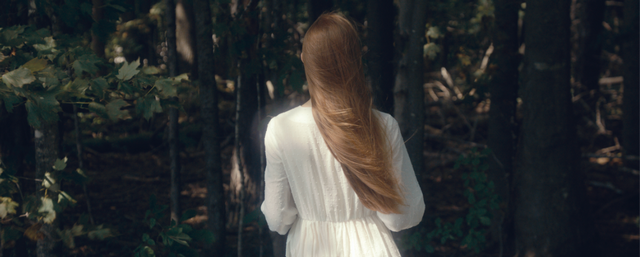
Brooks’ cinematography is stunning. Bright white light pours through windows. Interior practicals offer differing temperatures and shades of illumination. Outside, natural sunlight envelops Clara in the greens of grass and trees, often softened into an almost dreamlike glow. A recurring red ribbon dances against that verdant landscape as Clara herself moves freely beneath the sun.
But none of that beauty exists merely for beauty’s sake.
Bennett and Brooks established a strict visual grammar months before production began, determining when a wide shot could be “earned,” when the camera should move closer, when characters should be permitted space, and when the frame should become almost suffocatingly intimate.
In creating a film about the worship of light, Bennett and Brooks realized their filmmaking needed to embody that same devotion.
“Like Clara, we as directors wanted to worship the light as well,” Bennett explains. And Brooks does exactly that.
Calling story his “north star,” Brooks approaches cinematography not as an opportunity to create an isolated cool-looking image, but as another storytelling language working in concert with screenplay, direction, and performance. He also admits to an obsession that serves BLOOD SHINE particularly well.
“I am obsessed with people’s faces.”
Describing the cinematographer as “the first audience member,” Brooks wants to lean into a performance both emotionally and physically. Sometimes that means bringing the camera within inches of an actor’s face.
That proximity becomes increasingly important as Clara and Brighton move closer psychologically and spiritually. Brooks begins almost seductively, allowing Brighton’s gaze to lead us toward Clara’s lips or an eye before progressively pushing into more invasive extreme close-ups. Faces become landscapes. Eyes, mouths, skin, and blood become fragments of an increasingly intimate whole.
“Our story has to get closer and closer to our characters because our characters are getting closer and closer to one another,” Brooks explains, “and ultimately getting so close that some might say they are one.”
That visual progression is particularly effective because Brighton spends much of the film physically restrained. Shackled and unable to move freely, Call cannot rely on conventional blocking or physical action to convey Brighton’s shifting psychological state. His face becomes the action, and Brooks’ camera is there to capture every flicker of fear, calculation, desire, confusion, and surrender. Call is exceptional.
Bennett wanted him for Brighton virtually from the outset, having first taken notice of his work in THE STRANGE ONES and subsequently following his performances through independent cinema, including Fessenden’s DEPRAVED. Other names might have been suggested, but Bennett kept returning to the same conclusion.
“I mean, I guess we can consider these other actors, but I know it’s David.”
Once they met, her instinct was confirmed. Bennett was drawn to the grounded quality of his work and particularly to his ability to “turn on a dime.” Just as importantly, she sensed that Call’s approach would differ slightly from her own. “I just knew we would complement each other really, really well.”
The pairing proves inspired.
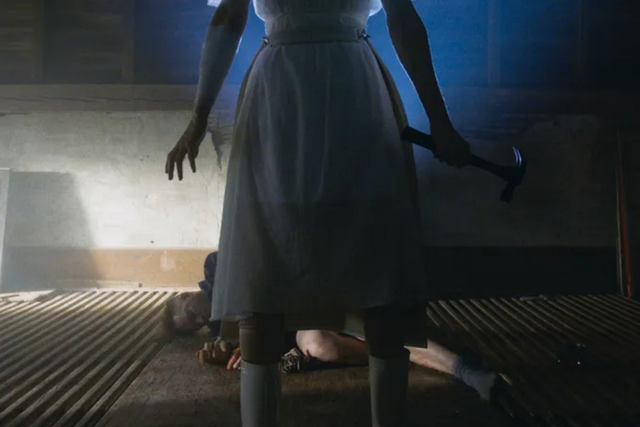
Bennett herself can pivot effortlessly from sweetly demure to something resembling a dominatrix in white, complete with leather butcher’s apron and immaculate rubber boots—remarkably immaculate given the copious quantities of blood surrounding her. Bennett laughs that Clara has simply had practice.
“Clara’s been doing this for a while. She’s good at keeping the blood where she wants it.” But the connection between Clara and Brighton goes deeper than captor and captive.
Bennett and Brooks were determined not to construct characters who exist neatly as good or evil. Brooks sees great villains as being remarkably close to their heroes, sometimes separated only by that proverbial “one bad day.” Finding a kinship between Clara and Brighton was essential.
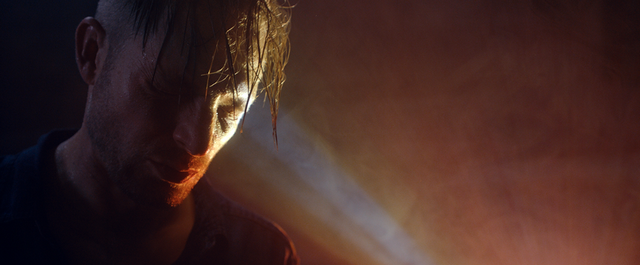
Making Brighton a filmmaker provided it.
Clara worships light as an article of faith. Brighton manipulates light in the creation of cinema. And perhaps, Brooks suggests, filmmaking itself isn’t so far removed from cult-like devotion.
“We all worship at the cinema. We all follow ridiculous dreams, even though everybody tells us how ridiculous those things are. It’s not far to say it’s a cult.” Two people from wildly different worlds thus discover a shared language of obsession.
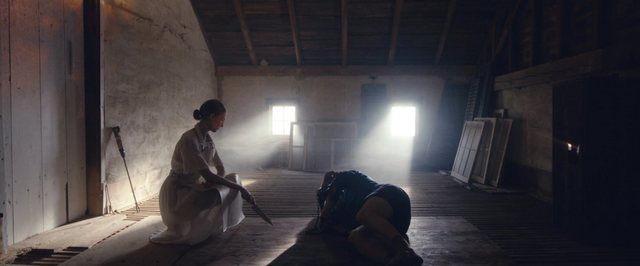
Throughout BLOOD SHINE, Clara’s attempts to bring Brighton into the light become progressively more brutal. She shackles him, strikes him with a hammer, cuts into his flesh with a butcher knife, each act of torture another step in what she believes is not destruction, but conversion. By the third act, ritual, violence, intimacy, and faith have become inseparable.
And then comes that blood-soaked third-act union, what Bennett and Brooks call the “blood sex scene.”
Having watched thousands upon thousands of films over the years, I can’t recall seeing anything quite like it.
Clara vertically slices open Brighton’s chest and inserts her hand into the wound, reaching physically inside him in an act as grotesquely intimate as it is horrifying. Yet within Clara’s belief system, this isn’t simply mutilation. It is communion. Only through this ultimate joining—through Brighton and Clara effectively becoming one—can he share in the enlightenment she believes she possesses.
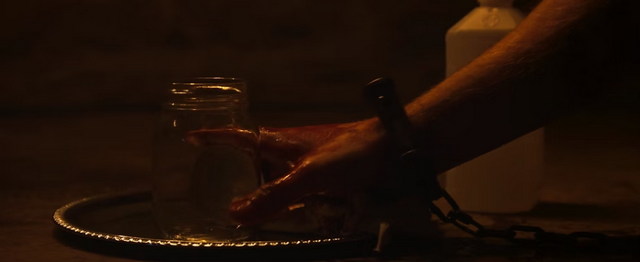
And suddenly Brooks’ visual strategy throughout the film reaches its inevitable conclusion.
From Brighton’s early gaze toward Clara’s lips and eyes, Brooks has progressively collapsed the distance between them through increasingly invasive extreme close-ups. As Clara penetrates Brighton’s defenses psychologically, spiritually, and finally physically, the camera has been doing much the same, pushing closer and closer until there is virtually no space remaining between character, camera, and audience.
“Our story has to get closer and closer to our characters because our characters are getting closer and closer to one another,” Brooks explains, “and ultimately getting so close that some might say they are one.”
By the time Clara’s hand disappears inside Brighton’s chest, that idea is no longer metaphorical.
But Bennett and Brooks make an even more audacious choice. They refuse to treat the moment as horror.
A conventional horror score could easily have attacked the imagery with shrieking strings and musical terror. Bennett and Brooks wanted precisely the opposite. To them, the scene is a romance.
“It is the height that their pleasure and their transcendence reaches,” Bennett explains.
That distinction becomes essential to understanding Ronen Landa’s score. Another filmmaker might accompany such imagery with those shrieking strings and the familiar musical vocabulary of terror. Bennett and Brooks instead asked Landa to score what Clara and Brighton are experiencing rather than what an audience might instinctively feel while watching them.
The images give us mutilation. The music gives us transcendence. The eye sees horror while the ear hears something approaching rapture.
That same willingness to trust the audience rather than dictate emotion carries into the film’s editing. Ward Crockett began the editorial process, with Matt Latham helping bring the film into its final form. For Brooks, who also edits and colors and readily admits to being something of a control freak, relinquishing footage to other artists wasn’t necessarily easy. But he and Bennett wanted collaborators, not technicians.
They provided a roadmap while actively encouraging their editors to challenge it. “If you need to step all over this thing, do it. Show us something new.”
It’s an ethos the pair carried throughout post-production, intentionally surrounding themselves with artists who possessed creative voices of their own. They chose people, Brooks explains, who weren’t there merely “to execute the technicals of the job,” but people who “have a voice because we want to hear that voice and we want to see that voice as part of the film.”
That philosophy finds one of its most beautiful expressions in Landa’s score.
Music is used judiciously throughout BLOOD SHINE. Silence and ambient sound are given room to breathe, allowing us to sit with Brighton and Clara and question what might be happening behind their eyes. Is Brighton reflecting? Is Clara reconsidering? Is faith strengthening or beginning to fracture?
When music does enter, Landa doesn’t simply tell us to be afraid.
Having previously worked with Landa on short films, Bennett knew the composer could engage with the more abstract challenge she and Brooks had in mind.
For Brooks, Landa’s willingness to wrestle with an idea rather than simply supply music was invaluable. He calls Landa “one of the most thoughtful composers” with whom he has worked, someone who wants to understand the film’s feelings and emotions and remain in conversation while solving its musical problems.
And Bennett and Brooks had handed him a considerable one.
“If you could hear light, what would it sound like?”
Landa finds an answer. And perhaps that’s why BLOOD SHINE remains so beautiful even at its bloodiest.
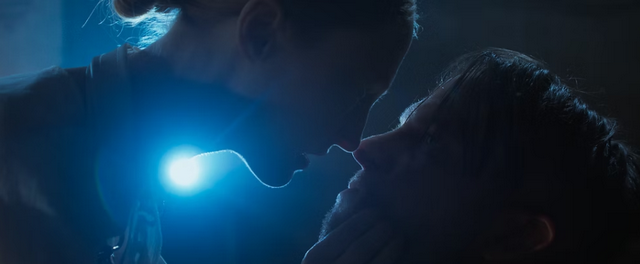
Chimes. Bells. Glass-like tones reminiscent of the resonant sound created by running a wet finger around the rim of a glass. Delicate percussive notes that shimmer rather than announce themselves. Landa builds a musical vocabulary suggesting illumination itself—something ethereal, vibrating, almost intangible.
Bennett and Brooks have made a film about faith without limiting faith to religion. Clara worships light. Brighton creates with it. Bennett and Brooks shape, bend, frame, and photograph it. Landa gives it sound.
Everyone, in one way or another, is worshipping at the altar of light.
For Bennett and Brooks, independent filmmaking gives them the freedom to create precisely that kind of personal cinematic sandbox. Bennett can build the character she longs to play. Brooks can explore the cinematography he longs to shoot. Together they can establish their own rules—and then invite trusted collaborators to challenge and enrich them.
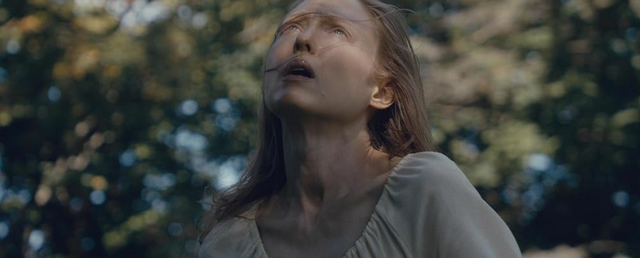
The result is a horror film filled with blood, bondage, violence, obsession, and religious fervor.
And after 45 years as a critic, I still come back to the first word that entered my mind. Beautiful.
Not terrifying. Not disturbing. Not grotesque. Not bloody—although BLOOD SHINE is certainly all of those things. Just, beautiful.
by debbie elias, exclusive interview 08/19/2026
BLOOD SHINE is available on VOD and Digital.