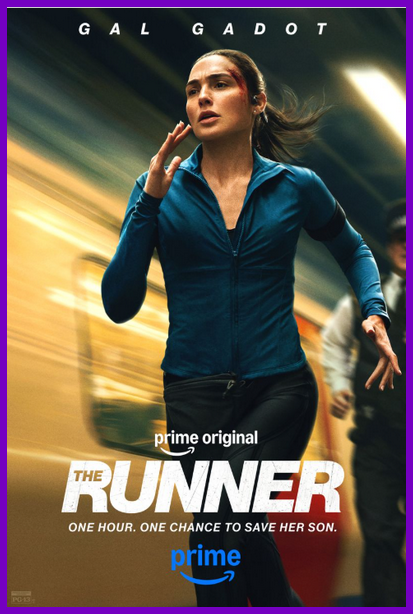
GRIPPING.
That’s the first word that comes to mind with director Kevin Macdonald’s THE RUNNER, an intensity-personified psychological action thriller that takes a deceptively simple premise and turns it into a breathtaking marriage of sight and sound—and sweat.
Written by Mark Gibson, THE RUNNER stars Gal Gadot as Maia Marten, a smart, successful, high-powered London attorney whose routine morning run becomes anything but routine when a mysterious caller informs her that her diabetic young son Noah has been kidnapped. The instructions are simple. Keep moving. Follow every command. Tell no one. Stop, and Noah dies. The clock is ticking. And so Maia runs.
But what elevates THE RUNNER beyond the familiar ticking-clock thriller is that Maia never stops thinking while she is running.
This is a woman accustomed to assessing people, processing information and thinking on her feet—no pun intended. She approaches the situation almost as she would a trial, mentally mapping the evidence and playing a chess game with the disembodied voice controlling her every move. She listens for inconsistencies. She tests boundaries. She searches for a weak link. Most importantly, she understands how to tell her adversary the story he wants to hear. Maia is playing to a jury of one.
Intriguingly, her tormentor comes to admire her. He recognizes a worthy adversary and, as the balance between them begins almost imperceptibly to shift, admiration takes on shades of envy. At one point he even urges Maia to “use your fear,” momentarily sounding less like her tormentor than her cheerleader.
But Maia’s intelligence is only one part of the equation. Macdonald wisely understands that a film constructed around almost perpetual movement needs more than a compelling premise to sustain it. It needs a cinematic language capable of making us feel as though we are running beside Maia.
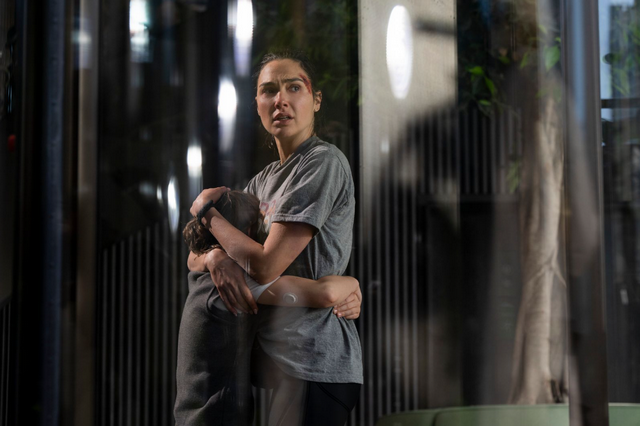
Enter cinematographer Anthony Dod Mantle.
Mantle’s lensing is stellar. Handheld camera work tears through the streets of London with frenetic, frenzied energy while an extraordinary reliance on extreme close-ups turns tiny physical details into visual information: an eye, lips forming words or simply gasping for breath, a creepy, decrepit Howard Hughes-like fingernail tapping impatiently, Maia’s shoes pounding pavement, the Caller curling his toes into the carpet à la Bruce Willis in DIE HARD, an IV drip, Noah’s little feet on a bed. Bodies become landscapes. Fragments become clues.
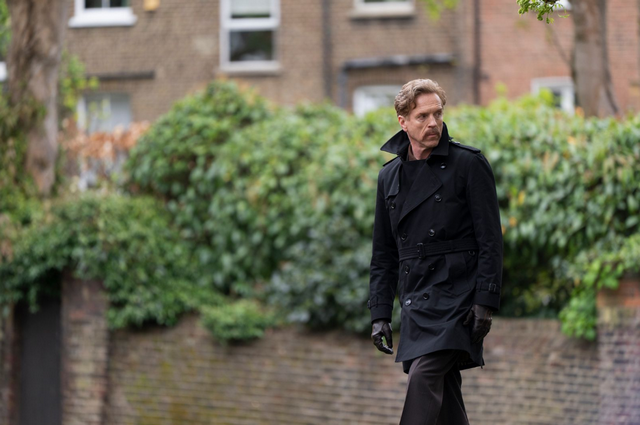
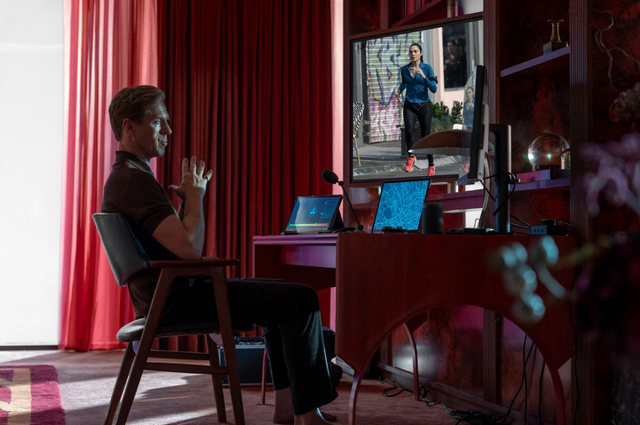
Particularly effective is the way Macdonald and Mantle incrementally reveal the Caller. We initially see only pieces of him and the banks of monitors surrounding him. Each return to that room gives us a little more, but never enough. His face remains hidden until the film is ready for us to see it, creating a visual puzzle that mirrors Maia’s attempt to construct a complete picture from incomplete information.
Yet for all the extreme close-ups and kinetic camerawork, THE RUNNER never sacrifices its sense of place.
London lives and breathes around Maia. Crowds surge past. Traffic moves. Stairways loom. Trains become sardine cans of humanity. Boats pass. People shout. Life continues with complete indifference to the terror unfolding in Maia’s ear. As her fear and exhaustion increase, those same surroundings begin to register differently. The city remains there, but Maia’s perception of it changes. People, vehicles and architecture become obstacles, opportunities or simply a blur as the clock continues counting down.
Equally notable is the film’s visual tonal bandwidth. Macdonald and Mantle resist the temptation to cloak this story in the shadowy visual vocabulary of a conventional thriller. Images are often bright, light, verdant and beautiful. The visual world doesn’t descend into darkness. That is left to the emotional world. And nowhere is that emotional descent more evident than on Gadot’s face.
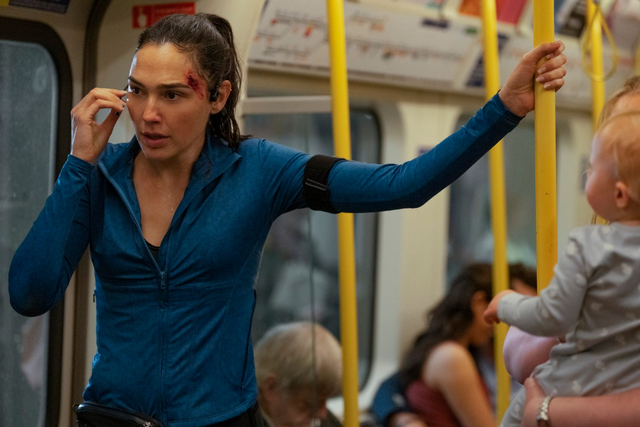
We watch Maia physically and psychologically deteriorate before our eyes. Fear gives way to attorney-like defiance. Defiance becomes determination. Determination gives way to panic and exhaustion, only for Maia to somehow find another reserve of strength. Sweat pours from her. Her breathing changes. Her body begins betraying her.
When she trips and hits the pavement, your heart stops with her.
Gadot’s physicality is indispensable to the film’s credibility. Maia must look like someone for whom running is genuinely part of her life, and Gadot has the athleticism and stamina to make that believable. But physical capability alone isn’t enough. What sells the performance is watching that capable body progressively wear down while Maia’s mind continues working. I can think of no other working actress today who could embody Maia as seamlessly as Gal Gadot.
She may be running out of physical resources. She is never running out of intelligence.
Bringing all of this together is editor Sam Rice-Edwards, whose cutting is whipsmart and rapier-sharp. The achievement isn’t simply speed. It is rhythm.
THE RUNNER moves at Maia’s pace, and that pace continually changes. She runs. An obstacle appears. The rhythm fractures. A phone is lost. Another is stolen. She falls. An ankle is injured. A car strikes her. An ambulance becomes another obstacle from which she must escape. Then, occasionally, the film lets her—and us—breathe. A church. A corner in which to hide. A memory of Noah.
Rice-Edwards beautifully incorporates montages and multilayered superimpositions that allow Maia’s thoughts and memories to interrupt the relentless physical present. These moments aren’t momentum killers; they’re emotional oxygen. Particularly lovely are the scenes between Maia and Noah, whether occurring in real time or flickering through her memory. Their calm sweetness reminds us what Maia is running toward rather than merely what she is running from.
And then Macdonald and Rice-Edwards pull the rug out from under us.
At approximately the 72-minute mark, THE RUNNER rewinds. We return to an earlier moment aboard the train, when Maia presses against another passenger while speaking to the Caller. We saw the moment the first time. We thought we understood it. We didn’t. Only now are we allowed to see what Maia was actually doing. WOW!
It’s a fabulous reveal because it doesn’t invalidate what came before; it recontextualizes it. The film hasn’t cheated by hiding an event from us. It has hidden our understanding of that event. Suddenly Maia’s earlier actions acquire another meaning, and the extent to which she has been thinking, strategizing and manipulating while seemingly operating on pure desperation becomes deliciously clear.
If Dod Mantle’s camera gives THE RUNNER its eyes and Rice-Edwards gives it its pulse, the sound team gives it its nervous system.
Led by supervising sound editor and sound designer Glenn Freemantle, with Danny, Nick and Olly Freemantle among the sound artisans, the soundscape is impeccable.
Layer upon layer builds Maia’s increasingly chaotic world: her own voice and ragged breathing; the Caller transmitted through her headset; his voice within his physical location; footsteps; traffic; horns; squealing tires; sirens; pedestrians; boats; shouting; phones. Even a seemingly innocuous spam call has its own distinctive sonic quality—and Maia, being Maia, finds a way to make even that interruption useful. The mixing allows all of these elements to collide without turning into unintelligible noise. It is controlled sonic chaos, mirroring Maia’s mental state while ensuring that the audience never loses the thread. And then there is Scott Joplin.
Early in the film, ragtime piano music can be heard through the Caller’s phone connection. It’s distinctive enough to register immediately as something more than incidental sound. File it away. THE RUNNER does. When Maia eventually enters the hotel and that music returns, sound becomes evidence. Before the film needs to explain anything, our ears have already made a connection. A small visual clue adds another piece to the puzzle. It’s superbly constructed audiovisual storytelling.
Composer Tom Hodge’s score works in tandem with the sound design while Macdonald deploys needle drops with energy and a wonderfully mischievous sense of humor. Blondie’s “Heart of Glass” helps get things moving, while the choice to send us out with “Hanging on the Telephone” after everything Maia—and we—have endured is nothing short of delicious. I laughed out loud.
For all of its technical prowess, however, THE RUNNER never becomes an empty exercise in cinematic virtuosity. Macdonald keeps Maia and Noah at its emotional center while Gibson’s screenplay gives Maia something far more interesting than brute strength with which to fight back.
Her body may keep her moving. Her love for her son gives her a reason to move. But her mind may be the most dangerous weapon she possesses.
At a lean 84 minutes, THE RUNNER has little interest in wasting time. Neither does Maia. Macdonald takes a familiar thriller construct and, through the collective artistry of Gadot, Dod Mantle, Rice-Edwards, Hodge and the Freemantle sound team, pushes it into something visceral, intelligent and cinematically exhilarating and gripping.
Every footfall matters. Every breath matters. Every sound matters. Every second matters. And from the moment that phone rings, we are running right alongside Maia. Don’t stop.
Directed by Kevin Macdonald
Written by Mark Gibson
Cast: Gal Gadot, Damian Lewis, Rory Wilmot, Alfred Enoch
by debbie elias, 08/27/2026
THE RUNNER premieres globally on Prime Video on September 2, 2026