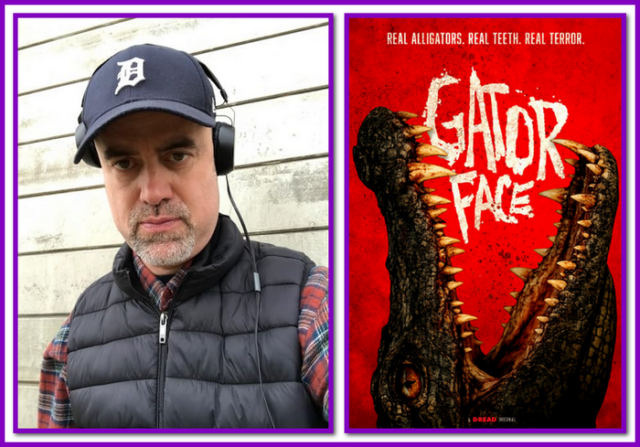
Of all the credits one expects to see at the end of a horror film, “Animal Nuisance Control” is probably not among them. But then, GATOR FACE was shot in the Florida swamps, where writer-director PADRAIG REYNOLDS had more to worry about than fake blood, killer cults and the very real alligators he deliberately brought in front of the camera.
Before Reynolds could put his actors into the water, Dennis Towns had to go in first and make sure nothing less invited was already waiting for them.
“He has to look for water moccasins because they’re very aggressive, and he has to look for alligators to make sure they’re not in that little part where we’re shooting,” Reynolds explains. “Basically, he stays there all day with the fire guy, and then that’s what he does.”
The alligators, it turns out, were part of the plan.
The water moccasins were not.
For Reynolds, however, there was never a question about where money needed to be spent, even on an independent production where every dollar mattered.
“It doesn’t matter if it’s an indie budget. The number one thing is safety,” he says. “I put that at the highest in the budgets because I knew where I was shooting. I knew the ramifications of all that stuff.”
Nor was Reynolds directing from the comparative comfort of dry land.
“I was in the water with them. Everybody’s in the water with them, and I’m the first one that goes in the water.”
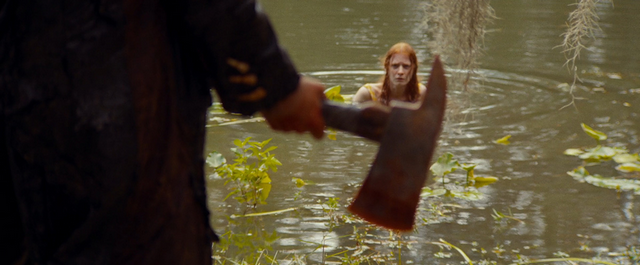
That willingness to get his own feet wet—quite literally—is indicative of how Reynolds approached virtually every aspect of GATOR FACE, a gleefully bloody creature feature that mixes slasher horror, cult mythology, Southern atmosphere, real alligators and a masked killer who looks as if a vintage gas mask and an angry reptile somehow produced offspring.
The movie itself began not with the killer or even an alligator, but with a building.
Reynolds was working a job in Florida when something caught his eye while driving down the road.
“I saw the beach house, and I was like, ‘Ooh, that’s a creepy fucking beach house.’ So I just kind of pulled in there, and I was taking pictures.”
When the owners came outside, Reynolds did what any filmmaker who has just discovered a potentially perfect horror location would do: he asked whether he could shoot something there.
They said yes.
“I stayed in touch with them, and I went back to my hotel room, and I wrote sort of just like a little synopsis of the shoot, and it all sort of just spilled out after that.”
Florida wasn’t finished contributing.
Driving to the airport, Reynolds passed the VFW hall that would eventually appear in the film. Again, he pulled over.
“I’m like, ‘Wow, that place is cool.’ I pulled over there. I’m like, ‘Okay, okay, I got two great locations here. So that’s the opening. We’re gonna rock and roll with that, and we’ll move down the line.’”
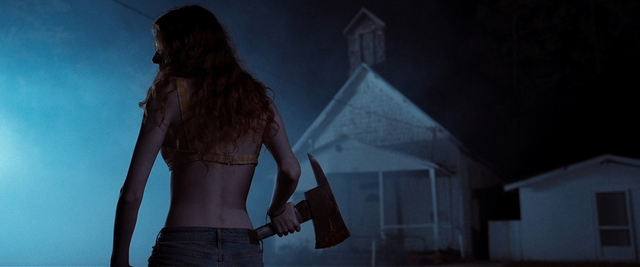
That approach extended throughout the production. Rather than trying to transform locations into something they weren’t, Reynolds found places that already possessed the texture and history he wanted. Even the church required little intervention beyond hanging a banner.
“I wanted to make the ’70s movie that took place now,” he explains. “I wanted to make sure that all these places were still functional, and they’re all there. They’re all still stood there. And that’s why I chose all those places.”
That 1970s sensibility also became fundamental to the film’s visual grammar.
Reynolds storyboards everything, creating individual books for each day of a shoot filled with drawings and notes detailing what needs to be accomplished. Before the crew arrives at a location, he walks it himself, sketches, shoots images on his phone and works out how he intends to use the space.
The look itself grew out of a conversation with cinematographer Michael Bolten, who shot the original GATOR FACE short.
“I wish we could shoot Super 16,” Reynolds remembers telling him.
Bolten had another idea.
“He goes, ‘Why don’t we shoot 2K on 16 millimeter lenses from the ’70s? It might be kind of crazy. We should try it.’ I’m like, ‘Okay, let’s fucking do it.’”
The result gave Reynolds the grit he was looking for while allowing the Florida environment to retain an almost inviting quality rather than plunging everything into conventional horror-film darkness.
“I wanted to color it a lot like what Florida looks like, very, you know, kind of aqua almost. Very, very hot.”
Or, as Reynolds puts it more evocatively: “I wanted to color it like a memory of Florida.”
When Bolten was unavailable for the feature, cinematographer Drew Suppa stepped in, carrying forward the visual language established by the short. That continuity mattered, particularly given the size of the operation.
“It was only a crew of five,” Reynolds says. “It was me, Drew, Sampson, Matt, and sound. That’s it for pretty much the entire movie. Until we got to the nights. Then we had one gaffer.”
Remarkably, Reynolds calls the 14-day production “probably my easiest shoot.”
Easy, of course, is relative.
Because there was no one to pay to create a production schedule, Reynolds did it himself. His solution was deceptively simple: shoot as much of the movie in order as possible. Besides helping him keep track of what had and hadn’t been completed, the approach proved particularly valuable when fake blood started flowing and an independent production’s limited wardrobe had to maintain continuity.
For one particularly bloody death scene, Reynolds scheduled the practical gag at the end of the day, knowing he wanted another angle the following morning.
“We already got that. Now we’re gonna wash his clothes, and we’re gonna do it from the other angle. So it gives me a whole night to prep.”
I couldn’t help complimenting the unseen member of the crew responsible for restoring the wardrobe so beautifully between setups. “Whoever did your laundry, they did a beautiful job.”
Reynolds didn’t miss a beat.
“It was me.”
There was a laundromat nearby. Unfortunately, Reynolds discovered, it wasn’t open at the hour an indie horror director covered in the remnants of the day’s carnage actually needed it.
“So I would just wash it all in my tub.”
Director. Writer. Scheduler. Location scout. Storyboard artist. Swamp safety guinea pig.
And laundry department.
Such is independent filmmaking.
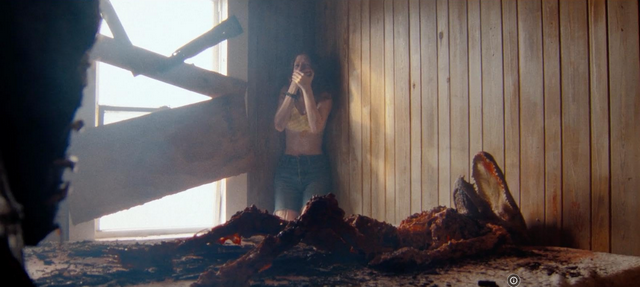
Yet for all Reynolds planned—and he planned extensively—some of GATOR FACE’s best moments came from recognizing opportunities he couldn’t possibly have put into one of those meticulously prepared day books.
None is better than the sequence of Gator Face training his alligators.
The film uses real alligators, but Reynolds wasn’t about to put his actors nose-to-snout with them. Having worked with animals previously, he understood that selling the illusion didn’t require putting performers in danger. What he needed were a few convincing images establishing animal and actor within the same visual space.
“You kind of got to have at least two to three shots where the alligators are in the same frame as the actress,” he explains. “And then everything else you can just get away with.”
Those key images were carefully planned for compositing. For a sequence in which an alligator appears to be swimming behind one of his actors, Reynolds captured overhead drone footage of a real gator swimming at the animal sanctuary and then composited it into the scene.
“As soon as I got back to the hotel, I’m like, ‘Oh, this is gonna look great.’”
But then the sanctuary gave Reynolds something he hadn’t planned at all.
He looked at Chris, one of the men handling the alligators, and saw Gator Face.
“I’m like, ‘Dude, you look exactly like my killer. Can you put this outfit on and see if they’ll follow you around in it?’”
Chris agreed, although he warned Reynolds the animals might be frightened by the unfamiliar costume.
They weren’t.
“They reacted great to him.”
Reynolds brought the footage back to longtime editor Ed Marx, who immediately saw what they had.
“He’s like, ‘Oh, we got to make a meal out of this. This is really great.’ I go, ‘Yeah, this is wonderful.’”
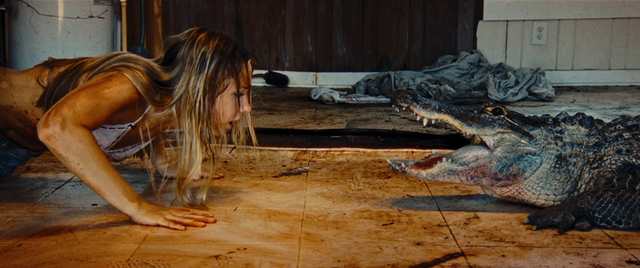
And suddenly GATOR FACE had something that hadn’t existed in the screenplay: a training montage in which its axe-wielding killer appears to command his reptilian charges.
“I think that’s what separates the movie,” Reynolds says. “I was like, okay, I’m making something that’s a little different here. We got a whole training montage where this guy Rocky-trains these alligators to freaking kill people, which is cool.”
It is also perhaps the purest example of Reynolds’ approach to GATOR FACE. He planned obsessively enough to know exactly what he needed—and remained loose enough to recognize something better when it unexpectedly walked, or crawled, into frame.
The same willingness to embrace the unexpected extended to the man actually inside Gator Face’s mask.
The mask itself was another piece of indie ingenuity. Without the budget to commission an elaborate custom creation, Reynolds found one created by Brian Blair at Pumpkin Pulp, contacted Blair for permission to use it and bought it. His Los Angeles-based wardrobe designer then completed the silhouette with a striking, and decidedly unforgiving, alligator trench coat.
“That thing was heavy to wear in the hot sun in Florida.”
Nikolas Kolasinski nevertheless did far more than simply wear it.
“I didn’t direct Nick at all,” Reynolds says. “He came up with all that stuff himself. The crawling on the ground like an alligator, the sniffing like an alligator, the little hop, skip and jump before he goes after somebody like an alligator. He brought all that to the table every day.”
Only later, during the festival circuit, did Kolasinski admit just how punishing the costume had been.
“That fucking jacket was hot. That mask was hot,” Reynolds recalls him saying.
It didn’t stop Kolasinski from throwing himself physically into the performance—including onto automobiles.
“He would jump on cars, and I would always be like, ‘Nick, you don’t have to jump on the car.’ He goes, ‘I want to jump on the car.’”
Reynolds let him jump.
That physical characterization helped turn Gator Face into something more interesting than a man wearing a monster mask. The elongated snout, circular eyes and industrial quality of the design also carry an unmistakable echo of early gas masks—an influence Reynolds confirms was intentional.
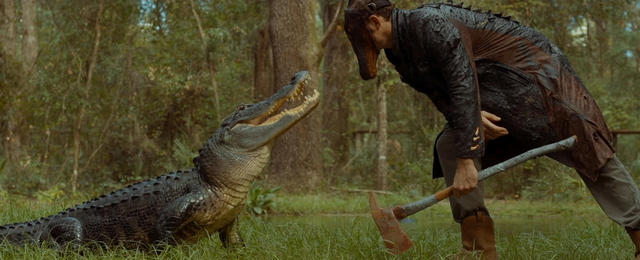
“That’s exactly what I was going for,” he says. “You’re the only one who’s picked that up. That’s exactly what it looked like—a gas mask to me. That’s what I saw.”
Once all those pieces were captured—planned and otherwise—they still had to become a movie.
Reynolds has considerable shorthand with editor Ed Marx, who cut the original short and has worked on all five of Reynolds’ films. That familiarity becomes especially valuable on a production moving this quickly. The same is true of composer Holly Amber Church, another longtime collaborator.
A musician himself, having spent roughly ten years in a band, Reynolds thinks about music in terms of rhythm and how it works with the cut rather than simply laying score over an image.
“I like to blend it in like a song,” he says. “I like to make it move to edit along.”
In many ways, that is also an apt description of how GATOR FACE itself came together.
Reynolds arrived with storyboards, daily books, locations, schedules and a clear visual design. He knew which shots would need to be locked for compositing. He knew when bloody practical gags needed to be scheduled. He knew actors and alligators shouldn’t actually be swimming together. And he knew somebody needed to check for water moccasins before anyone stepped into the swamp. But within all that planning, he left room for discovery.
A creepy house glimpsed from the road became the seed of a movie. A VFW hall spotted on the way to the airport became another location. An alligator handler happened to resemble the killer and gave Reynolds an entire sequence he hadn’t written. Kolasinski created Gator Face’s reptilian physicality himself. And a five-person crew kept moving.
For Reynolds, the lesson he carried away from GATOR FACE was ultimately very simple.
“I could do this with five people,” he says. “That’s what I kept saying to myself. I can do this with five people. We can do this.”
They did.
And Reynolds isn’t ready to leave the swamp.
Whenever he finishes a screenplay, he says, he writes the sequel while he’s still immersed in the world. In the case of GATOR FACE, that next script is already finished, although “sequel” isn’t quite the right word. GATOR FACE II would be a prequel, expanding the strange mythology Reynolds has only begun to reveal.
Then there is The Mom.
Arriving after the credits, elegant in black and veiled, she places a hand on a kneeling Gator Face, immediately suggesting another level to the hierarchy—and opening another tantalizing door into this increasingly strange world.
Reynolds says the next script is “really, really good” and goes “into a completely different realm.” All he needs now is someone to pay for it.
“Tell Epic, give me money to do a GATOR FACE II.”
How much?
“All I need’s 300. That’s all I need.”
$300,000 to send Gator Face back into the swamp?
Considering what Padraig Reynolds managed with five people, some vintage lenses, real alligators, an axe, a hotel bathtub and one very vigilant Animal Nuisance Control guy keeping an eye out for water moccasins, one can only imagine what he’ll do with that.
by debbie elias, exclusive interview 09/04/2026
GATOR FACE is in select theaters September 11th and on digital September 15th.