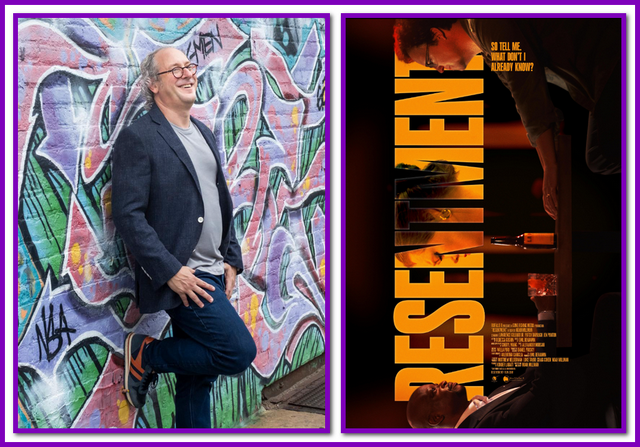
There is something inherently theatrical about RESENTMENT. Three characters. One bar. One night. Three acts of almost equal length in which relationships shift, resentments surface, and people who have known one another for years discover just how effectively they can locate each other’s emotional pressure points.
For writer-director Noah Millman, however, RESENTMENT was always a movie.
“A lot of times people who read the script said, ‘Why isn’t this a play?’ And for me, it always felt like a movie. I saw it in terms of shots and a cinematic language,” says Millman, who has since written a stage version and is working with a stage director to find a venue. “I did it backwards. Instead of making the play and then making the movie based on the play, I made the movie, and now I’m trying to make the play based on the movie.”
That cinematic language becomes essential when your entire dramatic world is confined largely within four walls.
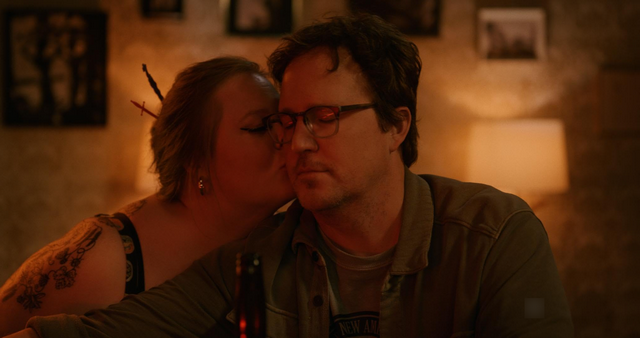
Structurally, Millman divides RESENTMENT into three nearly equal chapters—Betheca, Kayla and Tanya—each built around a different pairing among David (Patch Darragh), Trish (Jen Ponton) and Coleman (Lawrence Gilliard Jr.). Curiously, the women whose names title those chapters are not necessarily the people occupying the screen.
“The structure is very play-like in a lot of ways,” explains Millman. “Typical film Act Two is a lot longer than Act One and Three. In this case, all three acts are pretty much equal in length. And that was really driven by my feeling that the film needed to give equal weight to each of the characters.”
The chapter titles themselves arrived much later.
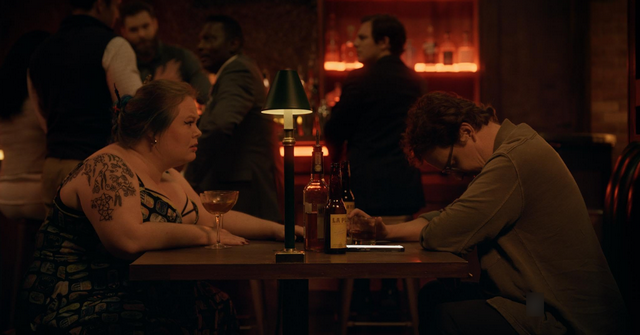
“That was an editing-room decision,” says Millman, crediting editor Emil Benjamin with suggesting Betheca for the first chapter because the story involving her provides a major turn late in the act. From there, Millman realized the same principle could carry throughout the film: “All three can be about—the title can be a character who’s not in the scene, but whose presence offstage or offscreen on some level causes the turn.” Kayla, David and Trish’s daughter, is upstairs during the second act; Tanya is Coleman’s wife, whom we never meet.
But Millman had another organizing principle in mind, one inspired by Mike Nichols.
“Mike Nichols has a line about how every dramatic interaction is either a seduction, a negotiation or a fight, and I took that very much to heart, and I sort of gave it a little bit of a twist.”
For Millman, Act One is an interrogation. Act Two is a battle. Act Three is a dance.
“I thought of the first act very much as an interrogation, and I think you see that in the way that David behaves, but also in the way the camera is used. Act Two is a battle, and I think you see that in the way that David and Trish interact in that act, as well as in the way the camera is used, particularly later on when it starts to go handheld—almost like a boxing match between the two of them. Metaphorically, of course. They’re not actually swinging at each other.”
And Act Three?
“I thought of [it] as a dance. A lot of that act is done in Steadicam. . . . I wanted the camera basically to be dancing with them, and I hope that comes across.”
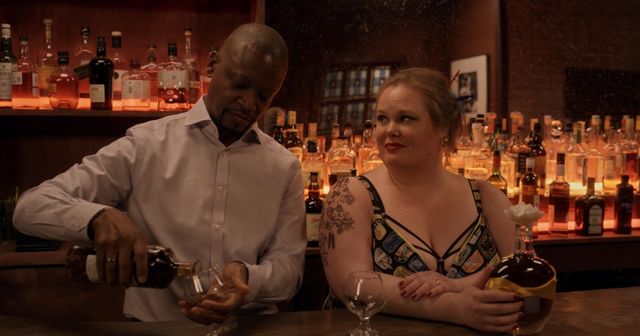
It does, with cinematographer Valentina Caniglia creating a visual grammar that changes along with the emotional dynamics while never sacrificing the cohesion of the film.
“I’ve got to give a lot of credit to my cinematographer Valentina Caniglia for that,” says Millman. “I think she really worked miracles lighting-wise, she and her team, with a very thin budget. And we spent a lot of time talking about what the visual grammar would be of the film as a whole, but also to make each act feel sort of like a different mini-film.”
That distinction was particularly important because, beyond brief interstitial glimpses of Brooklyn, the characters never escape the bar.
“It felt important to me that when we reset, we feel like we’re in a different story—a connected story, but a different story than we had been.”
From One Painful Night to Another
The origins of RESENTMENT are considerably more personal.
After an earlier feature failed to get off the ground in 2018, Millman concluded that the project had simply been too large for a first-time feature director to convince people to back. He began thinking smaller: one location, one night, something that could conceivably be made on a limited budget.
The emotional foundation, however, went back about a decade to what Millman cautiously describes as “a difficult conversation with an old friend.”
“I always am a little apprehensive about telling the story because it suggests a little bit too much more than is true about the relationship between my life and the film itself,” he cautions.
Millman had gone to his friend’s home, where the two drank and talked.
“I was basically complaining about life and whining and being a self-pitying guy. And he just kind of ripped me a new one. He just lit into me, and it was really pretty aggressive. And I think he thought he was sort of offering tough love. I didn’t really feel the love.”
The encounter left Millman devastated.
“He kind of forced me to confront all the ways in which I was not living my life, as he saw it, rightly, and was being a coward about decisions I needed to make. And at the end of the evening I said, ‘I feel like you’re saying I have a bad character.’ And he didn’t disagree. So I went home and I cried myself to sleep.”
The next morning his wife asked a deceptively simple question: Why did he continue seeing someone who invariably made him feel miserable?
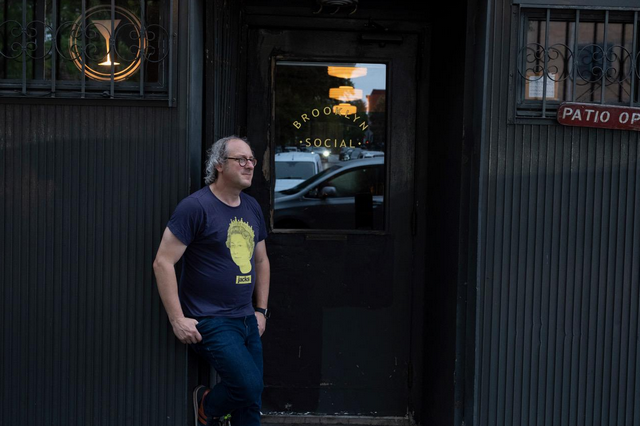
“And I thought, that’s an interesting question. Why would I? I do do that, and why do I do that? And I decided it must be that I, on some level, believe the things that he’s saying and feel like I need to hear them—or [I’m] punishing myself by hearing them—even though I’m not going to change in the ways that he’s saying.”
That question became the seed of David and Coleman.
“I liked the idea of two guys who have known each other a long time, and one is just aggressively going at the other guy, and the other guy is just sitting there and taking it. And that’s, I think, sort of the question I hope is in the audience’s mind in Act One: Why is he sitting there and taking it?”
Eventually a second question emerged: Why is David investing so much energy in tearing Coleman down?
Millman needed something more concrete beneath the psychology. “Between Trish and the movie, you have two sort of specific things that are concrete underlying things between them, as opposed to just a general psychological feeling.”
And there is a delicious kicker to the story. The morning after that devastating encounter, Millman’s friend emailed him suggesting that he turn the previous evening into a one-night play.
“I thought, ‘Wow, you’re a real jerk. That was a really difficult night, and that’s your thought? That you should write a play?’ But he was right. I eventually did it.”
Alcohol, David—and a Bar That Doesn’t Exist
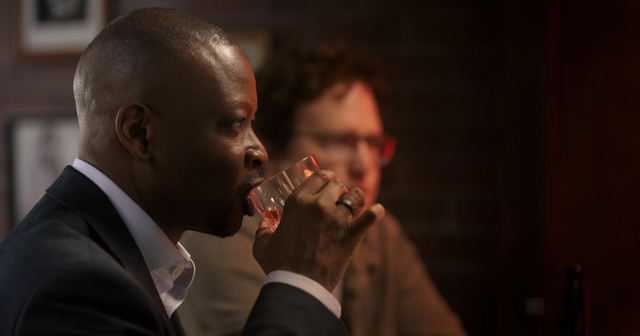
David’s drinking became another discovery in the writing.
“I didn’t originally set out to make David a high-functioning alcoholic. It’s pretty clear to me that that’s what he is. That wasn’t my original idea. But he just drank a lot on the page, and I realized, ‘Oh, this is part of his character.’”
Millman sees David as an intelligent man whose mind perpetually races. “His brain is going a hundred miles a minute. And I think there are guys like that who turn to alcohol or other ways of slowing their brain down.”
Even David’s ability to work seems tied to that pattern; he finally settles into editing Coleman’s film only after hours of drinking and emotional misery.
“I feel like that’s kind of the routine for him in a lot of ways.”
Once again, Who’s Afraid of Virginia Woolf? looms as an influence, not least because of alcohol’s enormous role in that story. And setting RESENTMENT inside a bar made its presence unavoidable.
“You set something in a bar, alcohol is going to be a character,” says Millman.
“And the bar itself, I think, is a character.”
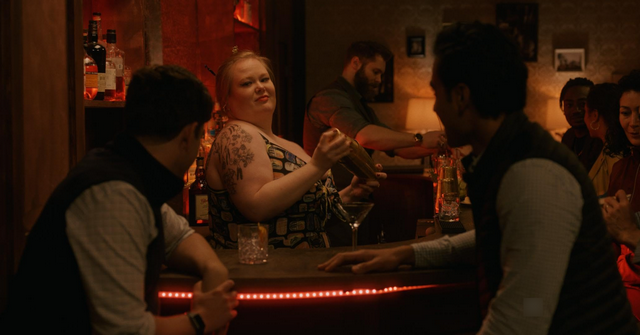
And what a bar it is.
Brick. Dark wood. Paned glass in the doors. Bottles filling the back bar. Brass-colored tools in the bartender’s hands. Everything about the place feels accumulated rather than decorated, so convincingly lived-in that it comes as something of a shock to discover the location never existed.
They built it.
“Not my original plan,” laughs Millman. “My original plan was to shoot on location, and it turns out shutting down a bar for the amount of time it takes to shoot a feature film is not a reasonable proposition. Nobody’s going to do it for really any price, certainly not for a price we could afford.”
Shooting during a working bar’s off-hours would have meant loading in and wrapping out every day, adding shooting days the production couldn’t afford. Millman even found a shuttered bar owned by another independent filmmaker that had effectively been turned into a permanent set. Surely one indie filmmaker could help another. Not quite.
“If it was one day or two days, I’d happily cut you a sweetheart rate,” Millman recalls the owner telling him. But with major productions willing to pay as much as $20,000 a day, surrendering the location for the length of Millman’s shoot simply didn’t make financial sense.
“So yeah, we went to building, and I was worried initially. I really wanted it to feel like a lived-in place,” says Millman. “I think my production designer Dan Prosky did an amazing job of achieving that. It was not easy. There were a lot of things that went wrong in the build, but I think the end result is really fantastic, and he gets a lot of the credit for that.”
But Prosky and Millman didn’t merely build a bar. They gave it a past.
“I just wanted it to feel like a real place,” Millman explains. “He and I talked a lot about the history of the bar and the history of the neighborhood. I wanted it to feel like it had a history to it.”
In Millman’s imagination, the space began life as an Irish bar. As the Brooklyn neighborhood changed, it became predominantly Black and the establishment became Black-owned. Another wave of change brought gentrification and, eventually, Trish.
There is even a photograph hanging in Trish’s office showing her receiving the keys from the previous owner.
“It was little things like that that we talked about to try to—even if you don’t notice them—hopefully make it feel like a real place.” Millman again returns to Nichols and Who’s Afraid of Virginia Woolf?, remembering the director going so far as to determine which books belonged on George and Martha’s shelves.
“Nobody sees that, but the fact that somebody paid attention to it means that there’s nothing they see that jumps out as wrong. It all sort of feels right,” says Millman. “I’m not going to pretend that we’re like that, but we were aiming for that.”
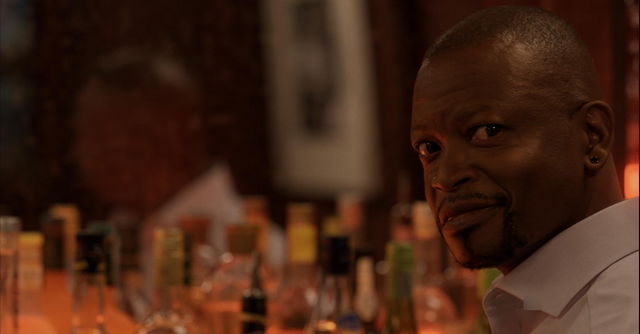
That attention extends to the bottles behind the bar.
“I spent months collecting those bottles. Every friend I have who drinks, I was like, ‘Save all your bottles.’ As soon as we started raising money, I said, ‘Save all your bottles. I want your bottles,’ so that hopefully it feels like a place where it’s not just all generic. It feels like somebody curated the list of bottles as well.”
And Trish’s bar is decidedly not a dive.
“If it’s a dive bar, you’ve got to have rotgut,” laughs Millman. “But this isn’t a dive bar. It’s a cocktail bar. And yeah, she’s trying to create that kind of atmosphere.”
Actor Eric Goldberg, who plays bartender Christian, brought another layer of authenticity to the set.
“A lot of actors are bartenders. Of course they are,” Millman jokes. “But Eric is a really serious bartender. It is kind of a passion for him.” The brass-gold barware Christian uses is Goldberg’s own. “I think it was incredibly valuable having somebody on set who just knows how all of this works. It’s all completely fluid.”
Goldberg could also reassure his director about the evening’s increasingly outrageous behavior.
“The shenanigans that went on here—it would have happened. That’s a normal day, normal week.”
Even the customers have imagined lives. Millman sees Vincent, the unfortunate recipient of Trish’s attention during her dance, as a trial lawyer coming from the nearby Brooklyn courthouses and a regular at the bar—although after this particular evening, “I doubt he’ll be back again.”
“We tried to make all the extras feel like people who would actually show up at a place like this and represent sort of the demographic diversity.”
Costume designer Willa Piro carries that attention to character into one particularly ingenious detail.
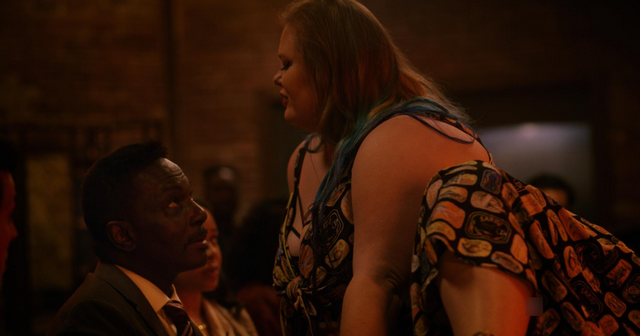
“I want to give Willa credit as well for the idea of the two combs that are in Trish’s hair. Those are made of cocktail stirrers. And that was her idea.”
Microbudget filmmaking pushing creativity?
“That’s the idea,” says Millman. “I really did try to think about every detail.”
The result was convincing enough that I found myself wanting to visit the bar—only to discover that Millman had deprived me of the opportunity by building the damn thing on a set.
“Gee, the best compliment you can pay,” he laughs. “Thank you.”
The Monster in the House
It is within that meticulously constructed world that another piece of RESENTMENT begins to reveal itself.
During the third act, Coleman describes to Trish the horror movie he has made: essentially a monster-in-a-house story in which the family senses the monster before they can see it.
Listening to Coleman, I was struck by something.
His movie is a metaphor for David, Trish and Coleman.
“I’m really glad you see that,” Millman responds.
Because RESENTMENT’s monster has been in the house long before anyone is prepared to name it. David and Trish’s problems reach well beyond Coleman. David’s problems with Coleman involve ego, drinking and a self-image built around being a great cinematic auteur who, unlike his old friend, has never actually managed to make the movie he has spent his life talking about.
And when I ask Millman why it was so important that Trish own the bar, the character dynamics come sharply into focus.
“It was really important to me from square one that Trish not be dependent on David. That if there’s a dependency, it runs the other way.”
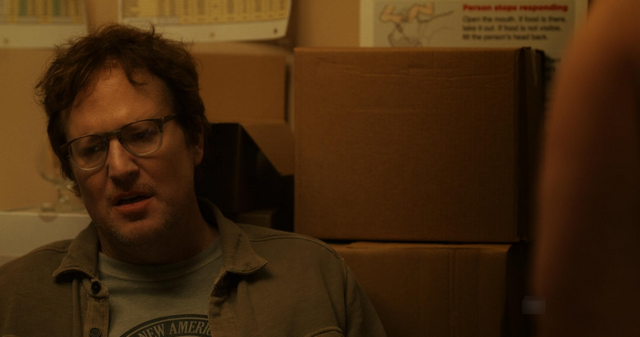
In Millman’s conception—material he notes is not explicitly in the film—Trish’s parents helped them purchase the building while property was still relatively inexpensive. She operates the bar without rent, and he imagines her as the landlord of the building’s other apartments as well.
“Basically, his whole lifestyle is kind of underwritten by her and by her parents.”
That leaves David with something else he believes he contributes to the marriage.
“What he thinks makes him attractive is, I think, his genius. He’s the artist. He’s brilliant. He’s fascinating. I think he knows that he’s long since stopped being that fascinating.”
And then Coleman arrives.
“It’s a different level of threat when his old buddy, who was a finance guy that he could look down on for doing that for a living, has suddenly actually made a movie—which he’s never done. He’s been talking about it for his whole life. He’s written a bunch of scripts. He’s tried to get things off the ground, but it’s never happened. And here he’s being lapped by this guy who started late.”
The irony becomes even richer when Trish reminds David that he never asked her to finance one of his films.
Millman sees David’s failure to ask as central to the character’s self-image.
“I think David thinks of himself as having been a good guy.” Mortgaging the building to finance a movie could have put them in serious financial trouble if the film failed. David can therefore tell himself that refusing to demand the money was an act of selflessness.
But Trish sees through him.
“I wanted to turn around what it would usually be, with two selfish people saying, ‘I want it. I want it. No, I want it.’ And I wanted to turn that around and make it be: How can your belief that you’re not being selfish actually be hiding some less attractive qualities?”
For David, Millman says, those qualities include “the degree to which he doesn’t believe in himself” and the degree to which “he’s too proud to ask her for help or depend on her for yet another thing.”
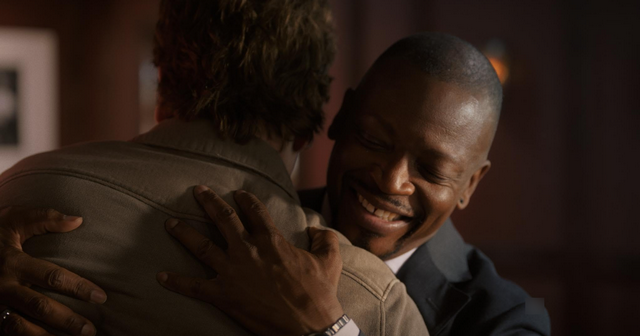
And that brings everything back to Trish.
“I think she’s the most powerful character in the story, if you define power in terms of who’s controlling what’s happening,” says Millman. But he immediately complicates that assessment. “She’s also a status quo character. She just wants to keep things as they are.”
Even her dance atop the bar is less rebellion than strategy.
“The whole dance that she does on the bar is an attempt to placate David. She’s like, ‘Okay, I’ll play your game. This is the kind of thing we normally do in private, but I will do it in public because you’re goading me to, because maybe that will get you to go upstairs and get out of the bar.’”
Trish may not be trying to change the world around her, but within it, “she is the most powerful character in terms of being able to determine the direction that a particular scene goes.”
Millman remains ecstatic about finding Ponton.
“I am absolutely over-the-moon delighted that we found Jen, and she just grabbed the part with both hands from the first time she read it. She absolutely knocked her audition self-tape out of the park.”
When Millman asked what drew her to Trish, Ponton poured several years of personal upheaval onto the table. None corresponded literally to the screenplay, but Millman understood what she meant: there was emotion and complexity she needed somewhere to put.
“And this is here,” he recalls. “And she did. She was ridiculously game. . . . Always went emotionally for the moment, never pulled her punches.”
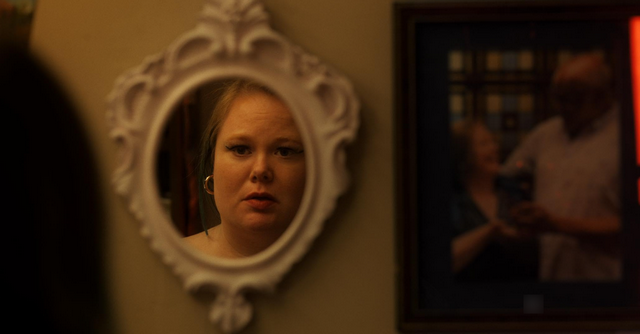
Finding Trish in the Edit
That fearlessness extends to the film’s two sex scenes—one in Trish’s office and another atop the bar—and it is in their contrast that Caniglia’s cinematography and Emil Benjamin’s editing become particularly important.
The office encounter is colder, starker and observed largely from outside. The bar sequence moves inward, becoming more intimate and subjective.
“We worked on that scene together a lot,” says Millman of Benjamin. “We had many, many drafts, many, many, many, many versions of that scene until we hit on this way of editing it.”
The objective was Trish.
“We really wanted to get Trish’s subjectivity, so that we really felt like we were with her in the scene. Because the scene in the office is shot so objectively, so much from the outside. We really wanted this to feel much more subjective.”
For Millman, Benjamin’s contribution extends far beyond that sequence.
“Emil is—I mean, he deserves co-credit for the creation of the film as a whole. So much happened in the editing room, which you wouldn’t necessarily expect because the film is so linear. There’s not a lot of opportunity to change the story in the editing room.”
The danger instead was stasis: three characters, a single location and long dialogue scenes that could easily become visually inert.
Millman credits Benjamin and Caniglia with preventing that.
“I’m thrilled with both of their work, and I would love to work with either or both of them again.”
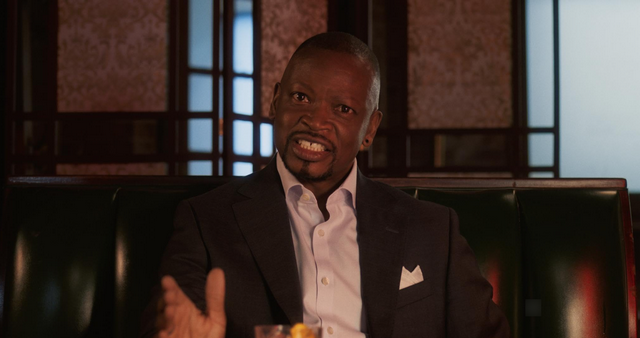
Making a Bar Sound Like a Bar
The illusion of that bar doesn’t end with Prosky’s walls, Caniglia’s lighting or Goldberg’s barware.
It also had to sound as though it existed.
Composer Alexander J. Morgan entered the film through Benjamin, an old friend, and proved unusually valuable because his abilities extended well beyond composing.
“Alexander is a composer. He’s also a singer and a songwriter and musician, and he’s also a sound editor and sound designer. So we used him in all of these capacities, and it was really helpful to have that melded.”
Because this is a bar, Millman and his team first confronted the obvious question: What’s on the playlist?
“There’s music going in a bar continuously, and that’s a lot of needle drops.”
Music supervisor Cheryl Wang provided access to a library that allowed the production to use numerous cues at a flat rate. The trick was finding music that could function naturally as whatever Trish happened to have playing while quietly complementing the dramatic temperature of a scene.
“We were able to find, with her help, a lot of different tones that underscored the emotion of the moment without being too obtrusive. So it still felt like we were in a bar listening to whatever it is the bar had playing, but it didn’t jar with emotionally what’s going on. It reinforced it.”
Morgan’s original score is used much more selectively, including during the interstitial passages and Coleman’s monologue, while his sound work extends the bar beyond the walls Prosky built.
“Since it was shot on a set, if you hear an ambulance going by, or you hear a dog barking, or you hear conversation—a lot of that is layered on afterwards.”
So are details as seemingly insignificant as the sounds of mixing drinks.
“Having one guy doing all of that and having a finger in all these different parts of the sonic pie was incredibly helpful,” says Millman. “It made things much more efficient and much more unified.”
The Trust Fall
By the time RESENTMENT was finished, Millman had learned enough from making his first narrative feature to fill another interview.
Some lessons were artistic. Some were financial. Some were painfully practical.
“One thing I learned is you need to work with people who you really trust. Showing up on set every day is like doing a trust fall every day, and if you hit your head on the concrete once, you don’t believe that they’re going to catch you the next day.”
Simply telling yourself that you have no choice but to trust someone doesn’t solve the problem.
“You’re still rigid. You’re still going to hit the ground hard.”
Another lesson sounds almost paradoxical for independent filmmaking: sometimes you need to spend money to save money.
“You can wind up putting yourself in a situation where you spend more later because you tried to save money earlier.”
And for a dialogue-heavy film with theatrical DNA, Millman discovered that rehearsal isn’t a luxury.
“If you’re going to do a play-like film with very long dialogue scenes, you need lots and lots of rehearsal time, particularly if you want to get long takes—which I did, because I wanted the scenes to really play out.”
He would also bring an editor into the process earlier next time.

Millman places himself somewhere on the continuum between Alfred Hitchcock, with a movie effectively edited in his head before photography, and Terrence Malick, accumulating enormous quantities of material from which the movie can later be discovered.
“I’m somewhere in between those two. And this film definitely taught me it would be beneficial to have more of an editor in my head starting out—to have a better sense of how all the pieces are going to fit together.”
Then comes perhaps the most portable lesson of all.
“If there’s something that you get and nobody else gets, cut it, because there’s a reason nobody else gets it.”
Across his two shorts and RESENTMENT, Millman has repeatedly discovered that something he loved but nobody around him understood eventually wound up on the editing-room floor.
“That’s the version of ‘kill all your darlings’ that I need to take on board as a writer or as a director looking at my own writing and saying, ‘Yeah, okay, I’m glad you love this, but that’s not gonna work. Nobody understands it.’”
There is, however, one thing Millman isn’t finished with: RESENTMENT itself.
Beyond the developing stage version, he wants audiences to discover the film—and ideally to experience it together.
“This is not a second-screen piece of content. Resentment is something you actually have to watch.”
His fantasy is wonderfully appropriate: audiences see the movie and then head somewhere familiar.
“The fantasy is that people go to it and then go out to a bar afterwards to argue about it and choose up sides and say, ‘Who’s on Team Trish and who’s on Team Coleman and who’s on Team David?’ And I know people who are in all of those camps. I want people to have those arguments.”
Preferably, apparently, in a real bar.
After spending an entire feature constructing an imaginary one, Millman may have had enough.
“This is a habit with me, though—picking difficult locations. My first short was shot mostly on water, and my second short was shot mostly in a moving bus. I never make it easy.”
His solution for next time? “I should have made a film where two guys are sitting on a park bench.”
Considering RESENTMENT has at least gotten him from open water and moving buses to people sitting in a stationary bar, I point out that he’s making progress.
“There you go,” Millman laughs.
by debbie elias, exclusive interview 09/16/2026
RESENTMENT is now available on digital platforms.