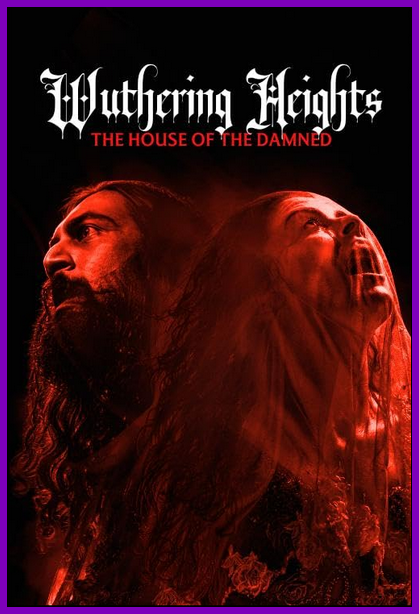
How many times can Emily Brontë’s Wuthering Heights be adapted for the screen? Apparently, there’s always room for one more. But with WUTHERING HEIGHTS: THE HOUSE OF THE DAMNED, director Rebecca J. Matthews (aka Becca Hirani) and screenwriter Liana Failla have accomplished something that decades of filmmakers have largely overlooked. They’ve taken one of literature’s most celebrated tales of obsessive love, vengeance, cruelty, and supernatural longing and unleashed the Gothic horror lurking within its pages. And what a deliciously dark, devilishly entertaining, and wonderfully weird interpretation it is!
Forget the conventional sweeping romance of Catherine and Heathcliff. Matthews isn’t interested in another reverential retelling of doomed lovers wandering the Yorkshire moors. Instead, she embraces the psychological torment, supernatural possibilities, and emotional depravity already embedded in Brontë’s novel, heightening those elements into a tale of ghosts, madness, bloodletting, and undying obsession.
The result is a visually atmospheric, often unsettling, and unexpectedly amusing Gothic horror film that understands the power of both suggestion and excess. There is beauty here. There is tragedy. There is darkness. And yes, there is blood. Plenty of it.
But what makes WUTHERING HEIGHTS: THE HOUSE OF THE DAMNED particularly enjoyable is the thought Matthews brings to the filmmaking itself.
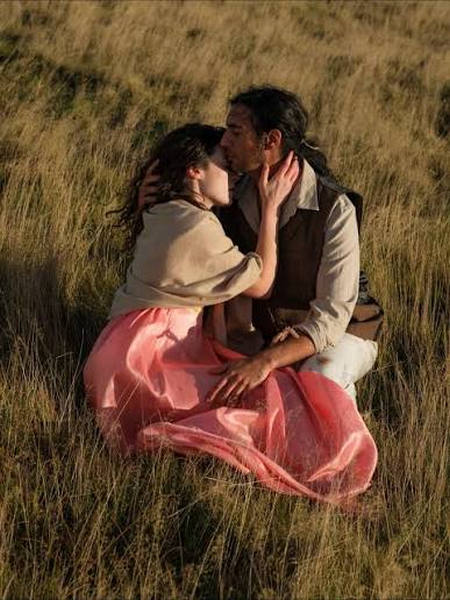
Working with Failla, who has considerable experience in horror filmmaking, Matthews constructs a narrative that retains the recognizable foundations of Brontë’s story while venturing into decidedly more macabre territory.
Mr. Lockwood (Ross Townsend-Green) arrives at the remote, storm-battered Wuthering Heights, where he encounters the brooding Heathcliff (Sky Cheema), a man consumed by his obsessive attachment to the long-dead Catherine (Elle O’Hara). But Catherine is hardly resting peacefully. Her spectral presence haunts the halls, while Heathcliff’s devotion has assumed a particularly grotesque form, involving blood sacrifice and the desperate hope of restoring his beloved to physical existence.
As Lockwood becomes increasingly ill and psychologically distressed, his curiosity about the house and its inhabitants draws him deeper into a nightmare in which the boundaries between reality, hallucination, memory, and supernatural manifestation become increasingly uncertain.
And Lockwood, bless his inquisitive heart, simply cannot stop snooping.
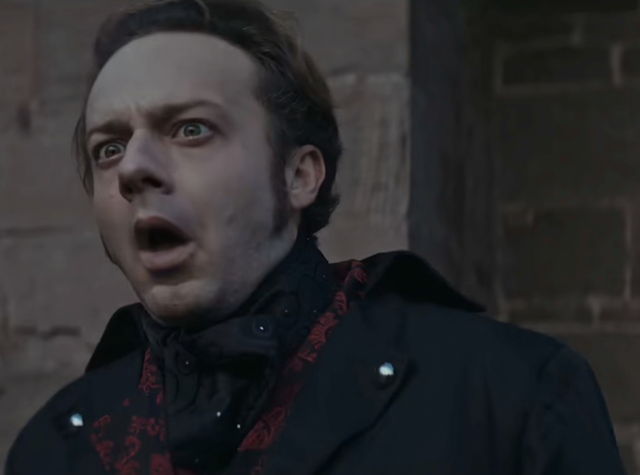
Townsend-Green is delightful in the role, giving Lockwood an almost foppish quality that provides much-needed levity amid the film’s darker developments. There’s a marvelous physicality to his performance, particularly in the small, seemingly inconsequential gestures that reveal Lockwood’s insatiable curiosity. Watching him furtively examine a diary, holding it close as though he were a child sneaking forbidden candy, is genuinely amusing.
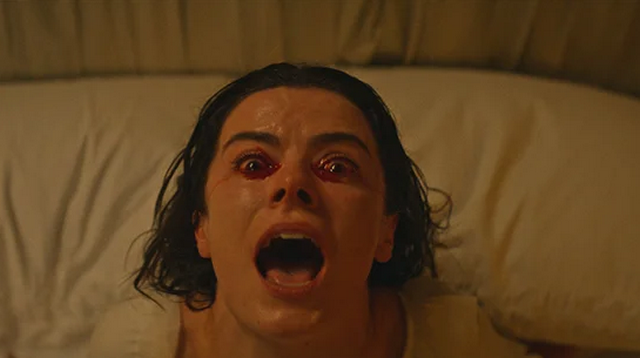
But as the character’s physical and psychological condition deteriorates, Townsend-Green becomes equally convincing in conveying his mounting distress. Red-rimmed eyes, perspiration, exhaustion, and increasingly agitated behavior chart his decline, with makeup and performance working in tandem to create a progressive transformation.
It’s a carefully modulated performance that provides the film with an effective audience surrogate. We discover the mysteries of Wuthering Heights through Lockwood’s experiences, never entirely certain whether what he sees is real.
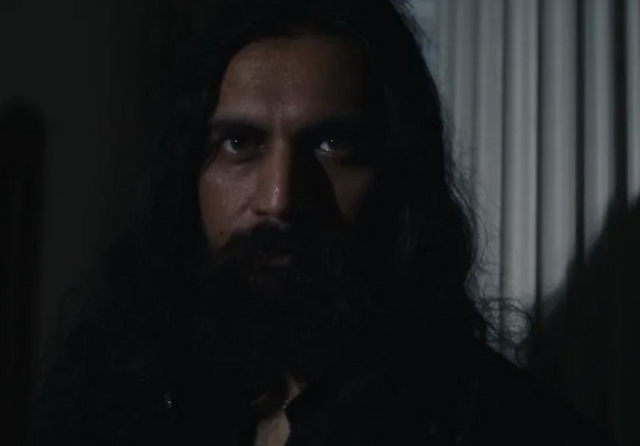
Cheema, meanwhile, gives Heathcliff a brooding, almost feral quality. His disheveled appearance, unkempt hair, and intense physical presence suggest a man who has surrendered himself completely to grief and obsession. He seems to be decaying along with the house, his identity increasingly inseparable from its darkness.
O’Hara’s Catherine is equally essential to the film’s atmosphere, appearing as an enigmatic spectral presence whose intentions and physical reality remain uncertain.
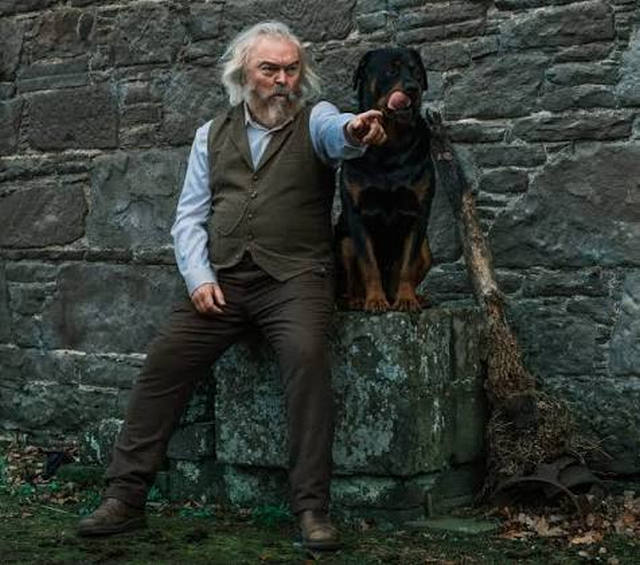
Supporting performances from Nicola Wright as Nellie and Gordon Joseph Millar as Joseph provide an especially effective counterbalance to the madness. Both characters have witnessed the history of the household and bring an outsider’s perspective to its increasingly disturbing circumstances. Joseph’s repeated warnings to Lockwood offer moments of dry humor, while Nellie’s inability to perceive certain things Lockwood insists he has seen adds another layer of uncertainty.
Sam Rowlands also makes a strong impression as Hindley, providing a contrast to Cheema’s Heathcliff.
Yet as effective as the performances are, it is the film’s visual storytelling that truly distinguishes Matthews’ approach.
Working with cinematographer Raffaele Nocerino, Matthews develops a distinctive visual grammar that changes according to the character and psychological perspective being explored.
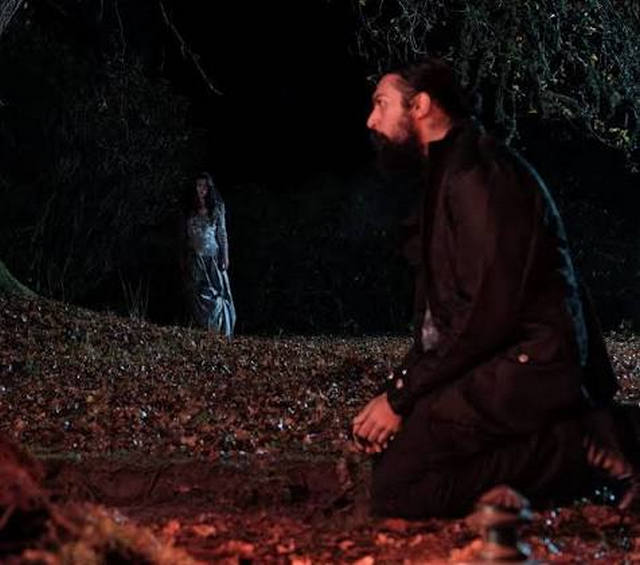
Heathcliff is frequently captured in tightly controlled, intensely composed shots that reinforce his emotional confinement. In certain sequences, the camera deliberately excludes faces, concentrating instead on torsos, legs, hands, and physical movement. This unusual framing creates an unsettling anonymity, particularly during the film’s more disturbing activities.
With Lockwood, the camera becomes more fluid and exploratory. It follows him through doorways, along corridors, up staircases, and into previously unseen rooms, allowing the audience to participate in his discoveries. The camera’s mobility reflects Lockwood’s curiosity while gradually becoming an instrument of his psychological disorientation.
It’s an effective contrast between a man imprisoned by obsession and another who unwittingly wanders into its consequences.
Nocerino’s lighting is equally impressive.
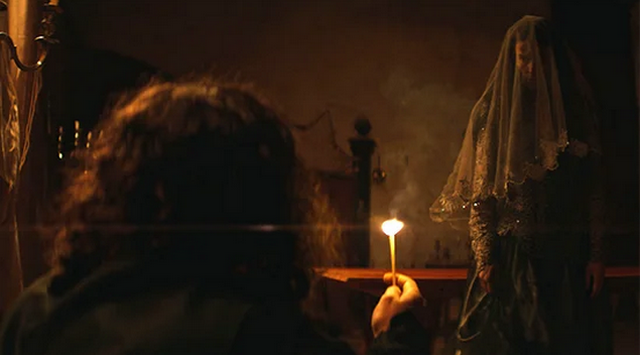
Candlelight becomes one of the film’s most expressive visual elements, illuminating faces and objects while allowing the surrounding architecture to dissolve into darkness. The interplay between flickering flames, heavy shadows, and the muted natural light entering through the castle’s windows creates an atmosphere of historical authenticity and supernatural unease.
There are striking compositions in which a single flame provides the dominant illumination, drawing the eye toward a spectral figure or an ominous movement within the darkness.
Of particular note is Nocerino’s masterful use of negative space and the gradations of darkness. Rather than allowing the shadows to collapse into a flat, impenetrable black, he works within a spectrum of inky blue-blacks, charcoal tones, and deep, shadowed blues that retain a sense of dimension and texture. There is depth within the darkness, an almost palpable layering that allows the eye to search the frame, uncertain whether something—or someone—might be lurking just beyond the reach of the light. This becomes particularly effective with Heathcliff, whose dark clothing and increasingly disheveled appearance allow him to seemingly materialize from the woodwork or dissolve into the surrounding wallpaper. Negative space becomes more than a compositional device; it becomes an expression of Heathcliff’s psychological imprisonment and the house’s oppressive hold over him. And when a candle flame punctures that darkness, the contrast is all the more striking, allowing illumination and shadow to exist in a constant state of visual tension.
And then there is the use of color.
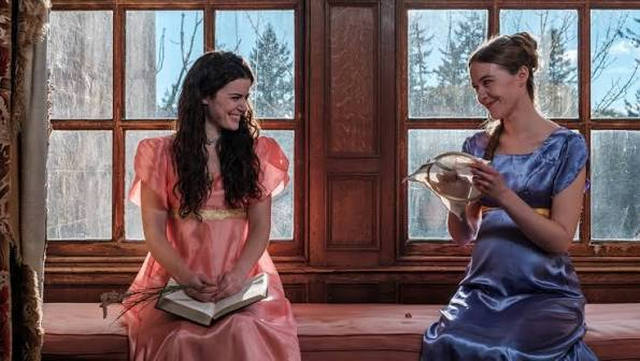
Deep reds punctuate the film’s otherwise muted palette, while the softer salmon, peach, and pink tones of Lockwood’s bedroom complement his more animated, almost foppish personality while establishing a visual connection to Catherine’s past.
This is where costume designer Francesca Fletcher’s work becomes particularly significant.
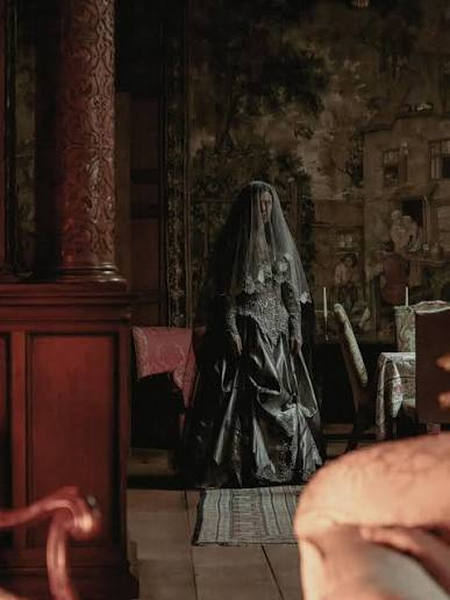
In one of the film’s most striking visual conceits, Francesca Fletcher’s gray and silver costume design transforms Catherine into an apparition whose very presence is defined by light. Beneath a heavily laced veil, subtle crystalline accents catch the flicker of candlelight, allowing her spectral form to emerge from the shadows without surrendering its mystery. Working in exquisite harmony with Raffaele Nocerino’s cinematography, the costume becomes an essential element of the visual storytelling, maintaining the ambiguity between supernatural manifestation and psychological hallucination.
The choice of gray and silver rather than traditional Gothic black is especially effective. The lighter tones permit Catherine’s silhouette to register against the darkness without revealing the face beneath the veil. Whether seen at a distance or suddenly appearing much closer, she remains an unsettling presence precisely because the costume conceals as much as it reveals.
Fletcher also uses costume to establish a visual connection between Catherine’s past and present. The soft pink fabric associated with the younger Catherine suggests innocence, warmth, and romantic longing, its color echoed in the bedroom where Lockwood stays. Against that softness, the spectral gray and silver of the present-day Catherine becomes an expression of what has been lost and what has endured.
Costume, color, lighting, and character psychology become inseparable. And that attention to detail extends to the environments surrounding the characters.
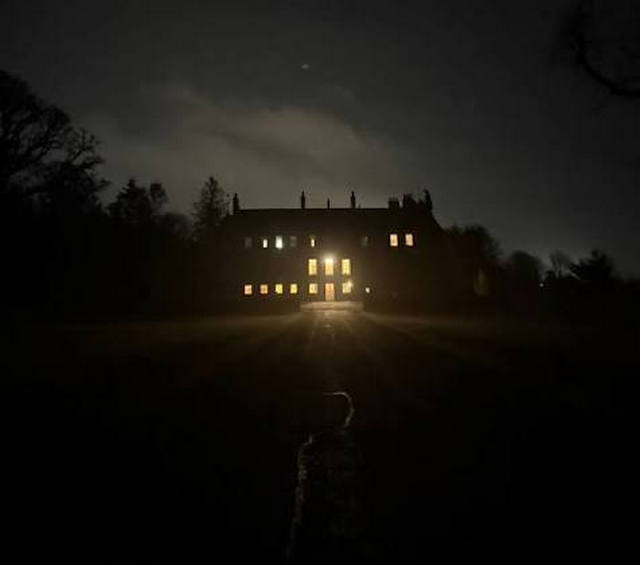
Production designer Christy Louise benefits enormously from the film’s historic location, Brecken Castle, whose preserved interiors provide a magnificent foundation for the period setting. Ornate furniture, rich draperies, decorative wall coverings, historic artwork, and beautifully maintained architectural details establish a world that feels genuinely inhabited rather than artificially assembled.
There is a richness to the textures and colors that is especially striking. Rather than appearing faded or diminished by centuries of wear, many of the interiors retain a remarkable visual vitality. The result is an environment whose elegance contrasts beautifully with the decay of the human relationships unfolding within it.
The castle’s long corridors, imposing staircases, intimate chambers, and expansive rooms provide Matthews and Nocerino with a wealth of opportunities for expressive framing. And while the interiors offer warmth and grandeur, the world beyond the windows is frequently defined by cold, wind, rain, and threatening darkness.
That contrast becomes particularly important to the film’s soundscape.
Working with composer James Allen Roberson and the sound design team, Matthews wisely avoids the temptation to overwhelm the film with music. The score is restrained, atmospheric, and occasionally unsettling, allowing environmental sound to become a central component of the storytelling.
Wind howls beyond the windows. Rain lashes against the glass. Thunder rolls across the moors. Fire crackles within the rooms. But what is especially impressive is the acoustic specificity of the interiors.
Too often, films set within enormous castles or historic mansions employ a hollow, cavernous sound that makes every room feel like an empty warehouse. Not so here. There is texture and dimension to the sound. Heavy furnishings, draperies, and the architectural character of the rooms seem reflected in their individual acoustic identities. A hallway sounds different from a sitting room. A roaring fireplace introduces a comforting sonic warmth that contrasts with the bitter weather outside. Even footsteps contribute to character.
The soundscape becomes an extension of the production design, reinforcing the distinction between the apparent safety of the interior spaces and the threatening world beyond them.
And Matthews understands something particularly important about horror. Sometimes silence is more frightening than music.
By allowing moments to unfold without an insistent score telegraphing danger, she creates genuine uncertainty. The audience is left listening, waiting, wondering whether the next sound will be a gust of wind, an approaching footstep, or something considerably more unpleasant. That restraint makes the film’s more graphic moments all the more entertaining.
Because when Matthews decides to unleash the blood, she does so with enthusiasm.
The practical blood effects are wonderfully excessive, occasionally bordering on the gleefully outrageous. One particularly memorable spray erupts upward before curving into a fountain-like arc, creating an effect that is as amusing as it is gruesome.
And that’s part of the fun.
Rather than pursuing strict anatomical realism, the exaggerated bloodletting complements Lockwood’s increasingly unstable perspective. When the audience cannot be entirely certain whether a horrifying image represents reality or a fevered vision, a certain degree of grotesque exaggeration becomes dramatically appropriate. The blood itself is a suitably dark, rich red, standing out vividly against the film’s muted palette.
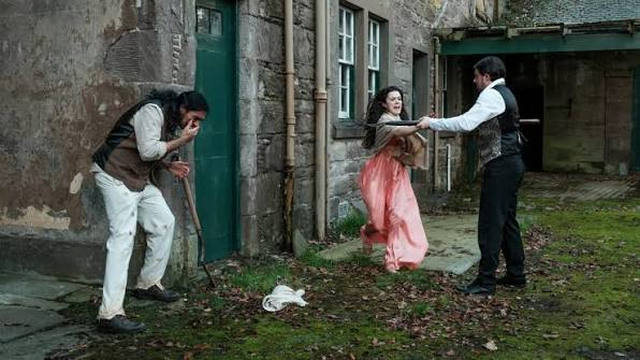
And, of course, there’s the matter of Heathcliff’s white trousers. In a world filled with blood, mud, madness, and Gothic depravity, one cannot help wondering how many pairs were required to survive production. Some mysteries are best left to the costume department.
Matthews also brings a distinctive sensibility to the film’s editing, which she handles herself.
Transitions between scenes are often fluid and imaginative, particularly when the narrative moves between past and present. Fire becomes a visual bridge between time periods, with the camera moving into flames before emerging in another moment of the story.
These transitions are not merely decorative. They reinforce the literary origins of the material, creating the sensation of moving through interconnected pages of a book while maintaining cinematic continuity.
Color, movement, and visual motifs help link the different narrative periods, ensuring that the film’s fragmented chronology remains emotionally and visually coherent.
It’s an especially effective approach for a story in which the past refuses to remain buried.
And that, ultimately, is what makes WUTHERING HEIGHTS: THE HOUSE OF THE DAMNED such an entertaining reinterpretation of Brontë’s novel.
Matthews and Failla recognize that the original story’s emotional extremes—obsession, vengeance, cruelty, grief, and the inability to relinquish the dead—are already the ingredients of Gothic horror. Rather than imposing an entirely unrelated genre upon the material, they amplify its existing darkness and give it a more overtly supernatural and blood-soaked expression.
The result is a film that respects the atmosphere and emotional foundations of its literary inspiration while gleefully embracing the possibilities of horror filmmaking.
There are moments of genuine unease, moments of unexpected humor, and moments of gloriously excessive practical gore. But beneath those pleasures is a thoughtful appreciation for the craft of filmmaking, evident in the relationship between camera movement, editing, production design, costume, performance, music, and sound.
Rebecca J. Matthews has found a wonderfully wicked way to breathe new life—and perhaps a little undead life—into Wuthering Heights. And damned if it isn’t fun!
Directed By: Rebecca J. Matthews (aka Becca Hirani)
Written by Liana Failla based on the novel by Emily Bronte
Cast: Ross Townsend-Green, Sky Cheema, Elle O’Hara, Nicola Wright, Gordon Joseph Miller, Sam Rowlands, Anna Coupe
by debbie elias, 09/17/2026
WUTHERING HEIGHTS: THE HOUSE OF THE DAMNED arrives on Digital and VOD October 16, 2026.