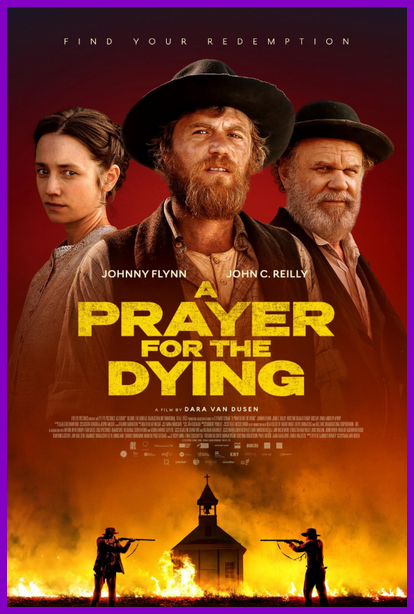
In A PRAYER FOR THE DYING, writer/director Dara Van Dusen creates a cinematic paradox: as the world of her characters grows increasingly lifeless, the visual language becomes increasingly alive, until the craftsmanship itself threatens to eclipse the tragedy it was designed to illuminate. And that’s not necessarily a bad thing.
An adaptation of Stewart O’Nan’s novel and Van Dusen’s feature directorial debut, A PRAYER FOR THE DYING is an apocalyptic Western steeped in disease, death, faith, morality, madness, and the destructive forces of Mother Nature. Set in 1870 Wisconsin, in the aftermath of the Civil War, the film follows Jacob Hansen (Johnny Flynn), a veteran carrying the psychological scars of war who now serves as both sheriff and pastor in a small, isolated community. With a wife, Marta (Kristine Thorp), and an infant child, Jacob seemingly has the opportunity to build a peaceful life far removed from the horrors he has witnessed.
But peace is an illusion.
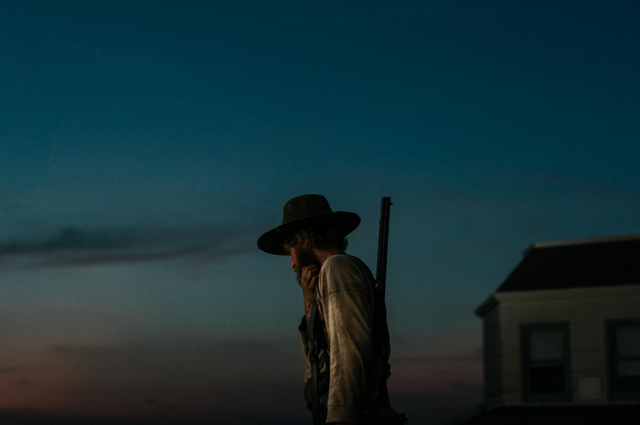
Disease has found its way into the community. A wildfire threatens from the distance. Fear, suspicion, and self-preservation begin to erode whatever sense of trust exists among the townspeople. And Jacob, already burdened by the demons of his past, finds himself confronting forces beyond his understanding or control.
Complicating matters is Doc (John C. Reilly), whose decisions concerning the spreading illness raise troubling questions about medical judgment, personal responsibility, and the conflict between science and faith. As the threat of disease becomes increasingly apparent, the choices made by those entrusted with protecting the community take on devastating implications.
There is an unmistakable contemporary resonance to these events. Disease, denial, the dismissal of warning signs, and the inability—or unwillingness—to confront an approaching catastrophe are hardly confined to the nineteenth century. Neither is the tendency to place personal conviction above evidence or collective welfare.
But while the narrative proceeds through an increasingly oppressive landscape of dread and despair, Van Dusen and cinematographer Kate McCullough take an altogether different approach to the film’s visual storytelling.
And what an approach it is.
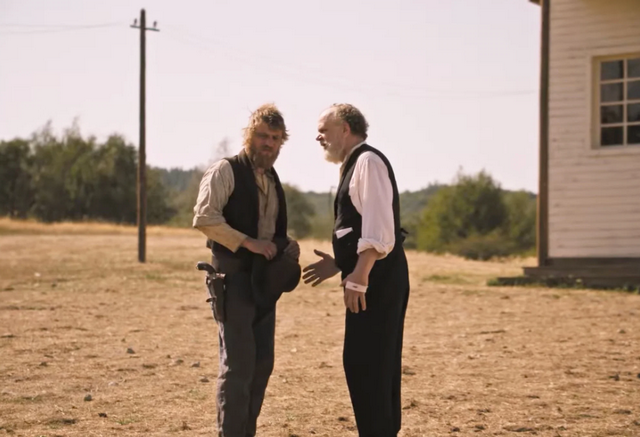
From the outset, the cinematography establishes a sense of isolation. Characters are frequently centered within carefully composed frames, surrounded by landscapes that dwarf them or confined by architectural elements that seem to hold them prisoner. Locations feel disconnected from one another, reinforcing the impression of a community whose inhabitants are separated not only by physical distance but by their own fears, beliefs, and suspicions.
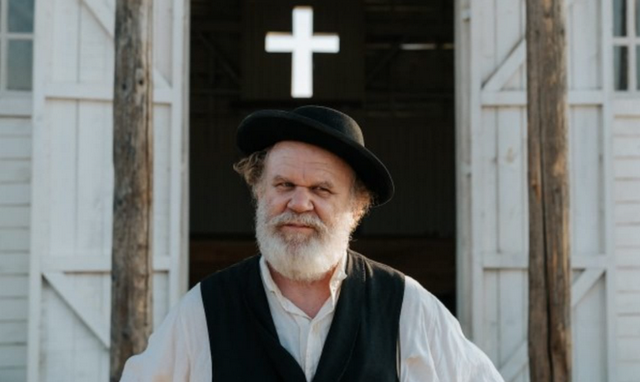
One particularly striking composition finds Doc standing outside the church, framed between two posts against the stark white building, dirt, and blue sky. His placement is ever so slightly off-center, to the right. It is a deceptively simple image, yet that subtle imbalance speaks volumes about a man whose motivations and decisions invite increasing distrust. And given the film’s ongoing arguments involving faith, morality, and the politics of the community, there is a delicious irony in seeing Doc positioned quite literally just a little to the right.
McCullough’s cinematography is filled with such deliberate choices.
There are unconventional angles, extreme close-ups, meticulously controlled framing, and zooms employed with an almost confrontational intensity. As the film progresses, the initially restrained visual grammar becomes more aggressive. Camera movement intensifies. Compositions become increasingly disorienting. The palette shifts toward vivid reds, fiery oranges, and ominous blacks.
The encroaching wildfire is particularly effective as both a literal threat and a metaphor for the darkness consuming Jacob and the community. Smoke becomes an almost supernatural presence, its reddish-orange and black clouds suggesting something far more sinister than a distant natural disaster.
And then there are the images that seem to emerge from Jacob’s nightmares.
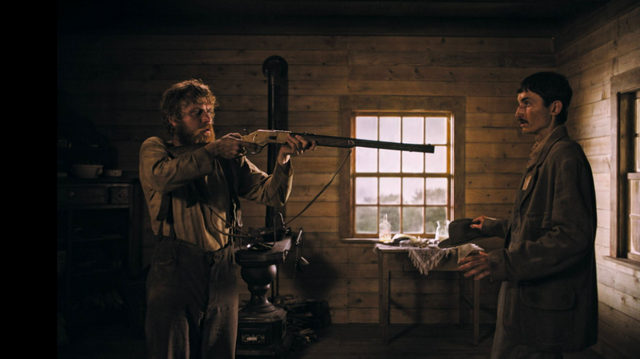
Against an otherwise black screen, a circular opening reveals fragments of imagery, often drenched in red. Jacob himself. A dead horse. Disturbing glimpses that suggest memory, madness, mortality, and the psychological wounds of war. These compositions are simultaneously beautiful and unsettling, almost abstract in their presentation yet unmistakably connected to the film’s exploration of spiritual and emotional disintegration.
The use of red becomes increasingly pronounced, eventually dominating the screen in a feverish assault on the senses. Fire, blood, hell, disease, and the darkest recesses of Jacob’s mind seem to converge in a visual nightmare.
Working in concert with McCullough’s cinematography is the editing of Fredrik Mofhedon, which embraces the film’s increasingly fragmented visual identity. The juxtaposition of images, sudden shifts in perspective, and movement between the physical world and Jacob’s psychological landscape create a deliberately unsettling rhythm. The result is often mesmerizing.
Yet it is also where A PRAYER FOR THE DYING begins to reveal its central problem.
The spreading wildfire, the advancing disease, and Jacob’s deteriorating mental state are all interconnected. Each represents a different manifestation of destruction, and each contributes to the film’s overarching meditation on mortality, morality, and the limits of human control.
But the disjointed transitions between locations, characters, and increasingly surreal imagery repeatedly interrupt the dramatic progression. Rather than remaining immersed in Jacob’s ordeal, one becomes increasingly conscious of the filmmaking itself.
In effect, two films seem to be unfolding simultaneously.
One is the bleak, deliberately paced story of a Civil War veteran confronting disease, catastrophe, moral uncertainty, and the disintegration of his world.
The other is an astonishingly imaginative audiovisual exploration of those same forces, expressed through color, composition, movement, rhythm, and sound.
They are thematically united. But they aren’t always dramatically synchronized. And therein lies the conundrum.
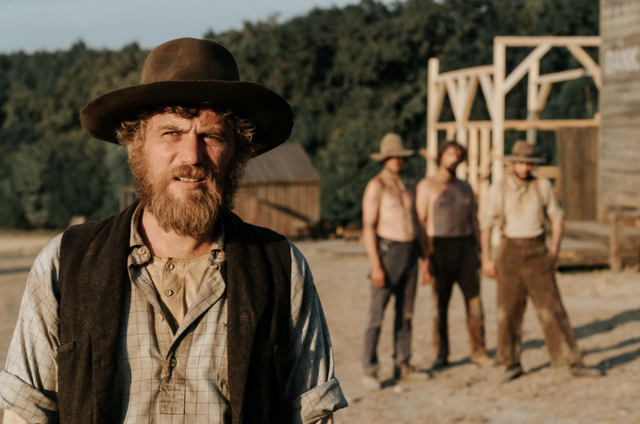
The aggressive visual language is frequently at odds with the tedium and bleakness of the narrative. While the story moves inexorably toward devastation, the filmmaking becomes more animated, more colorful, more experimental, and more visually intoxicating.
This contrast is clearly intentional, and there is considerable intelligence behind it. But intention and execution are not necessarily synonymous with dramatic effectiveness. The imagery becomes so compelling that attention shifts away from the characters and toward the mechanics of how their story is being told.
Rather than becoming more emotionally invested in Jacob’s tragedy, one can find oneself anticipating the next extraordinary composition, the next startling use of color, the next unexpected edit. And that is both the film’s triumph and its frustration.
Equally impressive is the aural landscape.
Composer Beata Hlavenková’s score and the sound design, led by Gustaf Berger, are integral to the film’s atmosphere. Silence is used as effectively as music, allowing the smallest sound to acquire tremendous significance. Of particular note are the isolated percussive beats that emerge at carefully chosen moments. Sometimes they suggest a heartbeat, a reminder of the fragile persistence of life amid so much death. At other times, they evoke the drums of war, recalling the violence and trauma Jacob carries within him.
The ambiguity is extraordinary. A single rhythmic motif can suggest both the physical pulse of a living body and the psychological reverberations of a battlefield. As Jacob’s world descends further into chaos, these sounds become part of the film’s increasingly visceral experience, connecting the external catastrophe to his internal collapse.
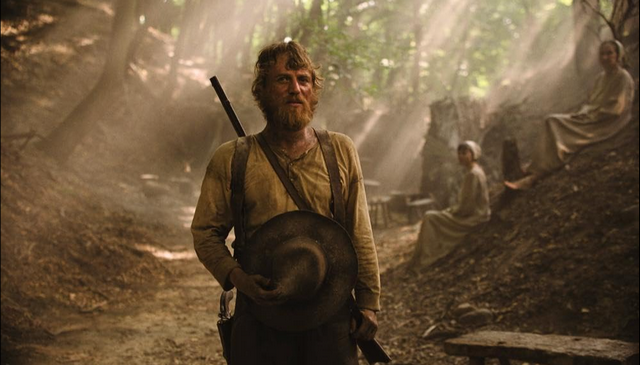
Production designer Hubert Pouille also makes a substantial contribution, creating a world in which the physical environment reveals character and circumstance without unnecessary exposition.
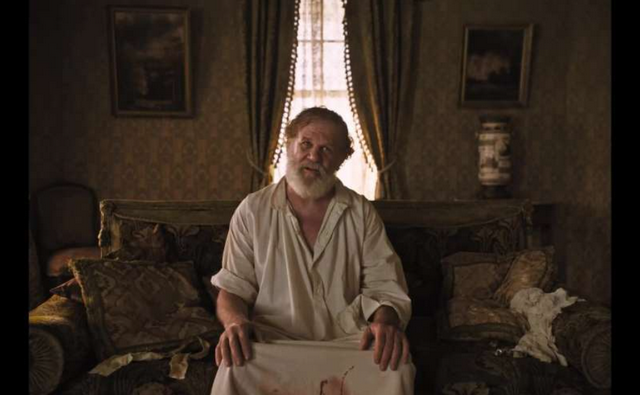
Consider Doc’s home. Its wallpaper, furnishings, artwork, and carefully maintained appearance speak to a degree of economic comfort and social standing that distinguishes him from those around him. Even his clothing tells a story. His white shirt and pristine pocket handkerchief stand in sharp contrast to the increasingly soiled garments and surroundings of the other townspeople.
These details establish social and economic disparities while subtly reinforcing questions about authority, trust, and the motivations of those who wield influence.
Costuming, makeup, and the gradual accumulation of dirt and physical deterioration contribute to the impression of a community being consumed from within.
Even the arrival of a circus provides an unexpected visual interruption, with its distinctive costumes, makeup, and remarkable handmade elephant introducing an almost surreal flourish into an already precarious world.
The performances provide a necessary human anchor.
Johnny Flynn brings an increasingly haunted quality to Jacob, a man struggling to reconcile his religious convictions, civic responsibilities, and the traumatic memories that continue to torment him. As the circumstances around him deteriorate, so too does his ability to distinguish between what he believes, what he fears, and what is actually happening.
John C. Reilly is an effective counterpoint as Doc, whose outward composure and position of authority become increasingly troubling in light of his decisions. There is an unsettling tension between the apparent respectability of the man and the consequences of his actions.
Kristine Thorp’s Marta brings another dimension to the story, representing the vulnerability and limited agency of women in a society where their concerns and emotions can be readily dismissed. Her presence also underscores the personal stakes of Jacob’s increasingly desperate struggle.
Yet despite these performances, the emotional connection to the characters is repeatedly challenged by the film’s shifting narrative and visual rhythms. This is not to suggest that the visual language is empty spectacle. Far from it.
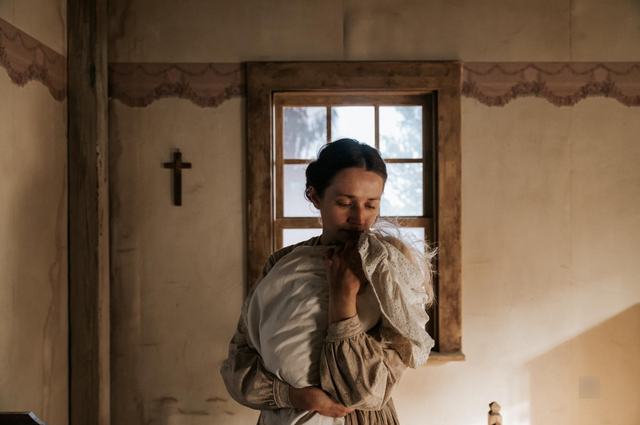
Every choice appears rooted in the film’s themes. The imagery is not merely illustrating the narrative; it is attempting to express forces that the characters themselves cannot fully comprehend. Nature, faith, disease, death, and psychological trauma become active presences within the cinematic frame.
Van Dusen deserves considerable credit for the ambition and discipline of that approach, particularly in a first feature. She demonstrates a remarkable command of visual storytelling and an understanding of how cinematography, editing, sound, music, and production design can work together to communicate ideas that dialogue alone could never adequately express.
But there remains a fundamental difference between creating a succession of unforgettable cinematic moments and sustaining an equally compelling dramatic experience.
A PRAYER FOR THE DYING achieves the former with striking regularity. The latter proves more elusive.
By the time the film reaches its feverish, red-saturated conclusion, the imagery has become almost overwhelming in its intensity. The visual and aural elements coalesce into something that feels simultaneously infernal, corporeal, and psychologically devastating. It is difficult to forget. And perhaps that is precisely what Van Dusen intended.
But the lasting impression is less the cumulative emotional weight of Jacob’s journey than the audacity of the cinematic techniques employed to bring that journey to the screen.
For a debut feature, A PRAYER FOR THE DYING is an undeniably ambitious undertaking, rich in metaphor, visual invention, and technical accomplishment. Van Dusen and her collaborators have created a world whose images and sounds linger long after the screen goes black.
The question is whether the human tragedy at its center lingers with equal force.
In this case, the craftsmanship proves more memorable than the story. And therein lies the paradox of A PRAYER FOR THE DYING: a film about a dying world whose most extraordinary achievement is how vividly alive its filmmaking becomes.
Written and Directed by Dara Van Dusen based on the novel by Stewart O’Nan
Cast: Johnny Flynn, John C. Reilly, Kristine Thorp
by debbie elias, 10/01/2026
A PRAYER FOR THE DYING is currently available On Demand (Spectrum) and in select theatres.