By debbie elias
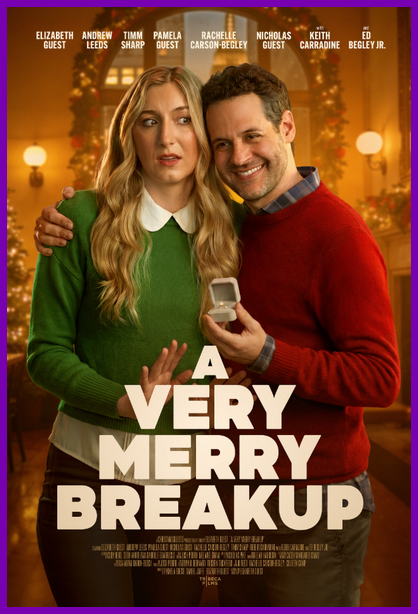
Love is complicated. Relationships are complicated. And when Christmas comes calling with an engagement ring, four parents, an ex-boyfriend, and a healthy dose of romantic panic, things can get downright chaotic. Such is the case with A VERY MERRY BREAKUP, a holiday romantic comedy from writer, director, and star Elizabeth Guest that boasts a delightful supporting ensemble, some genuinely funny situations, and impressive technical craftsmanship. Unfortunately, it also boasts a leading character whose romantic indecision and emotional frenzy threaten to wear out her welcome long before the New Year’s Eve festivities begin.
And therein lies the conundrum of A VERY MERRY BREAKUP. There is much to appreciate here, particularly in the performances, the generational humor, the editing, and the score. But there’s also Lydia.
Played by Guest, Lydia is a self-described love addict whose romantic history is littered with questionable decisions, failed relationships, and an almost pathological inability to recognize a good thing when she has it. And she most definitely has a good thing in Tim.
As played by Andrew Leeds, Tim is everything one could want in a romantic partner. He’s kind, thoughtful, emotionally available, patient, and grounded. He’s also funny, attentive, and sufficiently considerate to keep a gluten-free pizza in his freezer just in case Lydia needs one. It’s a small detail, but one that speaks volumes about the man.
So naturally, when Tim plans a storybook Christmas proposal in New York City, Lydia panics.
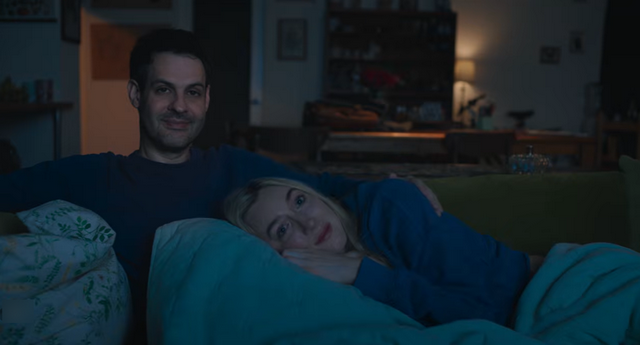
Rather than embrace the possibility of a loving, stable future, she bolts for Los Angeles, where her four parents, her best friend Ryan, and a revolving door of romantic complications await. Among those complications is former boyfriend James (Timm Sharp), whose reappearance does little to simplify matters.
The premise is ripe for comedy. The problem is that Lydia’s anxiety, desperation, indecision, and fear of commitment are so relentlessly played that what initially registers as romantic uncertainty soon becomes an exercise in audience endurance.
There is a difference between a flawed protagonist whose emotional struggles invite empathy and one whose behavior becomes increasingly difficult to embrace. Lydia repeatedly crosses that line.
Guest clearly understands the character. Having developed Lydia through two seasons of a web series inspired by her own dating experiences, she brings a deeply personal perspective to the material. And the decision to explore romantic dysfunction through the eyes of a woman rather than the traditionally commitment-phobic male protagonist offers an interesting reversal of familiar romantic comedy conventions.
But understanding a character’s flaws does not automatically make those flaws entertaining.
Lydia’s emotional chaos is so constant that there is little opportunity for the audience to discover the qualities that might explain why Tim remains so devoted to her. We understand why Lydia should want Tim. What proves far more elusive is understanding why Tim should want Lydia.
And that is the film’s fundamental emotional disconnect.
Fortunately, Andrew Leeds provides a welcome counterbalance.
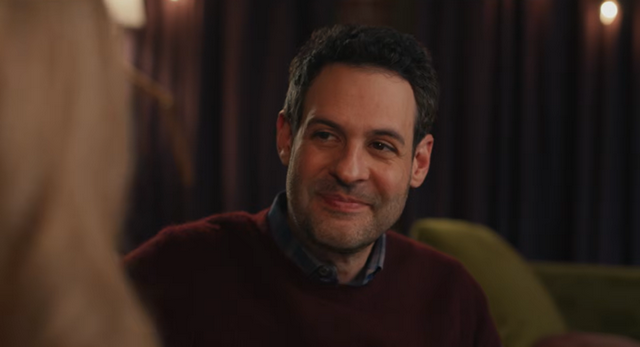
Leeds delivers a beautifully grounded performance, finding warmth and humor in Tim without reducing him to an impossibly perfect romantic ideal. Tim has boundaries. He possesses self-respect. He can forgive without being a pushover. And Leeds brings a natural ease to the role that makes Tim not only believable but enormously appealing.
His performance is among the film’s strongest assets, particularly because he never allows Tim’s kindness to become weakness.
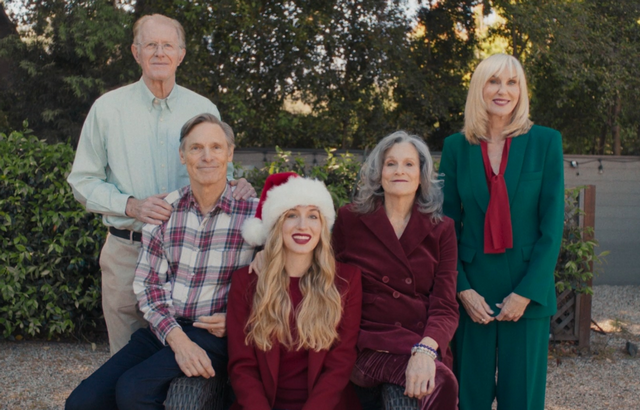
Equally entertaining are Lydia’s four parents, played by Ed Begley Jr., Nicholas Guest, Pamela Guest, and Rachelle Carson-Begley.
As Fred, Rick, Stella, and Cheryl, respectively, these four provide a wonderfully eccentric family dynamic, delivering some of the film’s most satisfying comedy through their interactions, conflicting opinions, and attempts to manage Lydia’s romantic disasters.
And unlike Lydia’s increasingly frantic behavior, their eccentricities are grounded in recognizable family relationships.
The chemistry among the four is unmistakable, helped enormously by their real-life connections. Nicholas and Pamela Guest are Elizabeth’s parents, while Ed Begley Jr. and Rachelle Carson-Begley are longtime family friends.
That familiarity translates into a comfortable comedic rhythm, whether the characters are planning an elaborate New Year’s Eve celebration, attempting to intervene in Lydia’s love life, or dealing with the seemingly simple task of preparing for a driver’s test.
The driving-test subplot is particularly amusing, offering a slice of generational comedy that is both relatable and delightfully understated.
Indeed, one could easily imagine an entire film built around these four characters. Their collective personalities, comic timing, and affectionate exasperation provide some of the most enjoyable moments in A VERY MERRY BREAKUP.
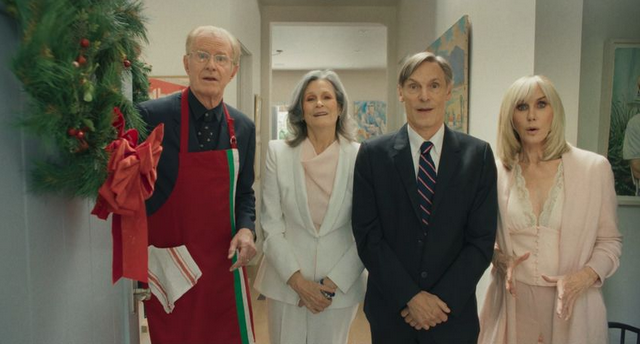
They are a welcome respite from Lydia’s romantic turmoil.
Another standout is Craig Bullock as Ryan, Lydia’s flamboyant, outspoken, and thoroughly entertaining best friend.
Bullock has an effortless way with a punchline, delivering his observations with a matter-of-fact confidence that makes even the most outrageous moments feel perfectly natural.
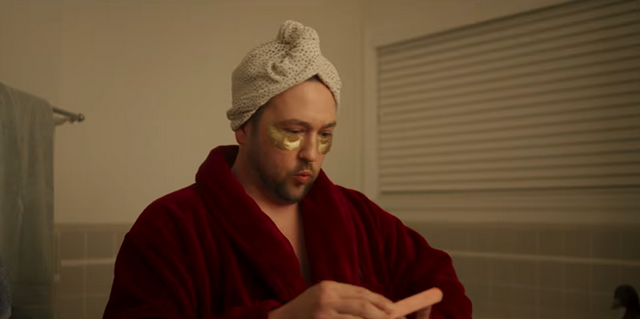
A scene in which Ryan chats with Lydia while tending to his nails and sporting under-eye masks is a particular delight. It’s an inspired bit of character comedy, relying as much on Bullock’s physical business and deadpan delivery as on the dialogue itself.
And when Ryan enters the New Year’s Eve festivities, Bullock again proves that a supporting character doesn’t need to dominate a scene to steal it.
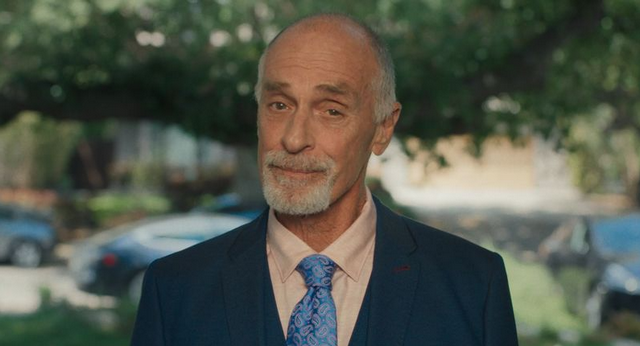
Guest also surrounds herself with an appealing collection of familiar faces, including Keith Carradine as Dr. Wagner, the late Robert Carradine as Bud, and Hayden Begley as Maggie. Their appearances contribute to the film’s lively ensemble atmosphere.
One of Guest’s strengths as a screenwriter is her ear for conversational dialogue. The exchanges among the parents, Ryan, and Tim have an easy, natural quality, with characters interrupting, teasing, challenging, and reacting to one another in ways that feel spontaneous rather than rigidly scripted.
There are some genuinely funny lines and situations throughout the film, and the generational satire is particularly effective.
The humor is strongest when Guest allows her supporting characters to simply interact, trusting their personalities and relationships to generate the comedy.
Visually, cinematographer Adam Baron-Bloch embraces a light, bright tonal bandwidth appropriate to the holiday setting and the film’s comedic sensibilities.
There is nothing unnecessarily elaborate about the visual grammar. Two-shots and medium compositions dominate, keeping the focus on character interaction and allowing the performances and dialogue to drive the storytelling.
Rather than calling attention to the camera, Baron-Bloch’s compositions provide an uncluttered framework for the comedy, particularly in scenes involving multiple characters. The approach is especially effective with the four parents, whose exchanges benefit from compositions that allow reactions and shifting relationships to play out within the frame.
But where A VERY MERRY BREAKUP truly finds its filmmaking strength is in the editing.
Editors Melanie Shaw and Josh Porro deserve considerable credit for giving the film its momentum, humor, and much-needed breathing room.
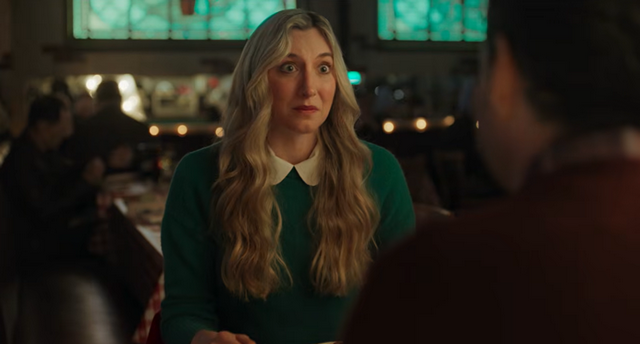
The montages are particularly effective, combining visual snippets, rhythmic cutting, and music to move Lydia through her romantic misadventures without becoming bogged down in endless dialogue or repetitive emotional crises.
These sequences do more than advance the story. They provide a welcome change of pace, injecting energy and humor while compressing time and allowing the audience to absorb Lydia’s increasingly complicated romantic circumstances.
Indeed, the editing frequently becomes the film’s saving grace. Shaw and Porro understand the value of timing, particularly in comedy, and their work helps maintain a brisk pace even when the screenplay becomes overly dependent on Lydia’s emotional agitation.
The montages have an almost music-video quality at times, but never at the expense of narrative clarity. Instead, they give the film a buoyancy that is essential to its holiday romantic comedy aspirations.
Working hand in hand with the editing is Nicholas Pike’s wonderful score.
Pike’s music does considerable heavy lifting throughout A VERY MERRY BREAKUP, providing emotional definition, comedic punctuation, and rhythmic support for the montages. His musical themes help distinguish the characters and their romantic circumstances, with Tim’s theme particularly effective in capturing the warmth and sincerity of Leeds’ performance.
The score also helps establish tonal distinctions between the various romantic entanglements, allowing the music to communicate emotional information that might otherwise require additional dialogue. And when paired with the montages, Pike’s compositions become an essential storytelling tool.
It’s a smart and effective collaboration between composer and editors, one that frequently elevates the material.
All of these elements come together during the elaborate New Year’s Eve celebration, one of the film’s most enjoyable sequences.
With a large ensemble, multiple character interactions, romantic complications, and an anniversary celebration all competing for attention, the sequence could easily become an unwieldy mess.
Instead, Guest, Baron-Bloch, Shaw, Porro, and Pike create an energetic convergence of comedy and character.
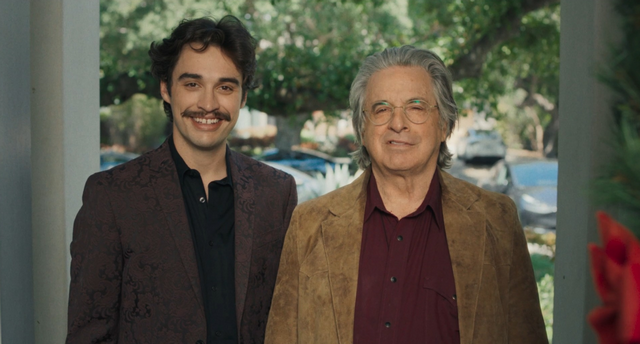
The four parents are particularly entertaining amid the festivities, their personalities bouncing off one another while Lydia’s romantic predicament moves toward its inevitable reckoning. The sequence benefits enormously from the ensemble’s comedic instincts and the editors’ ability to juggle multiple interactions without losing the momentum.
It’s also a reminder of what A VERY MERRY BREAKUP does best: allow its supporting characters to shine.
Ultimately, the film presents an intriguing contradiction.
Guest has created a romantic comedy filled with appealing characters, amusing dialogue, strong performances, and genuinely effective filmmaking craftsmanship. Her affection for the material and the people involved is evident, and there is a personal authenticity to the story’s exploration of romantic insecurity and fear of commitment. But that affection doesn’t necessarily translate into affection for Lydia.
The film asks us to accompany a woman on a journey toward emotional self-awareness, yet her repeated missteps and relentless anxiety make it difficult to remain invested in her romantic happiness.
There is an important distinction between finding a character’s behavior believable and finding that character compelling. Lydia’s behavior may be entirely recognizable to anyone who has encountered a chronically indecisive romantic partner, but recognition alone is not enough to sustain audience empathy.
And while Guest’s screenplay offers a welcome reversal of the traditional commitment-phobic romantic comedy, the reversal doesn’t eliminate the need for a protagonist whose emotional journey invites us to care.
Still, there is considerable enjoyment to be found in A VERY MERRY BREAKUP.
Andrew Leeds is terrific. Craig Bullock is a comedic delight. Ed Begley Jr., Nicholas Guest, Pamela Guest, and Rachelle Carson-Begley are worth the price of admission all by themselves. The editing is clever and energetic, the score is an absolute asset, and the holiday atmosphere provides an appealing backdrop for the romantic and familial shenanigans.
If only Lydia were as easy to love as the people surrounding her.
A VERY MERRY BREAKUP may test your patience with its leading lady, but thanks to an engaging supporting ensemble and some genuinely accomplished filmmaking, there’s still plenty of merry to be found amid the break-up.
Written and Directed by Elizabeth Guest
Cast: Elizabeth Guest, Andrew Leeds, Ed Begley Jr., Pamela Guest, Nicholas Guest, Rachelle Carson-Begley, and Keith Carradine
A VERY MERRY BREAKUP is available on Prime Video, AppleTV and Fandango At Home on November 3rd.