By debbie lynn elias
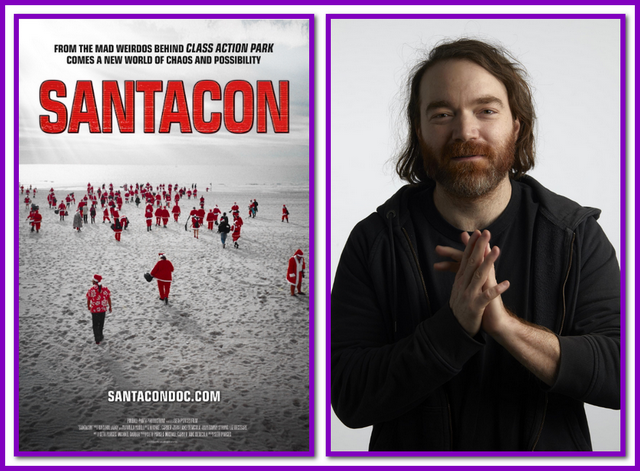
For many New Yorkers, SantaCon conjures images of streets filled with intoxicated revelers dressed in red suits, overflowing bars, and holiday festivities that have gone decidedly off the rails. But long before SantaCon became synonymous with seasonal excess, it began as an unconventional gathering of pranksters and performance artists in San Francisco during the 1990s. That earlier incarnation, and the people responsible for it, form the foundation of writer/director Seth Porges’ documentary SANTACON.
Drawing on decades-old home movies, archival recordings, and contemporary interviews with original participants, Porges traces the event’s beginnings within the countercultural world of the Cacophony Society and its eventual transformation into something its creators no longer recognized.
For Porges, whose previous documentary work includes Class Action Park, the journey began not with an extensive historical investigation but with an unexpected conversation in a bar.
“All I knew about SantaCon was the same thing everybody who’s ever lived in New York knew about SantaCon or knows about SantaCon, which is this is the worst day of the year,” Porges explained during our exclusive conversation. “If you see more than a couple Santas, you better cross the street lest you end up, you know, on the wrong side of a fist or vomit or police handcuffs or whatever it is.”
That perception changed when Porges encountered his friend Scott Beal, who had participated in SantaCon’s early years and possessed videotapes documenting those gatherings.
“He started telling me how it used to be this totally different thing, and I had no idea what he was talking about. He told me he and his friends had been there in San Francisco in the ’90s and started it, and it turned into this other thing, and they saw it basically mutate in front of their eyes.”
Beal also described connections between those early participants, Burning Man, and the countercultural activities that helped inspire Chuck Palahniuk’s Fight Club.
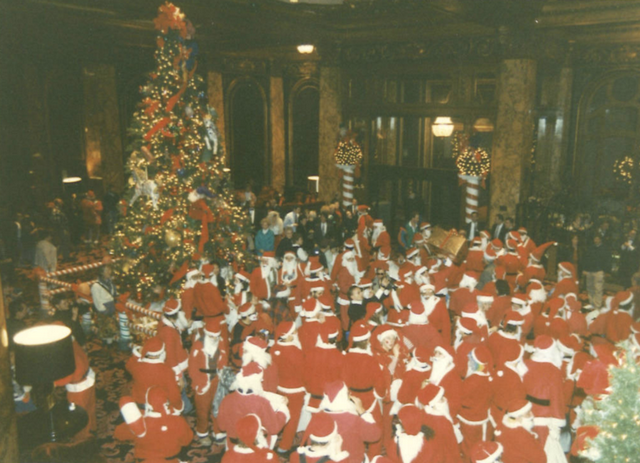
“And then he told me that he had personally videotaped many of the early years in the ’90s, and he still had this footage, and he just offered to show it to me. And when I saw his home movie footage, I was just taken back in time to this other time, this other place, and just filled with these emotions, and I just felt the need to make this movie.”
LETTING THE ARCHIVAL FOOTAGE LEAD THE WAY
With Beal’s tapes providing an initial visual record, Porges began the process of locating additional participants, identifying other archival sources, and determining how the existing footage could be used to construct the documentary.
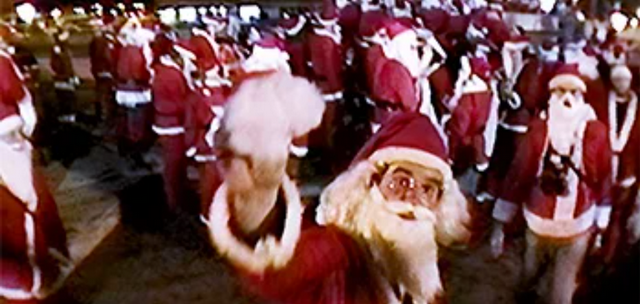
Rather than begin with a predetermined visual template, he allowed the recordings themselves to guide much of his approach. “I let the footage guide us. You know, we had all these people telling us all these incredible stories, but this isn’t the kind of movie that has recreations or animations or other things, and you don’t want to fall into the trap of having these kind of campfire apocryphal stories being told without visual evidence.”
For Porges, the archival recordings offered something that newly staged material could not. “The truth is that when you’re making a documentary like this, there’s no greater production value than the reality of archival footage.”
But identifying usable material among hours of unstructured home movies presented its own challenges.
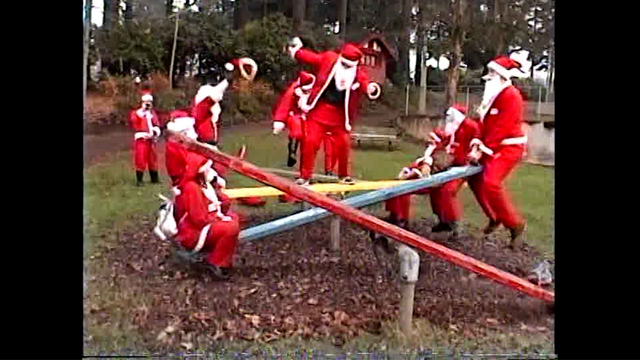
“When you have this chaos of somebody just carrying a camcorder around a city 30 some years ago, a lot of what you’re pulling is unintelligible as a scene. It’s a camera being whipped around frantically, and then things pause, and you see a scene play out in front of you, and sometimes those scenes feel like cinema.”
Once Porges identified those moments, he used the footage as a starting point for his conversations with the people who had participated in them. “I show those to the sources to refresh their memories, and I asked them, ‘What were you thinking? What are you remembering now that you’re seeing?’ I did everything I could to just sort of prompt their memories and take them back in time, so that whatever they were feeling or thinking when everything was going down, I could help them remember decades later.”
The resulting documentary is built around that interaction between images recorded in the moment and recollections offered years afterward.
FOLLOWING THE CAMERAS AND FINDING THE PEOPLE
Porges’ background in journalism became particularly useful as he pursued additional footage and interview subjects.
“There’s nothing I love more than just taking a subject and starting from zero and finding out who are the key people involved, what materials, footage, archives exist, just what is the universe out there that can help us tell the story.”
Beal provided introductions to several original participants, but Porges still needed to establish relationships with people who had long since distanced themselves from SantaCon.
“You’re dealing with people who have been, in many cases, unwilling to talk about SantaCon for some decades due to what it’s become and the reputation it’s developed, and they’re not exactly proud of being involved with this thing that changed after they left it.” Among them was Rob Schmitt, whom Porges identifies as the person who conceived the original SantaCon gathering.
“In some cases, such as Rob, the guy who actually came up with the idea of SantaCon, people warned me they probably wouldn’t talk. Until a couple years ago, he was anonymous about his role in SantaCon.”
For Porges, gaining access required more than simply requesting an interview. “You enter the trust-building phase. You get on a plane and you spend time with people, and you try to go in with an open mind and you try to ask them what the story actually is about.”
Ultimately, nearly everyone he hoped to interview participated, although the production also encountered the passage of time in a particularly poignant way. One principal participant died only weeks after being interviewed, an event Porges says affected the documentary’s eventual direction.
The archival investigation, meanwhile, took on an additional dimension when Porges began examining the footage for evidence of other people recording the same events.
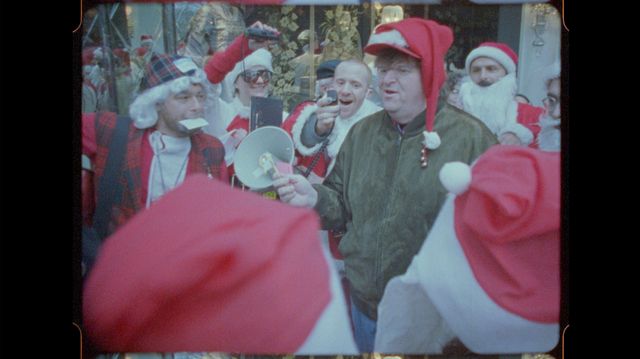
“I’d look at some of the archival tapes, and I’d be basically looking for other Santas in the background in frame who were filming it also, freeze-framing it, and then going down this investigative rabbit hole, trying to figure out who is that Santa who’s also filming these same events.”
Identifying another camera operator was hardly straightforward when everyone wore similar costumes and artificial beards. Nevertheless, the search occasionally yielded footage of the same incident from different perspectives.
“That led to some incredible finds that allowed us to show some scenes from more than one camera. It made it feel very cinematic, having effectively coverage with multiple people shooting the same scene 30 years ago and us stitching it together into a single scene.”
One discovery involved 16mm footage of the 1998 New York gathering photographed by filmmaker Harrod Blank, son of documentary filmmaker Les Blank. For Porges, locating those additional images expanded the possibilities of assembling scenes from recordings never intended to become parts of a single documentary.
PRESERVING THE LOOK AND FEEL OF THE PAST
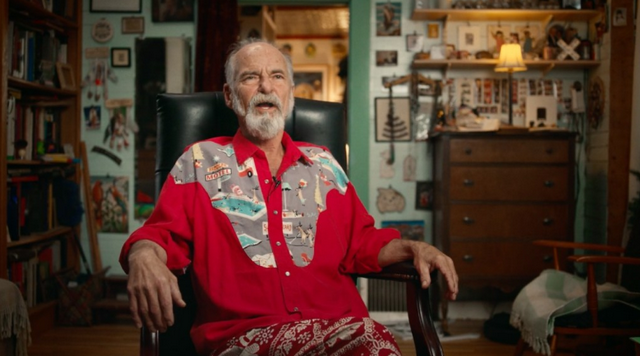
One of the documentary’s most distinctive visual characteristics is the contrast between its contemporary interviews, photographed by cinematographer Jake DeNicola, and the rougher texture of the original home movies. Rather than attempt to make decades-old VHS recordings look newly photographed, Porges deliberately preserved their visual imperfections.
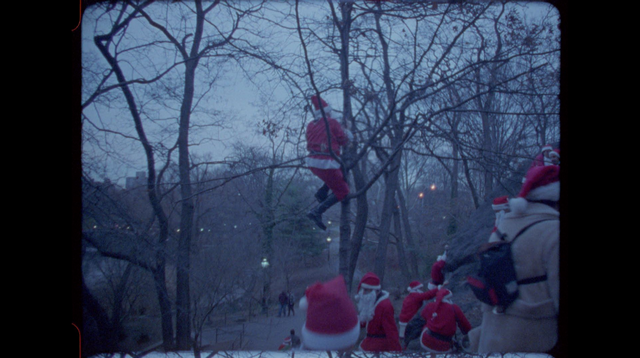
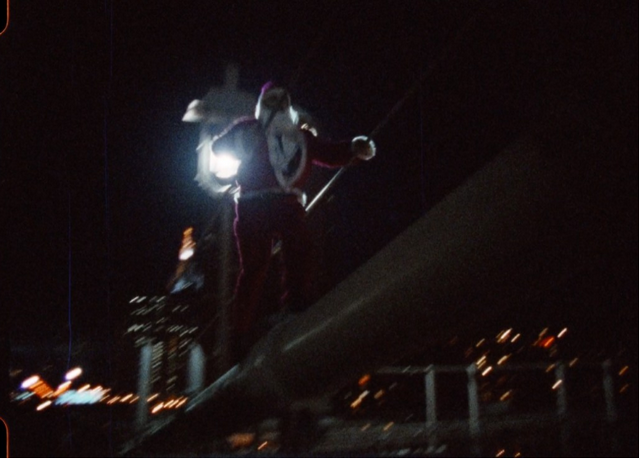
“I personally love how real the footage feels. I think there’s something about the grain and the tracking lines of vintage media that just takes you back in time. It really, really does. I had no interest in smoothing out those edges.”
That philosophy extended to the 16mm footage, where the physical characteristics of the film itself remain visible. “You can see the sprocket and the burn lines when the reel literally runs out in front of your eyes.”
Although the production performed some technical work on the archival recordings, Porges distinguishes those efforts from extensive visual restoration.
“The hardest thing we had to do was clean up the audio at times because none of these people were mic’d. You’re dealing with the on-camera mic on a VHS camera while 50 Santas are shouting and screaming over traffic and noise and everything like that.”
Subtitles were employed when necessary, along with some color grading. But Porges was equally impressed by the camerawork of the original participants, who often captured material with a degree of visual awareness that proved useful decades later.
“They’re doing exterior shots before they go into a venue. They’re doing establishing shots. They’re picking interesting camera angles. They’re asking people to quickly talk to them on camera about what’s going on and sort of setting the stage for what’s about to happen.”
He describes the experience of working with those recordings as a collaboration across generations. “They are my creative collaborators on this project in a very real way. They just didn’t know it at the time when they were shooting the footage.”
KEEPING TRACK OF THE SANTAS
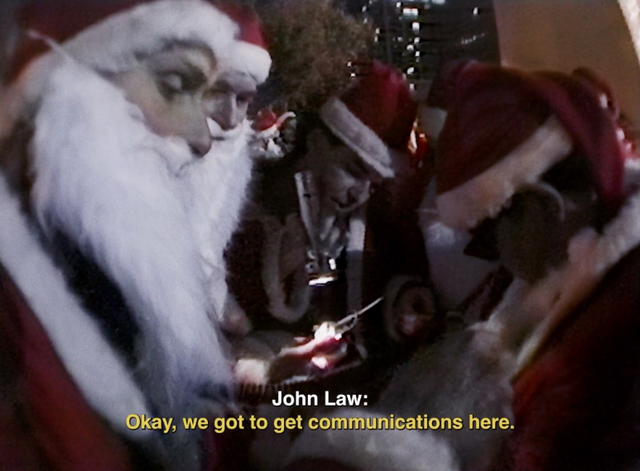
The documentary’s visual construction presented another practical challenge: helping viewers distinguish among people who, in the archival footage, often appear virtually identical.
“I had watched the footage so many times that I could tell you who many of these Santas were on sight even though they’re all wearing basically identical costumes. But somebody that’s jumping into this movie isn’t going to know who these different Santas are just by looking at them.”
The filmmakers addressed that problem through repeated on-screen identification and careful transitions between the historical recordings and contemporary interviews.
“We were very, very conscientious about making sure that you could follow who these people were, especially as you shift between the timelines of the past and the present, and making sure you can fully realize that this is the same person you’re seeing in this footage back in the past as you’re seeing in the interview in the present.” Sometimes the challenge was created by the interview subjects themselves.
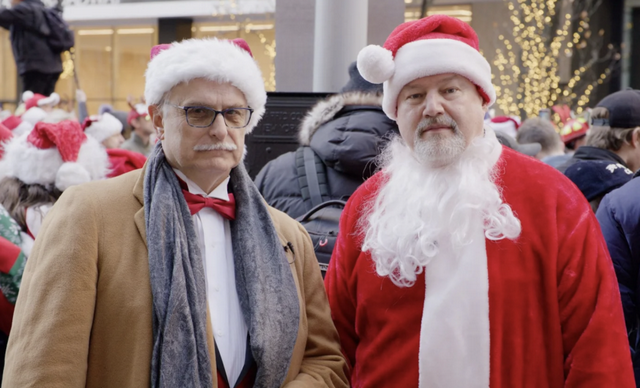
John Law, one of the documentary’s principal participants, shaved his substantial beard between interviews, creating confusion among viewers of early cuts. Porges and his collaborators responded by incorporating a humorous explanatory lower-third identifying Law as the same person despite his changed appearance. It was a small editorial solution to a larger problem of visual continuity, and one that fit the documentary’s irreverent subject matter.
MICHAEL GARBER: MORE THAN AN EDITOR
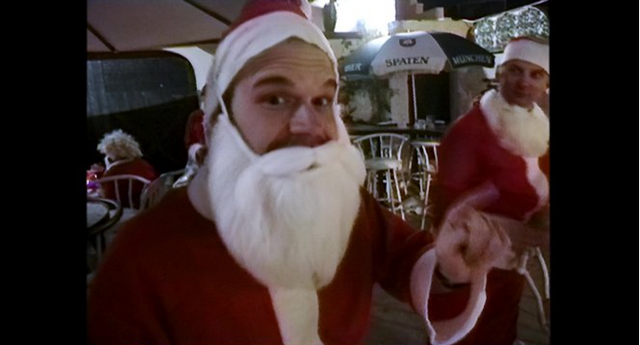
Central to the documentary’s production and post-production was Michael Garber, whose responsibilities extended well beyond editing. “If you look at the credits for this film, Michael Garber’s name appears multiple times. He was my secret weapon to make this film.”
The contemporary interview crew consisted of only three people: Porges, cinematographer Jake DeNicola, and Garber, who handled assistant camera duties and field sound recording in addition to his editorial responsibilities.
Porges had previously worked with Garber on Class Action Park and valued their established creative relationship. “He knows what we want. He understands everything we’re doing, and in many ways he’s sort of my co-author of this film.”
Having Garber present throughout the interviews was an intentional production decision.
“We realized that if he’s there with these people, gets to know them both what’s on camera, but then also behind the scenes, like just hanging out with them, doing all of these things, by the time we go in to actually edit it, he knows the story in and out. He knows the interviews in and out. He knows the characters in and out.”
That familiarity gave Garber a direct understanding of the personalities and material before the editing process began.
For Porges, the arrangement offered a considerable advantage over handing an editor an unfamiliar collection of recordings and asking that person to discover the story independently. “This movie doesn’t exist without Michael, is the truth.”
A DOCUMENTARY ABOUT MEMORY, FRIENDSHIP, AND CREATIVE LIVES
Although SantaCon’s public reputation provided the documentary’s starting point, Porges ultimately found himself drawn to the personal histories of its original participants.
Unlike some of his previous projects made with streaming platforms, SANTACON was a smaller, more personal undertaking. “This was a movie that was a couple friends getting together and saying, ‘Let’s do this,’ and that felt necessary because of what the movie was about.”
The experience also reinforced his understanding of the commitment required to make a documentary.
“Anytime you make a documentary, you’re basically giving yourself up to a couple years of living in somebody else’s world, and you have to be careful about what projects you choose because that can be consuming and that can be very emotionally intense.”
But the lasting impression was less about SantaCon as an event than about the people he encountered and the lives they had created. “Anytime I make a movie, I feel like I walk away a different person from when I entered into the project.”
For Porges, the documentary became a reflection on creativity, friendship, and the passage of time.
“This to me was a movie about what it means to live a good life, what it means to live a creative, fun life with your friends, and what it means to look back at your life and be able to say you have no regrets.”
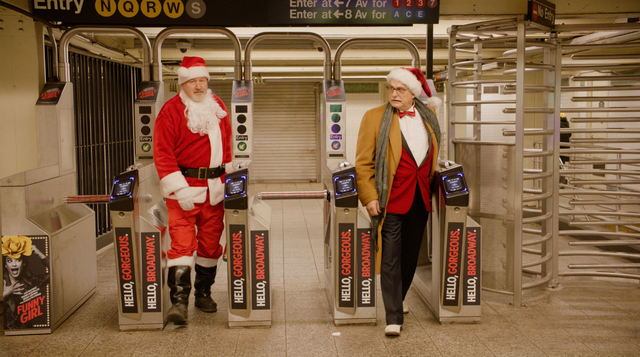
Spending time with the original participants, both in person and through the recordings of their younger selves, left him with what he describes as inspiration and gratitude. And while Porges accompanied the original organizers on their return to SantaCon for the documentary, he has little enthusiasm for making the event an annual tradition of his own.
“I spent my whole life avoiding SantaCon,” he laughed, explaining that he had already broken a promise never to return when a journalist subsequently invited him to attend.
Still, there may be one concession to the season. Asked whether he would appear in Santa attire for the documentary’s online premiere Q&A, Porges offered a modest commitment. “I’ll definitely have a hat on.”
For a filmmaker who spent years investigating the origins of an event built around hundreds of Santa suits, perhaps one Santa hat is quite enough.
exclusive interview 11/20/2026
SANTACON is scheduled for a December 2 theatrical release, followed by an online premiere December 13 and digital availability December 18.