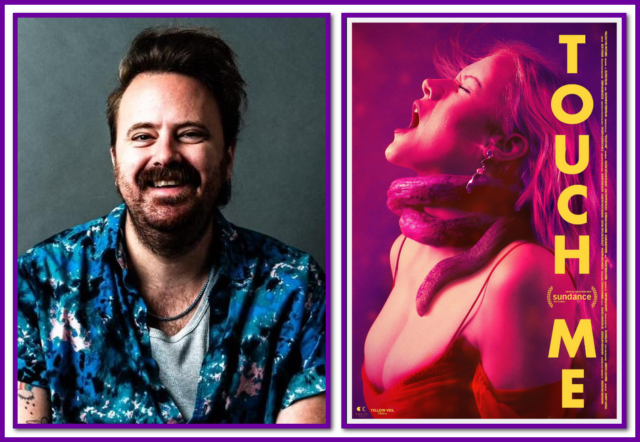
SYNOPSIS: A wacky, wild, sensual homage to Japanese exploitation films, TOUCH ME tells the story of two cringe millennials, Joey and Craig, who do everything in their power to do absolutely nothing. Of course they have capital “T” childhood trauma, but so does everyone, so like, judge them however you like. Seriously, JUDGE THEM. One regular day, Joey’s super-hot alien ex, Brian, comes back into town begging for her to forgive him and come back to his desert mansion for the weekend. With nothing better to do (and also a pretty unfortunate sewer explosion in Craig’s house), the two trepidatiously accept. Also, the fact that Brian’s slimy sexual tentacle appendage removes anxiety and depression may help solidify their decision. But at the house, under Brian’s veneer of healing is a sinister plot filled with murder, mayhem, and blood. Then again, maybe they can all get along in the most glorious throuple you’ve ever seen.
Written and directed by ADDISON HEIMANN, TOUCH ME stars Olivia Taylor Duffy, Jordan Gavaris, Lou Taylor Pucci and Marlene Forte.
*****
Some films announce themselves politely. TOUCH ME kicks down the door, slithers across the floor, wraps a tentacle around your brain, and dares you to keep up.
Written and directed by Addison Heimann, TOUCH ME is a gleefully strange psychosexual horror-comedy that fuses Japanese exploitation influences, practical creature effects, alien eroticism, and a surprisingly incisive exploration of trauma, depression, addiction, and co-dependent friendship. It is, by any measure, one weird film. But it is also beautifully constructed, emotionally grounded, and visually thrilling in ways that make its wildest swings feel not only deliberate but necessary.
For Heimann, that balance between outrageous surface and deeper emotional core was never accidental. In fact, it was the whole point.
After making his first feature, Heimann says he found himself in another profound depression, a struggle that naturally worked its way into the DNA of his next story. “All my movies kind of have to deal with stories about mental illness,” he explains, “and how to overcome it, or what we do to kind of numb the pain.” In the case of TOUCH ME, that pain relief comes in the form of a seductive alien ex named Brian, whose slimy tentacle appendage offers euphoric release from anxiety and depression — at least temporarily.
The spark for the film came from an unusual combination of personal darkness and cinematic inspiration. Heimann cites The Untamed, the Mexican film about a tentacled creature that offers pleasure and transcendence, as an important catalyst. “I was like, ‘I want that so bad,’” he says with a laugh. At the same time, he had been deeply immersed in Japanese cinema for years, studying everything from Kurosawa to Japanese exploitation films of the 1960s and 1970s, to modern J-horror. Those influences became the ideal lens through which to tell a story this strange.
What Heimann found especially compelling in that body of work was its tactile quality and willingness to embrace theatricality and artifice. “You feel like you can touch it,” he says, describing the visceral physicality of those films. He was drawn to their “Kabuki theatrical style storytelling,” and to the way their deliberate stylization could still produce something grounded, emotionally resonant, and surprisingly human.
So when he began shaping TOUCH ME, Heimann knew he had to go all in. “If I was going to make a movie about tentacle fucking that is a metaphor for trauma,” he says, “I needed to swing for the fences, because I was only ever going to get one chance to do something this wild.”
That willingness to swing is precisely what makes the film work. Beneath the absurdity and blood and bodily fluids, TOUCH ME is rigorously built around emotional themes that feel painfully recognizable. Joey and Craig may be cringe millennials stuck in arrested development, but Heimann never treats them as jokes. Their addictions may take different forms — drugs, sex, emotional dependence, fantasy, self-destruction — but they are all rooted in pain, loneliness, and the desperate search for relief. The alien tentacle may be outrageous, but what it represents is all too real.
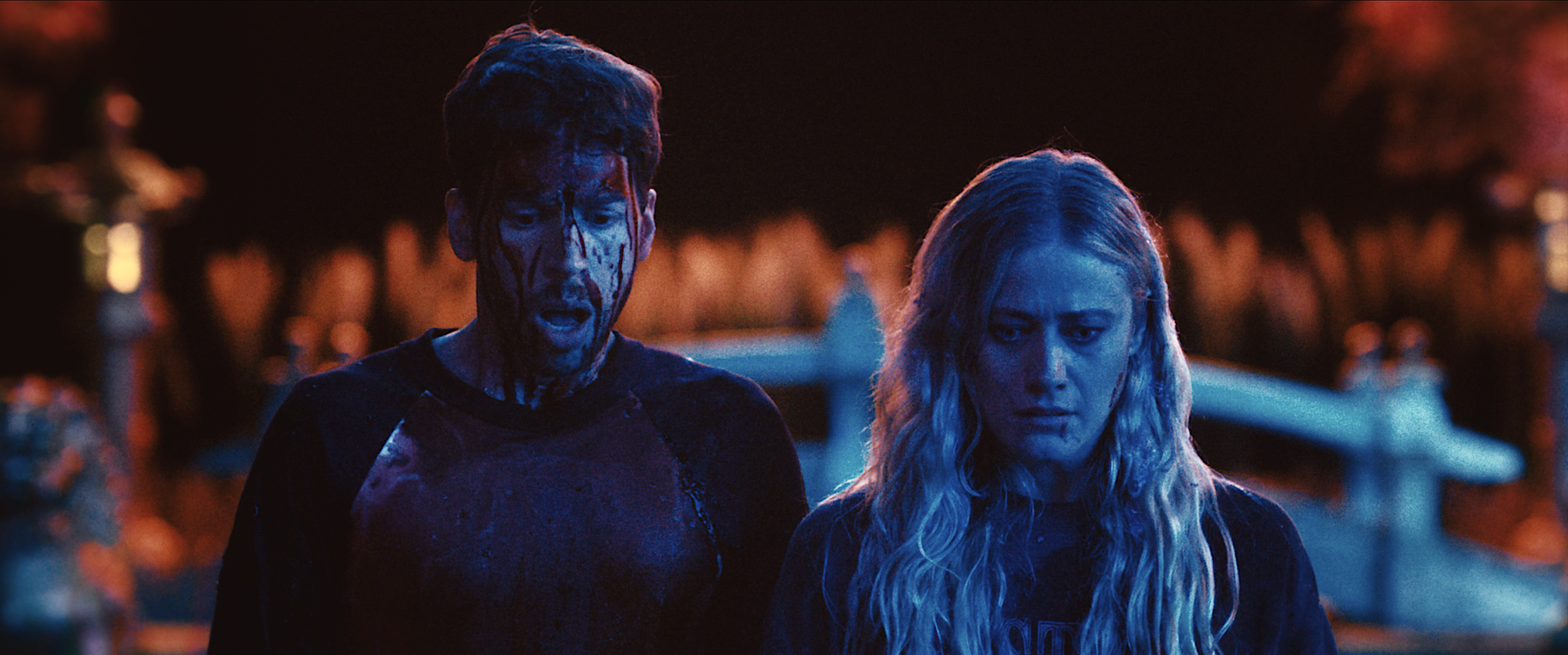
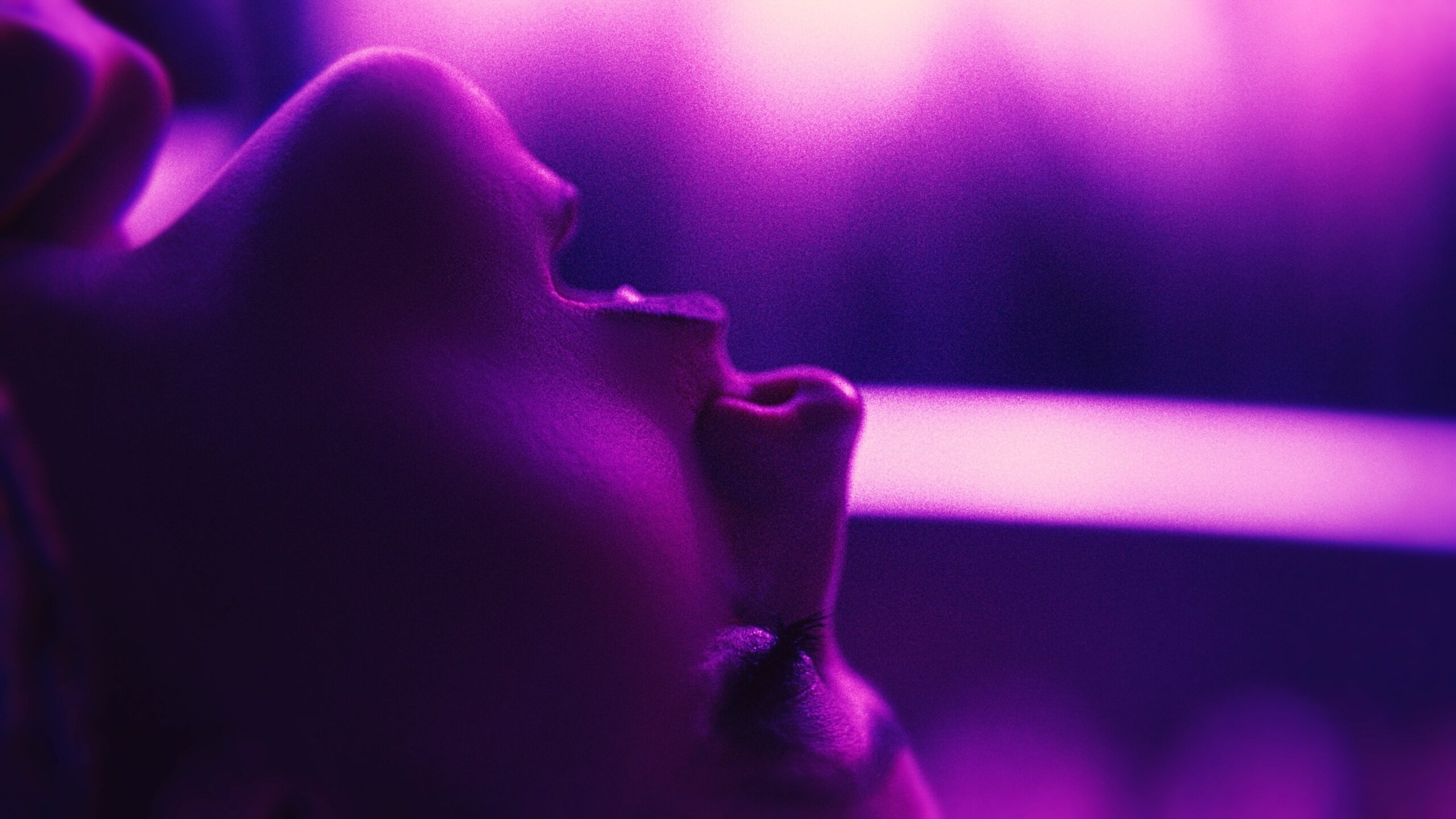
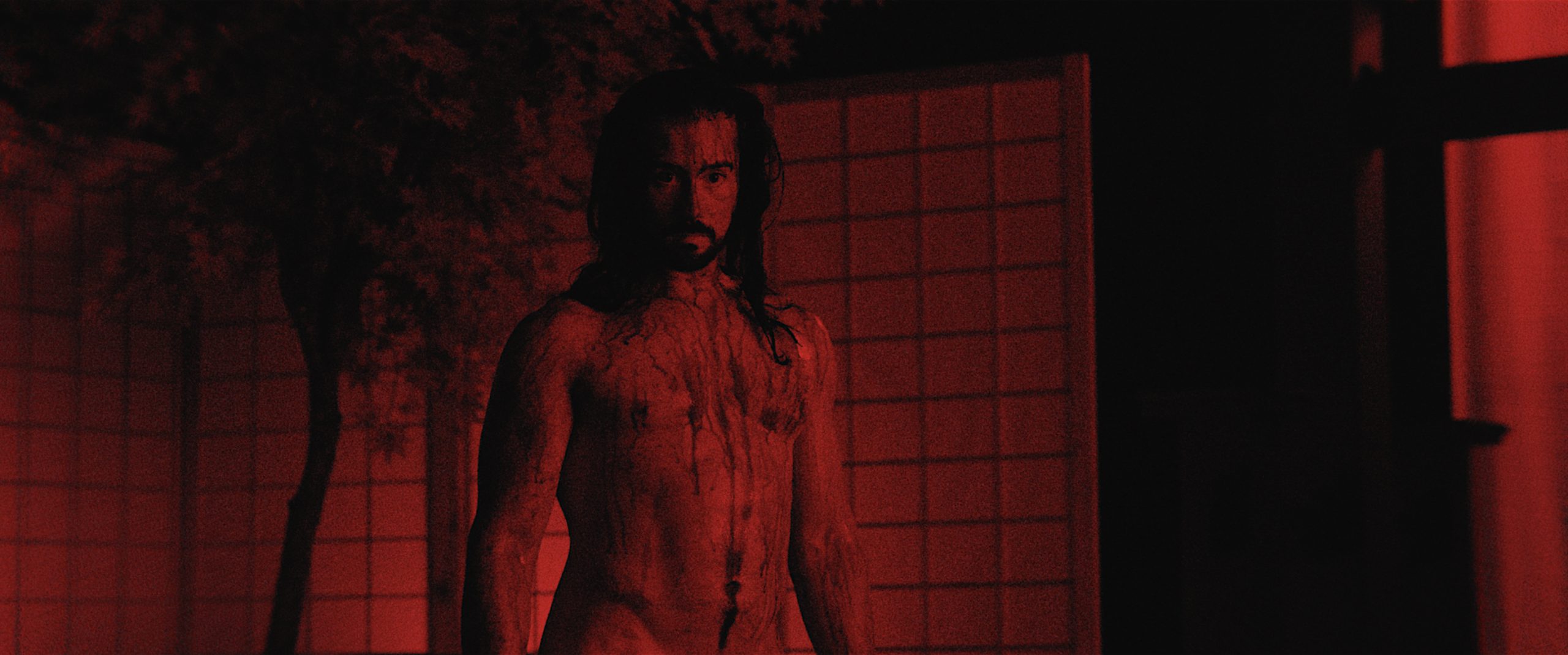
Visually, Heimann and cinematographer Dustin Supencheck created a film language as layered and contradictory as the characters themselves. The result is one of the most striking aspects of TOUCH ME: a visual grammar that moves fluidly between concrete modern interiors, theatrical stylization, Japanese cinematic homage, dreamy distortions, and stark, almost diagrammatic compositions.
Heimann approached that process with extraordinary specificity. He and Supencheck built the visual world not only from films that inspired him, but from specific shots, textures, and visual motifs he wanted to honor. “There’s probably like 20 or 30 homages to Japanese cinema in there,” he notes. But homage was only the starting point. The real challenge was how to synthesize all of those references into something cohesive.
One of the biggest creative decisions involved aspect ratios. Heimann and Supencheck struggled with how to visually separate the film’s distinct storytelling modes — the intimate, real-world relationship dynamics; the more overtly theatrical and exploitative sequences; and the black-and-white noir-inflected passages. Eventually, they decided to lean into the contrast rather than smooth it out. “These are two different worlds,” Heimann says. Once they embraced that idea and used changes in visual framing to reflect changes in tone and storytelling mode, “things started to click.”
That philosophy extended to lenses and in-camera effects as well. Heimann wanted a film where every color of the rainbow would appear. Supencheck responded by helping invent a visual landscape full of custom distortions and practical effects. “We had multiple lenses that were not like real lenses,” Heimann says. “They were created specifically for the movie.” Some produced rainbow flares, others crystal-like distortions, others blurs and textural shifts that gave the film its ethereal, heightened quality. It is the kind of ingenuity that recalls old Hollywood tricks — practical, tactile, handmade, and proudly visible as artifice.
That handcrafted quality is key to the film’s charm. The world of TOUCH ME feels designed rather than merely photographed. The concrete modernist house with its rounded hallways and UFO-like architecture becomes a source of visual tension in itself, its curves suggesting that something could emerge from around any corner. Heimann and Supencheck exploit those spaces beautifully, using slow Steadicam movements and creeping compositions to generate dread. In contrast, the more stylized settings — the crystal-centered rooms, the perfect symmetry, the carefully arranged objects — evoke the precision of theatrical staging and Japanese visual design. Together, those contrasting environments create a visual bandwidth that is constantly shifting between naturalistic unease and heightened fantasy.
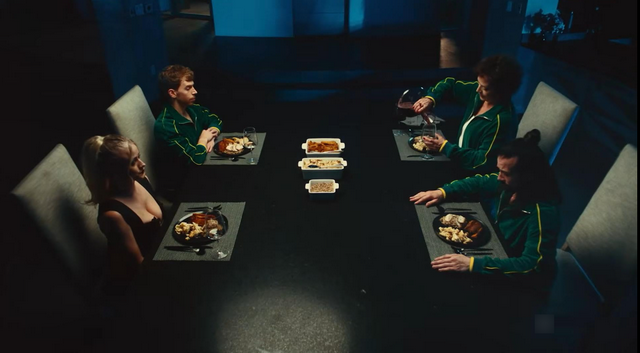
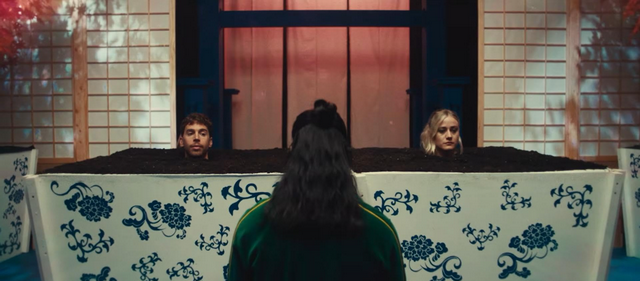

Heimann is candid about how difficult that balancing act was in the edit. “It was really a cool math problem,” he says, “to discover how much is too much and how much is too little.” By the end of the film, when split screens, dance montages, severed heads, spraying blood, and outrageous creature effects all collide, the audience has already been gradually acclimated to the film’s escalating language. What might have felt overwhelming early on instead feels earned.
That escalation was especially tricky in the opening stretch, where the film had to establish its emotional stakes and tonal rules before it could fully cut loose. Heimann describes the sequence after the opening monologue as the hardest part of the film to edit, precisely because the balance had to be so exact. Too much absurdity too soon and the audience would disengage; too little and the film would lose its identity. It is one of the reasons the opening monologue works so well: it lays out the emotional and thematic groundwork early, clearing the way for the visuals to take over.
Casting was equally crucial. Heimann knew from the start that TOUCH ME could only work if the actors were fully, fearlessly on board. “You can’t write a script like this and expect that everyone’s going to want to do it,” he says. In fact, he eventually realized that the more specific and unapologetic he was about the kind of film he wanted to make, the easier it became to find the right collaborators. “You’re looking for the freaks who would say hell yes.”
That clarity paid off in a cast that seems perfectly attuned to the film’s frequency. Olivia Taylor Dudley brings Joey a vulnerability and volatility that make her both frustrating and deeply sympathetic. Jordan Gavaris turns Craig into a maddeningly funny, painfully recognizable portrait of emotional dependence. Lou Taylor Pucci, meanwhile, gives Brian exactly the strange, seductive, faintly off-kilter energy the role requires.
Interestingly, Pucci was not the obvious choice on paper. Heimann says the part had originally been written for “an older, attractive, suave gentleman in his 50s.” But once he sat down with Pucci, he realized he had found something better: not the superficial type, but the essence of the character. Pucci, Heimann recalls, was not especially concerned with the film’s tonal shifts. Instead, he wanted to discuss the science-fiction logic behind the alien mechanics. “I was actually getting ready to defend my movie,” Heimann says, laughing. “And he was like, ‘Yeah, I just want to understand how the pods work.’” That, Heimann knew, was his guy.
The same instinct guided the rest of the cast. With Olivia Taylor Dudley, it was a long conversation about OCD that made Heimann realize she was exactly right for Joey. With every actor, the real question was not just whether they could perform the role, but whether they could meet the material at its own strange frequency. “What I needed to know,” he says, “is in their soul, were they as strange as me?”
Once he found that ensemble, Heimann says the directing itself became less about correction and more about support. “I had to do very little directing,” he explains. For him, the job was to build the structure solidly enough that the actors could live freely inside it. “It’s a film by us. It’s not a film by me.”

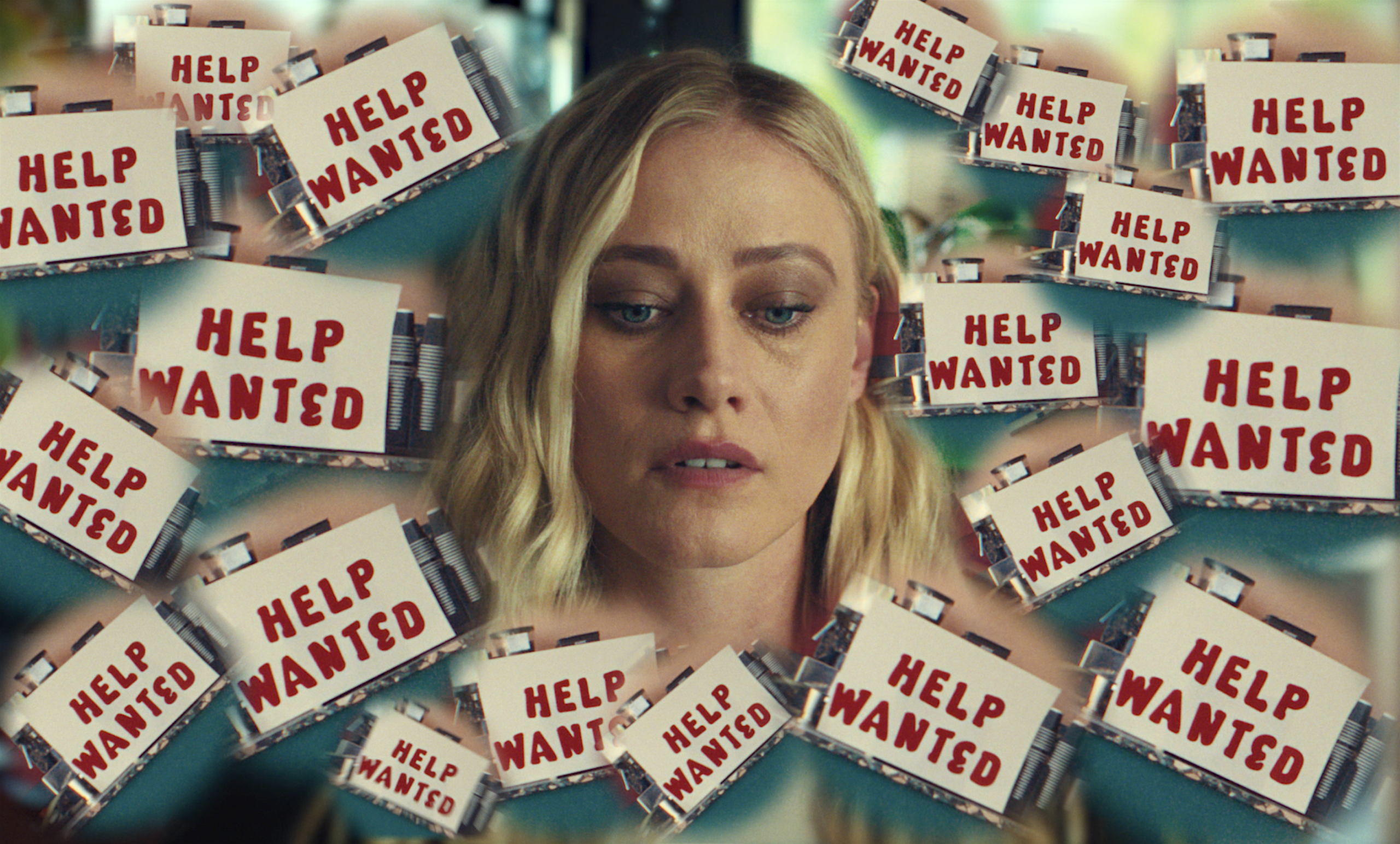

That collaborative spirit comes through in every frame of TOUCH ME. As chaotic and bizarre as the film appears on the surface, there is a clear architecture underneath it — emotional, visual, tonal, and thematic. Heimann knows exactly what he is doing, even when what he is doing involves alien tentacles, dance sequences, black-and-white noir riffs, and enough practical effects mayhem to leave his actual car totaled in the process.
And perhaps that is the film’s greatest achievement. TOUCH ME embraces excess, weirdness, and outrageousness without ever losing sight of the human pain at its center. It is a film about wanting relief so badly that you’ll take it in any form offered, even if that form is dangerous, delusional, or monstrous. It is about trauma, codependence, arrested development, and the seductive lie that maybe the thing hurting you is also the thing healing you.
With TOUCH ME, Addison Heimann delivers a film that’s unapologetically weird, visually daring, and emotionally grounded in ways you might never expect from a movie about alien tentacle therapy. It’s bold, inventive, and proof that sometimes the most outrageous genre concepts can say the most about the human condition. One thing’s for sure—whether you come for the spectacle, the satire, or the strange emotional honesty underneath it all, TOUCH ME is not a film you’ll soon forget. It is also, quite simply, a blast.
Heimann is already thinking ahead. “I’m not stopping,” he says. “I will continue to make movies for the weirdos like me.” On the evidence of TOUCH ME, that is very good news indeed.
by debbie elias, exclusive interview 03/05/2026
TOUCH ME is Exclusively in NY on March 20, 2026, in Limited Theaters on March 27, 2026, and On Demand and Digital April 2, 2026