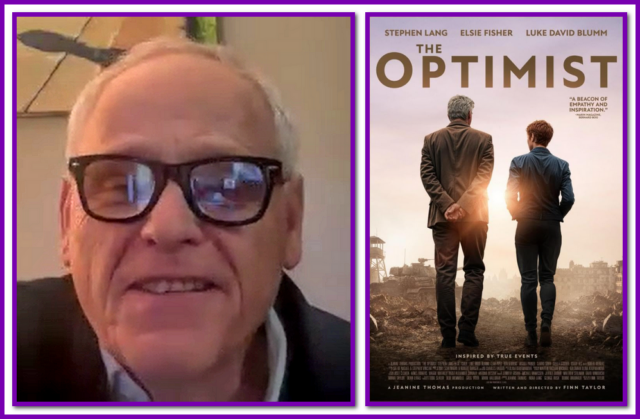
An exclusive interview with writer/director FINN TAYLOR discussing THE OPTIMIST: THE BRAVEST ACT IS TRUTH, based on the true story of Holocaust survivor Herbert Heller.
SYNOPSIS: Set against the majestic landscapes of Northern California, THE OPTIMIST centers on the unexpected bond between an ailing Holocaust survivor and a troubled teen. For more than sixty years, Children’s store owner Herbert Heller (Lang) has lived with the weight of the horrors he endured as a 15-year-old imprisoned in Terezin and Auschwitz. As illness forces him to confront the silence he has kept—even from his own family—he forms a surprising friendship with Abbey (Fisher), a teenager navigating her own emotional fractures. Through their growing connection, Herbert is inspired to finally share his truth, opening a path toward empathy, forgiveness, and renewal.
Written and directed by Finn Taylor, THE OPTIMIST stars Stephen Lang, Elsie Fisher, Luke David Blumm, Leah Pipes, Ben Geurens, Ursula Parker, Slavko Sobin, Stella Stocker, Oskar Hes, and Robin Weigert.
**********
There are films that tell history, and then there are films that bear witness to it. Finn Taylor’s THE OPTIMIST does both. Anchored by a deeply affecting performance from Stephen Lang and a remarkable turn by young actor Luke David Blumm, the film brings to life the true story of Holocaust survivor Herbert Heller, tracing both the horrors he endured as a teenager in Terezin and Auschwitz and the unexpected healing he finds decades later through an unlikely friendship with a troubled teenager.
What emerges is a film of striking emotional scope—one that moves fluidly between past and present while exploring trauma, memory, compassion, and the enduring resilience of the human spirit.
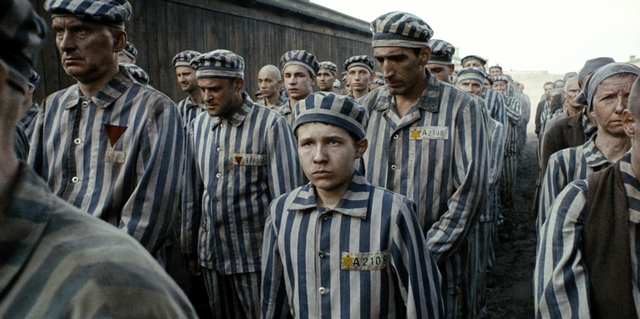
For Taylor, the responsibility of telling Heller’s story was never taken lightly. And from the moment audiences begin watching THE OPTIMIST, it’s clear the film has been carefully crafted to honor both history and humanity.
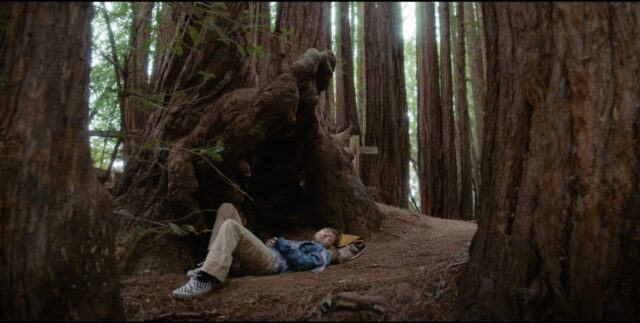
“I want to give kudos to a couple people,” Taylor said when discussing the film’s striking visual approach. “We realized it was best to shoot in Europe as well as the United States, because where Herbert lives, the redwood trees are magnificent and have a completely different look than Auschwitz. They’re a great contrast.”
That contrast—between Northern California’s towering redwoods and the stark landscapes of Nazi-occupied Europe—forms the visual and emotional backbone of the film. Cinematographers Antonio Riestra and Alexandra “Sasha” Czurko each brought distinct visual sensibilities to the project, shaping the contemporary and historical timelines differently.
In the present-day sequences, Taylor and Riestra leaned into a more intimate style, occasionally using handheld camerawork to capture Herbert’s vulnerability and anxiety as he begins to share the story he kept hidden for decades. “When Herbert is first being interviewed and he’s totally nervous, we went for more of a handheld feel there,” Taylor explained. “To show his fear—his nervousness about being interviewed.”
For the European sequences depicting Herbert’s youth, the filmmaking approach shifted dramatically.
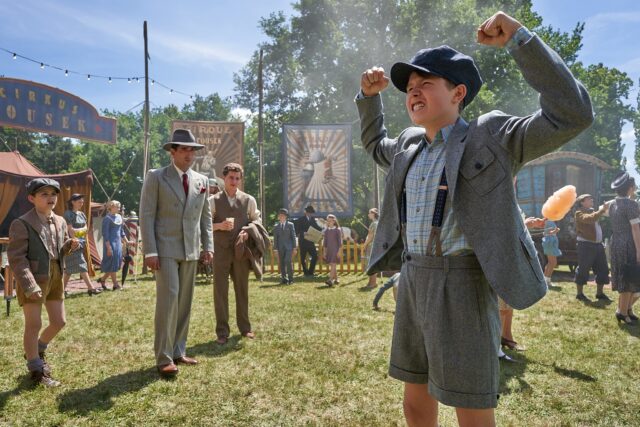
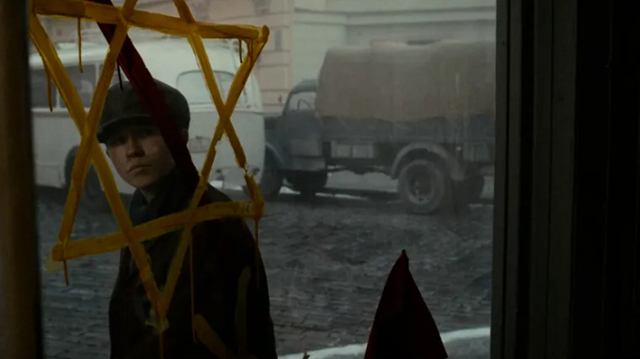
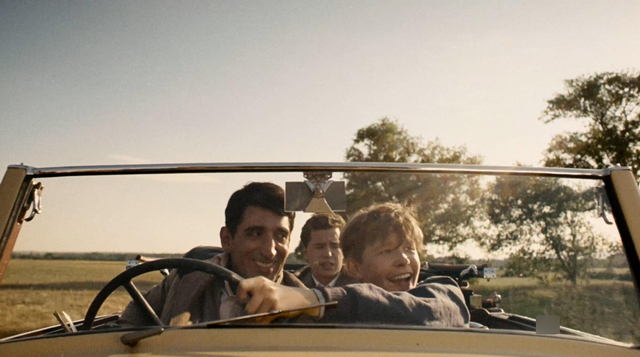
“We wanted to show everything from the perspective of the childhood Herbert,” Taylor said. “I really don’t like it when the camera racks focus or zooms to tell you what to look at.” Instead, the filmmakers chose extremely wide lenses and composed shots where young Herbert’s face remains central while the world around him unfolds in devastating clarity.
“I thought it was important to remain on Herbert’s face, but have everything in the background going on behind him—whether it be joy, whether it be the Nazis, whether it be Terezin or Auschwitz—completely clear and visible in the background.” That decision required a remarkable amount of trust from the film’s youngest performer. To achieve those intimate shots, Luke David Blumm often had the camera just inches from his face.
“Luke had to deal with the giant camera being inches from him for many of those shots,” Taylor said. “But he was such a pro. It was not a problem.”
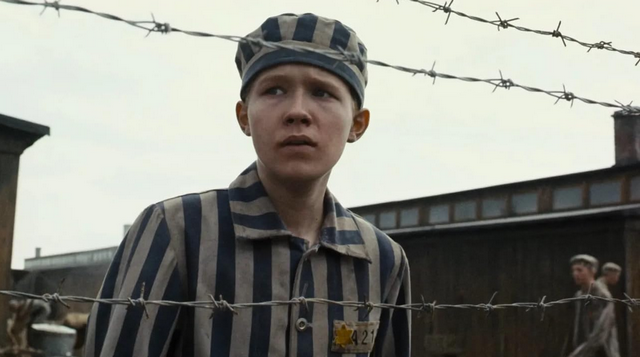
Blumm’s performance anchors the historical portions of the film with astonishing maturity and emotional clarity. His portrayal captures Herbert’s innocence, fear, and resilience as the boy’s childhood collides with unimaginable cruelty.
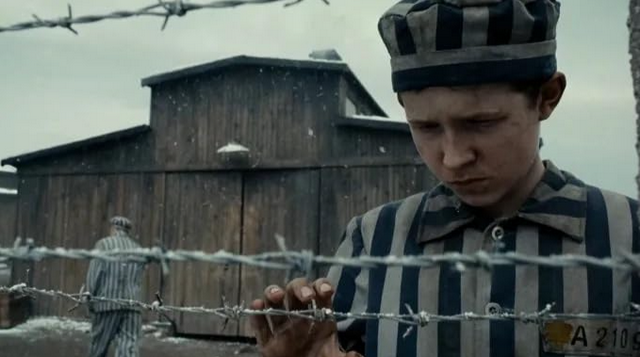
Equally vital to the film’s authenticity was the production’s work in Europe. The filmmakers shot in the actual town of Terezin, and the Czech Republic’s Stillking Studios—moved by the fact that Heller himself was originally from Prague—went to extraordinary lengths to support the production. “They bent over backwards,” Taylor said. “They built Auschwitz for us.” The scale of that effort is evident onscreen, where meticulous production design and costuming recreate the historical world with haunting precision.
Yet for all the sweeping historical moments in THE OPTIMIST, the film ultimately rests on performances—and Taylor assembled an extraordinary cast to bring Heller’s story to life.
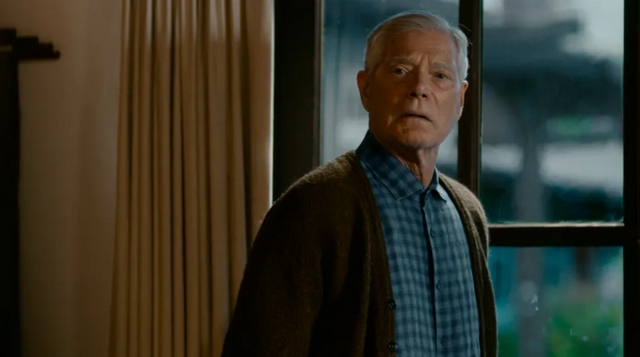
Stephen Lang delivers one of the most transformative performances of his career as the older Herbert Heller. Known to many audiences for physically imposing roles in films like Avatar, Lang disappears entirely into the role of the quiet, reflective survivor. Taylor explains his rationale for casting against type.
“If you cast someone who already feels like a Herbert type, people see the trailer and say, ‘Oh, I know what that is,’” he explained. “But Stephen—because his film portrayals are often so macho—you see a completely new person.” Lang’s commitment was so complete that even those who knew him well were startled by the transformation.
“Herbert’s family was stunned by his portrayal,” Taylor said. “I remember walking down a muddy path with him during filming and putting my hand under his arm to steady him because he was so in character. And then I felt this massive bicep under his costume. I thought, ‘This guy doesn’t need help walking down a muddy path.’”
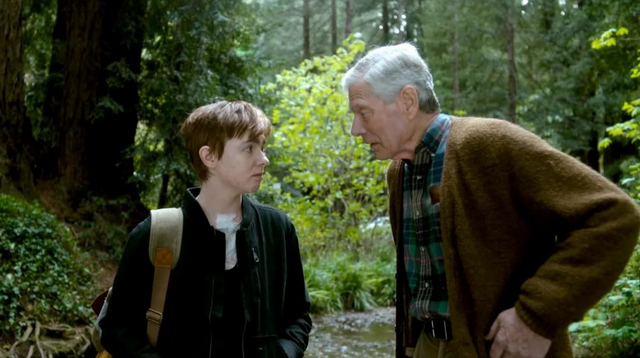

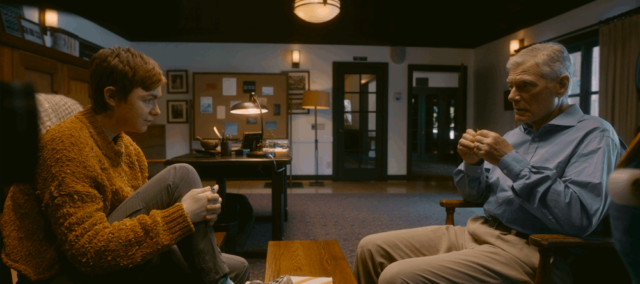
Opposite Lang is Elsie Fisher, whose performance as Abbey—a troubled teenager struggling with her own emotional wounds—creates the film’s central emotional bridge between past and present. “I saw her in Eighth Grade,” Taylor recalled. “At such a young age, she could convey such depth of emotion. It was an honor to work with her.”
Fisher and Lang develop a quietly powerful dynamic onscreen, their unlikely friendship becoming the catalyst that allows Herbert to finally share the story he has kept buried for more than sixty years.
One of the film’s most memorable scenes—an emotional exchange between Herbert and Abbey during a torrential downpour—was itself born from a filmmaking challenge. Taylor had written rain into the script. What the crew encountered was something far more extreme. “It was the worst rain we’ve ever seen in Northern California,” he said. “A total monsoon.”
The weather forced Taylor to improvise. “I said, get me an umbrella—but it has to be clear so the light comes through.” The resulting scene, with the river rising and rain pouring down around the two characters, has become one of audiences’ favorite moments. “It’s funny,” Taylor reflected. “You make this big film with sweeping scenes in Europe, but one of the favorite scenes people mention is that moment by the river.”
The scene works not because of scale but because of the emotional truth at its center. It also highlights one of Taylor’s greatest strengths as a storyteller: his understanding that the emotional core of history lies in the personal.
Structurally, THE OPTIMIST moves between Herbert’s childhood experiences during the Holocaust and his present-day conversations with Abbey. Taylor designed those transitions carefully, using thematic connections rather than visual clichés.
“When she talks about bullying, we cut to Herbert being bullied,” Taylor explained. “We let the subject of the moment create the transition.”
The editing process—handled by Rick LeCompte in the U.S. and Elina Kaufman in the Czech Republic—became a delicate balancing act between historical narrative and emotional continuity. Rather than relying on dissolves or dreamlike transitions, Taylor chose to keep the storytelling immediate. “He’s telling stories about another teenager close to her age,” Taylor said. “So I tried to connect them through story, through action, through music.”
Music became a crucial connective tissue between timelines. Songs sometimes begin in contemporary scenes before carrying across decades into Herbert’s memories. One particularly moving moment occurs when Abbey later visits Auschwitz and touches Herbert’s initials carved into a wooden post. In reality, Herbert never carved his initials there—but Taylor based the moment on something he observed during research visits.
“When we visited Terezin, many of the cells had initials scratched into the walls—many at the height of a child,” Taylor said. “I knew this was something that happened.” By incorporating that detail into the film, Taylor found a symbolic way to connect Herbert and Abbey across time.
If the film’s visuals and performances form its emotional spine, the score provides its heartbeat.
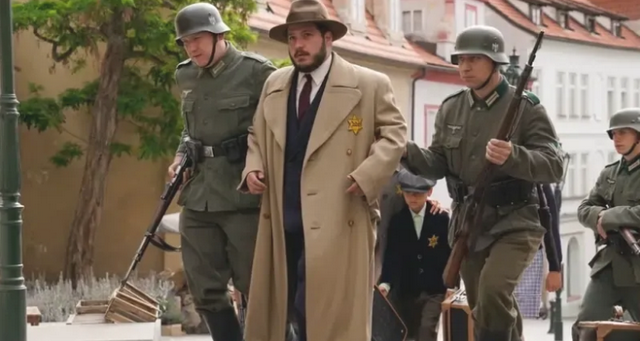
Composer Rob Berger collaborated with acclaimed violinist and composer Jenny Scheinman—who also happens to be Taylor’s cousin—to craft a score that captures both the fragility and heroism of Herbert’s journey. “Jenny understood Herbert’s story immediately,” Taylor said. “She had seen many of the interviews and really understood the emotional challenge of it.” In one striking sequence, when Herbert is forced to wear the yellow star for the first time and flees through the streets, the violin tremolo becomes almost kinetic—propelling the young boy forward.
Elsewhere, Scheinman’s music reflects careful historical awareness. In one scene, she initially used a traditional Jewish melody associated with weddings—only to reconsider after consulting a rabbi, ultimately composing a new piece that carried deeper emotional resonance.
The film’s closing credits offered a particularly moving moment during its Los Angeles premiere. “Jenny actually played the score live over the end credits,” Taylor said.
For Taylor, the entire project ultimately became an experience that changed him as both a filmmaker and a person.
Despite years of preparation, the emotional impact of visiting Holocaust sites firsthand proved overwhelming. “I had written what I thought was quite a good script,” he admitted. “But when I went to Auschwitz and Terezin… I became depressed.”
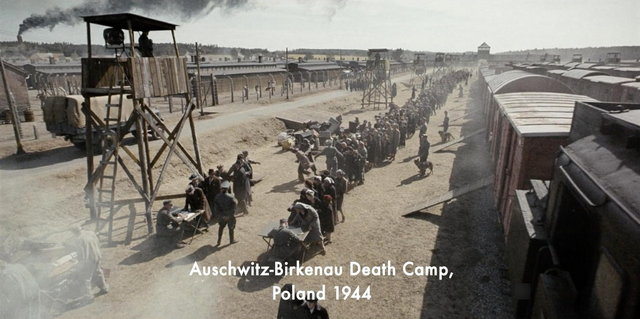
The reality of the history forced him to confront the weight of what he was portraying.
“You can have a really good plan,” he said, “but when it’s a giant historical event like the Holocaust, you have to find the truth of it—or you’re perpetuating a lie.” That realization led Taylor to deepen several scenes in the film, including moments depicting the brutal realities of camp life.
It also changed how he thinks about storytelling itself.
“You have to listen to what the world is telling you,” he said. “Listen to the echoes of millions of people beyond just the individual story you’re telling.” For Taylor, that became the film’s guiding principle. And perhaps no moment captures Herbert Heller’s spirit better than the memory Taylor shared about the survivor’s final days.
When Taylor asked whether sharing his story had brought Herbert relief after decades of silence, the elderly survivor answered yes—before delivering one final joke.
“Yes,” Herbert said. “But not like having gas.” Then he laughed and added, “Just kidding.”
Even at the end of his life, Herbert Heller was still trying to lift the spirits of those around him.
It’s that humanity—humor, resilience, and compassion in the face of unimaginable darkness—that THE OPTIMIST ultimately celebrates. And thanks to Finn Taylor’s careful, deeply respectful filmmaking, Herbert’s story now reaches far beyond the people who once knew him.
It becomes something we all carry forward.
by debbie elias, exclusive interview 03/03/2026
THE OPTIMIST is currently in theatres.