An in-depth exclusive interview with director CLAUDIO FAH discussing the riveting, high flying thriller TURBULENCE.
SYNOPSIS: Zach and Emmy’s romantic retreat aboard a hot air balloon takes a terrifying turn when they are hijacked by a sinister third passenger with a link to Zach’s past. As the mystery of their secret relationship is revealed, their spectacular ride becomes a brutal mental chess match and a lethal battle high in the sky. Kelsey Grammer leads a brilliant cast in this psychological thriller that will keep you guessing until the very last moment.
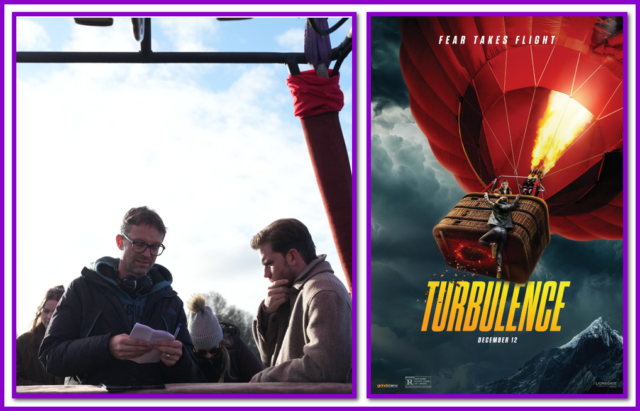
Directed by Claudio Fah with script by Andy Mayson, TURBULENCE stars Hera Hilmar, Jeremy Irvine, Kelsey Grammer, and Olga Kurylenko.
An exciting and insightful exclusive interview with director Claudio Fah, we quickly learn that when he set out to make TURBULENCE, a high-altitude thriller set almost entirely inside a hot-air balloon, he was under no illusions: this was never going to be a film blessed with easy logistics. After all, hot-air balloons are delightful for sightseeing—and absolutely terrible for controlled filmmaking. So Fah and his team leaned into a hybrid plan: build what they could, fake what they must, and make every technical choice feel as grounded as the story was sky-bound. “We knew a real balloon wasn’t going to cut it.”
Opening with an infectious and enthusiastic laugh, he recalls the earliest conversations about TURBULENCE. Hot-air balloons, he explains, are beautiful but utterly uncooperative film partners—drifting wherever the wind decides. So the team built their own solution: a partial balloon rig suspended from a crane, giving the actors just enough real movement and texture to perform against.
To capture the sweeping vistas needed for the balloon’s journey, the crew skipped the balloon entirely and instead sent a helicopter rig into the Dolomites—outfitted with a 360-degree high-resolution camera system. These plates, stitched and polished, would later stand in for the entire world around the characters. The footage provided the visual backbone of the film, replacing the blue screens that surrounded actors during studio shoots with natural landscapes that felt anything but artificial. This ingenuity came partly from necessity: using a fully functioning balloon for dramatic scenes would have been unsafe, unpredictable, and a logistical nightmare. Instead, the production relied on a special partial balloon rig originally built by Cameron Balloons. The team suspended only the lower portion of a balloon—basket and skirt—from a crane, allowing actors to perform with real physical contact and genuine sway while still keeping the environment controllable.
Blue screen work has improved over the years, yet it still has a tell: a certain crispness that gives away its digital nature. Fah and cinematographer Jaime Reynoso were determined to avoid that sterile quality, so they opted for a deliberately organic approach.
Their recipe: (1) Handheld shooting, to inject natural motion and mild imperfections; (2) Anamorphic lenses, to add character, softness, and a touch of distortion; (3) Cinematographer in the basket, not outside it.
Reynoso spent much of production wedged inside the cramped basket—sometimes nearly shoulder-to-shoulder with the actors—so the camera could inhabit the space along with the characters. The result is a visual intimacy that counterbalances the artificial environment surrounding them on set. Filming inside a tiny balloon basket required unusual problem-solving. As you’ll hear from Claudio, he and Reynoso developed a morning ritual: block the scene, determine the master shot, then hand the reins over to the actors and camera to find spontaneity. Reynoso was encouraged to pan, adjust, and improvise mid-take, capturing reactions and interactions that could never be storyboarded. This flexible visual grammar kept the confined setting from ever feeling visually repetitive, and—perhaps more importantly—mirrored the shifting emotional turbulence between the characters.
Now what would a hot air balloon flight in the Dolomites be without vertigo inducing experiences, dramatic explosive gravitas among the balloon riders, and of course, the nail-biting excitement and tension of storms. The film’s storm sequence became its own mini-production. Three days of relentless water, wind machines, and actors who were cold, drenched, and still expected to look convincingly terrified. Wind machines roared. Water cannons blasted the cast with icy sheets of rain. Lightning flashes strobed the set. Fah describes it as “a very wet endurance test disguised as a shooting day.”
To keep the cast from freezing, the team stationed mobile sauna seats just off-camera to prevent hypothermia. Actors would dash from battering wind to blissful steam, then back again for another take — an image as far from glamour as filmmaking gets, yet delightfully emblematic of TURBULENCE’s practical-meets-digital ethos. CGI stepped in where nature simply couldn’t behave on command: enhancing the balloon, extending the environment, and crafting the swirling menace that safely stayed off-set.
According to Claudio, “The calm center of a very technical storm,” was editor Tamsin Jeffrey who faced an unusual challenge: every scene essentially had to be cut twice. First came the edit built on performances—the blue-screen version. Then, once visual effects blended in the aerial plates and environmental details, the scene often felt different and needed to be recut for rhythm, tension, and continuity. The storm sequences amplified this complexity tenfold, requiring constant back-and-forth between editorial and VFX. Fah credits Jeffrey for her unshakable patience and keen storytelling instincts, shaping the film’s pacing while juggling an enormous amount of visual data.
Speaking candidly about the financial constraints compared to larger aerial adventures like The Aeronauts (a film Claudio and the team looked at “repeatedly”), rather than lamenting limitations, the team turned them into creative accelerators—using practical rigs, real environments, handheld intimacy, and a smart blend of digital and physical effects to craft a film that feels expansive without ever pretending to have a blockbuster budget.
What makes TURBULENCE stand out isn’t just its story—it’s the ingenuity behind capturing it. From helicopter-shot landscapes to crane-suspended balloon rigs, from handheld camerawork to sauna-assisted storm shoots, the film’s technical backbone is full of clever solutions to aerial filmmaking’s biggest headaches.
And in the end, those limitations didn’t tether the film—they helped it soar.
TAKE A LISTEN. . .
by debbie elias, exclusive interview 12/2/2025
TURBULENCE is in theatres, On Demand, and On Digital on December 12, 2025.