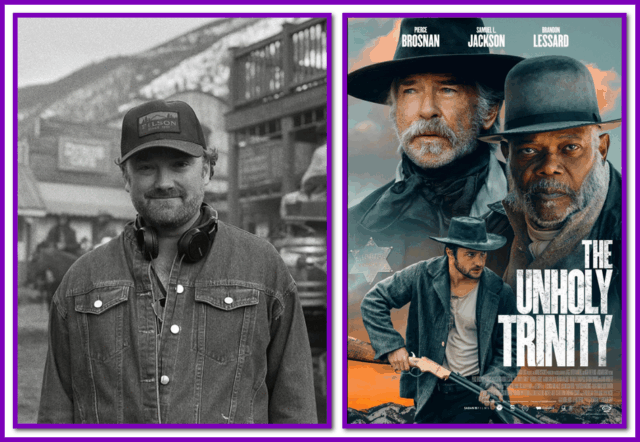
An interesting, insightful, and fun exclusive interview with director RICHARD GRAY discussing THE UNHOLY TRINITY.
SYNOPSIS: THE UNHOLY TRINITY promises to deliver an exciting blend of action, suspense, and Western grit with an all-star ensemble ready to captivate audiences this summer. A tale of revenge, dark secrets, and buried treasures, the film is set against the turbulent backdrop of 1870s Montana. It picks up in the moments before the execution of Isaac Broadway, as he gives his estranged son, Henry, an impossible task: Murder the man who framed him for a crime he didn’t commit. Intent on fulfilling his promise, Henry travels to the remote town of Trinity, where an unexpected turn of events traps him in town and leaves him caught between Gabriel Dove, the town’s upstanding new sheriff, and a mysterious figure named St Christopher.
Directed by Richard Gray with script by Lee Zachariah, THE UNHOLY TRINITY stars Pierce Brosnan, Samuel L. Jackson, Brandon Lessard, Veronica Ferres, Gianni Capaldi, Q’orianka Kilcher, Tim Daly, Ethan Peck, Katrina Bowden, and David Arquette.
RICHARD GRAY is a director of whose work I can never get enough. He excels at period pieces like Robert the Bruce and Murder at Yellowstone City. And yes, he does love westerns. But it’s not just westerns that he loves. RICHARD GRAY loves the art and craft of filmmaking, and even when facing challenges (which he loves to overcome), he has fun and enjoys what he does. You see it onscreen in every film.
In this latest exclusive interview with RICHARD GRAY, we break down his latest Western, THE UNHOLY TRINITY. Set in 1870s Montana, Richard highlights the complex narrative, the ensemble cast led by Pierce Brosnan and Samuel L. Jackson, and the challenging filming conditions in Montana. THE UNHOLY TRINITY was filmed on location at Yellowstone Ranch, Montana, Gray praises the cinematography by Thomas Scott Stanton and the production design by Tessla Hastings (who knows the Old West like the back of her hand), emphasizing historical accuracy all around. Also key to the production team is editor Lee Smith. He also discusses the collaboration with composer Marco Beltrami and Marco’s son Tristan Beltrami for the atmospheric score.


A tale that, through its characters, examines vengeance and redemption and the shades of gray within the moral complexities of man, THE UNHOLY TRINITY explores themes of what is justice versus what is just, and not only in 1870s Montana. The same questions face us today. With an emphasis on creating a nuanced, historically accurate portrayal of post-Civil War America through character development, Richard and screenwriter Lee Zachariah intentionally crafted characters with complex immigrant backgrounds – Irish, Scottish, German, Native American, and African American – to tell a true story of America. For Pierce Brosnan’s character of the Sheriff, they developed an Irish immigrant backstory, exploring the sadness and challenges of coming to America after the potato famine. With Samuel L. Jackson’s character, St. Christopher, a former slave, Gray ensured his motivations were deeply rooted and understandable, making him more than just a stereotypical “bad guy”. The goal was to avoid simplistic “good guys and bad guys” narratives, instead showing characters’ motivations and humanity. By giving each character depth and a meaningful backstory, THE UNHOLY TRINITY is a rich, nuanced exploration of immigrant experiences in the 1870s American West, allowing audiences to connect with their struggles and complexities.
In addition to the standout performances from Brosnan and Jackson, playing the third tine of the primary triumvirate is Brandon Lessard as Henry Broadway. Having appeared in Gray’s films, Murder at Yellowstone City and Robert the Bruce, Richard knew what Lessard was capable of. But to see him deliver this morally conflicted, vengeful young man who finds redemption within himself is an incredible journey to watch unfold. Not to be overlooked is an unforgettable performance by David Arquette as “Father Jacob”.
Working with his friend of 20 years, cinematographer Thomas Scott Stanton, Richard and Thomas chose to shoot in the fall in the fall in Montana to capture the spectacular light and diverse landscapes. Their goal was to make the film look as big as possible by using natural locations, with no studio sets, showcasing expansive, wide-screen panoramic vistas, and balancing those with intimate, extreme close-ups to show the breadth of the environment and emotional depth of the characters. They focused on capturing the breath of actors, the changing terrain, and the authentic light of Montana. By shooting entirely on location and avoiding studio sets, they could seamlessly transition between sweeping landscape shots and tight, textured close-ups that reveal the characters’ inner conflicts. The natural light and varied terrain of Montana allowed them to create a visual language that felt authentic and dynamic, giving equal weight to the landscape and the human drama unfolding within it.


There is a tactile nature to THE UNHOLY TRINITY that comes directly from shooting in real Montana locations during the fall. They intentionally chose to film when the landscape was changing, capturing the fall colors and even incorporating unexpected snowstorms. Shooting entirely on location allowed them to leverage the natural terrain’s varied elevations – from flat open areas to higher mountain regions with snow, something that Thomas appreciated, although changing terrain also presented its own challenges. The changing weather and authentic landscapes allowed them to create depth and texture in every frame. Always loving Westerns that show varied landscapes and moving away from typical desert Western settings, by embracing Montana’s natural environment, Richard was able to make the landscape itself a character in the film, giving the audience a truly immersive and tactile visual experience.
Adding to the immersive and tactile experience of THE UNHOLY TRINITY is the work of production designer Tessla Hastings, who previously worked with Richard on Murder at Yellowstone City. Her reputation for detailed, authentic production design is well-respected in the industry. As a Montana native, she’s deeply committed to historical accuracy and creating sets that feel genuinely real. Her approach was to build fully functional 360-degree sets where actors could move naturally without feeling constrained. For instance, in the bar and Sarah’s kitchen, everything was period-accurate and fully functional – from real French wallpaper to authentic props and furniture. Richard emphasized that her meticulous research and attention to detail made it easier for actors to immerse themselves in the world. The sets were complete environments, not partial sets with green screens, thus allowing actors to feel more connected to their characters. Tessla’s work created spaces that actors could trust and inhabit completely.
One of my favorite elements in Westerns is the action and stuntwork, and for Richard Gray, “authenticity of the action and stunt work” is essential. For THE UNHOLY TRINITY, he brought in Diz Sharpe as stunt coordinator and Tyler Gaisford as the ramrod leading the horse wrangling team. Just as Taylor Sheridan had done each season for Yellowstone, Richard and his team held a “cowboy camp” where actors trained with their specific horses, creating a relationship between actor and horse. Most actors did their own riding, with Veronica Ferres even buying a mechanical horse to practice when she didn’t have enough prep time. Brosnan, Jackson, Ferres, and Brandon Lessard all rode their own horses in the film. For the gunfights, Richard and Diz Sharpe focused on geographic accuracy, ensuring viewers could understand where characters were in relation to each other and where bullets were coming from. They wanted to avoid senseless violence, making sure each action sequence had a clear spatial understanding and emotional context. Richard stressed that they cared about making the action feel real and meaningful, not just about creating spectacle. The goal was to help the audience care about even the “bad guys” by showing their humanity during action sequences.
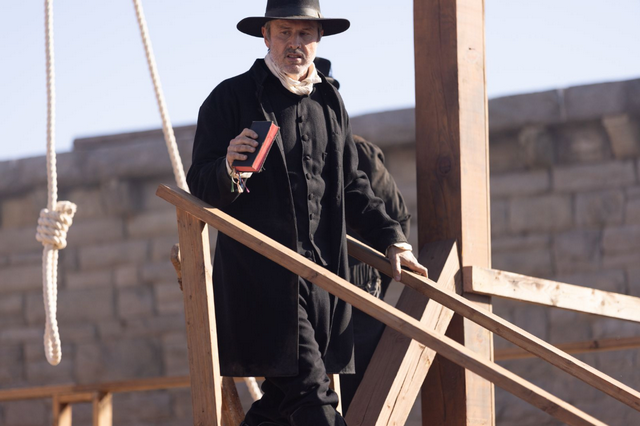
Calling on the masterful Lee Smith as his editor (Smith is responsible for films like 1917, Dunkirk, Spectre, Interstellar, and more), Richard learned to focus on what was actually filmed versus what was in the original script. Admitting that he used to be too “hands-on” in editing, Richard learned to trust Smith’s expertise and to work with the footage they had, creating depth and emotional resonance without relying on what was originally written. As comes as no surprise, Smith was particularly skilled in handling action sequences given his prior experiences with directors like Christopher Nolan and Sam Mendes. The biggest challenge with editing THE UNHOLY TRINITY was creating a tight, nuanced film in just 95 minutes while ensuring the audience cares about multiple characters, with the goal being to make the characters feel complex and relatable in a very short runtime.
Another piece of this cinematic tapestry is the score. Introduced to Marco Beltrami through Pierce Brosnan, as their families knew each other, Richard calls Marco a “blessing.” And bringing in Marco’s son Tristan as co-composer helped make THE UNHOLY TRINITY a true family affair; Pierce Brosnan’s sons Paris and Dylan are in the film, Richard’s daughter Eadie is also in the film and steals every scene she’s in, other cast and crew family members also participated in the production, and Ethan Peck, grandson of Gregory Peck who had more than a few Western notches on his cinematic belt, also fills in the familial cinematic canvas. For this score, Richard wanted something more atmospheric and less stereotypical for a Western. Interesting with this production, Richard learned not to use temp music during editing and waited to hear Marco and Tristan’s original compositions. The goal was to create music that was emotional without being overly sentimental and action-packed without sounding like a traditional “cowboys and Indians” soundtrack. While there are some Western motifs that we hear within the orchestral arrangements and instrumentation, through the musical composition, we feel the environment and conflicts of this world. The result from the Beltramis was a beautiful, nuanced score that enhances the film’s emotional depth while maintaining subtlety.
TAKE A LISTEN. . .
by debbie elias, exclusive interview 06/09/2025
THE UNHOLY TRINITY is in theatres now.