
There’s funny, and then there’s funny. The kind of laugh-until-you’re-crying funny that comes not from manufactured punchlines, but from recognizable truths pushed to glorious extremes. With THE BREADWINNER, director Eric Appel delivers exactly that kind of comedy – a bright, buoyant, wildly entertaining family film that embraces chaos while keeping one foot firmly planted in emotional authenticity.
Starring comedian Nate Bargatze in his first feature film lead alongside Mandy Moore, THE BREADWINNER follows salesman Nate Wilcox, a devoted husband and father, suddenly left to manage his comically chaotic household when his wife Katie heads to Korea after landing a life-changing Shark Tank-style business opportunity. What begins as an earnest attempt at “the dad era” quickly spirals into DoorDash dependency, Walmart survival shopping, endless missing towels, roof construction disasters, and eventually — because this film understands escalation perfectly — a horse in the house.
But Appel didn’t just want THE BREADWINNER to be funny. He wanted the chaos to feel real.
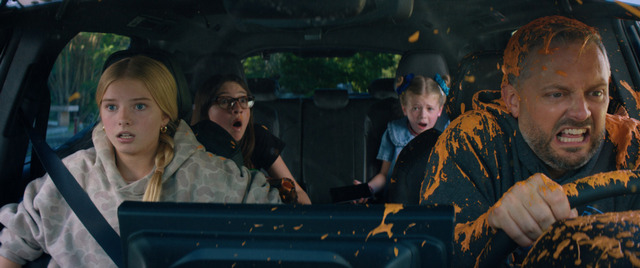
“I have a 14-year-old daughter and an 11-year-old daughter,” Appel explained. “I am the breadwinner of my family. My younger daughter has special needs. She’s deaf and has cochlear implants, so about a decade ago my wife made the decision that she’s going to take on all of those challenges at our home that I didn’t necessarily have the bandwidth for. Reading the script, I saw a lot of my own life in this.”
That deeply personal connection became foundational to how Appel approached the film. While comparisons to Mr. Mom are inevitable — and deserved — Appel was determined to modernize the dynamic.
“What I really related to was that he wants to help out and he wants to do a good job,” Appel said of Nate Wilcox. “He’s the one pushing his wife to pursue this passion project of hers. He just bit off a little more than he can chew, and he’s unaware of some of the invisible work that goes into parenting because his wife is so good at it she makes it seem invisible.”
That grounding in recognizable family life becomes the secret weapon behind the film’s laugh-out-loud success. Running gags involving mountains of wet towels, clutter accumulating throughout the house and yard, and Nate’s increasingly desperate shortcuts all land because they feel painfully familiar.
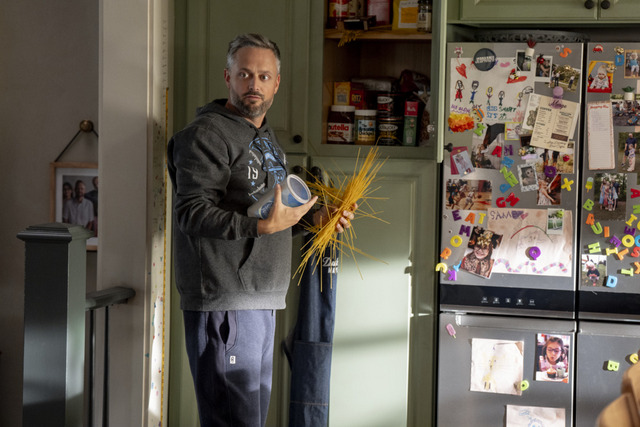
“The amount of clutter — that was always a thing,” Appel laughed. “I live in a house with younger daughters, and the stuff that you accumulate… all the little stupid things that are in gift bags at birthday parties that should end up straight in the garbage can but somehow are all over the place in the weirdest spots.”
That lived-in authenticity extends into every frame of the film thanks to the work of production designer Jon Billington, set decorator Jennifer Gentile, costume designer Alexis Forte, and cinematographer Eigil Bryld.
Appel and Billington meticulously designed the Wilcox family home down to the smallest detail, even utilizing VR technology during pre-production to walk through the set virtually before construction began.
“They had the whole set taped out on the floor,” Appel recalled. “I got to put the headset on and walk around the set in virtual reality with the exact scale, all the way down to the placement of the furniture.”
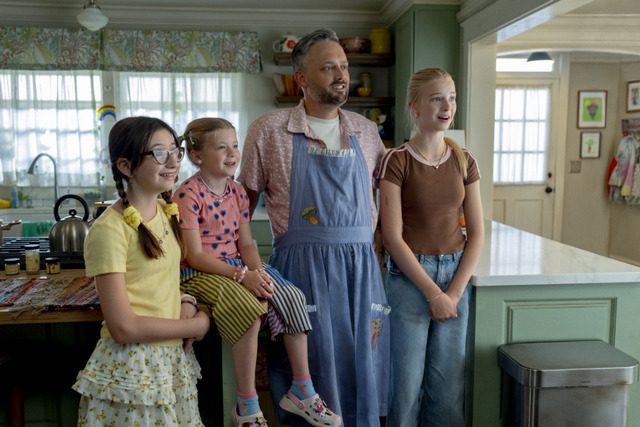
Every room tells a story. The daughters’ bedrooms distinctly reflect their personalities. Toys, sports equipment, forgotten junk, and random clutter spill organically throughout the house and eventually into the backyard as Nate loses control of domestic order. Even the family’s economic reality factored into the design process.
“We looked at what kind of house these people would be able to afford if this guy’s the top dealer at a local Toyota dealership,” Appel explained. “Katie has designed everything in the house. Their bedroom has almost none of Nate’s personality in it. That’s Katie’s space.”
Complementing the production design is Bryld’s wonderfully textured cinematography, which intentionally avoids the overly polished aesthetic common to many modern streaming comedies. Appel specifically referenced the rich visual texture of 1980s studio comedies while shaping the look of the film.
“We wanted to give it that old Kodak, Eastman film look,” Appel said. “Everything from Ferris Bueller’s Day Off and Back to the Future. The windows should be blown out in the back and we should see the glow of light coming through. A lot of people talk about the ‘Netflixification’ of movies where everything is so crisp and everything always seems to be in focus. We wanted to give it that richness and depth that a lot of those older movies had.”

That visual warmth proves essential in balancing the film’s escalating absurdity with emotional sincerity — no easy feat when juggling broad comedy, heartfelt family dynamics, child actors, and a horse named Ace playing “Cinnamon.”
“You don’t want to lose the heart and emotion,” Appel noted. “You don’t want things to get too silly or feel too off, just to keep it feeling grounded but still making it feel like a big comedy.”
Fortunately, Appel struck gold with his ensemble cast.
The chemistry among Stella Grace Fitzgerald, Birdie Borria, and Charlotte Ann Tucker as the Wilcox daughters feels effortless and authentic, but Appel credits an extensive audition and bonding process for creating that believable sister dynamic.
“We did multiple rounds of auditions and chemistry reads,” he said. “Right before we started filming, me and Nate and the girls all went bowling together. We went to this fun zone outside Atlanta with black-light dinosaur mini golf. Nate and I both have daughters, and we know how to have fun with kids. We created a real vibe with these kids where they just felt real.”

And then there was the horse.
“The horse was a bit of a challenge in the way that any animal would be a challenge,” Appel admitted. “But our horse actor was the most incredible animal actor I’ve ever worked with.”
That horse-driven third act also involved one of the film’s most ambitious practical builds — an evolving rooftop construction disaster that Appel insisted be done physically rather than digitally.
“That roof was actually built,” he revealed. “We built a replica elevated to the actual height. We had to build it in stages because you see it in stages throughout the movie. The whole Rube Goldberg roof collapse thing is practical.”
Even actor Will Forte was genuinely elevated atop the structure while filming.
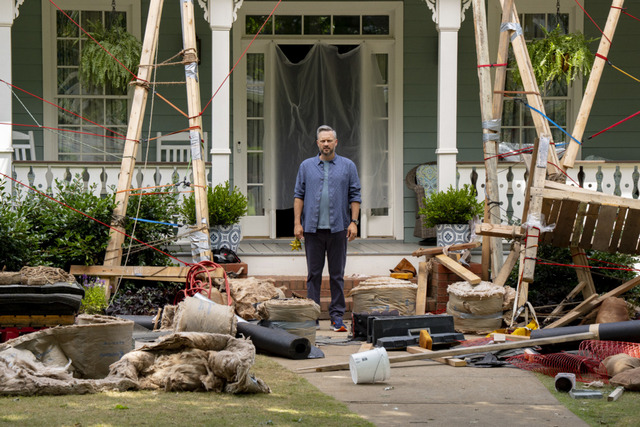
“He was up there safety’d onto the roof actually doing all that hammering,” Appel said.
That commitment to practical craftsmanship helps give THE BREADWINNER its tangible energy. Nothing feels synthetic or algorithmically assembled. The messes feel messy. The house feels lived in. The family feels recognizable. And the comedy lands because Appel and his creative team never lose sight of emotional truth underneath the escalating madness.
And yes — audiences may leave theaters wanting a horse.
“I’ll take it,” Appel laughed.
by debbie elias, exclusive interview 05/15/2026
THE BREADWINNER is exclusively in movie theatres on May 29, 2026.