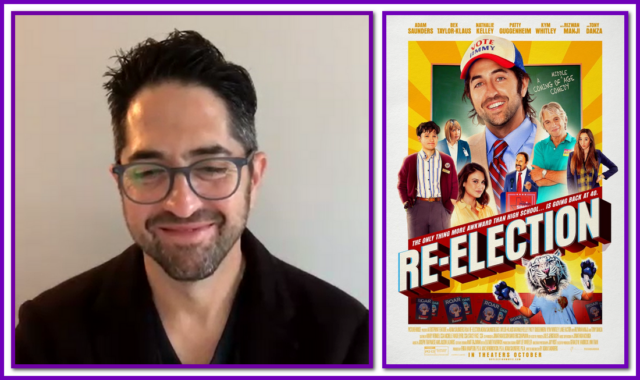
An in-depth exclusive conversation with writer/director/actor ADAM SAUNDERS talking RE-ELECTION.
SYNOPSIS: High school haunts everyone, in one way or another. For Jimmy Bauer (SAUNDERS), it was losing the race for class president during his senior year back in 1995, which caused him to drop out. Now a 40-something underdog stuck working in a memorabilia store owned by his dad (TV comedy icon TONY DANZA), Jimmy decides to go back to school for his missing class credits — and win the election he’s sure will make his life right. But after 30 years, things have changed a bit, and with the help of his new Gen-Alpha friend Noa (BEX TAYLOR-KLAUS) and former classmate-turned-girlfriend Ama (NATHALIE KELLEY), Jimmy learns that it’s not how we start a journey that matters — it’s how we finish it.
Written and directed by Adam Saunders, RE-ELECTION stars, among others,Tony Danza, Bex Taylor-Klaus, Adam Saunders, Kym Whitley, and Rizwan Manji.
Talking with Adam Saunders about his new film RE-ELECTION feels a lot like watching the movie itself: fast, funny, layered, and surprisingly thoughtful.
This was my second interview with Saunders, the first being for his delightfully entertaining freshman film Dotty & Soul, and he remembered me—which meant we skipped the formalities and jumped straight into the deep end. Adam is rapid-fire and enthusiastic when he talks, ideas stacking on top of one another as quickly as the jokes in his film, but what’s striking is how precise he is about why things work. Nothing in RE-ELECTION is accidental, even when it feels loose and playful.
At first glance, the premise is pure comic wish-fulfillment: Jimmy Bauer (played by Saunders), a 40-something underdog, returns to high school to complete his missing credits and win the class president election he lost back in 1995—an event that derailed his entire life. But for Adam, the story isn’t really about high school at all. It’s about being stuck.
Saunders is quick to point out that while Jimmy is a high school dropout, his emotional reality isn’t a literal autobiography. “The feeling that Jimmy has is universal,” Adam says. “It’s the feeling of, I have not done enough. I’m stuck. Where did I go wrong? Why did I do that instead of that?”
He’s felt it himself, despite being anything but unaccomplished—holding a BA in Drama from Duke and an MFA from Yale. The connection is psychological, not biographical.
“I have friends who say, ‘If I had just done this one thing, my whole life would be different.’ People really attach stories to whatever they want to. And sometimes the simplest little thing is more than enough for someone to completely unravel.” That idea—that a single, seemingly small regret can become the story we use to trap ourselves—drives RE-ELECTION. Jimmy’s obsession with the past isn’t logical, but it’s painfully human.
While American politics form the backdrop of the film, Saunders is clear: RE-ELECTION isn’t about picking sides. He’s far more interested in who we are before the labels.
The school becomes a microcosm of the country—intentionally diverse, intentionally representative, and deliberately reflective of modern America. The film strips away what Adam calls “social flags” and focuses on shared humanity—how people with wildly different perspectives still collide, connect, and occasionally grow.
That theme extends across generations. Jimmy’s return to school forces him into TikTok culture, social media chaos, and Gen-Alpha sensibilities, embodied most vividly by Noa (played by Bex Taylor-Klaus). The generational divide becomes both comic fuel and emotional lens—less about mockery, more about misunderstanding and unexpected connection.
One of the most fascinating parts of our conversation was Adam’s discussion of the film’s visual language, crafted in close collaboration with cinematographer Jay Visit. Adam doesn’t start with shots—he starts with feelings.
“What I try to do is express emotionally what I want it to feel like,” he explains. “Then we build the visual language from there.”
For RE-ELECTION, that meant leaning into a nostalgic, bright, fun aesthetic—intentionally avoiding gritty handheld chaos—so audiences feel like they’re in a light, entertaining world even as the film tackles heavier ideas.
“I’m always referencing an earlier time of moviemaking where things were bright and light and fun,” he says. “Within that fun visual world, we can have bigger conversations.”
But when the story demands it, the film isn’t afraid to pivot hard.
One standout example is the cafeteria speech and hallway sequence seen from Noa’s perspective. Adam wanted it to feel like a horror movie. “From Noa’s point of view, their world has been turned upside down,” he explains. “It needed to feel stylized, chaotic, scary.”
That led to a brilliantly motivated visual choice—pulling the fire alarm to justify flashing reds and whites, plunging the scene into controlled chaos while staying within the film’s established palette.
Color in RE-ELECTION isn’t decoration—it’s storytelling. Patriotic reds, whites, and blues dominate the political imagery. Stan’s world—the memorabilia shop run by Jimmy’s father, played by Tony Danza—is steeped in cool blues and desaturation, signaling a life stalled in the past.
Jimmy’s rise into ego and attention is literally golden: gold jacket, gold shoes, gold “roar.” He becomes a spectacle—intoxicating, shiny, and slightly ridiculous. Then, crucially, the color drains back to neutral as Jimmy grows up. “At the end, it’s less about ‘Look at me’ and more about ‘Let me help others,’” Adam explains. “He’s more settled. More grown up.”
Even locations carry meaning: the sickly yellow of the superintendent’s office radiates institutional discomfort, while Jimmy’s red shed out back becomes a visual stop sign—What are you doing, Jimmy?
With so many moving parts—fast comedy, emotional beats, multiple characters, and tonal shifts—the edit was one of the film’s greatest challenges. Saunders speaks glowingly of editor Elizabeth Merrick, describing their shared goal as creating a movie that feels “fun, light, fast-paced, energetic” first—so audiences are open to the deeper ideas underneath.
The strategy was intentional: stay in a “comfortable center lane” tonally, never pushing so hard that viewers disengage. Adam likens it to how great communicators throughout history have packaged difficult ideas in accessible ways. The edit becomes part of that invitation—warm, quick, and inclusive.
High energy, he stresses, doesn’t happen by accident. “It’s high energy by design.”
For all the visual flair and comic momentum, Adam’s favorite moment in RE-ELECTION is quiet. It’s a scene between Jimmy and Stan, just before Stan fires him. Danza delivers a line that cuts through everything: “We have a sacred responsibility to ourselves.” For Saunders, that line crystallizes the entire film. We get lost in obligation. In regret. In stories we tell ourselves about who we were or should have been. But at the end of the day, we only get one life—and we owe it to ourselves to live it fully.
Underneath the jokes, the energy, and the visual fun, RE-ELECTION is a socially conscious film about second chances, self-responsibility, and letting go of the past. It asks big questions without shouting them. It invites laughter, then reflection. And it never forgets that entertainment is the door through which meaning walks in.
Talking with Adam Saunders, it’s clear that his comedy isn’t accidental—and neither is his optimism. He believes people can change. He believes opportunities return. And he believes that fun might just be the most effective way to get us to listen.
And honestly? After spending time in his world, it’s hard not to believe it too.
TAKE A LISTEN. . .
by debbie elias, exclusive interview 12/17/2025
RE-ELECTION is available to buy or rent on Prime Video and AppleTV