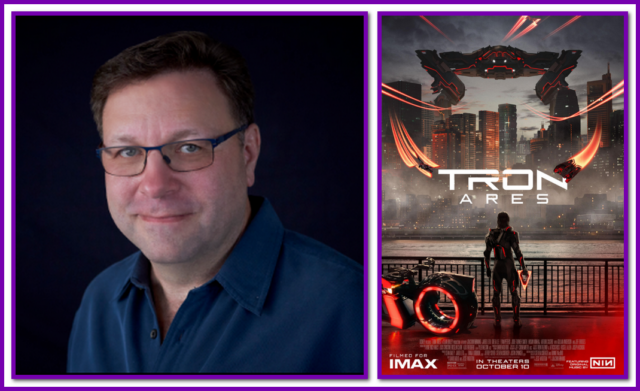
This companion piece to my exclusive interview with re-recording mixer RON BARTLETT distills Ron’s approach to TRON: ARES into a set of practical, system-level strategies applicable to large-scale, effects-driven features with heavy score integration and multiple exhibition formats. The film presented a uniquely complex challenge: three distinct sonic worlds with separate aesthetic rules, extensive cross-departmental collaboration, and a dialogue-first mandate across Atmos, IMAX, and home delivery.
1. World-Based Mixing vs. Layer-Based Mixing
Rather than organizing the mix strictly by stems (DX / FX / MX), Bartlett conceptualized TRON: ARES as three discrete sonic systems:
Real World — Physical, broadband, weight-forward
The Grid — Stylized, processed, electronically abstract
1982 World — Sparse, reverent, spatially expansive
Each world was assigned its own spectral density, dynamic range behavior, and spatial philosophy. Importantly, these worlds were not isolated into hard stem boundaries; instead, assets were allowed to migrate between categories depending on narrative need (e.g., score functioning as sound design, or ambiences carrying emotional rhythm).
Key takeaway:
World-based mixing allows narrative meaning to dictate signal treatment, rather than forcing story into rigid stem hierarchies.
2. Character-Specific Voice Processing Architectures
Grid-based characters were treated as evolving sonic entities. Bartlett designed:
Individual dialogue sub-mixes per major character
Dedicated plugin chains reflecting character “state” (AI → human)
Progressive reduction of modulation, distortion, and formant manipulation over time
Mechanical qualities were introduced early via filtering, harmonic distortion, and transient shaping, but midrange intelligibility (particularly consonant articulation) was preserved throughout.
Key takeaway:
Voice processing can function as character development, provided intelligibility is protected as a fixed constraint.
3. Dialogue as the Primary Reference Signal
Bartlett’s workflow enforced dialogue as the absolute reference across all mix passes and formats. Practical techniques included:
Consistent midrange protection (2–4 kHz) via EQ carving
Dynamic ducking of score and effects during critical lines
Frequency reassignment of effects (e.g., light cycles living above or around dialogue bands)
Multiple passes on dense sequences to locate sustainable “dialogue pockets”
Rather than compressing dialogue aggressively, the surrounding mix was shaped to accommodate performance.
Key takeaway:
Dialogue clarity is achieved more effectively by subtractive mixing elsewhere than by boosting or compressing dialogue itself.
4. Action Sequence Balancing in Dense Spectral Environments
The light cycle sequences exemplified extreme spectral competition: bass-heavy electronic score, stylized vehicle design, and essential dialogue. Solutions included:
Designing vehicle effects with reduced low-end dominance
Shifting impact energy into upper harmonics for perceived power
Trading off moment-to-moment dominance between music and effects
Executing three to four complete mix passes per major set piece
Key takeaway:
Perceived intensity does not require constant maximal energy; temporal contrast and strategic ducking preserve clarity and impact.
5. Spatial Minimalism for Reverential Scenes
The 1982 “temple” sequence inverted typical blockbuster density. Bartlett employed:
Sparse, high-frequency ambiences
Long-tail reverbs and subtle delays on dialogue
Minimal competing midrange elements
Score textures biased toward air and high-end sustain
The goal was spatial grandeur without spectral congestion.
Key takeaway:
Reducing information density can increase emotional weight and intelligibility simultaneously.
6. Score Integration as System Design
Trent Reznor and Atticus Ross delivered music as finished stereo mixes. Bartlett’s role was not deconstruction, but expansion:
Core musical content anchored front-heavy to preserve “record” integrity
Atmos used primarily for textural and ambient extension
Height and surround channels employed to enlarge, not displace, the mix
Early three-day sessions established level, dynamics, and interaction templates that governed the entire film.
Key takeaway:
Respecting a composer’s internal balances while scaling spatially yields more coherent score integration than aggressive object dispersion.
7. Interdepartmental Feedback Loops
Sound decisions were made in active dialogue with cinematography, makeup, VFX, and editorial. This included:
Adjusting sound textures to match lighting and material choices
Responding to visual transformation cues in character sound design
Open mix reviews where picture and sound influenced each other reciprocally
The result was a dissolution of strict departmental boundaries.
Key takeaway:
Sound design is most effective when developed in parallel with visual systems, not downstream from them.
8. Format-Specific Mastering Strategies
Atmos served as the hero mix. From there, Bartlett created bespoke masters for:
IMAX (5.0 / 12.0 with derived sub)
Theatrical non-Atmos
Home Atmos
5.1
Stereo
Key challenges included:
Re-shaping low-frequency content for IMAX’s non-standard bass management
Collapsing object-based mixes while preserving narrative intent
Rebalancing dense electronic score for small-room playback
Each format underwent independent QC and dialogue intelligibility checks.
Key takeaway:
True multi-format mixing requires rethinking—not rendering—the mix for each environment.
9. Organic Source Material in Synthetic Design
Despite the film’s electronic aesthetic, Bartlett incorporated organic recordings—including his own voice—into effects design. These elements were heavily processed but retained human unpredictability, adding life to otherwise synthetic textures.
Key takeaway:
Organic sources introduce complexity and emotional resonance that purely synthetic material often lacks.
Conclusion: Sound as Narrative Infrastructure
Ron Bartlett’s work on TRON: ARES demonstrates a mature, system-oriented approach to re-recording mixing—one where sound is treated as narrative infrastructure rather than embellishment. By prioritizing dialogue, designing worlds instead of layers, and integrating music and effects through collaboration rather than competition, the film achieves clarity without sacrificing scale.
For sound professionals, TRON: ARES offers a compelling case study in managing complexity while protecting story—a challenge increasingly central to modern cinematic sound.
by debbie elias, exclusive interview 11/14/2025