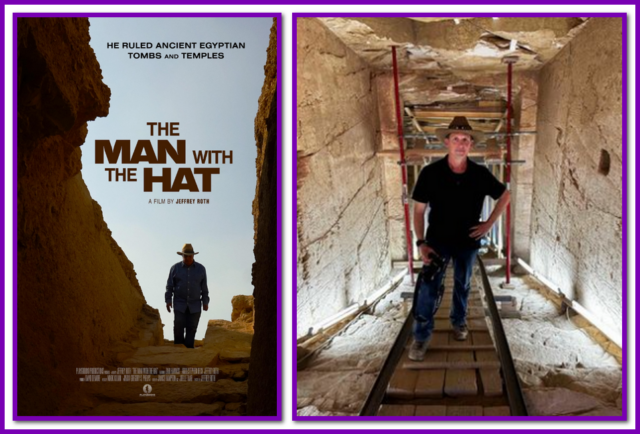
In this exclusive conversation, documentarian JEFFREY ROTH discusses THE MAN WITH THE HAT and documenting Dr. Zahi Hawass, the fragile stewardship of Egypt’s antiquities, and the human stories hidden inside ancient stone.
THE MAN WITH THE HAT isn’t just a documentary about Egypt—it’s a documentary about belonging to Egypt. Directed by Jeffrey Roth and co-written by Roth and Stephen Beck, who both serve as Executive Producers, the film is built around a simple but powerful idea: if you’re going to understand the grandeur of 4,000 years of civilization, you first need to understand the man who has devoted his life to protecting it. And not as an academic figure pinned beneath a title, but as a human being with roots, wounds, pride, humor, and an almost combustible sense of purpose.
That’s where Dr. Zahi Hawass comes in—world-renowned Egyptologist, guardian of antiquities, and the “real-life Indiana Jones” who has long been the public face guiding viewers from studio talking heads to the real artifacts on the ground. But Roth’s film isn’t interested in using Hawass as a familiar shortcut. It’s interested in the question Roth couldn’t shake: Who is he, really? The aura is undeniable, the hat iconic, the presence larger than life—but the heartbeat of this film is personal.
Roth, a documentarian drawn to character and human-interest storytelling, describes his process as beginning with the person, always. “This is the fourth feature-length documentary film that I’ve made,” he says, “and the one thing that I… my style… is the human interest story of whatever subject I’m doing.” He’s done Apollo astronauts, and a film about U.S. presidents and vice presidents that focused not on partisan heat, but on relationships. For him, the subject has to be someone he can live with for years—because these projects aren’t weekend flings. “You do spend two or three years on these things,” he explains, “and you better like what you’re doing.”
Then Hawass appeared on a computer screen—staring back like a challenge. Roth remembers the boyhood fascination with ancient Egypt, the TV programs, and Hawass always there as the connecting thread—present, charismatic, but not fully known. “He has created this aura, this character,” Roth says, “this real-life Indiana Jones figure. But who is he, right? Yeah, that’s where my interest started.” Roth sent an email. And in what feels like the first brush of movie magic, he got a response almost immediately: “Meet me in Salt Lake City next week.”
A week later, Roth sat down with Hawass at a hotel. Ten minutes into the meeting, Hawass was already grabbing a pen and mapping out a route like a man who lives in motion: “All right, we’re going to go here, here, here and here.” Six or seven weeks later, Roth and his small team were in Egypt filming.
What emerges from that leap of faith is a film that doesn’t treat Egypt as a museum—sterile, distant, sealed behind glass. THE MAN WITH THE HAT makes Egypt feel alive: the ancient standing shoulder-to-shoulder with the modern. Drone shots reveal the centuries coexisting—temples and artifacts pressed against high-rise buildings, old stones and new cities inhabiting the same frame. It’s a deliberate visual philosophy: awe, yes—but also context. The past isn’t “back then.” It’s right here, still present, still vulnerable, still fought over.
That vulnerability becomes part of the story as the film traces the historical forces that shaped the preservation battle. The documentary notes how Napoleon was among the first Europeans to travel through Egypt with scientists documenting antiquities—maps, drawings, records—an early attempt to catalog what stood. Yet real global obsession didn’t ignite until Howard Carter opened King Tut’s tomb in 1922, and the resulting surge of interest helped fuel pillaging, raiding, and the ongoing fight over who owns Egyptian history. Hawass’s mantra—delivered with the insistence of a man who has seen what happens when history is treated like a souvenir—lands like a thesis statement: “Preservation, conservation, conservation.” (So important, he repeats “conservation” twice.)
Roth’s camera follows Hawass through sites that are never random. That’s key. This isn’t a travelogue of greatest hits. As Roth explains, “Every place that we take him to… is personal, or he’s had some dealing with that site… we don’t take you to random sites and then just say, okay, well, what’s this?” Hawass leads the way in first person—on dig sites, in voiceover, in memory. He’s not merely explaining Egypt; he’s speaking of it as something intimate and essential. “The Nile is a source of life,” Hawass says. “The Sphinx is a living stone.” He doesn’t describe antiquities as objects. He talks about them like relatives.
And the film leans into what makes Hawass more than a public figure: his origin story. He grew up in a village along the Nile in a family of farmers—“educated farmers,” as he proudly frames it. There were six children. His father believed in education, in character, in resilience. Hawass carries those mantras like internal scripture: have passion, be honest, be strong. When Hawass speaks of his father, and then of his mother, the film’s tone shifts into something quietly reverent. These aren’t side notes. They’re the foundation of the man who now stands at the center of Egypt’s cultural identity.
Roth’s greatest strength is understanding that a documentary about ancient wonders only truly sings when it becomes human. Hawass personalizes everything—present, past, sacred, ordinary—until the viewer feels the stakes at a gut level. The pain he expresses when describing an obelisk “missing” its counterpart—because one stands in Paris—lands as something deeper than historical trivia. It’s an ache about displacement. About fragments torn from home. About identity scattered across the world in museum glass.
That theme—roots and home—threads through the film like the Nile itself. Hawass doesn’t just fight to protect Egypt’s antiquities because it’s his job. He fights because, in his eyes, these are the roots of all of us. This is where civilization breathes from. In that sense, the documentary becomes less about tombs and more about custodianship: who guards the past, who profits from it, and what it costs to preserve it in the present. And preserving it is not cinematic fantasy. It’s gritty. It’s bureaucratic. It’s physically brutal.
“Once you say go and he agrees to do it,” Roth admits, “that’s where your problems start… and they don’t end.” Egypt isn’t a place where you show up with a truck of gear and a film permit smile. “You can’t just show up. You have to have a fixer,” he explains. The fixer becomes the bridge between the production and everything else: government permissions, sites, schedules, and access. Gear is restricted—serial numbers logged—so the mandate becomes survival filmmaking: travel light or don’t travel at all.
Then there’s time. Or the lack of it. Some sites grant access measured in minutes, not days. In Ramses II’s tomb, a location not open to the public, Roth’s crew had one hour. “You’ve got to be on your toes,” he says. “Sometimes the government will only give you an hour.” The film’s urgency isn’t manufactured; it’s baked into the reality of the shoot.
That pressure is part of what Roth loves about documentaries. “For me,” he says, “a lot of times you do have to figure it out then. And that’s the challenge… that’s the movie magic… finding as opposed to writing it here, and then forcing your will when you’re there.” And that attitude—openness, improvisation, willingness to chase what appears—leads to the film’s most haunting and unforgettable moment.
The most powerful discovery in THE MAN WITH THE HAT wasn’t planned. It was whispered by a local man in Saqqara while the crew was filming elsewhere: “Oh, mummy down there.” Roth remembers the confusion—what mummy?—and then the decision to follow. What they found was astonishing in its starkness: what they believe is a family of five mummies, “just wrapped in the sand with no coffin, no nothing else.” No spectacle. No gold. No pageantry. Just the quiet, eerie intimacy of bodies laid together—human history stripped to its simplest truth.
Roth calls it “the most fascinating thing in the film,” and he’s clear it could never have been scripted. “These are things you can never write in advance, because they’re the moments that you find while you’re there.” He structures the sequence like a cinematic refrain: first Hawass on stage holding a canvas image of the five mummies, then the film cuts to the real burial site, and later circles back to Hawass discussing that image with his granddaughter—an emotional triptych that binds discovery, documentation, and legacy into one sequence. Science meets family. History meets tenderness. Preservation becomes personal, again.
The physical production mirrors that intensity. Roth describes being lowered sixty feet into tombs where the crew must remain unseen, gear minimized, and light managed in suffocating spaces: “They drop you down 60 feet in a hole. You don’t know what’s down there yet… you’ve got to bring small cameras, small gear, small lights.” Local workers—experienced, protective, no-nonsense—wave them off: “No, no, don’t bring that one.” The crew contorts into unnatural positions; muscles pulled, bodies sore. And because reshoots in these environments are nearly impossible, redundancy becomes a lifeline—GoPros, iPhones, anything that can capture additional angles without slowing the process.
Even sound becomes a minefield. Only a limited number of people are permitted in certain tombs. Sometimes the sound mixer is barred as “non-essential,” forcing wireless setups prone to interference. When the reality can’t be cleanly captured on-site, Roth re-records select lines later—but he refuses to over-control Hawass’s delivery. “I’ve never asked him to repeat anything,” Roth says. “If that’s the way he says it, that’s how he says it.” He wants the natural rise of a thought—the unpolished truth of the moment—because Hawass’s authenticity is the film’s engine.
Visually, the film matches the scale of its subject. Claustrophobic tunnels under Cleopatra’s domain give way to sweeping aerials of the Lost Golden City, revealing serpentine walls from above before drifting closer as Hawass explains their ancient engineering logic—how their curves resist flooding. Handheld street footage in Cairo pulses with modern life; steadier movement inside Hawass’s former home feels intimate, lived-in, personal. Roth calls it a planned “journey”—not an academic lecture, not something you watch in school, but a film designed to move with emotion and momentum.
Music becomes another layer of authenticity. Composer Mark Kilian, working with Roth for the third time, came aboard early—between the first and second Egypt trips—to spot scenes and understand the film’s rhythm. Kilian even traveled to Cairo to record with local musicians using Egyptian instruments. The result isn’t just a beautiful score; it’s a score with a pulse that feels rooted in place, giving the documentary texture and identity rather than generic “region” flavor.
Roth is also candid about what independence means. It gives freedom—but not ease. “We’re independent,” he says, “and that’s not always a good thing.” Still, he made Hawass a promise: “I’m going to tell this story the way that I want to tell it, without anybody telling me how to tell it.” The edit took roughly two years—sometimes paused for trips, sometimes driven forward by voiceover sessions, sometimes slowed by the sheer logistics of shaping huge material into a coherent narrative. But Roth speaks about the struggle the way good filmmakers always do: as part of the joy. “Why make it easy?” he asks. “Then it’s boring.”
If the film is ultimately about preservation, it also preserves something else: the labor of preservation itself. The workers at the sites—often treated as background in other documentaries—register here as participants in legacy, proud of their culture, eager to find, protect, and reveal. Roth even dedicates the film to them in the end credits, honoring “their tireless dedication to bringing their history to the world.”
That sentiment points to what Roth says he learned making THE MAN WITH THE HAT: to keep his cool, to go with the flow, to accept that control is an illusion in a foreign land where every rule and regulation can shift. But more than that, he says, the experience humbled him. In Hollywood, he works in make-believe. In Egyp,t he was working at the pyramids, in the Valley of the Kings—places so monumental it feels unreal until you remember: this isn’t a set. It’s the weight of actual history. Real stone. Real legacy. Real responsibility. And even the smallest movement of a camera rig comes with a reverent calculation: you don’t want to clip a sarcophagus. You don’t want to take a “chunk off” something that has survived millennia.
By the time the documentary closes, it feels like Roth has done what Hawass spends his life attempting: he’s made people care. Not as passive admirers of ancient splendor, but as witnesses to how fragile access can be—restricted permissions, cramped shafts, political tremors, and the unpredictable grace of a local pointing into darkness and saying, almost casually, there’s history down there.
In the end, THE MAN WITH THE HAT functions as portrait and time capsule—magical, mysterious, jaw-dropping, and educational, yes—but made personal because Hawass makes it personal. Roth captures Egypt’s immensity, but he also captures the beating heart inside it: one man’s devotion to the idea that antiquities are not trophies, not commodities, not props. They are home. They are roots. They are life.
And because Roth embraces both the planned and the accidental—the aerial grandeur and the unrepeatable moment of “mummy down there”—the film doesn’t just show what Egypt once was. It preserves what it is right now, and the humans fighting to keep it from slipping away.
by debbie elias, exclusive interview 01/14/2026
THE MAN WITH THE HAT is available to rent or buy on 1/20/2026: https://geni.us/themanwiththehat