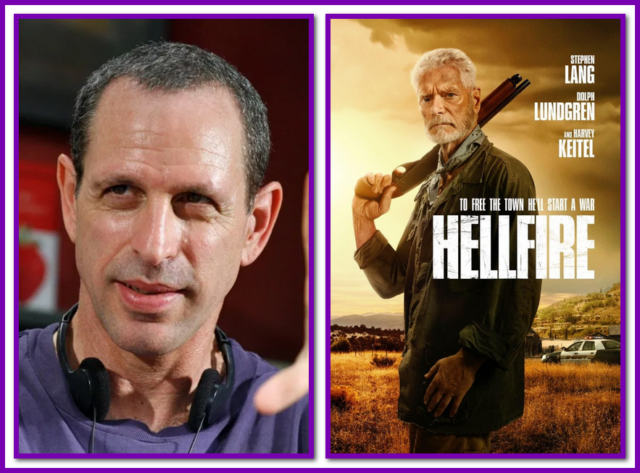
An in-depth conversation with writer/director ISAAC FLORENTINE discussing his latest action-packed thriller, HELLFIRE.
SYNOPSIS: A haunted ex–Green Beret drifter (Stephen Lang) wanders into a Southern town ruled by a ruthless crime boss (Harvey Keitel) and a corrupt sheriff (Dolph Lundgren). When violence erupts, the Man wages a one-man war for justice, redemption, and the soul of a broken town.
Directed by Isaac Florentine with script by Richard Lowry, HELLFIRE stars Stephen Lang, Scottie Thompson, Dolph Lundgren, Michael Sirow, Chris Mullinax and Harvey Keitel
In this exclusive interview, director ISAAC FLORENTINE discusses his film HELLFIRE, highlighting its character development and pacing. Breaking down the various cinematic elements of the film, he explains the decision to set the film in 1988 to avoid modern communication issues, the casting choices, including Harvey Keitel as Jeremiah and Stephen Lang as The Man with No Name, working with longtime cinematographer RossW. Clarkson, low-budget challenges, pre-production planning and creative solutions. He also notes the importance of a supportive team, particularly producer Bobby Pascal, and the critical role of editing in maintaining the film’s pace and psychological impact.
* * * * *
Isaac Florentine has never been interested in action as empty calories. In HELLFIRE, he builds the movie the way you build a pressure cooker: character first, violence last — and when the lid finally blows, the action isn’t there to decorate the story. It’s there to complete it.
Florentine is candid about the architecture. “Kind of the first half is more character development and storytelling, and then the action starts,” he says — a choice that immediately separates HELLFIRE from the modern rhythm of constant escalation. He wants you to sit in the town, breathe in the rot, and feel the moral corrosion before the reckoning comes.
One of Florentine’s smartest moves is also one of the simplest: setting the story in 1988 in Rondo, Texas. Not for nostalgic window dressing, but for structural necessity.
“This cannot work in our days because of internet and cell phones,” he explains. In 2026, the film’s central tension collapses under the weight of immediate communication. In 1988, the town can remain isolated — a sealed ecosystem where power has room to metastasize and a stranger can arrive without the modern world instantly neutralizing the premise. In 1988, corruption can breathe. Silence can linger. Fear can metastasize.
Florentine is blunt about casting philosophy: “We’re serving the movie. We’re serving the script. That’s what we do. We serve the script.”
Character development is a living process for Isaac. He starts with the script. Then brings in actors he trusts or that are strongly recommended. And he works with them to see “where you can push and where you can fill up”. Then he expands or reshapes roles (Vivian, Zig, Michael, etc.) as performances reveal more depth. Isaac’s casting philosophy shows strongly here as he didn’t want model type faces, he wanted “real people”. “In the beginning… casting, they bring you pictures, and you say, wait a minute, these are models. I don’t want people that look like a poster. I want real people.”
That clarity becomes the backbone of HELLFIRE’s ensemble. Harvey Keitel, as crime boss Jeremiah Whitfield, gives the film its flinty center — a small-town tyrant whose authority feels institutional rather than theatrical. Florentine describes Keitel as “very nice” and easy to work with, but on screen, the performance reads as something harder: a man who doesn’t need to shout because the town already knows what happens when you cross him.
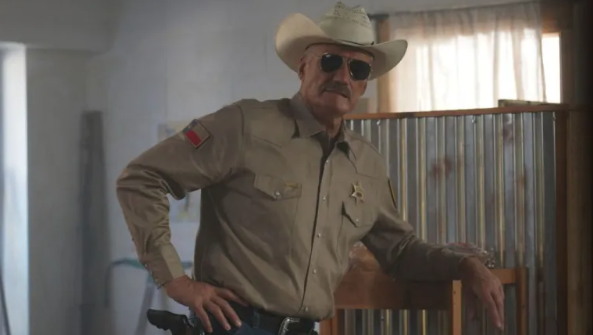
Florentine also goes deliciously against type with Dolph Lundgren as Sheriff Wiley — not the expected imposing heavy, but a crooked redneck lawman with a fake mustache and a mean streak. Florentine’s history with Lundgren (dating back to the early ’90s and Bridge of Dragons) gives him the confidence to push Dolph into stranger, funnier, and more human territory. “It was an opportunity for him to play a little bit like a redneck Sheriff… with the fake mustache, and to go with it.”
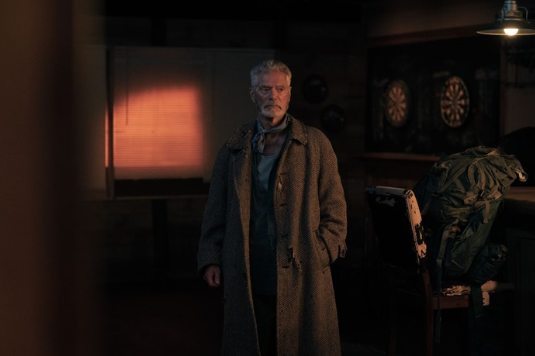
At the center is Stephen Lang’s drifter — Nomada, “The Man With No Name” — a figure Florentine explicitly frames as an homage to Clint Eastwood’s mythic strangers in High Plains Drifter and Pale Rider. “You don’t know if the character is a ghost… or is for real,” Florentine says. “You play in that space… you don’t know, is he a real angel? Is not a real angel.”
That ambiguity isn’t just dialogue; it’s physical. Visually and behaviorally, he looks like a hobo, but his posture and physical control immediately signal “there’s more to this guy than meets the eye”. Florentine talks about posture and movement — shoulders back, the way Lang sits, walks, watches — as the earliest tells that this man is more than he appears. Even the silhouette becomes part of the mythology. As Isaac explains, “The old jacket and hat were Stephen’s idea”, a detail Florentine initially resisted until it clicked. “He brought it, and he said,’ Isaac, I think this should be in the movie’… and then I said, ‘Wow, you’re absolutely right.’ It was like the poncho of Clint Eastwood in Fistful of Dollars that was later in For a Few Dollars More and The Good, the Bad and the Ugly”, a wearable symbol that carries genre.
If Lang’s Nomada is the myth, Lena is the faith that tests it.
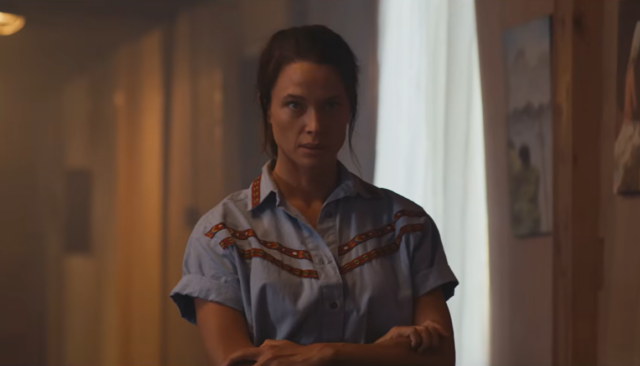
Scottie Thompson’s performance as Lena anchors the film’s emotional undercurrent: a Vietnam war widow living in a town that has stopped believing anything can change. With the idea of wanting “real people” rather than “poster” faces, he praises Thompson not just for her beauty, but for the lived-in truth underneath it. “She is beautiful, yes, but her inside is a real person… she comes and she creates a real person”, a fully lived in character. She is the real thing: emotional, physical, authentic, not artificial.
It’s this realness that lets Thompson carry Lena’s emotional journey from the doubting war widow to someone tentatively open to the idea that an “angel” might walk into her life. The vulnerability, faith, and physical resilience you see on screen are all anchored in that authenticity making Lena the film’s beating heart that takes us from grief toward the possibility that something like grace might walk into town wearing boots — becomes HELLFIRE’s quiet spine.
Clearly responsive to what actors bring and willing to expand roles when he sees more potential, Isaac discusses some of the supporting players, starting with Johnny Yong Bosch as Zig. “I’d worked with him on Power Rangers, knew his capabilities, and the character of Zig “grew up” substantially. Isaac is quick to point out that Johnny is not just an actor but also a filmmaker and later a key collaborator on action and fight choreography: “Johnny… not only created a character… but his contribution… to the movie is a huge contribution.”
As Jeremiah Whitfield’s son Clyde, thanks to Michael Sirow’s ability and depth, Clyde grew as they worked. For both Sirow and Chris Mullinax who plays Lena’s dad Owen, each “brought ideas to their characters.” Chris arrived with a specific haircut, “I liked it and it became part of the character.” The role of Rufus the motel clerk was an admittedly difficult one to cast locally in Arkansas where they were filming, but believing him perfect for the role, they flew Kim Estes in from LA. “His presence adds its own nice little touch.”
Despite being low budget, Isaac described the set atmosphere as “very good,” especially among the cast. Everyone was “in there to try to do their best and to come up with the best movie”
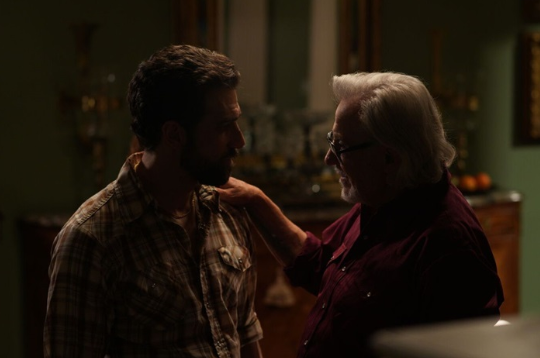
The action and fight choreography in HELLFIRE deepens character and, although fantastic, is not just spectacle.
Isaac is quick to point out that Stephen Lang did most of his own action. Isaac brought in a double early, unsure of his capabilities, and then discovered Stephen could actually handle much more than anticipated (e.g., jumping the bar) and kept that in, grounding Nomada as physically real, not just “mythic” in concept. The fights aren’t just “cool choreography”. It’s the payoff of the earlier, quiet mystery. The man who calmly fixes plumbing now reveals a controlled, lethal side that matches the angel/avenger aura the story’s been setting up. Mixing up fight disciplines, fighting style becomes biography.
Isaac stresses that Stephen Lang absorbs real hits and falls, within reason, so performance and stunt work are intertwined. Johnny and Randy’s choreography is built knowing what Stephen can believably do. This keeps the fighting tied to Nomada’s age, experience, and weariness — not superhero invincibility.
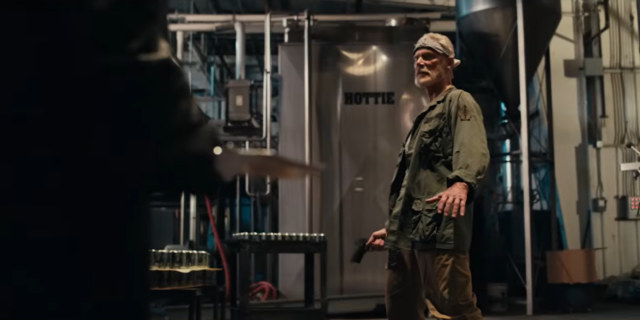
Because of the budget, Isaac had to pre-plan fiercely and delegate. Action is handled heavily by Johnny Yong Bosch and Randy Hall, people he already trusts stylistically. Johnny, as both an actor (Zig) and filmmaker, helps build action that still feels like Isaac’s world, not a disconnected unit. They divided the fight over multiple days, intercutting with drama scenes, to avoid compromising on the action. Because the same small, trusted group shapes both drama and action, fights feel like extensions of character beats, not genre inserts.
In the brewery fight sequences, Isaac uses the single large location to be everything: drug lab, saloon, hotel, and the fight arena. That brewery becomes a pressure cooker where everyone’s true nature is forced out. Fights are staged to emphasize Nomada moving through the environment with purpose, versus others being trapped or overwhelmed. Using the geography of bars, counters, and industrial elements to the character’s best advantage ultimately shows his tactical awareness.
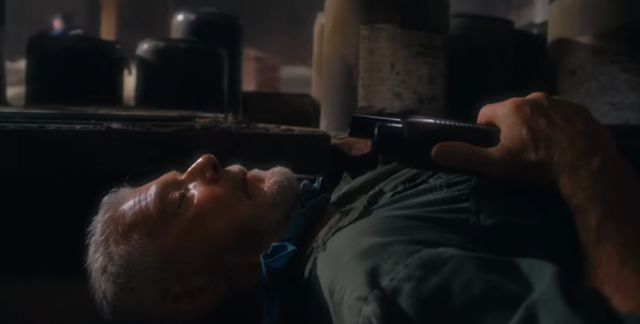
Florentine’s longtime partnership with cinematographer Ross W. Clarkson is the secret weapon here. They’ve collaborated since Undisputed II (2005/2006) and Florentine describes their shorthand with affectionate bluntness. “At this point, people say, you guys are like a married couple. You don’t talk. We don’t have to talk because he understands me, and I know [him].”
For Isaac, Ross is not only an “excellent DP” but “probably the best camera operator” he’s ever worked with. “When he takes the camera to his hands, magic happens.”
As a result of their lengthy intuitive collaboration, the visual grammar develops naturally into a classic solution. “We decided that we’ll shoot… like wide letterbox, so it will give some kind of a feel of an epic feel to the film.”
Going close with wide lenses is something Isaac loves. “Going with close [shots] with wide lenses. This is something that I always like to do.” Visually, that means faces and figures feel large and mythic, even in modest spaces, and environments stretch around them, giving a Western style scope without a massive budget.
Isaac cites Sergio Leone as a key influence. “I really am an admirer, of course, of Sergio Leone, for me, is the really the best…” He also brings up John Frankenheimer (e.g. The Train) as underrated, especially in black and white composition, framing and lens choices. Isaac’s own practice of close wides, strong compositions, and kinetic camera with Ross is consciously in that lineage. “I’m doing, actually, the same thing that they do, you know, because for me, it’s more cinematic.”

When the third-act climactic brewery fight arrives, it doesn’t feel like an action movie “finally starting.” Nomada’s calm control finally erupts, confirming what the film has been whispering through posture, silence, and withheld capability. Issac discovering Lang could do far more of the action than expected — and keeping that physicality in, grounded the myth in muscle and age-worn reality.
Florentine repeatedly points to the edit and Paul Harb’s work as where the movie’s psychological effect is forged — especially in flashbacks and quieter intercuts like a chilling bathtub scene. Co-editing with Kurt Nishimura, the heavy-lifting storytelling came from Harb and Florentine. The editing sustains the spiritual ambiguity right through the final moments, culminating in an ending dissolve that feels less like punctuation and more like a lingering question: was this salvation, or simply a very broken man doing what broken men do best?
HELLFIRE may deliver its catharsis in punches and blood, but Florentine’s real aim is older and stranger — a modern Western built from faith, doubt, and the uneasy possibility that redemption might show up wearing the face of violence.
by debbie elias, exclusive interview 02/11/2026
HELLFIRE is available On Digital and On Demand on February 17, 2026