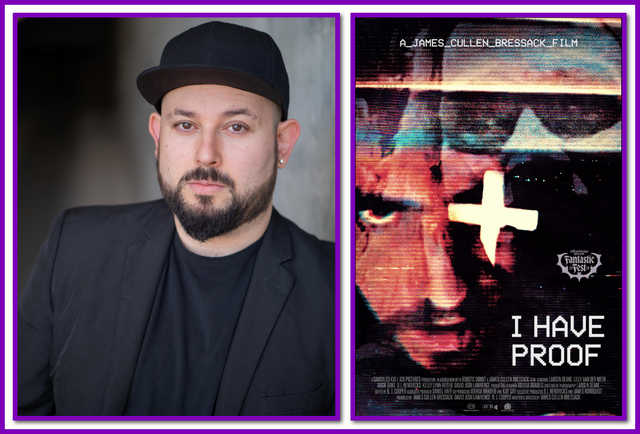
After more than a decade and countless conversations with writer-director JAMES CULLEN BRESSACK about his films, surprises are increasingly difficult to come by. His body of work has run the gamut from horror and action to thrillers, ensemble pieces and intimate character studies, often with familiar collaborators both in front of and behind the camera. But with I HAVE PROOF, Bressack delivers something unlike anything he has done before.
And frankly, unlike anything I have seen before.
Built around six VHS “evidence tapes,” I HAVE PROOF is a psychologically charged descent into obsession as Alex, played by Larsen Deane, attempts to prove something that no one else believes. But rather than tell us what to think—or even necessarily what to trust—Bressack places the evidence before us and turns the audience into judge and jury.
“I really wanted to make something where we’re following a character that believes something so much that he will stop at nothing to try and prove what he believes,” explains Bressack. “I wanted to make it in a way that was submitted as evidence, so that ultimately an audience gets to decide, almost like a jury, if they believe that he’s telling the truth or not.”
For Bressack, the genesis came from something far more relatable than the extremes to which Alex ultimately goes.
“There’s been times in my life where I’ve believed something and everybody thought I was crazy. And so to fight against odds, even though everybody around you believes you’re wrong—what is that mindset? I think something like that was interesting to explore, obviously at an extreme.”
That refusal to dictate a verdict is essential to I HAVE PROOF. At virtually every turn, Bressack challenges us to question what we’re seeing. Is this proof? Perception? Paranoia? Something manufactured? Something inexplicable? The film doesn’t hand us an answer sheet. It trusts us to examine what Alex presents and reach our own conclusions.
“In a day and age where many people are sleuths of their own and follow conspiracy podcasts and watch true crime docs and all these different things, I wanted to count on the audience to make their own decisions. And I hope that the audience at Fantastic Fest—and beyond Fantastic Fest—this creates discussions amongst them about what was going on.”
Those discussions are almost inevitable, because Bressack and his team fill every frame—and every tape—with clues, contradictions and tactile detail.
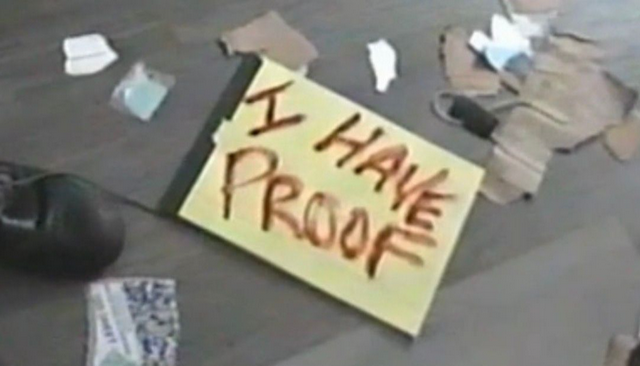
There is virtually no traditional dialogue for much of the film. Instead, storytelling comes through images, movement, objects and sound: blood-written messages on yellow legal pads; Polaroids marked with bloody fingerprints; black gloves; white envelopes pushed beneath a door; rosary beads and crosses; the increasing disorder of Alex’s hotel room. Even something as simple as a gloved finger dragging across glass becomes unnerving.
Nothing feels casually placed.
Working with production designer Joshua Bradeis, Bressack became particularly hands-on with the physical world surrounding Alex.
“I collaborated very heavily with Joshua, and I also went on a little buying spree on eBay and Amazon. I personally bought most of the things that you see on camera. And then Josh and I worked very heavily on decorating the hotel room and putting trash and stuff everywhere, so it felt like it was constantly in disarray.”
That collaboration became a necessity as much as an aesthetic choice. I HAVE PROOF was made with a crew of approximately five people.
“So many were wearing many hats. Josh was the production designer, but I was helping out in art, and he was helping out in moving lights around. All of us were doing many different things to be able to accomplish this movie.”
One of those many hats belonged to Larsen Deane.
As Alex, Deane gives Bressack a performance largely stripped of the actor’s most obvious tool: dialogue. His character is communicated through movement, breathing, stillness and increasingly unsettling behavior. At times he stares into a mirror almost as if trying to identify the person looking back at him. But Deane was doing something else simultaneously that makes the performance even more remarkable.
He was operating the camera.
Deane had previously appeared in Stupid Games, a smaller film produced by Bressack, and the filmmaker remembered what he’d seen in the actor. “I thought he was great in the movie, and I thought he would really be fantastic here. I think he brought a really brilliant quality to the character.”
Then Bressack handed him a camera.
“He also served as the DP, and he had never operated a camera before. He was acting as an extension—like the camera was an extension of his character. I think that it enhanced his performance by how he moved the camera.”
That choice proves invaluable. Alex isn’t merely being observed by the camera. In significant stretches of I HAVE PROOF, Alex is the camera. The incomplete sweeps around the hotel room, deliberate pans, searching movements and sudden discoveries become part of his physical vocabulary.
“Larson was very dedicated, and I was very impressed with him every day on set. I was blessed to have him on the film.”
But perhaps the film’s most haunting visual idea came about almost by accident.
Bressack made the unusual decision to shoot with VHS-C cameras. Finding unused tape stock wasn’t exactly as simple as walking into a store, so he turned again to eBay, buying tapes containing strangers’ old home movies and recording over them.
Fragments sometimes survived between takes. And those fragments sparked an idea.
“I got on eBay a ton of home movies from other people, and I was recording over their home movies. Fragments of that would cut in between takes, and that’s where I started to come up with, ‘Oh, having this birthday party would be great.’”
Bressack scripted the idea into the film and shot additional material during a pickup day. Working with his longtime editor R.J. Cooper, he then transformed those seemingly innocuous childhood images into one of the film’s most poignant structural motifs.
At first, glimpses of Alex’s childhood birthday party have some duration. As the evidence tapes progress, they become increasingly abbreviated until memories are little more than momentary blips.
“As the film progresses and as Alex’s desperation becomes more real, his humanity starts to fade away as he’s re-recording over his past. The less of him exists the further we get into the movie.”
It’s a beautifully conceived metaphor made possible by the physical medium itself. Alex’s obsessive need to document the present is quite literally destroying his past.
“It was almost poetic and symbolic to re-record over his history—to then show this proof—that his past and his life and his family and his love was less important than exposing the truth.”
Cooper is particularly instrumental in making that progression work. A longtime Bressack collaborator, he understands the director’s rhythms almost intuitively.
“R.J. is phenomenal. I don’t know what I would do without him. Him and I have such an in-sync energy. We’ve done so many movies together. I love the man to death, and he’s an unbelievable talent.”
Equally integral is sound designer Brian Berger, another longtime member of Bressack’s filmmaking family. Berger has worked with him since Bethany, made when Bressack was just 21, and his work on I HAVE PROOF is particularly critical because Bressack removes another familiar cinematic safety net.
There is no conventional musical score telling us when to become frightened. Instead, sound itself creates tension.
Alex’s breathing grows heavier and more desperate. Wind creeps into the soundscape. Environmental noises take on unsettling dimensions. Indistinct sonic textures seem to rise from somewhere beyond the frame. Small sounds become enormous because there is no musical cushion beneath them.
“I wanted to create tension and make things scary without necessarily doing what a standard horror movie would do, because I didn’t want to manipulate the audience with music and drones and tones.”
Berger therefore had to make the world itself frightening. “Brian found a way to make the sounds of the world create that. Really, my hats off to Brian. That was a lot of heavy lifting on his end.”
Then there is the analog technology itself.
For Bressack, shooting I HAVE PROOF on VHS-C wasn’t merely an aesthetic gimmick designed to evoke another era. The choice is embedded in Alex’s psychology. Convinced that electricity itself could be compromised or monitored, Alex relies on battery-powered equipment, physically labels tapes and records his evidence using technology that exists outside the connected digital world.
But Bressack’s attraction to analog went beyond story logic.
“I think that we live in a day and age where we spend so much time scrolling on our phones and being exposed so constantly now to AI-generated content and things that we’re seeing that are so digital. I felt that audiences would be craving something that was fully handmade and analog.”
And in one of the film’s most fascinating collisions of form and content, Bressack and his tiny crew weren’t merely photographing props representing Alex’s evidence. They were actually making the evidence.
“We were physically making tapes on set filming. We were creating the evidence tapes—the six tapes that are in the movie. We were on set making those tapes that he would then be sending to the police.” For Bressack, that became almost ritualistic.
“I liked the ritual and idea of life imitating art—that we were physically creating what the character was physically creating.”
That commitment to physicality extends into the film’s practical makeup and effects, particularly as I HAVE PROOF moves into its increasingly intense final act. Cheryl Holtzman and Eric Fox’s work benefits enormously from the imperfect texture of VHS-C. Rather than exposing the seams of practical effects, the format seems to make them more tactile.
“Something about shooting on VHS-C really makes practical effects feel even more real. My hats off to them as well.”
It all builds toward a final stretch in which the careful accumulation of evidence, image, sound and obsession erupts. Yet even then, Bressack refuses to take the jury’s decision away from us.
And perhaps that’s why I HAVE PROOF feels like such a departure for a filmmaker whose work I’ve followed for more than a decade. This isn’t simply Bressack working on a smaller scale or experimenting with an older format. He has stripped filmmaking down to some of its most elemental components—image, sound, movement, physical objects and editing—and then constructed a narrative in which the very means of recording reality becomes part of the question of whether reality can be trusted.
It is handmade filmmaking about the uncertainty of evidence in an age when evidence itself has become increasingly easy to manufacture.
And Bressack may not be finished presenting his case.
Asked whether there might be another chapter, his answer comes quickly. “If an audience wants it and it does well at Fantastic Fest, I already have an idea for a sequel. If people want it, I’ll make it happen.”
After six evidence tapes, James Cullen Bressack has presented his case.
The verdict now belongs to us.
by debbie elias, exclusive interview 09/10/2026
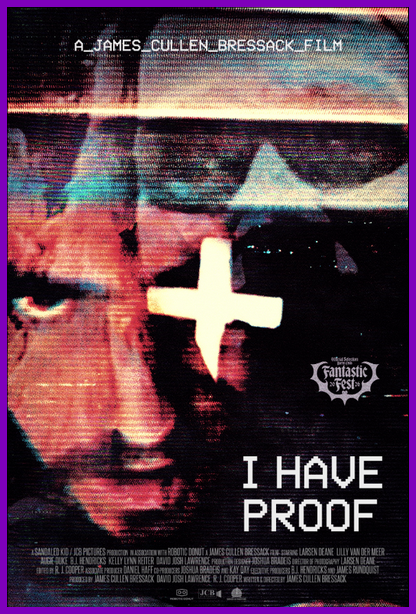
I HAVE PROOF makes its World Premiere at Fantastic Fest on Monday, September 21st at 5pm CT (Austin)