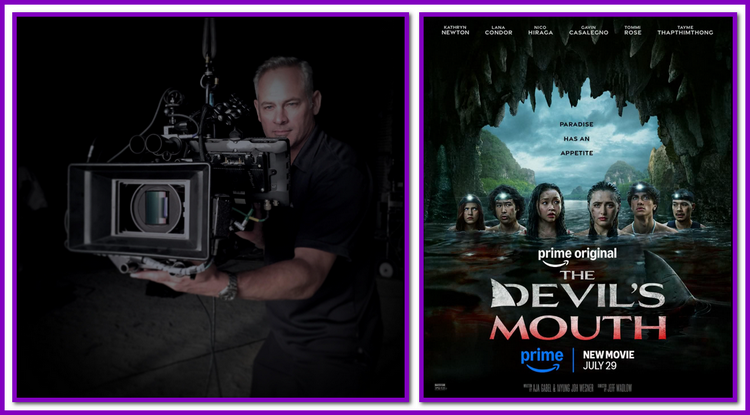
For cinematographer JAMES KNIEST, THE DEVIL’S MOUTH was more than another film credit. Having begun his career diving alongside acclaimed underwater photographer Ernest Brooks, the film reunited him with the underwater world that first inspired his passion for visual storytelling.
That passion courses through every frame.
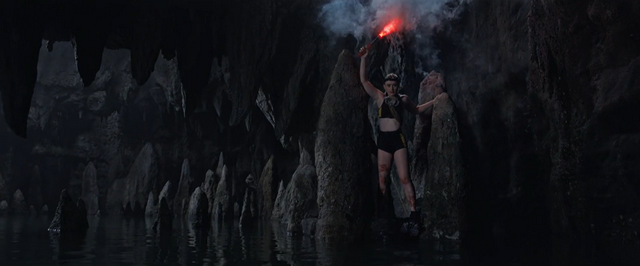
Set within a labyrinth of flooded caves hidden beneath Thailand’s spectacular coastline, THE DEVIL’S MOUTH immerses audiences in a world where darkness, murky green water, centuries-old stalactites and stalagmites, suspended debris, and dwindling pockets of air become as formidable an adversary as the bull sharks stalking their prey. Before a single shark attacks, the environment itself becomes the monster. Every narrowing passage, every wavering beam of light, every desperate search for breathable air ratchets up the tension until the cave seems intent on consuming everyone trapped within it.
The visual result is as exhilarating as it is terrifying. It is little wonder that, during our conversation, Kniest immediately laughed and embraced my description of the film as “The Descent meets Jaws,” as he admitted that The Descent remains one of the few films that genuinely unnerves him because of its overwhelming claustrophobia. That personal connection to the emotional experience of confinement quietly informed his approach to photographing THE DEVIL’S MOUTH, where fear begins long before the sharks arrive.
Reuniting with director Jeff Wadlow after previous collaborations, Kniest didn’t wait to be invited aboard. Eager for the opportunity to return to the underwater cinematography that first drew him into filmmaking, when he learned that Wadlow was mounting a shark thriller set within underwater cave systems, Kniest didn’t wait for the phone to ring. Instead, he reached out, assembled a reel showcasing his underwater work, and quickly realized that many of the story beats Jeff envisioned mirrored experiences he had already photographed. “I was kind of chomping at the bit and foaming at the mouth about how to approach all this,” Kniest recalls with a laugh. That enthusiasm, coupled with years of underwater experience, quickly instilled confidence that he could bring the film’s ambitious visual demands to life.
The attraction wasn’t simply another feature assignment. It was a chance to, as he puts it, “circle back to my roots with underwater work and underwater lighting and underwater camera equipment.”
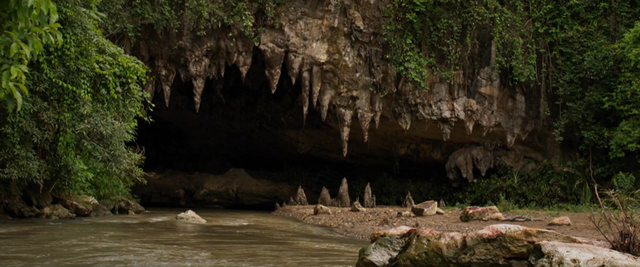
“We wanted to start the movie out showing this environment and establishing it… as much scope as possible… and then we slowly moved into the confines of the cave by shooting in real caves and real rivers that were just stunningly beautiful.”


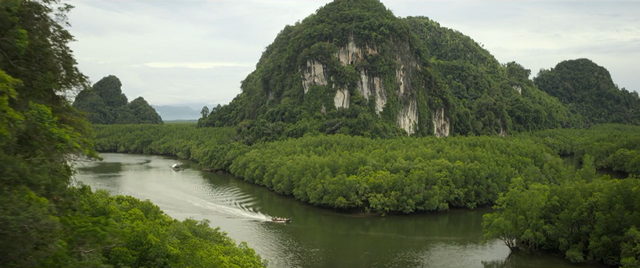
Shot on location in Thailand, THE DEVIL’S MOUTH opens in striking contrast to the claustrophobic nightmare that follows. Vast expanses of crystalline water, dramatic limestone cliffs, and sweeping Technocrane shots from a barge immerse viewers in the idyllic beauty of a tropical paradise. The images are lush, inviting, and deceptively serene. That visual generosity was entirely intentional.
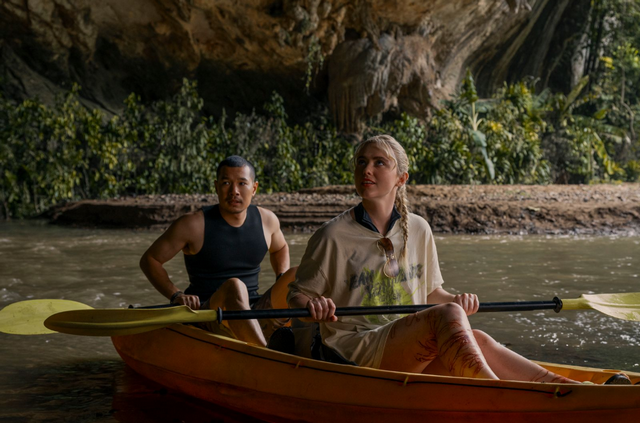
“It’s such a stunningly beautiful area… and that was one of the things Jeff [Wadlow] really wanted to accentuate — how beautiful the environment was — and set the tone that this was an exotic, fun, incredible vacation for these kids” before the story quite literally descends into darkness. The beauty of the opening becomes the emotional counterpoint to the suffocating terror that awaits beneath the surface.
“Your destination starts to take a hold of you.”
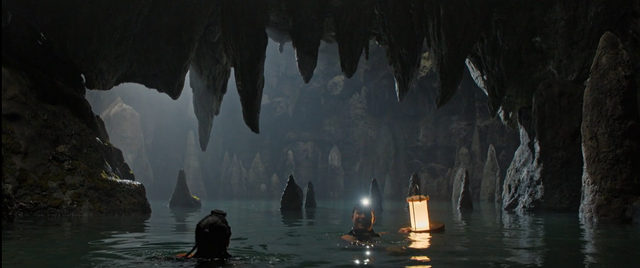
From there, both the story and the production plunge into increasingly complex territory. Filming became an intricate dance between Thailand’s real caves and rivers and an enormous stage-built tank designed to transform repeatedly throughout production. In the natural cave systems, Kniest and his crew navigated unknown depths, slippery terrain, safety restrictions, and constantly changing conditions while relying on compact floating camera and lighting platforms that could weave through narrow passages and disappear behind ancient stalactites and rocky outcroppings.
“We found some really, really interesting places that were safe enough for us to shoot in, and the water was warm enough and clean enough for us to shoot in — but it was real. It was real places for sure.”
On stage, production designer Alec Hammond constructed an approximately 180-by-80-foot tank populated with towering stalactites and stalagmites mounted on casters, allowing the environment itself to evolve from sequence to sequence. “Some of these stalactites and stalagmites were 10, 15 feet tall.” Even the cave ceilings became movable, suspended on pulleys and motors so sections could open to accommodate overhead lighting while preserving the illusion of an endless subterranean labyrinth. Rather than building multiple sets, the same cavernous space was continually reshaped, redressed, and relit to become an entirely new section of the cave system.
“One of the things we had to do was repurpose the same space for the different caves and the story points. So [Alec] was moving stuff all the time… We had a Technocrane in the tank on a platform that would roll around and be able to get in the right position for our coverage for the day.”
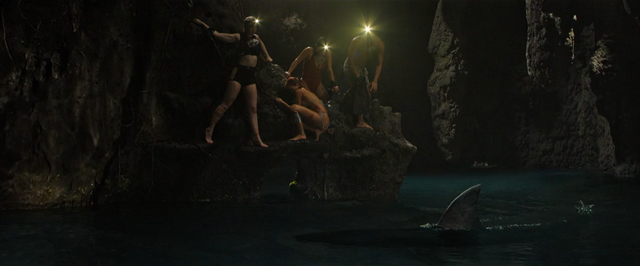
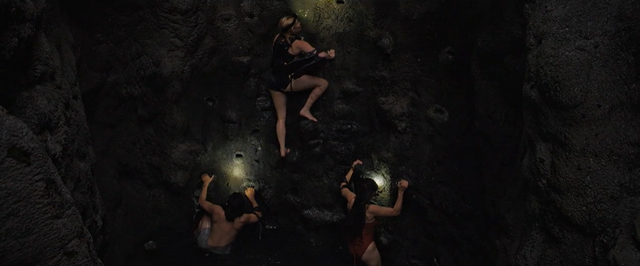
The unifying visual element—and one of THE DEVIL’S MOUTH’s quiet triumphs—is its lighting, particularly beneath the surface.
“There’s one thing about just lighting in general, and then there’s a thing about crafting the light, and so I try to always do the best I can.”
With no off-the-shelf underwater motion picture lighting available in Thailand, Kniest’s gaffer devised an ingenious solution, constructing custom battery-powered fixtures by clustering pool lights inside homemade metal troughs for use in both the rivers and the production’s massive tank sets. It was a practical solution born of necessity, but one that yielded an unexpected artistic reward.
Those homemade fixtures naturally produced a subtle green color spike—something Kniest initially feared would undermine the image.
“The funny thing about these homemade lights… is they naturally had a green spike in them because they weren’t motion picture lights. After scouting and shooting a couple tests in the real river and the real water column, that naturally has a real green vibe to it, these sort of homemade DIY lights… actually helped us with the continuity of the water column between the stage work and the real-life work.”
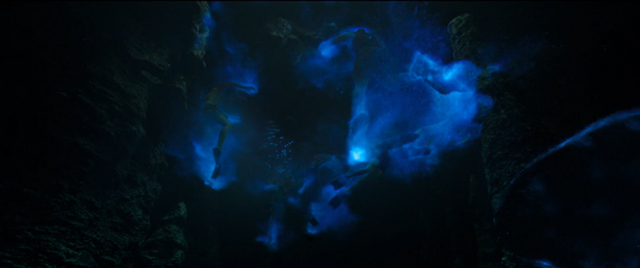
What first appeared to be a technical flaw suddenly became one of the production’s greatest visual assets, allowing the stage work and location photography to blend seamlessly into a single immersive world.
It’s one of those invisible accomplishments audiences never consciously notice, yet instinctively feel. Watching THE DEVIL’S MOUTH, there is never a moment where the illusion breaks. You cannot distinguish where the real caves end and the constructed environments begin. Instead, the oppressive green water, suspended debris, and suffocating darkness merge into one relentless visual experience. The world simply closes in around you.
Above and below the surface, the film’s most distinctive visual motif is its use of headlamps. Much like The Descent, much of the cave action is illuminated by the characters themselves, their narrow beams carving fleeting pathways through darkness, suspended debris, and murky water.
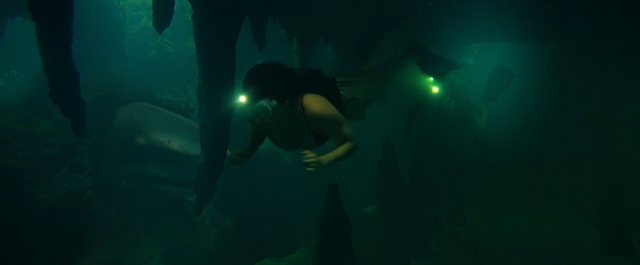
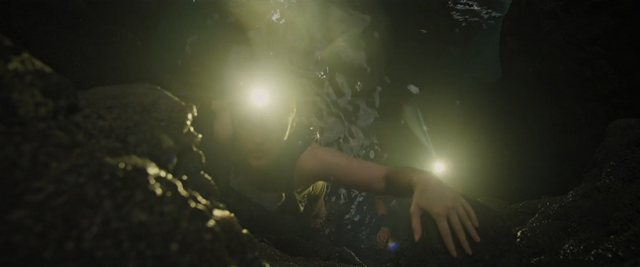
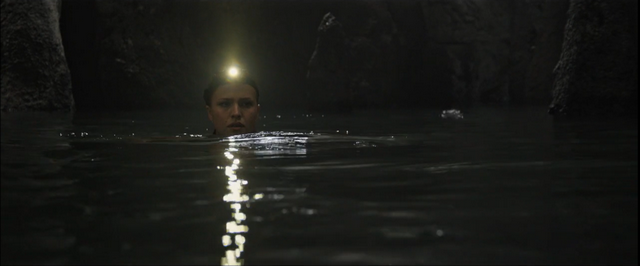
Kniest initially worried the lamps would overexpose faces and overwhelm the image with lens flares. Instead, they became one of his most valuable creative tools.
“The headlamps were an interesting thing because at first I was like, oh wow — they’re going to be three feet away and then two feet away and their faces are going to be all blown out. Secretly, I started to really embrace it because I felt like anytime there’s a conversation between the characters, at least there’s a light motivator, and their partner could be lighting their face for them.”
Working in water, where simply walking over to adjust a fixture isn’t an option, Kniest developed a visual shorthand with the cast. Small cues such as, “Tilt your light up a little,” allowed actors to subtly reshape the lighting from take to take without ever breaking the scene’s naturalism. It was an elegant solution born of necessity, transforming the performers into active collaborators in sculpting the film’s visual language.
Those headlamps worked in concert with the production’s battery-powered lighting units and wireless iPad-controlled fixtures, giving Kniest and his team the ability to make minute exposure and lighting adjustments in real time while cameras continued rolling. In today’s digital workflow, where there are no built-in pauses to reload film and rethink a setup, that flexibility proved invaluable, allowing the production to maintain both momentum and precision without sacrificing the immersive realism of the environment.
For Kniest, the choice of camera was an easy one. “The Sony Venice — I love that camera. It’s so versatile. Dual ISO is helpful, especially in low light. The one-stop internal NDs help me make minute adjustments really quickly remotely from the DIT tent because everything’s kind of wireless now.”
Equally invaluable was the Venice’s Rialto mode, which separates the sensor block from the camera body via a lightweight umbilical cable. Working from cramped boats and within fragile cave systems, the lightweight Rialto head could ride on custom flotation rigs or small skiffs while the heavier camera body remained safely elsewhere, dramatically increasing mobility without sacrificing image quality.
He paired the Venice with Angénieux EZ zooms, chosen specifically because they handled headlamp flare with elegance and, as full-frame, fast zooms, could live in underwater housings without constant lens swaps.
As Kniest notes, “We knew we needed zoom lenses because taking the cameras out of the water and taking [them] out the housing and changing lenses is just not time efficient. So we tested a bunch of zooms, and the Angénieux EZs were the ones that handled the flare the best. They were fast, they were full frame, they were small enough to fit into the housings.” Once submerged, the housing itself effectively becomes part of the optical system, making lens selection critical not only for image quality, but for production efficiency.
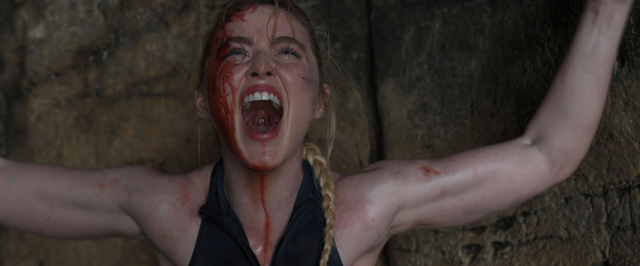
Of course, sharks are another key component of THE DEVIL’S MOUTH. “The main shark was visual effects brought in after the fact,” but even there, Kniest’s approach is tactile and performance-driven. “We did have several dummy sharks or models we used for scale and for framing.”
For Kniest, “One of the coolest things that somebody came up with was one of those little RC boats that they put an LED shark fin on”, giving the actors a moving eyeline they could track in real time. “It would be funny if two actors were imagining a shark swimming, but they’re both looking in other ways.”
It’s a charmingly analog solution to a digital problem—and emblematic of the film’s overall ethos: hand-crafted, practical ingenuity in service of an immersive modern genre film.
For Kniest, the journey proved every bit as rewarding as he had hoped. Looking back, he describes making THE DEVIL’S MOUTH as “fascinating, challenging, and I think very fruitful.”
The result is a film where logistical rigor, technical innovation, and emotional storytelling collide beneath the surface. What audiences experience—the creeping claustrophobia, the vertigo of endless depth, the disorientation of fractured beams of light cutting through murky water—is no accident. It is the work of a cinematographer who began his career exploring the underwater world beside Ernest Brooks, only to return decades later with the experience, confidence, and artistic maturity to transform that lifelong passion into one of the year’s most immersive visual achievements.
In THE DEVIL’S MOUTH, James Kniest didn’t simply photograph an underwater nightmare. He came home.
by debbie elias, exclusive interview 07/21/2026 – Part of our Behind the Lens Artisan Series
THE DEVIL’S MOUTH premieres globally on Prime Video on July 29, 2026!
#TheDevilsMouth