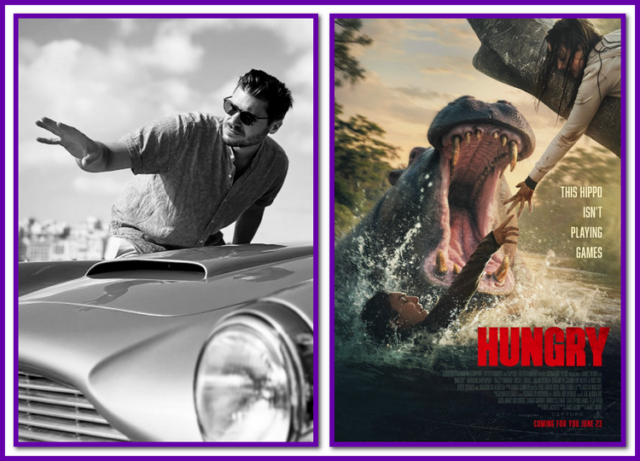
There are killer sharks. Killer crocodiles. Killer bears. Killer snakes. Killer just about everything. But killer hippos?
That’s exactly the delightfully unexpected hook at the center of HUNGRY, the latest creature feature from writer/director James Nunn, and one that proves there is still fresh blood to be found in the genre waters.
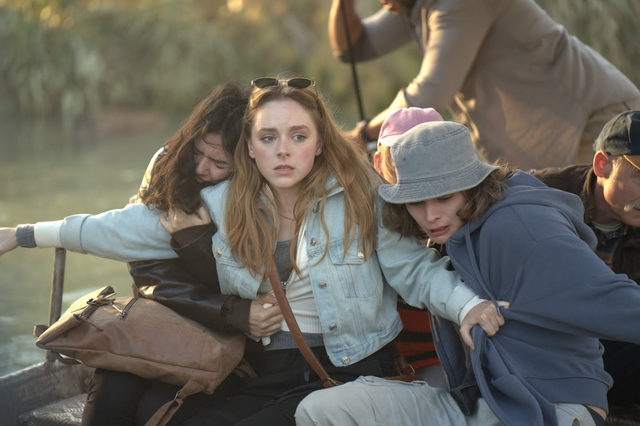
Set deep in the Louisiana bayou, HUNGRY follows a group of tourists whose thrill-seeking riverboat excursion turns into a brutal fight for survival against one of nature’s deadliest predators lurking beneath the murky swamp waters. And while the premise may initially sound tongue-in-cheek, Nunn approaches the material with the same reverence for tension, character, and atmosphere that fueled classic creature features like Jaws and Jurassic Park.
The seeds of HUNGRY were planted years ago after Nunn worked on 47 Meters Down with director Johannes Roberts.
“I was googling, ‘What are the most deadly animals on Earth?’” Nunn recalled with a laugh. “Hippos came up as one of the deadliest. It’s wild — they kill upwards of 500 people a year, more than sharks, lions, elephants combined.”
That discovery sent Nunn down a fascinating historical rabbit hole.
“I had recently been to New Orleans, which I loved,” he explained. “I had my animal, I had my location, and then I was like, ‘Well, how do I get the hippo in Louisiana?’”
The answer turned out to be stranger than fiction.
Nunn stumbled across the little-known true story of a proposed 1920s Louisiana hippopotamus ranching initiative designed to solve both a meat shortage and the spread of invasive Japanese water hyacinths clogging southern waterways.
“They were going to bring hippos to Louisiana to solve two problems,” Nunn said. “The hippos love eating the hyacinths, and they also needed to feed the population.”
Originally, Nunn envisioned the film as a 1920s-set period piece centered around the abandoned ranching operation itself. But practical realities — and audience perceptions of hippos as cute, harmless animals — forced a rethink.
“Everyone was like, ‘Hippos are cute and bubbly and fun.’ Nobody sees them as scary,” he laughed. “And then everyone was like, ‘This movie is going to cost way too much money because it’s a period movie.’”
Years later, however, the idea resurfaced when a producer encouraged him to revisit the project.
“Everyone loves creature features — they just get tired of sharks.”
That renewed push allowed Nunn to reimagine the story in present day while retaining the historical framework of abandoned hippos left to roam the bayou for generations.
“Lo and behold, 100 years later, we’ve got generational hippos in Louisiana,” Nunn said. “And that’s how we have hippos in Louisiana.”
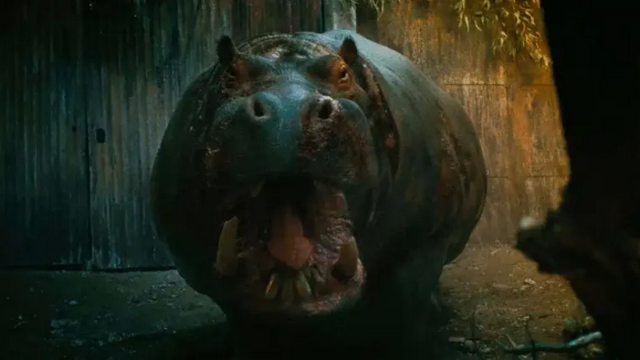
But what makes HUNGRY especially effective is Nunn’s restraint. Rather than immediately revealing the hippos in full, he carefully withholds them, allowing tension and uncertainty to build beneath the waterline.
“We’ve learned those lessons from Jaws, haven’t we?” Nunn said. “With hippos, nobody really knows what they’re going to get. We were able to tease it more.”
For much of the film, audiences catch only glimpses — rippling water, massive shapes undulating beneath the surface, ears twitching above the swamp. The effect is unsettling precisely because hippos carry such deeply ingrained cultural associations of cuteness and whimsy.
Ironically, part of that visual inspiration traces back to childhood animation itself.
“It’s probably closer to Fantasia,” Nunn admitted when discussing the film’s now memorable ear wiggles and aquatic movement. “They subconsciously implanted it into my brain when I was five.”
That contrast between familiarity and terror becomes one of the film’s greatest strengths. Nunn weaponizes the audience’s comfort level with hippos, gradually transforming ballet-like movements and seemingly harmless mannerisms into something genuinely frightening once the full destructive power of the animals is unleashed.
Visually, HUNGRY punches well above its budgetary weight thanks to Nunn’s continued collaboration with cinematographer Job Reineke. Having worked together for more than a decade, the two approached the film with an intensely prep-oriented mindset that began long before cameras rolled.
“Job likes to plan everything,” Nunn explained. “We talk about the sun, the orientation of the set, how the light’s going to move through the day.”
That planning became especially critical given the film’s ambitious central location: a massive outdoor water tank constructed specifically for the production in Malta.
“The tank itself was built with the orientation of the sun in mind,” Nunn said. “We wanted a fairly consistent backlight on certain parts of the set that would make it feel pretty, but also scary and visually bigger than the sum of the parts we could actually afford.”
That visual strategy extended beyond lighting into virtually every technical decision on the production — underwater photography, night-vision sequences, camera systems, lens selection, and even the physical mechanics of how to move cameras through the environment.
“Because we’re operating in the middle of a tank, essentially, you can’t just move the camera like you would in a room on a tripod,” Nunn explained. “You have to think about how you’re physically going to get out in the middle of the water to film something.”
Those considerations forced constant logistical problem-solving. Building separate dry sets for close-ups would have dramatically increased costs, while relying on cranes or movable platforms created additional time and budgetary complications on an already compressed five-week shoot.
“Can we afford a crane reaching over the tank the entire time? Can we afford platforms? And if we can, can we afford the time it takes to move them?” Nunn said. “So we had to employ a lot of technical thinking into how to achieve it. That’s one of Job’s strengths and one of our strengths together.”
The result is a visual language that maximizes the claustrophobia and danger of the swamp environment while simultaneously giving the film a cinematic scale rarely seen in modern creature features operating at this budget level.
And those logistics were substantial.
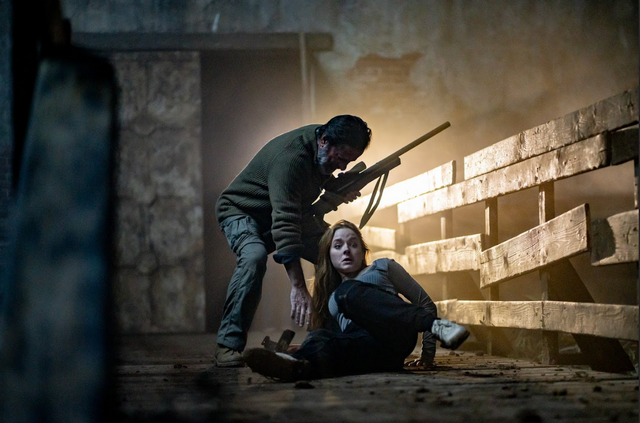
Though set in Louisiana, HUNGRY was actually shot in Malta, where production constructed a massive 50-by-50-meter outdoor tank in the middle of an overgrown wooded area. Production designer Charlo Dalli transformed the location into a grimy, abandoned hippo ranch layered with rusted cages, swamp decay, and decades of accumulated grime.
But building a convincing bayou in Malta came with unexpected complications.
“Malta’s so dry,” Nunn explained. “It was constant wet-downs and pouring water on the ground.”
Even the massive water tank itself presented challenges.
“It wasn’t heated at all,” Nunn laughed. “It was only filled about three days before we filmed, so it didn’t have time to warm up. And there was a tiny leak somewhere in the tank, so it had to just keep getting replenished with cold water. It never ever ever had time to reach any kind of temperature. So bless the actors — they were cold for sure.”
That physical discomfort ultimately added another layer of realism to the performances as the cast spent much of production soaked, shivering, climbing across submerged branches, and navigating Nunn’s murky hippo-infested waters.
A major contributor to HUNGRY’s carefully calibrated tension is the work of editor Richard Blackburn, whose collaboration with Nunn helped shape the film’s unusual rhythm of mounting dread punctuated by sharp jump scares and bursts of chaos.
“Richard’s a great editor,” Nunn said. “He’s a good friend. He actually did One Last Shot for me as well this year, so we’re two for two.”
What especially intrigued Nunn was the contrast between Blackburn’s sensibilities and his own.
“With my ‘One Shot’ movies, I love realism,” Nunn explained. “I’m pushing for that, whereas Richard comes from movies like Face/Off and John Woo. He has this old-school Hollywood mentality — double cuts, heightened energy — so somewhere in the middle we found this hybrid of realism meets Hollywood.”
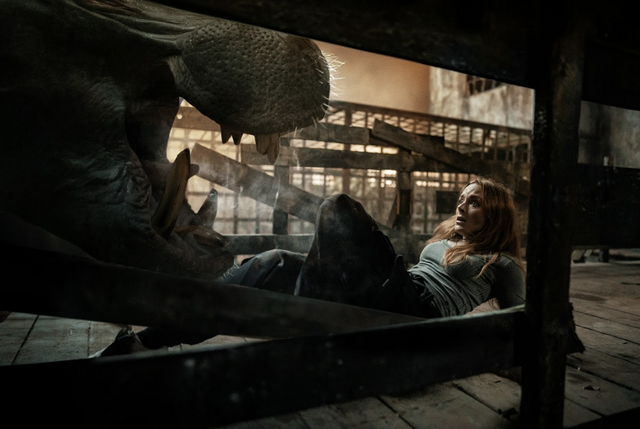
Ironically, the extensive visual effects work required for the hippos created a rare post-production advantage. Because the creature VFX took nearly a year to complete, Nunn and Blackburn were able to repeatedly revisit and refine the film in stages — a luxury most productions never experience.
“Usually you’ve got ten weeks to edit a movie, finish it, and it’s out there,” Nunn said. “You don’t get that same level of finesse.”
Instead, HUNGRY evolved through multiple editorial passes as new material arrived over time. Initial assemblies were revisited after Louisiana drone footage was completed. The film was then reworked around animatics and evolving hippo sequences before undergoing further refinements once near-finished VFX shots were delivered.
“It was a really amazing way of doing it,” Nunn reflected. “Things improve the more you see them. You put something to bed for a week and come back to it, and you’re going to make it better because you’ve had time to sit with it and see the flaws in it.”
That extended refinement process ultimately allowed Nunn and Blackburn to sharpen the pacing while preserving the film’s deliberate suspense-building structure.
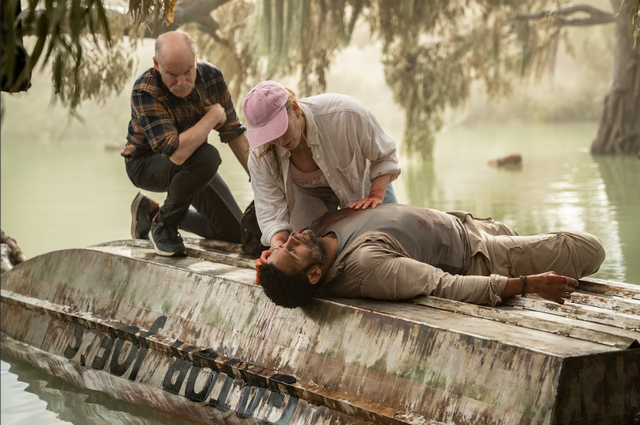
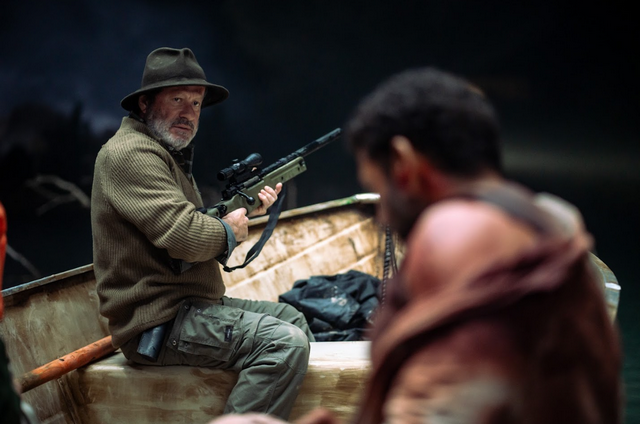
Nunn was equally enthusiastic about casting Jim Meskimen as retired firefighter Tim after discovering the actor’s audition tape.
“Jim is Hollywood royalty, as far as I’m concerned,” Nunn said enthusiastically. “His mum is Marion Ross from Happy Days. She’s Mrs. Cunningham, so she’s a national treasure… and he’s a very famous impressionist.”
Ironically, Nunn had only recently discovered Meskimen’s work online before the actor’s audition tape landed in his inbox.
“I even texted my producer, ‘Jim Meskimen for Tim!’” Nunn laughed. “And then I watched the tape, and he was just amazing. Not only was he great, he was by far and away the best Tim tape that we had. So I was like, ‘We have to get him.’”
Nunn was equally passionate about casting Madison Davenport as the film’s lead, Sistene, identifying her as his first choice from the outset.
“She was offered the role straight away,” he said. “She just immediately wanted to do it.”
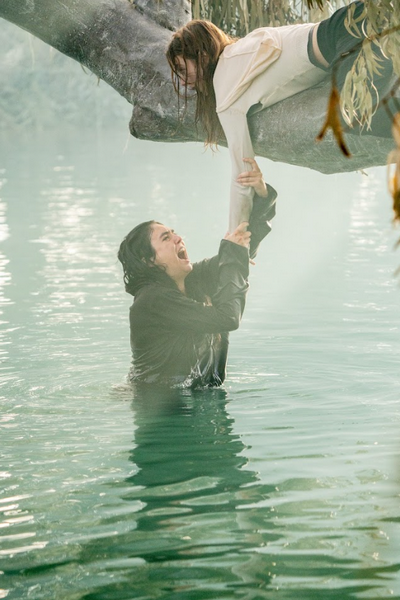
That emphasis on character ultimately separates HUNGRY from many modern creature features. While the film certainly delivers brutal attacks and crowd-pleasing jump scares, Nunn was adamant that the people caught in the hippos’ path feel like fully realized human beings rather than disposable cannon fodder.
“I like to create characters that you actually like,” Nunn explained. “Characters that have some kind of purpose and meaning rather than just being props to be eaten.”
For Nunn, emotional investment was essential to making the suspense work.
“I wanted audiences to actually give a shit when somebody died,” he said bluntly. “That was very intentional.”
At the same time, Nunn also wanted the screenplay to organically seed the human flaws and bad decisions that place the characters in danger in the first place — greed, ego, thrill-seeking, and the temptation to push beyond safe boundaries for the promise of something bigger.
“The reason they’re out there is because somebody paid some money to go a bit further than they should have,” he noted.
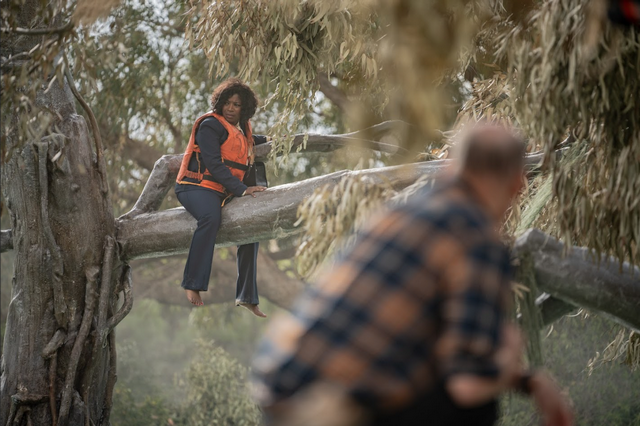
Interestingly, Nunn revealed that the original screenplay contained even more character material than what ultimately appears onscreen. But finding the proper balance between emotional depth and creature-feature momentum became one of the film’s biggest creative challenges during post-production.
“There was probably another ten pages of character stuff,” Nunn said. “And then in the edit, me and Richard and the producers had to figure out what makes them feel real, but also what drives what this movie is.”
That balancing act became central to shaping the final tone of HUNGRY — preserving enough humanity to emotionally ground the story without allowing the film to drift too far away from the suspense and propulsion audiences expect from a creature feature.
“You wrestle with when it becomes too much,” Nunn admitted. “At a certain point you go, ‘Hang on a minute… are we making a drama now?’”
Ultimately, that careful calibration between emotional realism and genre thrills becomes one of HUNGRY’s greatest strengths. The audience isn’t simply waiting for the next attack. They’re invested in the people trying to survive it.
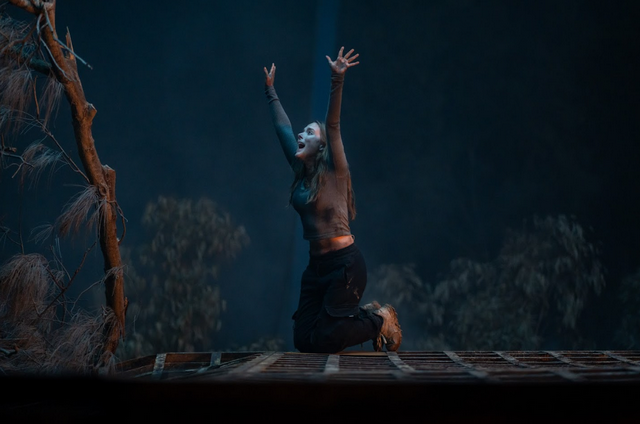
That care extends into the film’s broader thematic undercurrents involving greed, environmental disruption, and humanity’s tendency to underestimate nature’s unpredictability — thematic echoes that further connect HUNGRY to the Spielbergian adventure thrillers Nunn openly reveres.
Not surprisingly, Jurassic Park remains his all-time favorite film.
“In a way, this is like my mini Jurassic Park,” Nunn said. “It’s me living out my boyhood dream of making a film like that.”
And for creature-feature fans, that enthusiasm is infectious.
By blending old-school suspense, practical production ingenuity, emotional investment, and a wonderfully outrageous premise, HUNGRY delivers the kind of earnest, crowd-pleasing creature-feature filmmaking that reminds audiences why they fell in love with the genre in the first place.
And if Nunn has his way, this may only be the beginning.
“I’ve already got sequel ideas,” he teased. “Three cool ideas.”
by debbie elias, exclusive interview 05/21/2026
HUNGRY is in theatres on June 3, 2026 and on VOD on June 23, 2026.