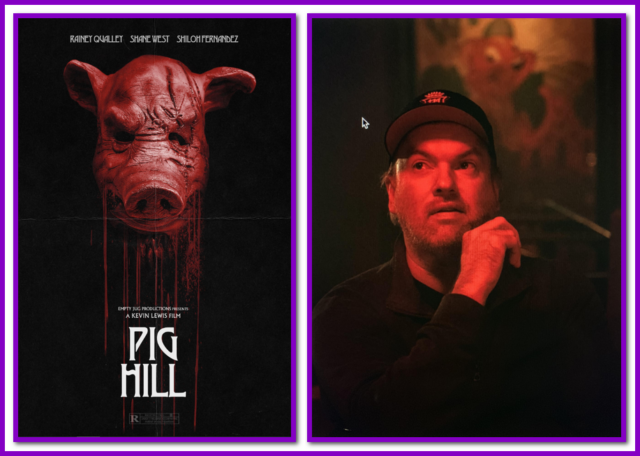
An exclusive interview with director KEVIN LEWIS discussing the making of his latest horror film, PIG HILL.
SYNOPSIS: Carrie has been fascinated by the local legend of the pig people of Pig Hill, revolting creatures who breed and cause havoc in the area. As the tenth woman goes missing, Carrie can’t stop thinking that there could be more to these stories.
Directed by KEVIN LEWIS with script by Jarrod Burris, PIG HILL stars Shane West, Rainey Qualley, Shiloh Fernandez, and R.A. Mihailoff.
KEVIN LEWIS is a filmmaker with a distinct directorial voice whose work I enjoy and respect, and who happens to be one of the nicest guys in the business. It was a joy to reconnect with Kevin for PIG HILL after conversations on his prior films, The Accursed and the acclaimed Willy’s Wonderland.
“I’ve always loved movies that feel like waking dreams,” Lewis says, citing Jacob’s Ladder, David Lynch, and Italian giallo as long-standing touchstones. “That idea that you’re awake, but something is… off. Reality keeps slipping.” That philosophy became the backbone of PIG HILL, a film he describes as deliberately moving between grounded drama and a “fantasmic” dream world without clearly announcing when one ends and the other begins.
Kevin first encountered the project through familiar territory. One of his producers from Willy’s Wonderland sent him Jarrod Burris’s script, adapted from Burris’s novel. “By the time I hit the third act, I was like, ‘I have to do this movie,’” Lewis recalls. What hooked him wasn’t just the horror elements, but the thematic undercurrent. “We’re living in this gaslighting, kind of grooming, isolating culture,” he says. “The pig people are almost a MacGuffin. The real horror is psychological.”
That thematic focus immediately dictated the film’s visual grammar. Working closely with cinematographer Tyler Eckels, Lewis set out to create a clear—but flexible—division between the real world and the nightmare spaces of Pig Hill. “The real world is Carrie’s normal life, Andy’s normal life,” he explains. “That stuff’s more classical—sticks, Steadicam, nice clean moves.” Once the film enters the barn, the cave, and the pig visions, that stability collapses. “That world is grungy, expressionistic. Dutched angles. Weird compositions. Shifting POV.”
Point of view was crucial, especially in the cave and barn sequences. “It’s got to be her POV,” Lewis insists. “It’s very dreamlike, and it’s what she’s seeing. You’ll notice there’s never a master shot in there.” That choice was intentional—by denying the audience a clean overview, Lewis forces them into Carrie’s subjective experience. “You’re not watching it happen. You’re inside it.”
Color becomes a storytelling language of its own. “Red is the past,” Lewis says, “but it’s also the past bleeding into the present.” As the film progresses, the palette intensifies, drifting from naturalism into full giallo territory—deep reds, blues, greens. In the barn, those colors curdle into muddy browns and burning oranges. Lewis fought hard to include fire in those sequences. “It’s primal,” he says. “Caveman stuff. Burning disgust.”
That obsession with tactile, memorable imagery extended to the pigs themselves. Kevin admits he was anxious about the design. “I didn’t want it to feel like just some pig mask,” he says. “It had to stick. It had to be something you don’t shake.” Jason Baker—known for designing The Black Phone’s Grabber mask and his work on Terrifier 3—handled all pig-related effects, from masks to puppets to the deeply unsettling pig baby. “Jason did such a great job,” Lewis says. “We looked at tons of references together, and we just kept pushing until it felt right.”
Even the distinction between the adult pig mask and the child pig mask was carefully considered. “That kid pig is very specific,” Lewis notes. “It’s tied to Uncle Jack. It needed to feel different.”
Casting carried the same weight. “This was not an easy movie to cast,” Lewis says plainly. When Shiloh Fernandez finally committed, it marked a turning point. “When Shiloh said yes, I was like, ‘Okay. Now we’ve got the movie.’” He describes Fernandez as “a fire that just keeps burning,” while Rainey Qualley brings what he calls a “transcendent quality” that keeps the audience emotionally tethered, no matter how strange things become. Shane West, meanwhile, grounds the film. “You feel for Andy,” Lewis says. “He’s humble. He’s been through something.”
Kevin was particularly focused on the brother–sister dynamic between Chris and Carrie. “Chris is always overwrought, always tweaking,” he explains. “And Carrie’s constantly defending him, excusing him. That tension is there from the start.” Andy, by contrast, is revealed slowly. “You don’t really know him until the third act,” Lewis says. “But the breadcrumbs are there. Eventually, they make a full cookie.”
In the edit, Lewis and his longtime editor Ryan Liebert faced the challenge of shaping a dense, twist-heavy narrative into something propulsive. “The assembly was like two hours and ten minutes,” Kevin laughs. “We had to get ruthless.” Still, clarity mattered. “I knew some scenes dragged, but I also knew I needed the information.” One experimental solution involved a montage Lewis pitched as feeling “like a videotape rewinding,” flashing through fragments as the story snaps into focus. “Ryan took that idea and just crushed it,” he says.
Sound ultimately became the glue holding everything together. Composer Emoi’s score is neither traditional horror nor conventional drama. “It’s more sound design than score,” Lewis says. Inspired by Dead Calm, Goblin’s 1977 Suspiria, and Lewis’s own habit of listening to The Cure throughout production, the music breathes, squeals, and blurs into the environment. “We used breath sounds, pig squeals—stuff that messes with you,” he explains. “You don’t always know where the music ends, and the sound begins.”
Editing and score worked in tandem to reinforce the film’s central goal. “I stopped worrying so much about whether everyone would ‘get’ everything,” Lewis admits. “I just wanted it to feel right. I wanted the ride.”
By the end of the conversation, PIG HILL emerges as a natural evolution of Kevin Lewis’s sensibilities—more confident, more visually aggressive, and less interested in hand-holding. It’s a film designed to linger, to haunt through image and mood rather than explanation. Talking with someone who clearly understands his rhythms, Lewis seems comfortable leaving a little mystery behind.
And let’s not forget what Kevin has coming down the pike for us as he talks about that as well!
TAKE A LISTEN. . .
by debbie elias, exclusive interview 12/05/2025
PIG HILL is available on VOD from Cineverse.