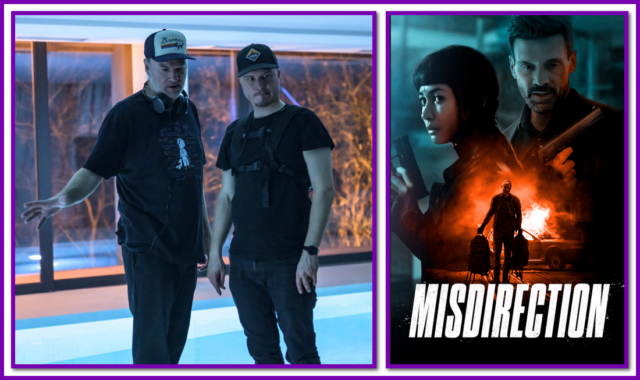
Director KEVIN LEWIS goes in-depth discussing MISDIRECTION.
SYNOPSIS: Set over one long night in a glass-walled modern house, MISDIRECTION follows a couple, Sara and Jason, who are planning that one final heist that will set them up for life before leaving their life of crime behind. Everything goes smoothly until things don’t. Their target, wealthy lawyer David Blume, returns home unexpectedly and stops their escape in its tracks. But Blume is neither the easy mark they thought him to be nor the person they thought he was; but then, neither are Sara and Jason. As the night spirals out of control, the pair find themselves caught in a web of secrets, deception, and deadly consequences.
Directed by KEVIN LEWIS with script by Lacy McClory, MISDIRECTION stars Frank Grillo, Olga Kurylenko, and Oliver Trevena.
*****
After several films rooted firmly in genre — from the grindhouse insanity of Willy’s Wonderland to the visceral sprawl of Pig Hill — director KEVIN LEWIS takes a deliberate detour with MISDIRECTION, a sleek, neo-noir thriller set almost entirely inside a modern glass house over the course of a single night.
It’s a bold shift on paper, but in conversation with Lewis, it quickly becomes clear that MISDIRECTION isn’t a departure so much as a recalibration. Genre labels matter far less to him than geography, performance, and emotional pressure — and here, all three converge inside one transparent structure filled with people who may be lying to us.
Lewis is quick to draw distinctions not between “horror” and “non-horror,” but between what each script demands. MISDIRECTION traps its characters — and the audience — inside a single location, where the house itself becomes an active participant in the storytelling.
“With this, you’re trapped in this house with these characters, and the idea that that house is a character…” Lewis explains. “With Willy’s, you’re trapped in a pizza fun land for kids. With this, you’re trapped in a house.”
That distinction matters. Where Willy’s Wonderland uses its location to drive heightened genre mechanics and spectacle, MISDIRECTION relies on proximity, faces, and time. Shot over fifteen nights in Serbia, the film leans into handheld immediacy, tight close-ups, and an escalating sense of unease that comes not from monsters, but from people watching each other — and hiding things in plain sight.
The entire project crystallized the moment Lewis saw the house. “When I saw this house and the sexy modern vibe to it, it felt like David would live here,” he says. “He would own this house. That was the one I was like, ‘We’ve got to shoot it.’ I knew that was our movie.”
The script was reshaped to fit the architecture — including relocating a pool inside the house — so that story mechanics, blocking, and tension were literally built around the space. The structure’s defining feature — walls of glass — immediately dictated both the shooting schedule and the visual language. “The whole film lives inside those walls, so the house had to be as strong a character as anyone on screen.”
“This was a pure glass house, so we had to shoot at night,” Lewis notes. “And that provided different challenges. But once I saw it, I knew that was our movie.”
Glass became both an aesthetic and an obstacle. Lewis and cinematographer Matti Eerikainen designed the film around reflections, negative space, and what remains unseen, transforming transparency into a weapon. “What you see and what you don’t see — that’s where the tension lives,” Lewis says, citing Hitchcock as a guiding influence. Because the home is a pure glass box, Lewis and DP Matti couldn’t cheat. “We had to shoot at night and design every shot around reflections and negative space – what you see and what you don’t see is where the tension lives.”
At its core, MISDIRECTION is a performance-driven thriller. Lewis repeatedly emphasizes that action is never the starting point — it’s the result.
“It’s primal,” he says. “Jealousy, anger, all these dark emotions that take over you. Every character thinks they’re doing the right thing. They’re the hero of their own story.”
That philosophy drives his camera choices. Tight close-ups dominate the film, allowing micro-shifts in expression to communicate truth, deception, panic, and control.
“If you want tension, you do tight shots on a face,” Lewis says. “Nothing can substitute a face.”
That approach gives Frank Grillo room to bring his trademark coiled intensity to David, a man whose sharp wit and barely contained violence make every exchange feel combustible. Oliver Trevena, wearing both producer and actor hats, adds emotional volatility as Jason — a wounded wildcard whose charm and hurt keep loyalties constantly shifting. And Olga Kurylenko anchors the film as Sara, carrying guilt, resolve, and uncertainty with an openness that never lets the audience fully settle.
Lewis made a deliberate choice to present Kurylenko without glamour — minimal makeup, a natural look that removes any barrier between the audience and Sara’s emotional state. “If you’re going to go rob a place, you’re not glammed up,” he says. “Keeping Olga natural was about protecting the emotional core — what would really happen with these characters.”
The decision wasn’t cosmetic; it was foundational. With the camera pushing closer and closer, Lewis wanted nothing distracting from Sara’s inner life. Every flicker of doubt and resolve plays directly on her face, reinforcing the film’s moral gray zones.
Despite its contained setting, Lewis chose to shoot MISDIRECTION handheld with anamorphic lenses — a combination that marries intimacy with scale.
“It’s a contained script, so on paper you don’t ‘need’ widescreen, but I grew up in the cinemas of the 70s, 80s, and 90s,” he says. “Movies look a certain way. Shooting anamorphic gave this one-house story that big, vintage feel while still staying right up in the characters’ faces.” The result is a widescreen frame that breathes with the actors — expansive enough to emphasize isolation, yet close enough to feel suffocating as the night unravels.
Working with longtime editor Ryan Liebert, Lewis designed the film’s tension as a gradual escalation rather than a single spike.
“We do a slow burn in the opening,” he explains. “Once they get into the house, everything just starts going haywire.”
The cutting pattern evolves from wider compositions into increasingly tight close-ups, culminating in extreme facial intimacy shot on longer lenses. Repeated digital clock inserts remind us that time is a factor, while flashes of weapons, blood, and reflections punctuate the mounting anxiety.
Sound design becomes especially crucial in the third act. “It turns into this hellish world,” Lewis says, describing how audio was layered to trap the audience inside the characters’ unraveling psyches.
Among all the technical precision, one of the film’s most quietly powerful elements is Bob — Sara’s battered stuffed dog.
Lewis credits instinct for the choice. After reviewing multiple options with the Serbian production team, one stood out immediately. “When I saw Bob, I was like, ‘That’s it.’ It just spoke to me,” he says. Olga agreed instantly.
Bob becomes an emotional anchor — a small, fragile object carrying the weight of love, damage, and loyalty. In a film about deception and moral compromise, he’s a reminder that tenderness and hurt often coexist.
Lewis is emphatic about acknowledging Oliver Trevena’s role beyond the screen. “Most people call themselves producers,” he says, “but Oliver is a true producer.”
Trevena assembled the project from the ground up — securing the script, bringing in Kurylenko and Grillo, and introducing Lewis to Eerikainen. MISDIRECTION exists because its pieces were intentionally brought together, not merely assigned.
What emerges from MISDIRECTION isn’t a rejection of Kevin Lewis’s genre roots, but proof of control. By stripping away spectacle and leaning into faces, space, and time, Lewis shows a filmmaker comfortable enough to let tension simmer — and confident enough to trust performance over excess.
It’s a film about confinement, but also clarity: a reminder that sometimes the most dangerous place to be trapped is a room where everyone thinks they’re telling the truth.
TAKE A LISTEN. . .
by debbie elias, Exclusive Interview 01/26/2026
MISDIRECTION is available on digital on February 10, 2026, from Cineverse.