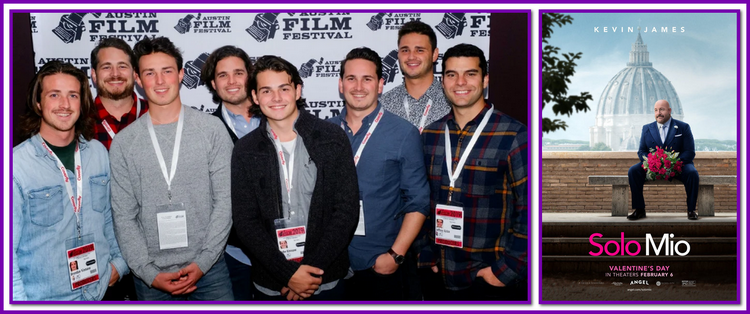
Romantic comedies don’t usually have to ask permission. They arrive in picturesque cities, point the camera at cobblestones and cathedrals, and let borrowed beauty do the work. But SOLO MIO, the first feature from the credited eight-man filmmaking collective known as The Kinnane Brothers, found itself doing something far rarer: seeking entry into a living tradition that had already decided it wanted nothing more to do with movies.
Directed by Charles and Daniel Kinnane and written by John and Patrick Kinnane together with Kevin James, SOLO MIO stars Kevin James, Nicole Grimaudo, Kim Coates, Alyson Hannigan, Jonathan Roumie, and Julee Cerda in a story about a man left heartbroken in Rome after being left at the altar at his wedding. However, against his own instincts, it doesn’t take long before stranded groom Matt Taylor (Kevin James) finds his ruined honeymoon transformed by a determined local (Nicole Grimaudo) and a few meddling travelers (Coates, Hannigan, Roumie, Cerda) — proving that sometimes heartbreak is only the beginning.
The Past Mends and Melds With The Present
Speaking with Executive Producer Jeffrey Azize (a Kinnane brother-in-law) and co-writer John Kinnane, I quickly learned that it wasn’t shooting in Rome and Tuscany that presented the biggest challenge for this filmmaking family. At the heart of that challenge lies the Palio di Siena — the centuries-old horse race that pulses through Siena’s Piazza del Campo each summer, governed not by tourism boards but by the city’s fiercely loyal Contrade. These neighborhood factions carry their colors and rivalries like medieval sports teams, and their relationship to the Palio is cultural, emotional, and generational.
According to Jeffrey Azize, the Contrade had effectively closed the door to outside productions after a previous film left relations strained. “They were very hesitant for another production company to come in,” he explained. “They said, ‘We do not allow this anymore.’” For SOLO MIO, access wasn’t automatic. It required unanimous agreement from all the Contrade — simply to license authentic race footage and to select one district of their choice to incorporate into the story. That rare approval transformed the Palio from a background spectacle into something earned.
Rather than staging an imitation elsewhere, the filmmakers embedded their actors and background performers into the real Piazza del Campo, later intercutting those moments with genuine race footage. The sequence carries an immediacy that no recreation could replicate and gives SOLO MIO an unusual texture for a romantic comedy — the sense that the film briefly intersects with a ritual that existed long before its arrival and will continue long after its departure. Fittingly, shooting at the Palio became the final day of production, turning the wrap into an emotional farewell not just to a location, but to a community that had cautiously opened itself back up to cinema.
A Family Affair
The effort behind that access reflects the collaborative ethos of The Kinnane Brothers, for whom SOLO MIO marks their Chuck’s second feature-length narrative directorial. All eight brothers contributed across the production: Chuck and Daniel Kinnane directed; John and Patrick co-wrote the screenplay; Brendon and William produced; Pete Kinnane edited; and brother-in-law Jeffrey Azize served as executive producer. It’s a model built on adaptability — something essential for a production that moved from concept in March to filming by September while navigating an overseas shoot.
The Man Who Made Italy Happen
Again and again, when discussing how SOLO MIO achieved its authenticity — from Roman streets to Tuscan vistas — the conversation returned to location manager Giancarlo Bartolomei. As Azize noted, “Giancarlo was our locations manager on set, and made everything happen . . . He literally, whatever we wished for, other than the Coliseum, that was pretty expensive to do, so that we unfortunately couldn’t film at the Coliseum, but he checked off all of our wish list items. He was a phenomenal locations manager, and he had these relationships with everybody at these venues, and he was able to negotiate on our behalf.” Those relationships proved vital — including in earning the trust necessary to work within Siena’s Palio itself.
In a fun bit of casting, and demonstrating Batolomei’s dedication to the project, he was cast as Gia’s ex-boyfriend Vicenzo. According to John Kinnane, “We were trying to find… Vincenzo. We were watching all these auditions, and we were just like, we can’t find the right one… Finally, they’re like, why don’t we just get Giancarlo to do it?” And he did! A fitting symbol of how deeply the production relied on his presence.
A Luminous Counterpoint
At the center of the film’s emotional journey is Nicole Grimaudo as Gia — a revelation for American audiences, though already well known in Italy. Luminous on screen, with an infectious smile and laugh, Grimaudo brings a warmth that reshapes the film’s romantic core. Her chemistry with Kevin James elevates his performance into something more grounded and vulnerable than audiences may expect — arguably his strongest work since Here Comes the Boom. According to Azize, “She just took the film to another level. . .She’s a diamond in the rough. She’s amazing. . . Nicole spoke very little English, and we had to work with a translator on set. And she learned all of her English lines phonetically. . .Nicole is the same person on camera as she is off camera… her energy, her attitude… was infectious… she always just lifted everybody up and kept the set very light and funny, and always was very inclusive to everybody, and made everyone feel a part of the project in a very special way.”
Despite Grimaudo speaking limited English, her commitment underscores the filmmakers’ willingness to prioritize presence and authenticity over convenience. The result is a dynamic in which Gia doesn’t simply support Matt’s journey — she catalyzes it. Kevin James’ performance finds its strength not in isolation but in response to hers.
Italy as Emotional Landscape
Cinematographer Jared Fadel builds on that authenticity by turning Italy into more than scenery — it becomes an emotional barometer.
As Azize notes, “When you film in Europe, a lot of movies tend to lean into the claustrophobicness of the environment. It’s not like America where things are open wide spaces.” In Rome, narrow streets are framed not as claustrophobic but as intimate, cocooning the central characters within the vastness of the Eternal City. Expounding on Fadel’s work, John Kinnane notes that “[Jared] definitely leaned into it, wanting to make it and use it to our leverage for intimacy, rather than its claustrophobia. And that you could be anywhere in Rome, and feel intimate, like it’s just the two of them in a city alone, the Eternal City,”
The choice to avoid claustrophobia underscores the emotional safety and warmth of Matt and Gia’s connection. Matt’s story starts in narrow, intimate frames in Rome with a man emotionally closed in, just off a broken wedding. As his relationship with Gia deepens, the movie literally opens up with wider frames that mirror his widening emotional horizon. By the time we arrive in Tuscany, the “wide, open, glorious spaces” reflect a man whose world has expanded beyond heartbreak into possibility.
Jared Fadel’s camera traces Matt’s inner shift from constriction to emotional openness, using geography and framing as a visual barometer for his connection with Gia. As the story progresses, the visual language expands. Tighter Roman compositions gradually give way to wide, sunlit Tuscan vistas, mirroring the protagonist’s emotional shift from heartbreak toward renewed possibility. Fadel’s imagery preserves the warmth of Italy’s historic textures — stucco walls, terra cotta hues, and centuries-old patinas — grounding the romance in lived-in reality rather than postcard fantasy.
Color and texture also come into play with the visual grammar and visual tonal bandwidth. With Jared’s work, we really get the feel of the colors, many of which are centuries old, on some of those buildings; the stucco, the terra cotta, and we really get to see and appreciate that. As Jeffrey explains, “In Jared’s early look book he presented, it matches the final product of what you see in the theaters. He nailed it immediately…”
More Than a Backdrop
Ultimately, SOLO MIO treats Italy not as decoration but as a partner in storytelling. Rome shelters. Tuscany expands. Siena’s Palio endures. In a film shaped by family collaboration, cultural trust, and a luminous emotional core, love doesn’t unfold in isolation — it unfolds within legacy. The legacy of tradition, of place, of community, and of a city that has long understood that heartbreak and joy are simply part of life’s rhythm.
And in the Eternal City — where history hums beneath every footstep — SOLO MIO finds its footing not just in romance, but in a shared love of life itself, a love shared by each and every one of The Kinnane Brothers.
by debbie elias, exclusive interview 02/13/2026
SOLO MIO is in theatres now.