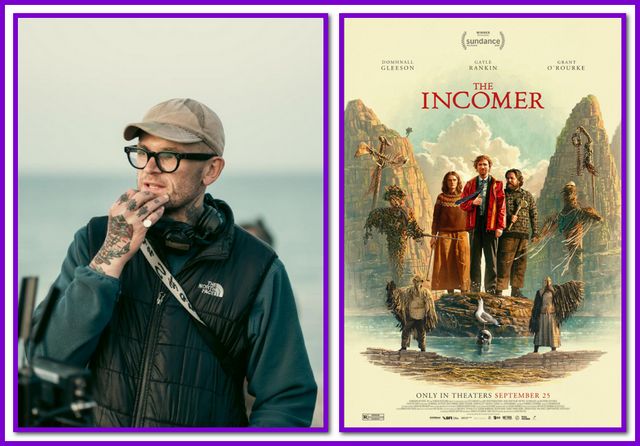
Long before there was an Auke Island, an Isla and Sandy, an awkward mainlander named Daniel, or even THE INCOMER, there were islands.
For writer/director LOUIS PAXTON, they were the islands surrounding the UK and Ireland, most personally the Orkney Isles just north of Scotland where his family has roots and where he spent time growing up.
“My family are from the Orkney Isles, which is the archipelago just north of Scotland, and I grew up going to these islands, and you know, just spending time around these these incredibly kind of evocative, romantic locations where you know there was history dating back 1000s of years. You had standing stones and shipwrecks and abandoned crofts. And these islands that at one time were inhabited, now there were just the ruins of these these houses that they used to live in. And I became really obsessed with the the the decision that they made these people at some point to leave these islands, and why they made that decision.”
Paxton couldn’t stop wondering why. He became fascinated by the people who had once called those islands home, by their unusual ways of life, their folklore and, most of all, by the decision they eventually made.
“I became really obsessed with the decision that they made, these people at some point, to leave these islands, and why they made that decision.”
Out of that childhood fascination comes Paxton’s wonderfully strange, darkly humorous and unexpectedly heartfelt narrative feature directorial debut, THE INCOMER.
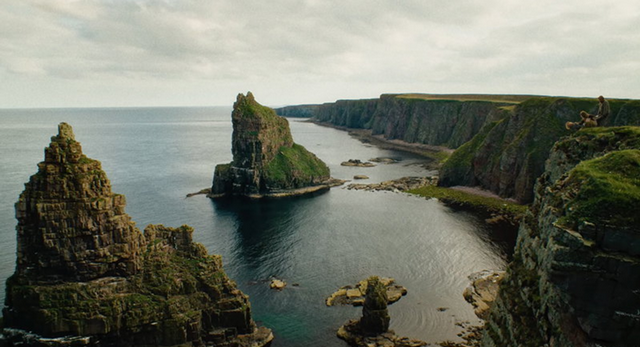
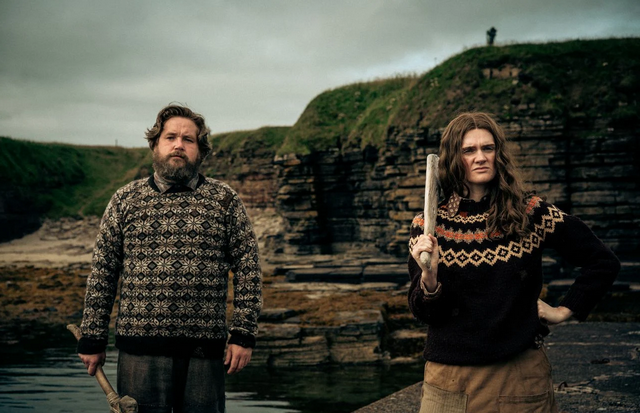
Set on the fictional Auke Island, THE INCOMER centers on brother and sister Sandy and Isla, played by Grant O’Rourke and Gayle Rankin, who have lived alone together for more than 30 years. Their existence is steeped in the Scottish folklore and stories passed down by their father, including the belief that they are descended from gulls. Isla converses with mythical creatures inhabiting the surrounding waters. Sandy, sheltered from virtually everything beyond the island and shaped by what his sister has taught him, retains an almost childlike innocence and wide-eyed wonder.
And anyone arriving from the mainland has a name. Incomer.
Enter Daniel.
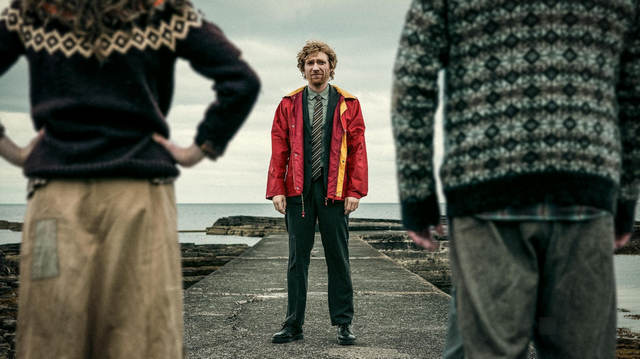
Marvelously played by Domhnall Gleeson, Daniel is a socially awkward worker-bee who is far more comfortable avoiding face-to-face human interaction than engaging in it. Unfortunately for him, his thoroughly unpleasant boss Roz sends him to Auke Island to evict Isla and Sandy.
His welcome is less than warm.
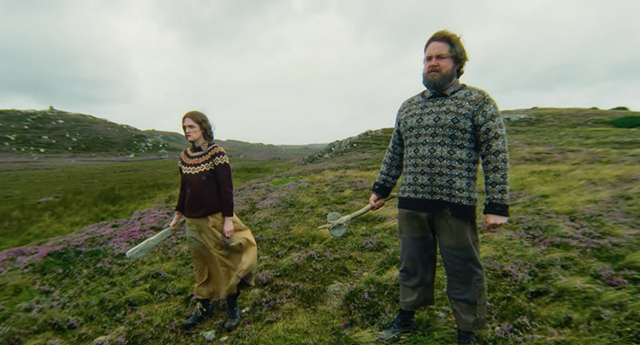
Dressed in handmade bird costumes, Isla and Sandy greet their Incomer by throwing a rock at his head and knocking him unconscious. Welcome to Auke Island.
Absurd as all of this sounds, Paxton understands that THE INCOMER only works if nobody behaves as though any of it is absurd.
“The best jokes are told with a straight face,” Paxton recalls cinematographer Patrick Golon telling him. That philosophy became fundamental to the film.
“The more seriously it’s played, and the more seriously everyone takes it, the funnier it is,” says Paxton. “Especially if it’s something that’s really absurd.”
There are few conventional gags or one-liners. Paxton never asks his actors to search for a laugh.
“I would never—I don’t like them to go looking for laughs. I like them to just play the reality of the situation.”
And therein lies not only the humor of THE INCOMER, but its heart.
Paxton never treats Isla and Sandy as ridiculous people simply because their reality differs from ours. Their beliefs, fears and peculiarities are emotionally real to them, and Rankin and O’Rourke play that reality with complete sincerity. Gleeson does the same with Daniel, whose bewilderment at the world into which he has been dropped never becomes a knowing wink at the audience.
The result allows us to laugh at the absurdity without laughing at the people.
More importantly, beneath the gull costumes, folklore and eccentricity, Paxton is exploring something deeply recognizable. Isolation.
“The more I developed the story, the more I found the relevance to contemporary society with this sense of isolation and how in modern society we can often feel still quite lonely and still quite isolated despite being surrounded by people all the time.”
But Paxton gives that idea a fascinating geographical contradiction. Isla and Sandy are physically isolated from virtually everyone. Yet they have each other.
Daniel lives on the mainland, surrounded by civilization and people. Yet he is alone.
Paxton was drawn to “the contrast of them being geographically isolated, but then the person from the mainland, despite being surrounded by people, ultimately feeling quite isolated themselves.”
For all their wildly different backgrounds, the three share something fundamental: “The more different we are, the more the same we are, and that really comes through beautifully here.”
As Daniel gradually becomes more than simply an Incomer, the closed world Isla and Sandy have inhabited begins to shift. Friendship becomes possible. New emotions emerge. For Sandy, whose universe has essentially consisted of his sister and the stories she has passed along to him, another human being suddenly means another relationship to understand. For Isla, whose life has been governed largely by fear and the responsibility of protecting their existence, Daniel introduces possibilities for which she has no real frame of reference.
One of the sweetest expressions of that comes when Isla retreats to her shed and turns to old women’s magazines for guidance on makeup and hairstyles. With her mother’s old cosmetics carefully saved through the years, she applies lipstick, fixes her hair, adds flowers and puts on a dress. She isn’t playing dress-up for a joke. She is trying to understand what women do when romance enters their lives. It is funny, innocent and deeply touching all at once.
And Sandy, discovering that a new friendship may also mean having to share his new friend with his sister, has his own unfamiliar emotions to negotiate. Sometimes loudly. Sometimes physically.
Sibling diplomacy on Auke Island can involve a considerable amount of hitting.
But beneath the comic sibling combat is the disruption caused whenever another person enters a previously closed emotional system. Daniel’s arrival doesn’t merely threaten Isla and Sandy’s home. It changes the relationship between them by making their world larger.
Visually, Paxton and Golon were determined to approach that world with the same seriousness as the performances.
“What if we treated this really seriously?” Paxton recalls of their early discussions. “We didn’t necessarily shoot it like a comedy.”
Rather than the brightly lit or heightened imagery commonly associated with comedy, Paxton and Golon looked toward period films, westerns and even horror.
“The more we kind of lean into the the realism of it, which sounds like a silly word because it’s so heightened, but genuinely, our all of our references were, you know, period films and westerns and things like that.
The straighter it’s played, and the more they leaned into the realism – an admittedly curious word for a story involving people who believe themselves descended from gulls, “I felt like this film would benefit from that.”
Their color palette came largely from the landscape itself. The purples of heather. Greens. Earthy bogs. Lichen clinging to buildings. Rich yellows in the plant life.
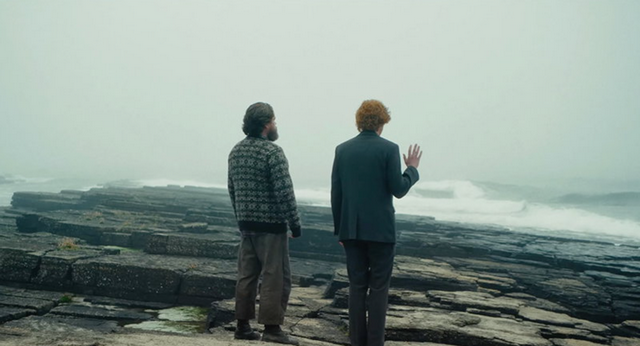
“All of these colors were our exteriors, and then the yellow, the big kind of rich yellows you get with the the the plant life up there as well. But then the interiors were all locations that we sourced within 100 miles, and they were so like all of the buildings that were essentially just cleared out. Whilst we dressed them and we did work to them, they’re largely as we found them.”
Almost every location was found rather than constructed, allowing Paxton, Golon and the production design team to draw upon the textures and colors already embedded in the environment. Interiors brought distressed mint and sage tones together with warm teak-colored woods.
“The interior of their house has this these beautiful kind of like passport colors to them. There’s this kind of mint, sort of sagey kind of color, which is really distressed, and then these beautiful kind of woods as well, this kind of teak color, and we just that that became our palette for the film because that’s what we were working with.”
Only Isla’s coastguard shed was built. Even that was constructed on the edge of a cliff.
Because Isla and Sandy live without electricity, “we just lent into the fact that they wouldn’t have electricity, and so it was candlelight or it was oil lamps, and you know, and daylight. And from that point of view, a lot of our references were things like “There Will Be Blood” , or just like films that were set during a period where there wasn’t necessarily a lot of electricity, or kind of electrical, you know, tungsten lighting. You hit on this contrast we wanted to find as well.”
And then the mainland intrudes.
“When the mainland turns up, the mainland is kind of, you know, it sticks out. It’s like it’s garish or it’s overt. It’s kind of luminous. The first instance of that is actually the dildo when it even is like it’s so alien and it’s kind of like pink. We deliberately wanted to make that as garish as possible, so that it really just felt like it was an alien object in this landscape.”
The Incomer doesn’t simply arrive.
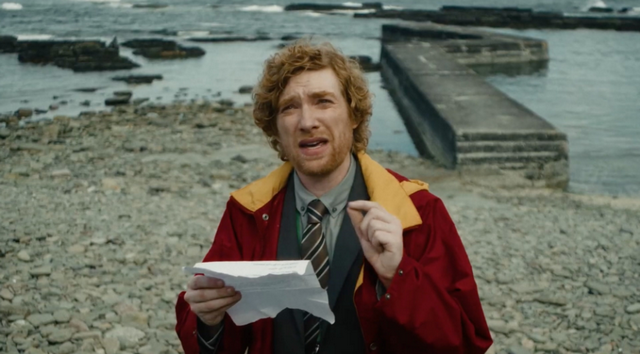
Visually, he doesn’t belong.
Daniel subsequently arrives wearing a bright red-and-yellow jacket. Even the boat announces itself in an “emergency red color.”
When Paxton eventually takes us to the mainland, the visual grammar changes again.
“We looked at everything being—we looked at straight lines and filming people square on,” he explains. “Inside the council building, it’s very you, know regimented.”
Auke Island is treated differently. “We often played the depth and used foreground kind of nature, whether it was plant life or shooting round buildings and things like that.”
Movement is similarly restrained, allowing space and awkwardness to develop within the frame.
“I feel comedy works well when you get a sort of sense of space and an awkwardness, and so much of this tension.”
But once again, comedy is only part of the equation. Paxton is equally inspired by horror, and THE INCOMER repeatedly borrows its cinematic vocabulary.
“I’m just as inspired by horror as well. There was a lot of sequences which are very horror coded. There’s a lot of tension, and then the release is often a laugh.”
That relationship between tension and release becomes one of the film’s most important creative principles.
“It’s definitely more of a comedy. But a lot of the language is, I suppose, very cinematic, classic cinema.”
It also made the editing room critical.
Working with editor Brian Phillip Davis, Paxton had to continually calibrate precisely how long a laugh, emotional beat or scare could live before it altered what followed.
“Tonally, you’re just constantly tweaking.”
Sometimes that meant removing an entire scene or a line.
“Sometimes there’s just not room for another joke there because you want this moment to land emotionally, or you can’t necessarily play a scare as hard because you want the weight of that scare and the hangover just kind of will derail the next scene.”
Davis, whose work encompasses both horror and comedy, proved an ideal partner.
“I’ve worked with Brian a few times now, and he is so skilled,” says Paxton, praising the strength of Davis’s initial assemblies and his instinctive understanding of the material.
A beautiful example of the film’s tonal dexterity comes when Daniel teaches Isla how to swim. What begins as one of THE INCOMER’s sweetest passages can pivot toward something much darker without feeling as though Paxton has suddenly changed films.
That works because the language of horror has been quietly present all along.
“There’s definitely points where we’re playing a moment for humor, but it’s not so much like one-liners. There’s not gags, you know. There’s a couple of kind of slapstick moments that are definitely kind of comedic. But the key to those, we’re always about tension, and it was always about playing everything for real. It’s it’s very much my style when I work with actors. I don’t like them to go looking for laughs. I like them to just play the the reality of the situation.”
And it isn’t only in the imagery or the edit.
Composer Tom Kingston provides another essential component of THE INCOMER’s tonal identity. Paxton wanted the musical world rooted in Scottish folk instrumentation but had one important instruction.
“I want to use Scottish folk instruments, but I don’t want to use them traditionally because they don’t live a traditional life.” It is a wonderfully concise expression of the entire film.
Isla and Sandy have inherited folklore and tradition, but their existence is entirely their own. Kingston’s music operates in much the same way, taking recognizable musical heritage and reshaping it into something unusual, sometimes playful and frequently foreboding.
Paxton was particularly inspired by the score for RAVENOUS and its use of looping instrumentation.
“I love the idea of looping instruments,” he says. “Tom took that, went away, and just ran with it, and came back with something that was beyond what I could have hoped for.”

Percussion becomes especially effective, with individual drumbeats functioning almost like the heartbeat of the island itself—a driving pulse beneath the characters and landscape.
Intriguingly, heard apart from the film, much of Kingston’s score doesn’t immediately announce itself as comedy at all. “A lot of it’s quite horror,” says Paxton. “It’s not necessarily comedy again.” Some passages are playful, but others are unmistakably foreboding.
And again, Paxton returns to tension.
“It’s all about tension, really. Whether you release that tension in a comedy through humor or a laugh, or in a horror, you release it through a scare or a jump. I think it’s the same.”
Kingston’s involvement also gave Paxton and Davis an unusual advantage during editorial. They didn’t use temp music.
Instead, Kingston created a library of music specifically for THE INCOMER while the film was being edited, allowing Davis and Paxton to cut against the actual musical language of the finished film rather than becoming attached to borrowed cues that would eventually need replacing.
The result is remarkable tonal cohesion.
Cinematography, performance, editing and music are all doing essentially the same thing.
Keeping a straight face.
Patrick Golon’s camera believes in this world.
Brian Phillip Davis’s edit believes in it.
Tom Kingston’s music believes in it.
And, most importantly, the actors believe in it.
That collective commitment allows Paxton to blur folklore and reality, horror and comedy, fear and affection without ever having to signal where one ends and another begins. Mythical creatures can inhabit the waters. Two grown siblings can dress as birds. A socially awkward mainland bureaucrat can find himself thrust into a world unlike anything he understands.
And all of it can be funny. But none of it is a joke.
Decades before THE INCOMER, Louis Paxton was a boy wandering among the standing stones, shipwrecks and abandoned crofts of islands once filled with people, fascinated by the lives that had been lived there and the decision those inhabitants eventually made to leave.
All these years later, that childhood fascination has become a feature film filled with folklore and fear, isolation and friendship, horror and humor—and three wonderfully peculiar people discovering that loneliness has very little to do with geography.
Perhaps that is why, beneath the gull costumes, mythical creatures and glorious absurdity of THE INCOMER, Paxton never loses sight of the question that first captured his imagination: What makes us stay—and what might finally make us go?
by debbie elias, exclusive interview 08/03/2026
THE INCOMER releases in theatres on September 25, 2026.