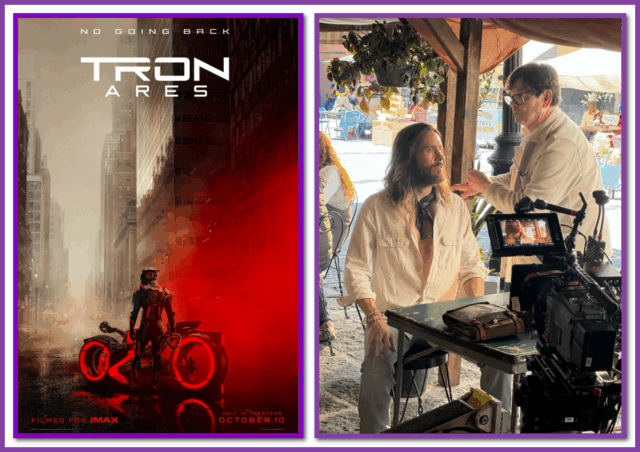
It’s always a joy speaking with master makeup artisan DONALD MOWAT—not only about the projects he’s working on, but about film in general and the next generation of artisans coming up behind him. We did exactly that when we hopped on the phone to talk about TRON: ARES.
While the heart of our conversation centered on designing and developing makeup for what can only be described as a technically precise shoot — one in which each craft, especially hair and makeup and, cinematography, along with costume design, and visual effects, is deeply interdependent—we found ourselves chatting long before the formal interview even began about Donald’s dedication to nurturing young makeup artists and filmmakers, an aspect of his life many may not know about.
He devotes countless hours to schools and students, offering demonstrations, workshops, early instruction, and even one-on-one mentoring to high-schoolers across every demographic and economic background. Often, he relies on the generosity of vendors to donate makeup products so students can learn with proper materials. It is truly a labor of love—and one for which the industry should be profoundly grateful. After all, who will pick up the filmmaking mantle when today’s masters eventually set down their brushes and cameras, if not the youth we shepherd today?
Which brings me back to TRON: ARES, a film that mesmerized and enthralled me with every frame, every sound, and every piece of music. It is truly technically masterful.
TAKE A LISTEN as Makeup Artisan DONALD MOWAT talks all things TRON: ARES (and more) and enjoy this written companion piece. . .
In the world of this film, nothing was simple — least of all the faces on screen. The story’s emotional core required an interplay between precision and humanity, between engineered perfection and fragile imperfection. It was makeup designer DONALD MOWAT who found himself at the center of that delicate balance in Joachim Ronning’s TRON: ARES, navigating a highly technical production that folded makeup, lighting, costume, performance, and even the score into one tightly interdependent ecosystem.
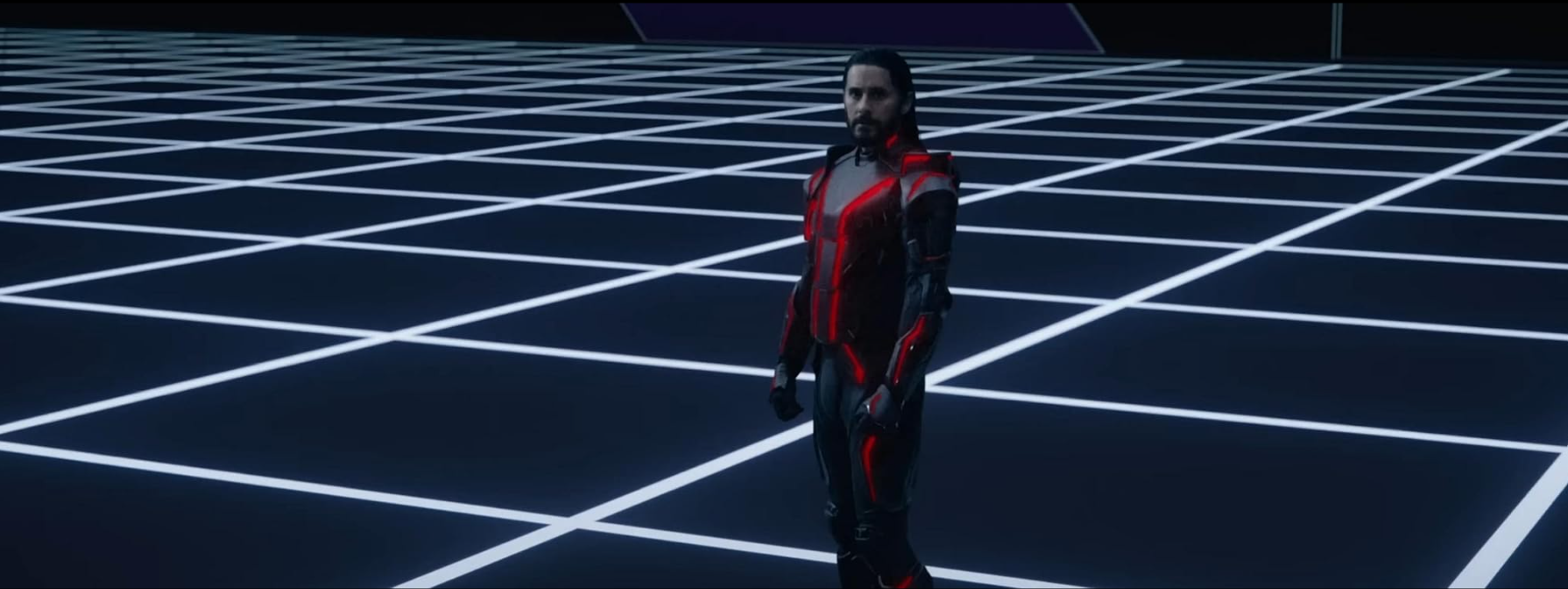
With three distinct worlds in TRON: ARES – the Grid, off-Grid, and the Kevin Flynn world – and primary principal actors Jared Leto, Jodie Turner-Smith, Greta Lee, Evan Peters, and Gillian Anderson, all with varying skin tones, from a makeup and hair perspective, Mowat had his work cut out for him. “On this film, there was nothing to hide behind. Everything had to be practical, high-quality makeup, precise lighting, and the occasional bit of digital cleanup. That was it. And in that lighting — the reds, the extremes — it could have looked terrible if we weren’t careful.”
From the first tests, Mowat understood that Ares — played by Jared Leto — could not resemble a robot in the classical sense. He referenced the unnerving smoothness of Jude Law in “A.I.”, not as a template but as an inspiration for the “subtle unplaceable quality” he wanted. “We weren’t going for plastic or artificial,” he later explained. “We wanted something that felt too perfect — a precision that still allowed you to believe he was human.” Under cinematographer Jeff Cronenweth’s macro lenses, imperfections were impossible to hide, which meant Mowat’s work had to be flawless, layered, subtle, nuanced, and invisibly complex.
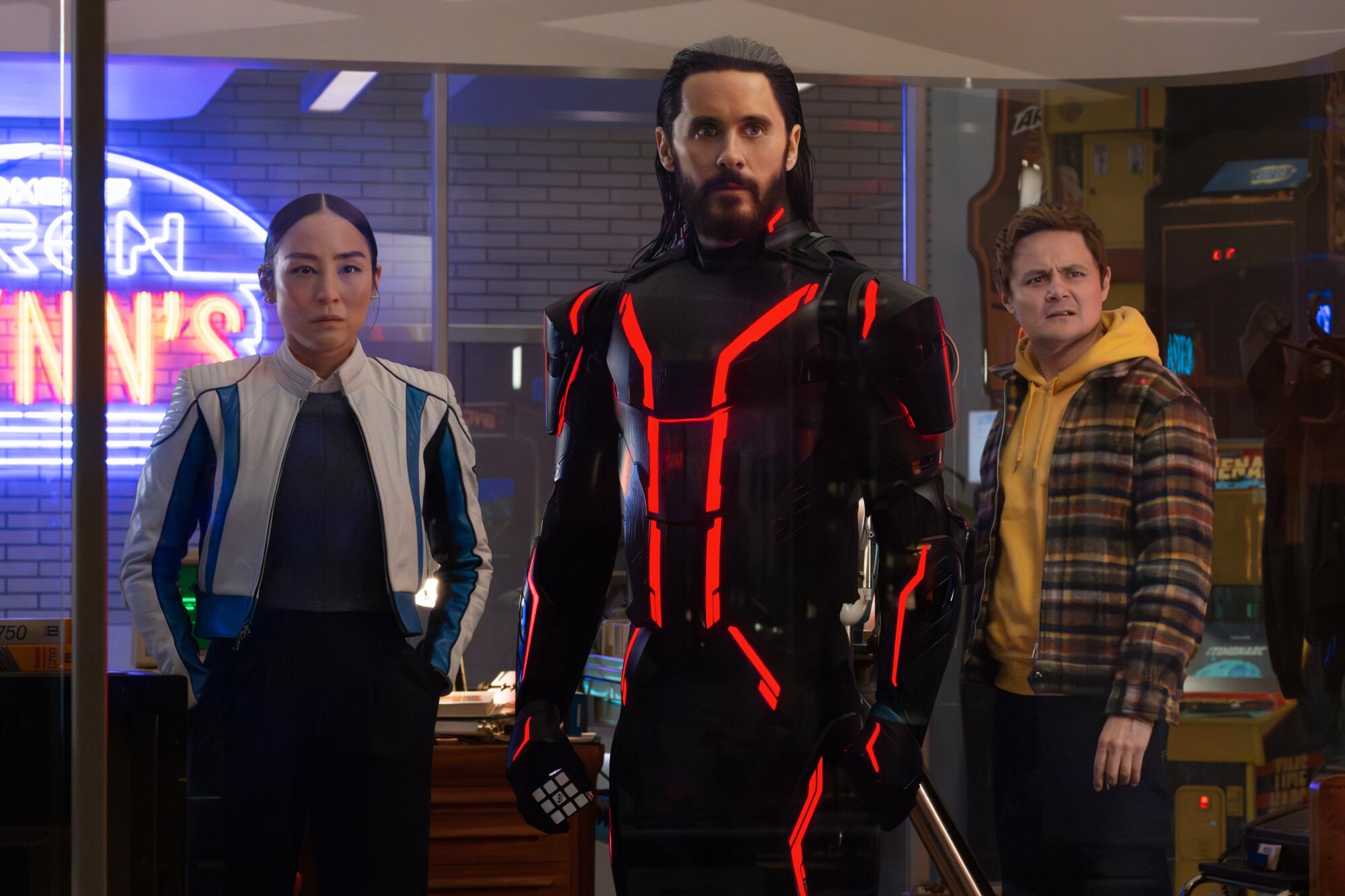
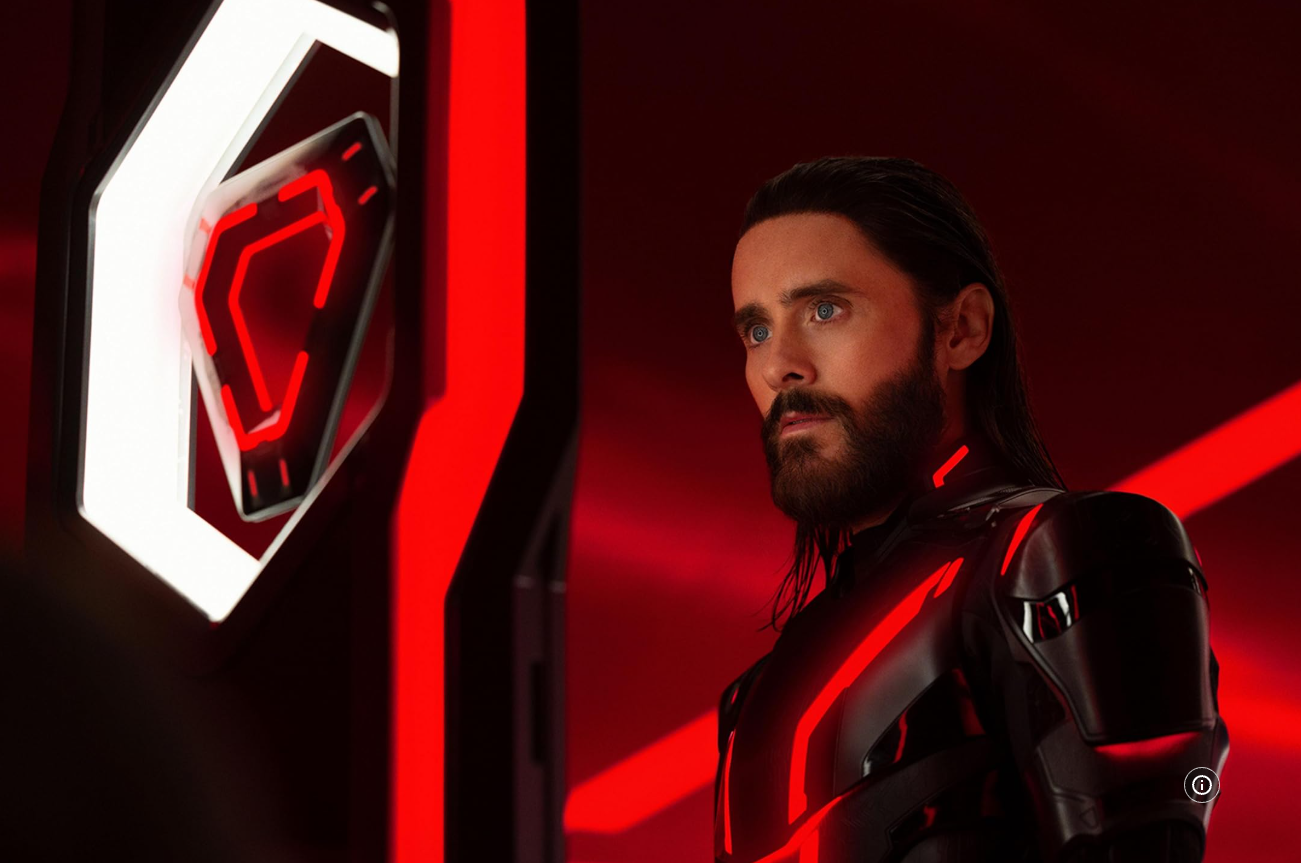
Cronenweth became an unusually hands-on collaborator, pulling Mowat into the DI suite, soliciting feedback on skin tone, sheen, contrast, and the way makeup behaved under extreme lighting. “That kind of relationship is rare,” Mowat noted, especially in makeup — it’s often the last stop on the train. But here, everything was integrated.”
Leto’s transformation was a departure for him. The actor is famously comfortable behind heavy prosthetics and characters who wear literal or metaphorical masks, but the role demanded exposure: sculpted skin, multiple base tones, bronzer, painted brows, and an almost airbrushed finish. At first, he resisted. But once he saw the dailies — especially the sequences in which Ares begins to deteriorate emotionally and physically — he embraced the process. When his hair loosens, and the sweat starts to come through, you suddenly see him as a person. That’s when his humanity emerges.
Working with Cronenweth “was incredible. I hadn’t had that kind of collaboration in a long time — not since working with someone like Roger Deakins — where a DP would actually call me into the DI and ask, ‘What do you think? Is this working?’ I was pulled in for Greta’s close-ups, Jodie’s, Jared’s. We were all working together in real time. It was unbelievable. I can’t tell you what it meant to be included at that level again.”
“The lighting was extreme — the Grid, off-Grid, the transitions — so I had to constantly evaluate how far I could push things. When Ares becomes more human, when the hair loosens, when he starts to perspire and eventually gets beaten up… honestly, that was my favorite stage. One day, Jared said, ‘God, I look really good.’ And I told him, ‘Everyone looks good beat up!’ I think he had a moment of realizing how much he was giving to this role. I admire him deeply, and I hate that people have been unkind about the film. It hurts. Not just the project — it hurts the people who worked on it.”
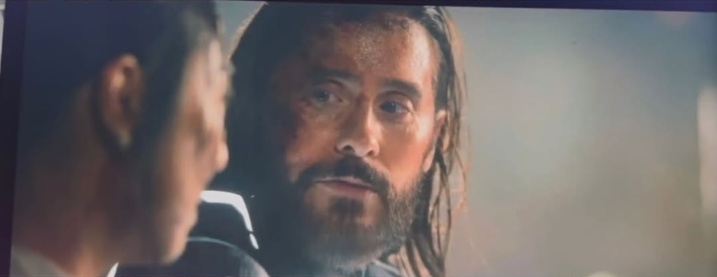
As Donald explains it, “From a cinematic perspective, what we achieved — especially with Athena — deserves recognition. We had two women of color and a white male lead inside extremely unforgiving lighting setups. It was incredibly precise work. Jodie [Turner-Smith], for example, goes ashy very easily. We did her makeup for the first time in LA and I thought, ‘You look great, but let’s wait until we see this under Grid lighting’.”
“And then there were the early hair ideas… She originally wanted this orange wig. It was a disaster — one of those moments where someone has to speak up. And I did, because that’s my nature. They had wanted me to be both the hair and makeup designer, which we don’t typically do in the U.S., but at that point, I decided I needed to take charge. We scrapped the wig, and then came the bleaching, which I think was Jodie’s idea, and the shaved brows — all happy accidents.
The first day Mowat did Jodie Turner-Smith’s makeup after the hair bleaching was met with mixed reactions from the studio, but for Donald Mowat, his expertise and confidence made all the difference. “It reminded me of the 80s, when we did those big, bold eyeshadows where the upper lid connected to the tail of the brow. So I grabbed this thick blue Dior crayon, sketched out the shape, blended it. [Jodie] came up with the extended reverse eyeliner — essentially replacing the brow. It was brilliant. That’s collaboration.”
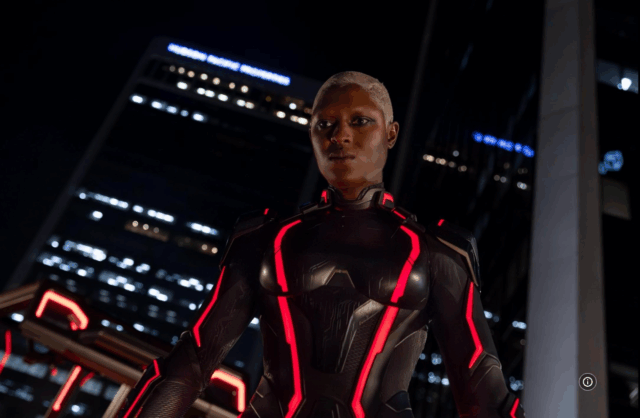
But as a very dark-skinned Black woman, there were other make-up challenges to conquer – “matching her, and matching her to the lighting, and matching her to the other two — it was a constant balancing act. With every close-up, we’d get notes like, ‘Do you think we need a tiny bit of powder on the far right side of Jared’s upper cheekbone?’ That’s how precise the work was.
Watching the film, it’s so clear that this is one of those rare moments where the collaboration between makeup and the DP is absolutely critical. Cronenweth is using all of those incredible robotic arms—the motion-control rigs from Sisu—and coming in for these extreme shots. They’re not even ECUs; they’re true macros on the eyes. And for that to work, the makeup had to be perfect and precise at a level you rarely see.
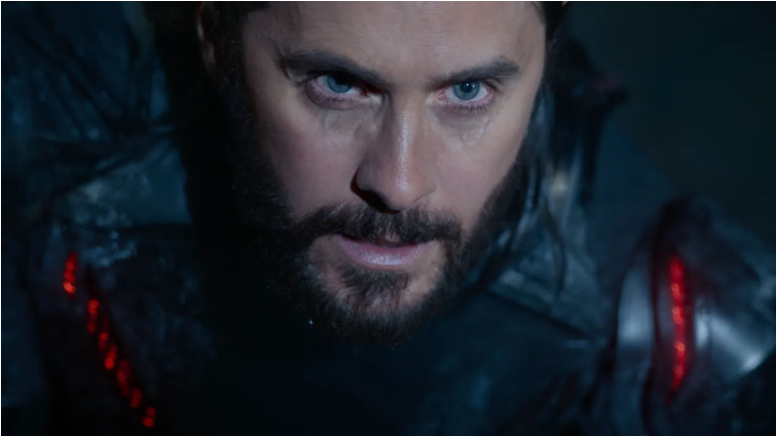
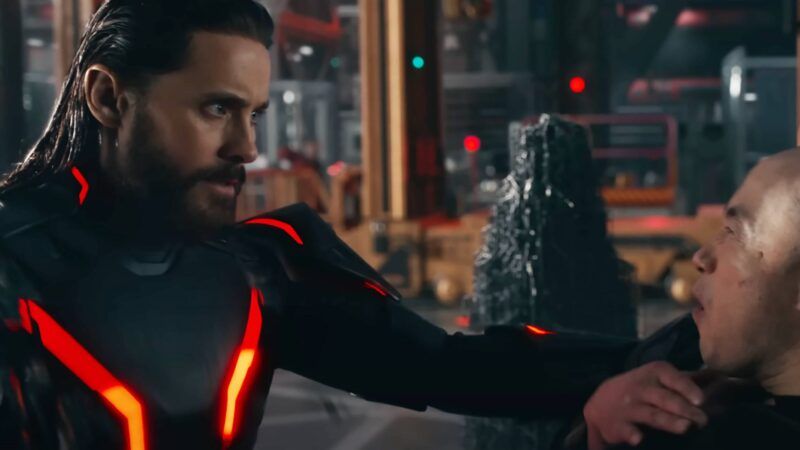
Some of those shots where Cronenweth zooms all the way in—like the one with Leto lying on his side, the camera rolling and then pulling out—you can see every eyelash, every pore, every shift in texture. His skin looks taut, seamless, flawless. The eyelashes are gorgeous, the surface of the skin is immaculate, and none of that is forgiving in macro photography.
Mowat and Cronenweth had to be in complete lockstep for those shots to work, especially with the lighting changes and the movement of those robotic arms that bring the camera so impossibly close.
“There were a couple of shots that were so close — truly that close — that before Jeff brought the camera in, they’d give me a second to step in and make adjustments. I’ve never made up a man like that in my entire career. Never. Jared had everything: eyeshadow, painted brows, sculpted cheeks, three or four different shades of base, bronzer — all of it. I’ve never had to build a man’s face to that degree, but for this character, and for those shots, it had to be done. And the same was true with Greta [Lee]. The makeup had to be calibrated to each specific lighting environment, every time.”
The film’s craftsmanship proved so intricate that the muted critical reception stung more than Mowat expected. “People forget that behind every frame are dozens of people who’ve poured themselves into this,” he said. “There were other films this year, imperfect in every craft sense, that were embraced. This one required such delicate technical work — especially with actresses of color in brutal red lighting — and that should have been acknowledged.”
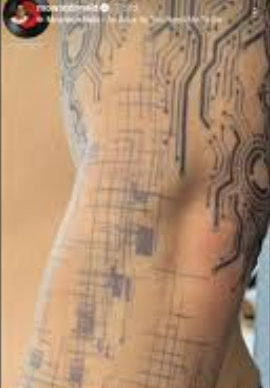
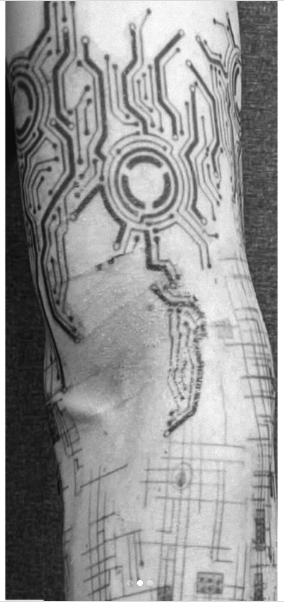
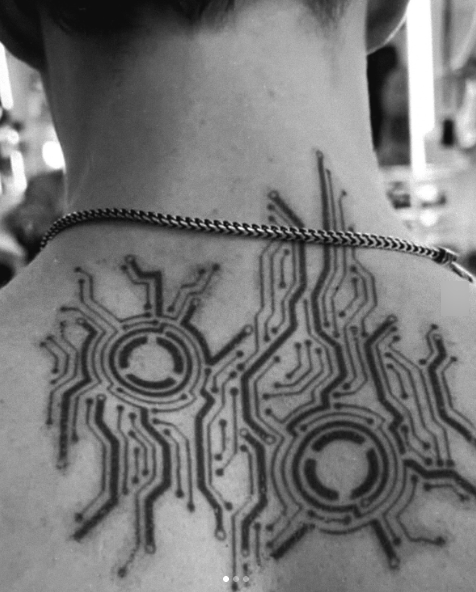
One of Mowat’s proudest achievements came from the most unexpected place: the circuit-board tattoos worn by Dillinger, the calculating, brilliant antagonist played by Evan Peters. It was Peters who asked for a defining physical feature — “What’s my thing?” he’d said — and from that seed grew the elaborate, schematic tattoos created by master tattoo artist Kentaro [Yano]. What was initially planned as four days of work ballooned to nearly fifteen when the production began requesting insert after insert. “They turned it into a commercial for the tattoos,” Mowat joked. “But honestly, they were gorgeous. It was worth it.”
The set itself became a lesson in modern cinematographic challenges. The snow sequences, all shot in the volume, created a new kind of technical chaos for makeup. The LED walls cast a magenta spill over the actors — a hue that deepens and distorts warm undertones, especially on Asian and Latino skin. Mowat recalled Cronenweth summoning him to the monitor, worried that something had shifted. “For a moment, we thought we’d changed a base tone,” he said. “Then we realized it was the projection. The volume is extraordinary, but it’s also unforgiving. It forced us into constant recalibration.”
For Greta Lee, who plays Eve Kim, that meant painstaking adjustments. Asian skin can read heavy under harsh or colored light, and the magenta spill amplified that risk. “It was never-ending,” Mowat admitted. “But it taught us a lot. The volume is a completely new frontier for makeup.”
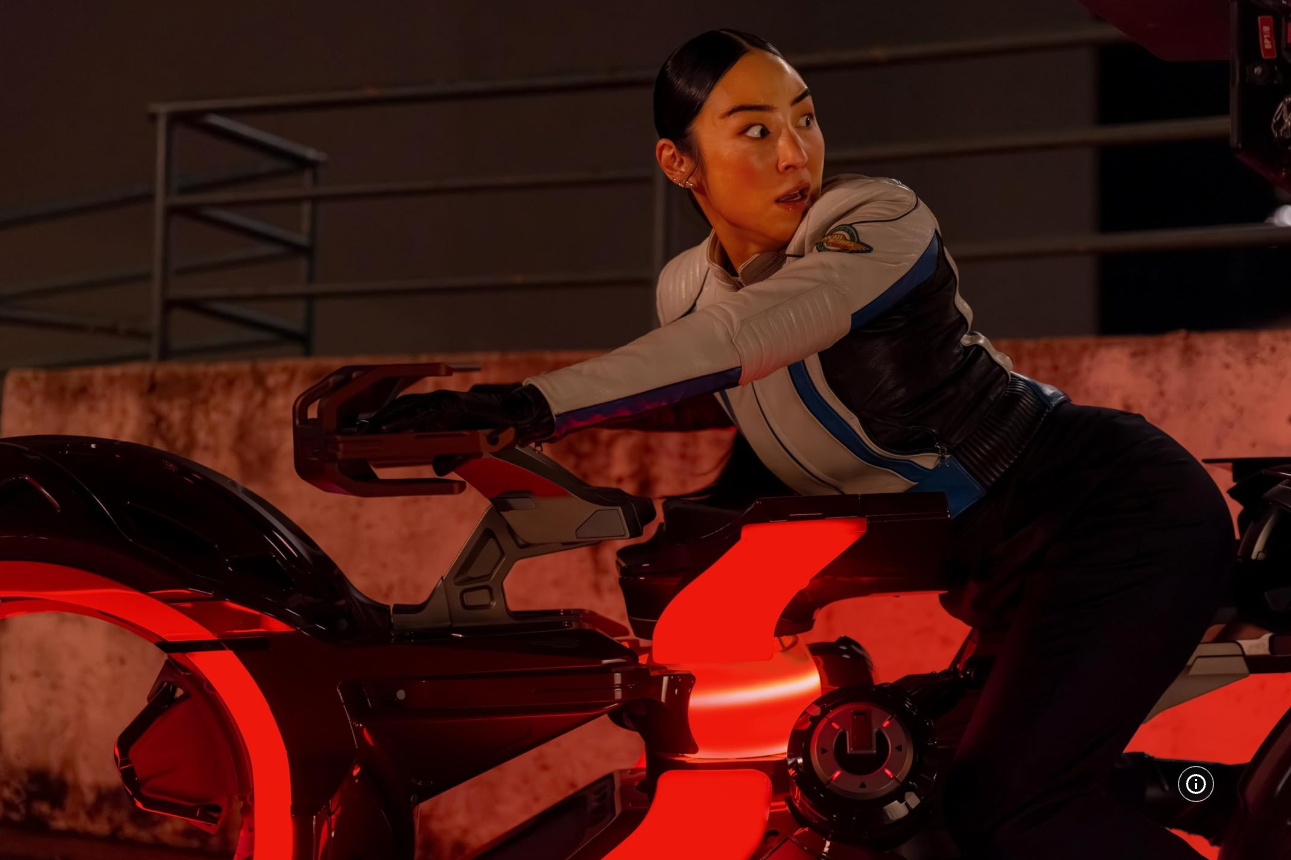

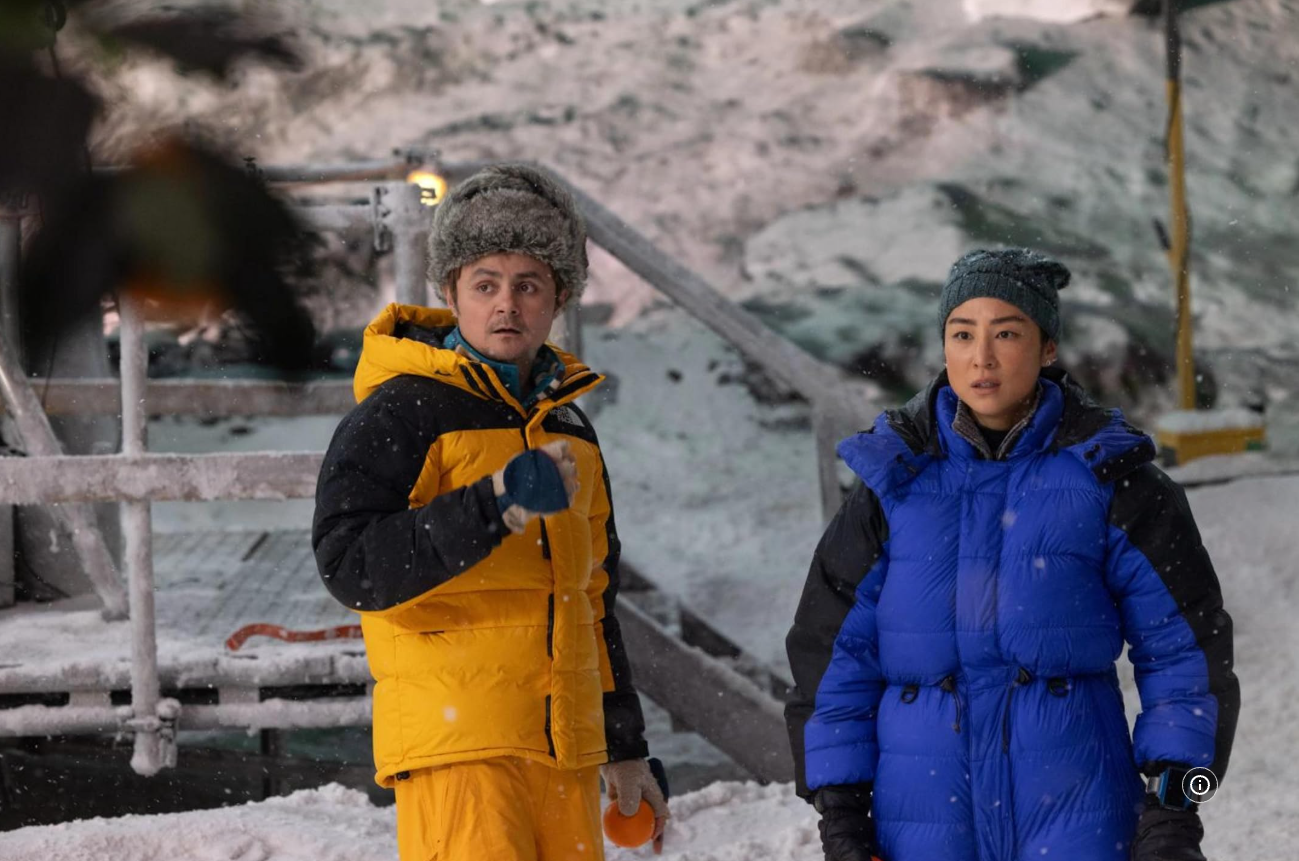
Some key scenes involving Lee are snow scenes, and that presents a whole different challenge. “Cold, bright environments are brutal on makeup — every highlight, every bit of texture, every tiny shift in color suddenly becomes twice as visible. And with Greta, again, because of her skin tone, we had to be extremely careful. The snow reflects so much light upward that it can wash her out instantly or make the makeup look heavier than it is. So everything had to be softened, balanced, and perfectly calibrated for that environment. The goal was to keep her looking real and present in that world without letting the elements betray the makeup. It was delicate work — but those scenes ended up being some of my favorites, because the simplicity of the look lets her performance come through so purely.”
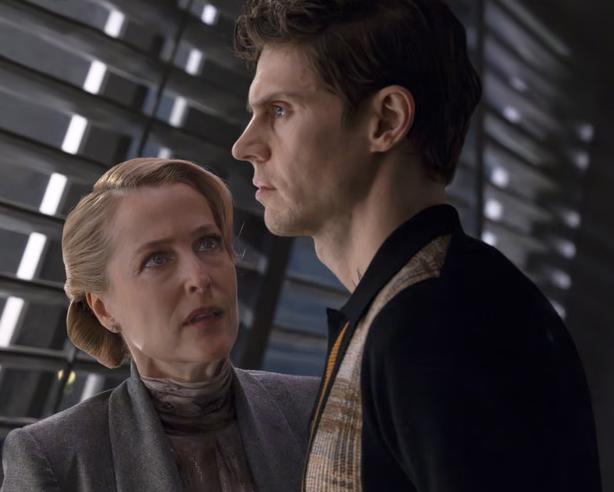
The film’s attention to craft was nowhere more evident than in the dynamic between Peters’ character and his mother, played with chilling severity by Gillian Anderson. Known for her natural, minimal, television-friendly makeup style, Anderson needed a transformation: sharper cheekbones, tauter skin, a blonde coiffure that nodded subtly toward Margaret Thatcher, and a purplish-red lipstick. The result was a formidable, flinty presence that defined the mother-son and CEO-subordinate dynamics long before a line was spoken. Against her immaculate rigidity, Peters appears increasingly undone — sweat beading, hair disheveled, his genius unraveling. Their contrasting looks tell a story on their own.
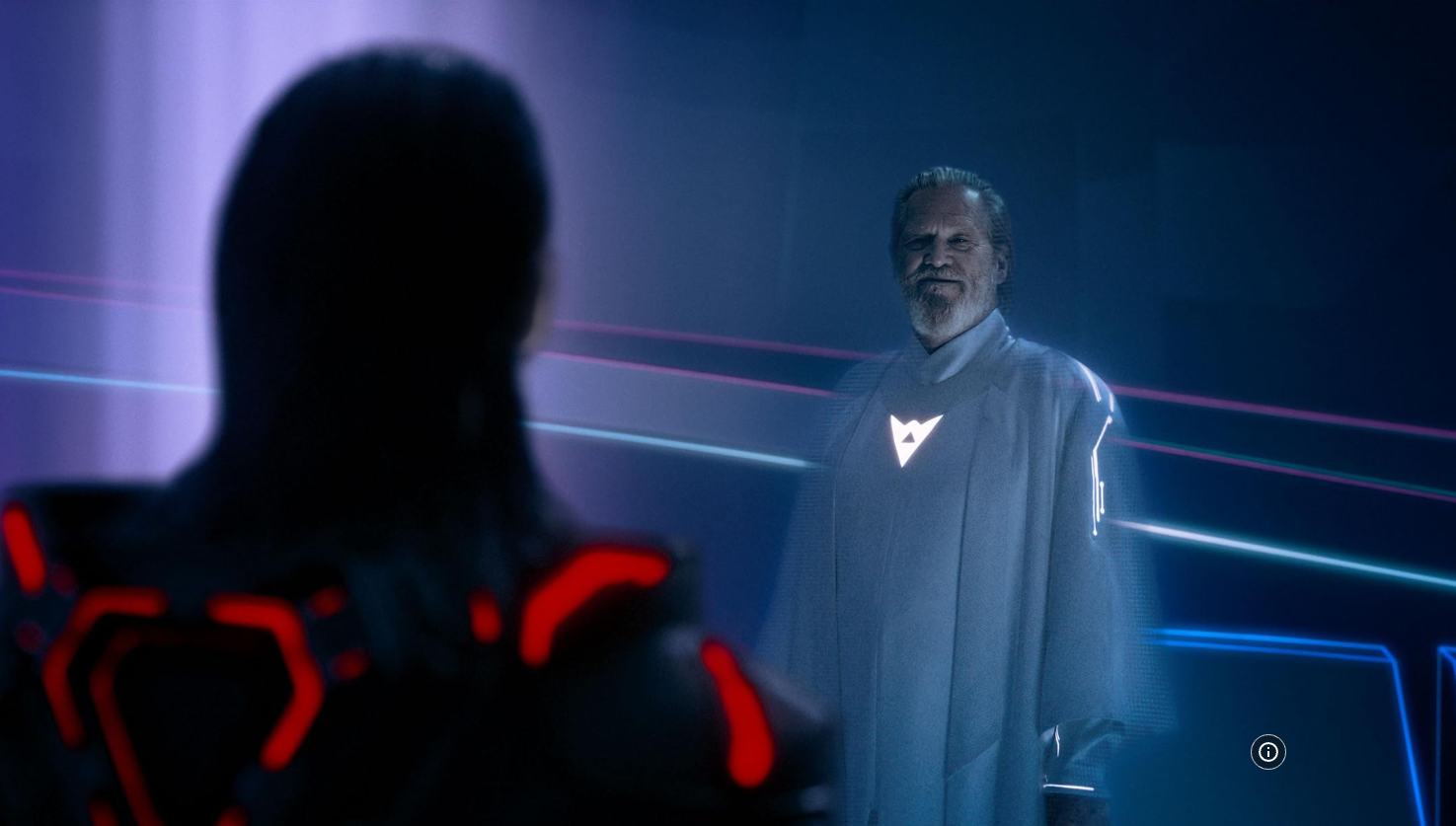
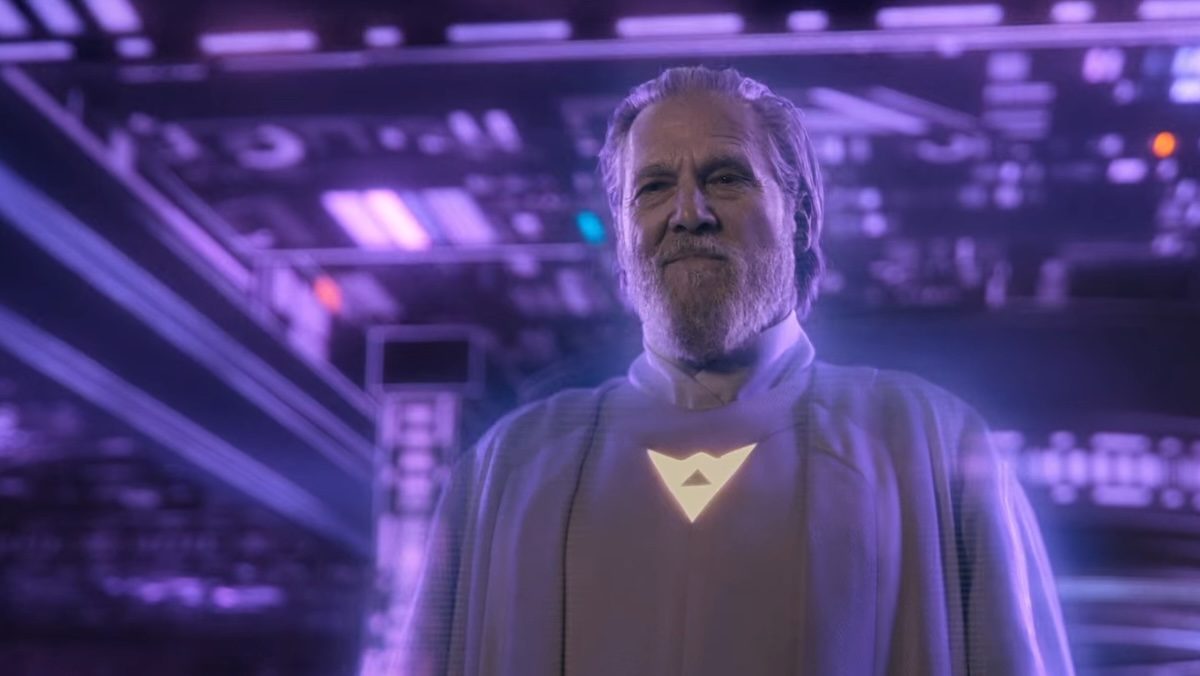
In contrast, Jeff Bridges’ brief appearance as Kevin Flynn brought warmth — and a different challenge. Describing it as “such a thrill” working with Jeff Bridges, “It’s a really distinctive blend of color and texture, especially because the lighting for Flynn’s world is unlike anything else Jeff Cronenweth used on set. It has this almost mythic glow, but then you layer on the anamorphic grain, that slightly MTV-video static, that analog hum on top of everything… it gives the entire environment this lived-in, digital-ghost quality.”
With only three days on set, Bridges required a naturalistic approach that preserved his age, texture, and the softness of Cronenweth’s lighting. His longtime makeup artist, Thomas Nellen, warmed him subtly to avoid washout under the film’s grainy, music-video glow. The scenes between Bridges and Leto, Mowat noted, “shifted the whole energy of the production.”
Throughout the process, Mowat kept returning to the idea of craft interdependence — how one department’s work is inseparable from another’s. “This is one of those films where everything has to function hand-in-hand-in-hand, and when it does, the result is fantastic.” The sheen of a fabric affects how foundation reads. A shift in lighting temperature alters every contour. The score influences camera movement, which dictates how much detail an audience can absorb on a face. “People talk about craft like it’s separate departments,” he said. “It isn’t. Craft lives in the space between us.”
Despite the technical hurdles, the film reaffirmed something essential for him. “It reminded me why I love what I do,” he said simply. “Every challenge — the lighting, the volume, the nuances of skin tone — forced us to elevate the work. It was complicated. It was exhausting. But it was thrilling.”
by debbie elias, exclusive interview 11/02/2025