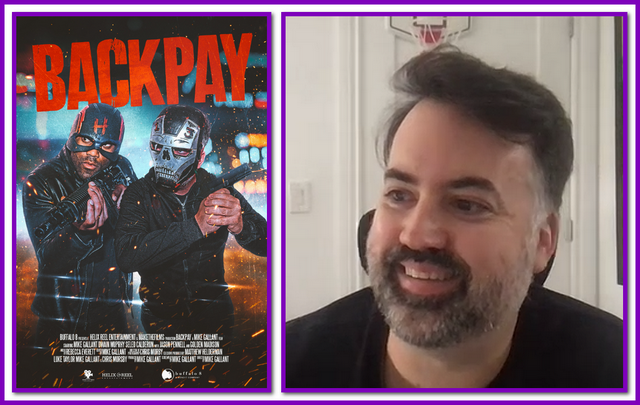
How far would you go to get what you believe you’re owed? It’s a question that resonates with anyone who has ever felt wronged by an employer, but in writer/director MIKE GALLANT’s neo-noir action thriller BACKPAY, the answer involves kidnapping, extortion, a corrupt politician, and a criminal scheme that rapidly spirals out of control.
Gallant wears multiple hats on BACKPAY, serving as writer, director, editor, and lead actor, playing Steve Walker, a husband and father whose financial troubles threaten the life he has built with his wife, Dawn (Seled Calderon). When Steve reconnects with Murphy (Dwain Murphy), a former undercover cop with a complicated past, the two hatch a plan to kidnap politician Peter Freeman (Jason Pennell), gain access to his safe, and recover money Steve believes he deserves. Complicating matters further is Ximena (Golden Madison), whose involvement brings another set of motivations and problems into an already precarious situation.
Working with cinematographer and executive producer Chris Morsby, a compact cast, limited locations, and an equally lean crew, Gallant approached BACKPAY with an editor’s understanding of what could be accomplished within a tightly controlled production.
In conversation, Gallant delved into the film’s origins, the challenges of simultaneously directing and performing, the influence of editing on the screenplay itself, his affection for the texture and color of film, and the decision to encourage Jason Pennell to take Peter Freeman into increasingly outrageous territory.
From PATERNAL to BACKPAY: Finding the Personal in Payback
BACKPAY began not as a feature but as a roughly ten-minute short film called PATERNAL, made approximately six months before principal photography on the feature. The basic premise was already in place: a financially desperate husband, a growing family, and a man convinced that his former employer owed him something.
“I made a short version of this film called PATERNAL about six months prior to when we shot BACKPAY, and the premise was very similar,” Gallant explained. “It was a guy named Steve who’s married to a woman named Dawn. They had a second kid on the way, and he decides to hold his old boss hostage for ransom money that he believes is owed to him.”
For Gallant, PATERNAL was also an experiment in combining disciplines. Having spent years primarily working behind the camera and in post-production, he wanted to explore acting again while handling the responsibilities of writing, directing, producing, and editing.
“It was more of just an experiment to see if I could act. I hadn’t really acted over a decade,” he recalled, describing the short as a proof of concept that could potentially be expanded.
The decision to develop a feature was influenced as much by economic circumstances as by creative ambition. Gallant had been distributing smaller projects through FilmHub, generating modest revenue, and began considering whether a feature might offer greater opportunities. At the same time, the lingering effects of industry strikes, uncertainty in the Canadian production landscape, and the arrival of his second child brought financial pressures into sharper focus. “It was the scariest time of my life for sure,” he admitted.
Those experiences helped shape the feature’s central anxieties. Rather than create a sprawling production requiring substantial resources, Gallant returned to a story that could be told with relatively few actors and locations while drawing upon concerns he understood personally. “I still wanted to keep it very tight because I wanted us to get the best possible return on our investment,” he explained. “I didn’t want to blow out the budget, and hey, we didn’t really have the money to do that anyway.”
As the screenplay developed, he looked to a piece of writing advice from Robert McKee: go deeper. For Gallant, that meant identifying the fears beneath Steve’s increasingly desperate decisions. “I just tried to pull as much from my life,” he said. “There’s definitely been movies about guys who have turned on their boss before. That’s a very primal feeling I think a lot of us can relate to.”
He also wanted Steve to be someone he could understand from the inside, particularly because he intended to play the character himself. “I wanted Steve to feel as close to myself as I could, just so I could play it,” Gallant explained. “I wanted him to feel as relatable as possible.”
Wearing Multiple Hats: Trust, Coverage, and the Value of a Small Crew
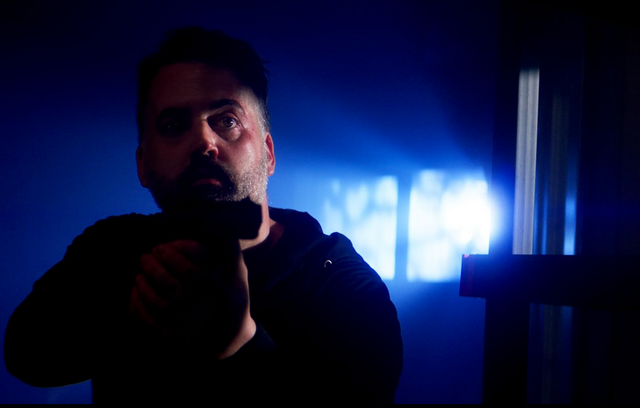
Writing, directing, editing, and producing a micro-budget feature presents considerable logistical challenges. Adding the responsibility of playing the lead character creates another layer of difficulty, particularly when that character appears in the overwhelming majority of scenes.
For Gallant, one of the greatest obstacles was the inability to monitor his own performances during production. “The hardest part was not being able to watch while we were filming, like obviously the scenes that I was in, and not even having time to do playback,” he explained. “I just had to trust my EP slash DOP Chris Morsby.”
That trust became fundamental to the production. Beyond his cinematography duties, Morsby assisted with blocking, monitored the action while Gallant was performing, and collaborated in discussions about the edit. “This movie doesn’t exist without him,” Gallant said. “He came on as a partner, and he sort of helped direct mainly blocking stuff. We also had a lot of conversations about the edit afterwards and everything. But he was integral to this.”
Gallant’s extensive editing background also informed the way he approached production. Having worked in post-production since the early 2000s and edited numerous features, he was accustomed to anticipating what an editor would need before a scene was photographed.
“The main thing to me is always about, let’s just make sure we get coverage and let’s make sure everything’s on the right axis,” he explained. “If you can get those two things down, you’re probably about 85% of the way there, just from a fundamental standpoint.”
Maintaining the camera axis—the spatial relationship between subjects that preserves screen direction—was especially important to Gallant, who regards it as one of the technical fundamentals that can be overlooked in hurried productions.
With limited shooting time, some setups were completed in a single take. Gallant also recalled instances when Morsby adjusted the camera’s framing during a take rather than stopping to reset, leaving the director to discover those decisions later in the editing room. “Sometimes he’d be shooting, and then he would just reorient the camera if he felt the shot wasn’t working. But he wouldn’t cut,” Gallant said. “Sometimes I would find that out in the edit. I was like, oh, so I guess he moved the camera. But nine times out of 10, it made sense.”
The production’s compact size was another deliberate choice. Five principal actors carried most of the story, while a handful of interiors and carefully selected exteriors provided the principal settings. Gallant preferred the flexibility of a smaller company to the complications of coordinating additional personnel in already restricted spaces.
“I wanted to move fast,” he explained. “If you start filling up your set or your house or whatever you’re shooting with more and more people,” the practical complications begin accumulating, from rearranging equipment to accommodating additional crew. Most shooting days ran approximately ten hours, although Gallant recalled a couple of longer days. Crew members occasionally assumed responsibilities beyond their primary jobs, with even the gaffer appearing on camera as one of the men who invades Steve’s home.
For Gallant, the production depended upon that willingness to collaborate and adapt.
Finding the Film in the Edit: When the Story Changes During Production
Editing was not simply the final stage of BACKPAY. It became an active part of the writing and directing process while principal photography was still underway.
The initial shoot took place over a concentrated stretch in May 2025, with a long weekend providing Gallant an opportunity to begin examining the footage before the remaining scheduled work. One of the first sequences he assembled was an argument between Steve and Dawn. The experience of watching their conflict play out prompted him to reconsider another scene that had yet to be filmed.
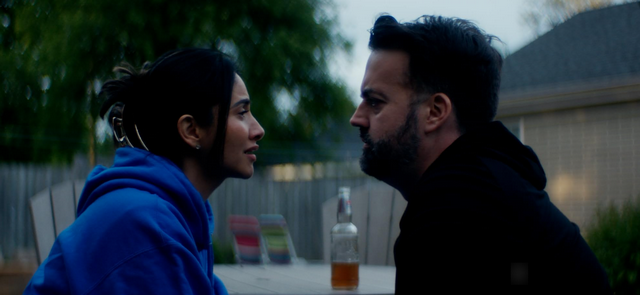
Originally conceived as an additional confrontation, the later sequence was rewritten as a quieter backyard conversation about the couple’s experiences with IVF. “I had a completely different scene we were supposed to film,” Gallant recalled. But after working through the earlier argument in the edit, he decided the relationship needed another emotional register.
“I’m exhausted from watching us argue,” he remembered telling Calderon. “I feel like we should just go in a completely different direction. And instead of getting at each other’s throats, you pick me up.” The revised scene was written shortly before filming.
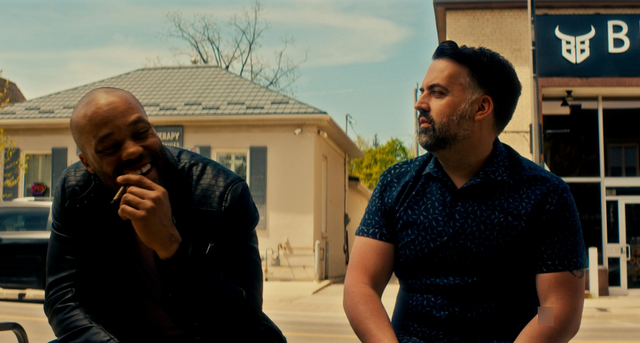
Another significant addition came after Gallant completed an early cut and shared it with trusted collaborators. Dwain Murphy, who plays Steve’s accomplice, felt that the audience needed a stronger understanding of the relationship between Steve and Dawn before witnessing its deterioration. “You guys need more love,” Murphy told him, according to Gallant. “I need to see how this relationship started.”
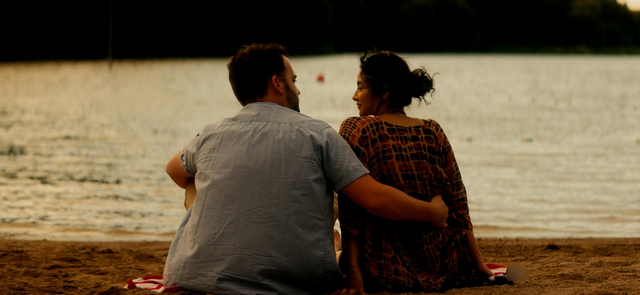
Gallant initially believed the existing flashbacks provided sufficient context. Murphy disagreed, prompting further consideration and, ultimately, the creation of the beach sequence that now opens the film. That material was photographed months after the original shoot.
The process illustrates how feedback from actors and the experience of assembling footage can reshape a film beyond the boundaries of its original screenplay.
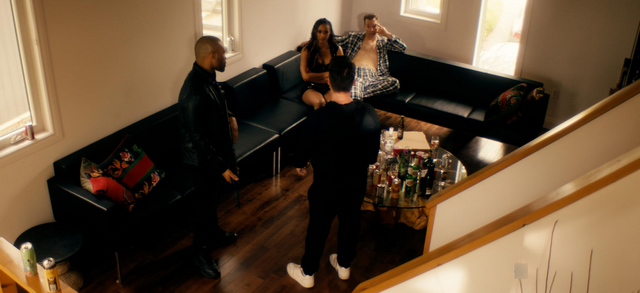
The same editorial thinking informed the handling of an extended confrontation in Peter Freeman’s living room. The scene brings together Steve, Murphy, Peter, and Ximena, with shifting agendas, revelations, and a considerable amount of dialogue to navigate. Gallant knew the sequence would occupy roughly six minutes of screen time, and that the story required numerous pieces of information to emerge during the exchange. “There were so many plot points that we all had to hit that for the movie to make sense, we had to keep them in,” he explained.
His approach was to maintain momentum through both performance and cutting. “Anytime you can be sarcastic about a line, go for it,” he recalled telling the actors. “Any way we can make this more entertaining.”
In post-production, Gallant employed J-cuts, overlapping dialogue, interruptions, and cutaways, seeking to vary the visual rhythm while moving the conversation forward. “I basically left no pregnant pauses or breathing room in there unless I absolutely needed to,” he said.
For Gallant, these were practical decisions shaped by his familiarity with editing and his awareness of how long the audience would remain in one room.
Color, Memory, and 8mm: Exploring the Visual Language of BACKPAY
Beyond the logistics of production, Gallant and Morsby explored different visual approaches to Steve’s memories and his present circumstances.
The film incorporates vividly colored recollections of Steve and Dawn’s relationship, including their proposal, alongside home-movie imagery captured on actual 8mm film.
During the interview, discussion turned to the saturated blues, greens, and yellows of the romantic memories, a departure from the desaturated or sepia-toned imagery frequently used to signify flashbacks. For Gallant, the decision reflected a broader preference for vibrant color, particularly when working with digital photography.
“When it comes to coloring on films, if you see most of what I do, I always try and push the color,” he explained. “I almost always have to shoot digital just for budget reasons. But film, 35 mil, is obviously king, and it’s like you can’t beat the color space that film gives us.”
He expressed frustration with the muted, grayish appearance he sees in much contemporary digital cinematography. “I’m always about pushing the color, crushing the blacks, trying to be as vibrant as possible,” he said. “Whether it’s a flashback, flash forward, whatever, I always want the color to be as good as humanly possible.” That preference informed his decision to preserve the colorful photography of the proposal sequence even after discovering that some viewers did not immediately recognize it as a flashback.
Gallant considered converting the scene to black and white to make the temporal shift more obvious, but ultimately resisted. “There’s such good color,” he explained, pointing to Calderon’s costume, the waterfall, and the surrounding environment. “I’m not gonna take away from it.”
Another component of the visual design came from Gallant’s affection for shooting on film itself. Unable to incorporate the amount of photochemical photography he might ideally have preferred, he used an 8mm camera to capture portions of the home-movie material. That process produced an unexpected complication when the camera malfunctioned during filming. The resulting irregular frames became part of the final imagery. “It actually gave us these cool, like, stutter frames that actually helped me transition throughout a few scenes,” Gallant recalled.
Although he had hoped to capture more material with the camera, he incorporated what survived into the film’s visual treatment of memory. The combination of digital cinematography, heightened color, and 8mm imagery reflects Gallant’s interest in using different photographic textures to approach Steve’s emotional history.
Unleashing Peter Freeman: Jason Pennell Finds His Inner Villain
Among the performances in BACKPAY, Jason Pennell’s portrayal of corrupt politician Peter Freeman commands particular attention.
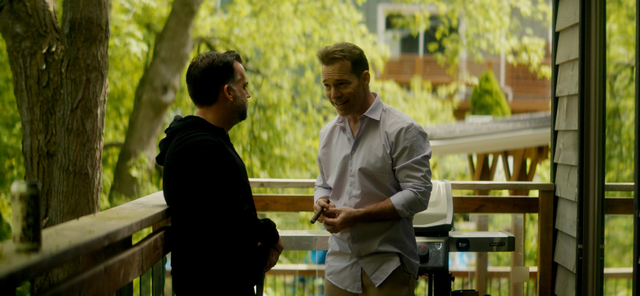
Initially presenting as a comparatively unassuming, weaselly political figure, Peter becomes increasingly aggressive and theatrical as Steve and Murphy’s scheme unravels. By the third act, Pennell embraces the character’s arrogance, contempt, and appetite for power, turning Peter into an outsized presence. His extended living-room monologue, touching on politics, society, money, and Steve’s extraordinary foolishness, gives Pennell an opportunity to dominate the confrontation through sheer force of personality.
Gallant had worked with Pennell previously on vertical dramas, but the actor’s earlier roles had not necessarily suggested the particular qualities required for Peter Freeman. “I’d never seen him play a villain,” Gallant recalled. “He’s a very, very nice, easygoing guy.”
Nor had Gallant approached the casting with a fixed notion of the character’s appearance or political identity. He wanted someone interesting to watch rather than a performer who immediately signaled a particular ideological position.
“I never wanted to reveal if Steve was right wing or left wing, or if he [Peter] was right wing or left wing, because I feel like there’s sort of like touches of both sides of both of them,” Gallant explained, believing the ambiguity made the characters more interesting. Eventually, he turned to Pennell, despite uncertainty about how far the actor could take the role. “I hadn’t seen him do tons of monologues and stuff like that,” Gallant said. “And I’ve never seen him play a villain.” That uncertainty began to disappear once filming commenced.
According to Gallant, Pennell found the character’s increasingly volatile personality after several takes, and the director encouraged him to push further. “I just kept encouraging it. I was like, go crazier. I was like, this is your Joker moment. Like, just whatever you got inside of you, just go.”
Complicating matters was the shooting schedule. The garage confrontation near the film’s climax was photographed early in production, requiring Pennell to reach the character’s most extreme emotional register before completing many of the earlier scenes. Nevertheless, Gallant recalled that Pennell quickly found his footing. “He was so locked in then,” he said.
The physical demands of the climactic garage confrontation also left Gallant with some very tangible souvenirs of the production. “The fight scene I have with Jason, I bruised my arm. Like, this was all purple, and then we had to film around it the next day. It was so bad,” recalled Gallant. And the bruising wasn’t limited to his encounters with Pennell. Between physical scenes with Dwain Murphy and Seled Calderon, Gallant found himself taking more than a few hits throughout production.
“I really got beat up on it, but it was great. I wouldn’t change it for anything.”
Such experiences added another dimension to the demands of directing while performing, particularly in a film with physical confrontations and limited time for recovery between shooting days.
As for Pennell, Gallant expressed particular satisfaction that the performance was drawing attention. “I’m so glad to hear people responding to his performance because I certainly enjoyed watching it and acting alongside it,” he said. “He definitely deserves his flowers for sure.”
Looking Beyond BACKPAY
Having completed BACKPAY, Gallant remains committed to narrative feature filmmaking and to the possibilities of working on a small scale.
He regards the production as confirmation that his background in editing and his experience across multiple filmmaking disciplines can be brought together within a tightly controlled budget.
But there is one responsibility he is less eager to assume again: playing the lead in a film he is also directing. “I don’t think that’s my priority right now,” he acknowledged.
Instead, Gallant hopes to continue directing features while allowing himself greater freedom to concentrate on the filmmaking process. He also expressed enthusiasm for the future opportunities awaiting his collaborators, including Murphy, Calderon, Pennell, and Madison.
For a filmmaker who began with a ten-minute short intended partly as an experiment, BACKPAY became a larger undertaking involving the demands of feature-length storytelling, a compressed production schedule, and the constant negotiation between what was written, what could be photographed, and what could ultimately be assembled in the editing room.
And perhaps that is the most revealing aspect of Gallant’s experience: not simply the number of hats he wore, but the extent to which the film’s development depended on knowing when to trust the people working alongside him—and when to change the plan.
“The team we had around us was so phenomenal, and everyone just wanted to make something good,” reflected Gallant. “That’s the great thing when you have a smaller crew, is that everyone just feels more committed and more invested.”
by debbie elias, exclusive interview 10/12/2026
BACKPAY is now available on VOD and digital.