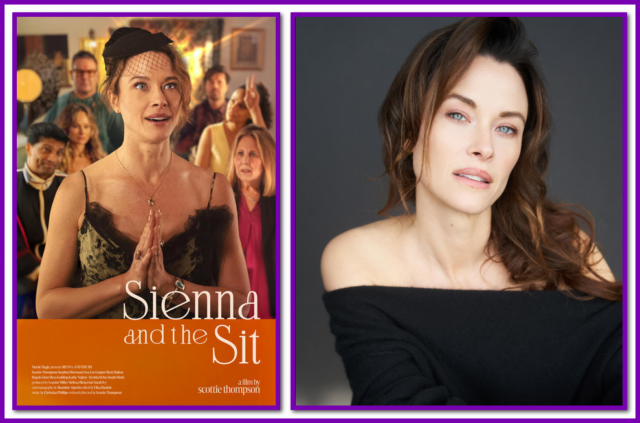
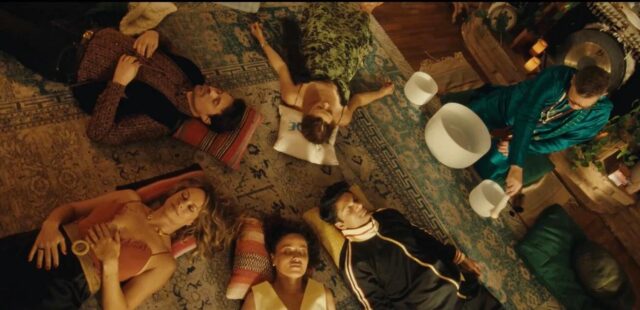
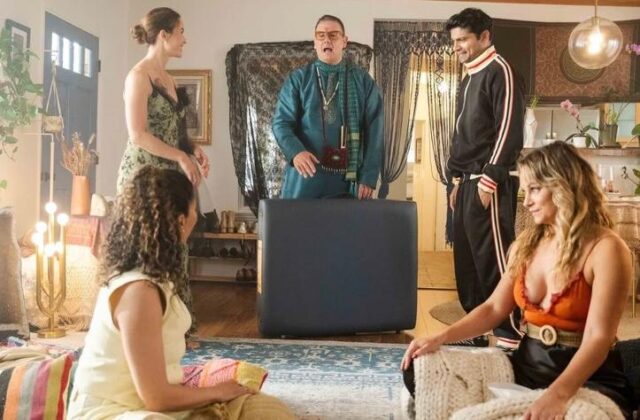
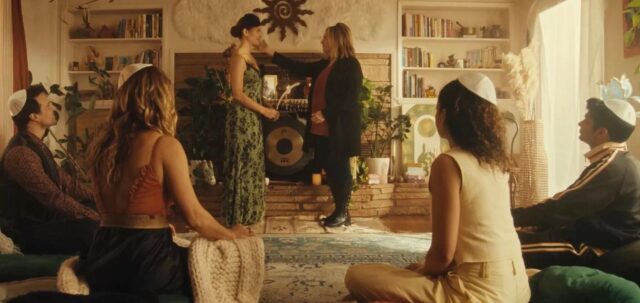
After trading bullets and silences in Isaac Florentine’s HELLFIRE, SCOTTIE THOMPSON did something that surprised even herself: she wrote, directed, and starred in her own short film, SIENNA & THE SIT, the tale of Sienna, a woman who, having exhausted every cleanse and crystal out there, decides to sit Shiva in a last-ditch effort to finally get over her ex. The seed was planted almost immediately after HELLFIRE wrapped.
“We filmed HELLFIRE in like the fall of 2022,” she recalls, “and then I went from that to SEANCE with…Vivian Kerr, who writes, directs, and acts in her own…feature. And she just really inspired me.” Watching Kerr wear all three hats made Thompson interrogate her own path. “I’d been finding myself craving expanding into other arenas,” she says. “I’d been writing for quite some time…”
The real jolt, though, came a year later on a hilltop in Italy. “How have I not made my own film?” Thompson had taken herself to a writing retreat in Tuscany with a pilot script under her arm. “It was a year later,” she says. “I was on a writing retreat in Tuscany that I’d gotten into with a pilot that I’d written, and everyone else, all eight people…all the other people had made their own short films.” The realization hit hard. “I was like, ‘Wait, what? I’ve been in this business for, like, longer than most of them, and, worked on more sets than most of them. How have I not made my own film?’”
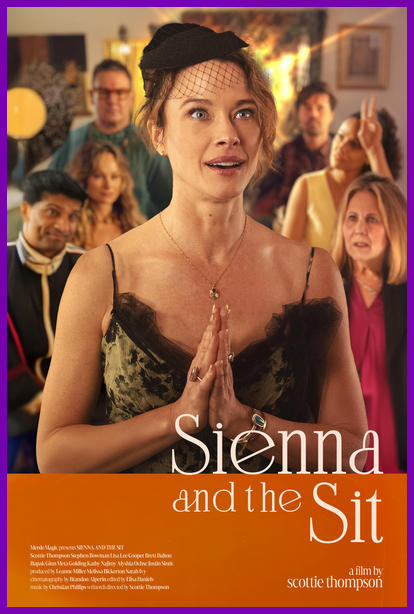
The answer became SIENNA & THE SIT.
“I finally sat down and wrote SIENNA & THE SIT,” she says, “and within two months, in early January ’24…it was like a year, a little over a year after HELLFIRE, that I wrote and directed that…we shot it.”
What began as an experiment quickly turned serious. “For me, it was also motivated by wanting to do more comedy,” she explains. “Because people don’t see me as a comedian, and I’m not really the funny guy in the film. I’m the straight man, which I’m fine with.” The finished short runs about 16 minutes. Thompson is in every frame. “That film, for me, started out as a writing exercise,” she says, “and my next film as a director, I want to lean more into the visual language.”
Thompson is candid about where she focused her energy on this first outing. “I was more focused on figuring out how to direct in general,” she says. “It was a comedy that’s sort of in one location or less, and I played more with visuals in the second half or last third of the film.”
She doesn’t pretend to have suddenly become a visual stylist overnight. Instead, she treated SIENNA & THE SIT as a laboratory for story and performance. “I don’t need to be a DP,” she says. “I’m not going to aspire to be a cinematographer, but it’s fun to, like, understand what those things are and get a better way of…speaking about them too.” Even so, she knew enough to surround herself with strong collaborators. “You’ll see when you watch it that I had an excellent DP,” she notes, “and I feel really grateful for it, and just super high production value, because I know the value of that.”
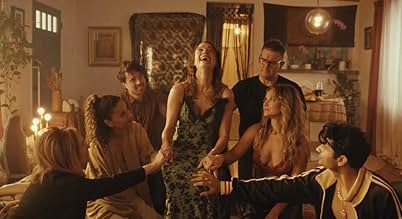
Her background as an actor and producer meant that pre-production and the shoot itself felt familiar. It was everything that came after that that tested her. “The thing I just really didn’t know at all” was editing and sound, which made her biggest learning curve post-production.
“For me, making my short was…understanding editing [and] sound,” she says. “I had produced before. So I understood pre-production and obviously physical production…[but] the thing I just really didn’t know at all was the edit phase and then the sound phase.” Thompson threw herself into it, discovering how small changes can alter the entire emotional rhythm of a scene—especially in comedy. Her poor editor bore the brunt of that discovery.
“I think my editor was ready to kill me by the end,” she admits with a laugh, “when I was like, I need to open up the entire edit [and] pay almost as much for the entire thing for one three-second beat, because it wasn’t landing. And I was like, ‘This is worth it.’ And I still stand by having done that.” On the sound side, she suddenly found herself thinking in layers: dialogue, ambient, effects, music, silence.
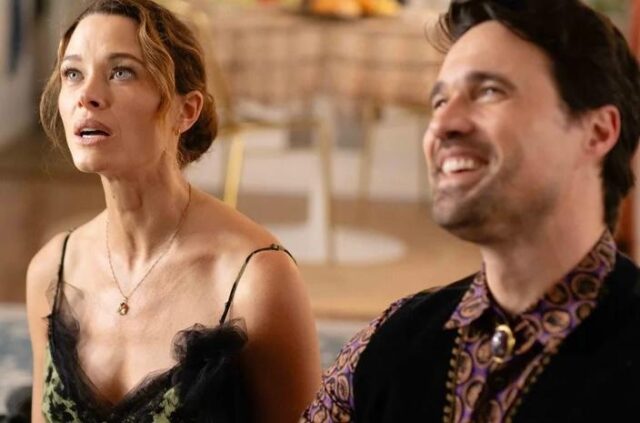
“It’s fascinating to learn those parts of the journey,” she says. “And I loved going through that experience.” The lesson, hard won as it was: nothing about the back end of a film is trivial—especially not when you’re the one signing off on every frame.
If post taught her patience, the shoot itself taught her how to let go of control.
“At the end,” she says of the film, “there’s a fire sequence outside. And my premise is somewhat absurd. And I was headed into the weekend, and it was going to rain all weekend, and I was like, ‘Oh, fuck, I have a fire sequence.’” She also had a story problem: she wanted her protagonist to end up hosing everyone down, but couldn’t find a believable way to stage it. A friend cracked it for her.
“My girlfriend was like, ‘Well, you have an absurd premise with a person asking an absurd thing of her friends, like, why wouldn’t she just drag them out to the rain?’ And then I was like, ‘Oh, that’s so great.’” Suddenly, the forecast became an asset. “So the rain became this character,” Thompson explains. “And then we had to control the fact that we were shooting the final sequence before we were outside [in] the rain. So we were like, well, how do we control how wet everybody is, right?” Her producer offered a practical and poetic solution. “My producer was like, ‘How about we get some umbrellas and make it be like a funeral?’ And I was like, ‘Oh my God!’” The umbrellas turned what could have been a continuity nightmare into a striking tableau.
“The elements, actually, the element of the rain, elevated the entire story, in my opinion,” she says. “It just ended up being such a better visual for the film and elevated the story itself.” And, in perfect indie movie fashion, nature gave them a closing flourish. “Also, side note,” she adds, “a rainbow came out at wrap, which I called, like, two hours before wrap. I was like, ‘I call the rainbow.’”
For Thompson, the experience was a visceral reminder of something she’d already sensed working with Isaac Florentine on HELLFIRE: if you let them, unexpected conditions can deepen character and story. “It was such a great lesson to me,” she says, “let go of control, let the elements work.”
In the wake of SIENNA & THE SIT, Thompson is clear-eyed about what comes next. Directing wasn’t a one-off experiment. It’s a path. “Now I’m addicted,” she says. “And I want to go direct more.”
The first half of this year, she explains, is about building a portfolio. “My sort of first half of this year is like, finish your…six or seven projects,” she says. “Some of which are 90% baked and some of which are 2% baked, but get enough so that you can say, ‘Here you go. This is what I, this is my voice, this is what I am.’ And you can back it up with watching my short film as a director.”
She’s just finished her first solo-written feature, has co-written a feature comedy, and is already starting another.
“I hope somewhere in there to, you know, start teaming up with, looking for how to get these things made,” she says. “You know, that’s always the fun…”
“At the moment, my real focus right now, outside of looking for my next acting gig, is the writing and getting a portfolio to a place where I can hopefully go get…a literary agent,” she says, “and ideally, a lit director agent.” She’s feeding that process with labs and retreats – another writing retreat in Europe – while also plotting her next directing move. “I’m ready. I’m ready to make my feature,” she says. “But I might try another short to play around with before I jump in with that. So we’ll see.”
If there’s a project that keeps surfacing in her imagination, it’s a road trip two-hander—a story that would let her combine her love of performance, landscape, and controlled chaos. “I wrote [one] as a road trip film,” she says, “and I’m like, you can just come on this fun road trip, see America with me.”
But this isn’t just an excuse to drive. “Part of why I wrote the film I wrote,” she explains, “is to celebrate the nature of this nation, especially as it’s all under threat. I like to weave in my…subtle commentary on it. But the celebration of this beautiful country. Because when I think of America, the beauty…what’s so great about America? The land, quite frankly.” But Scottie is not naive about the complications.
“We’re this amalgamation of cultures,” she says, “and we’re going through this moment where we’re witnessing the challenge of amalgamation…we don’t really have, like, a cultural history that’s rooted in anything other than not great things, I’d say.” A road trip film, for her, is a way to hold both the beauty and the tension—on screen and in production.
“I’m excited to discover things on the road,” she says. “To say, ‘Oh, this…calls to us, that gives us a whole new flavor.’ I’m not tied to the locales as much as I am, like, the story itself. And so what room is there to play within it?” It’s the same lesson she learned in the rain: plan, but leave room for magic.
“I hope…to find the two lead actors…who are willing to play,” she says. “Build in an extra two days on the road where you’re like, ‘Well, if we get behind schedule by a day or two, that’s cool, because we’re going to actually, like, use that as an inspiration point as opposed to a point of concern.’”
For an actor who has spent years embodying other people’s visions—from network procedurals to action thrillers like HELLFIRE—SIENNA & THE SIT marks the moment SCOTTIE THOMPSON began shaping the frame herself.
And if her mix of rigor, curiosity, and willingness to dance with the unexpected is any indication, this is only the first step in a much longer directorial journey.
by debbie elias, exclusive interview 02/27/2026
SIENNA & THE SIT is currently on the film festival circuit.