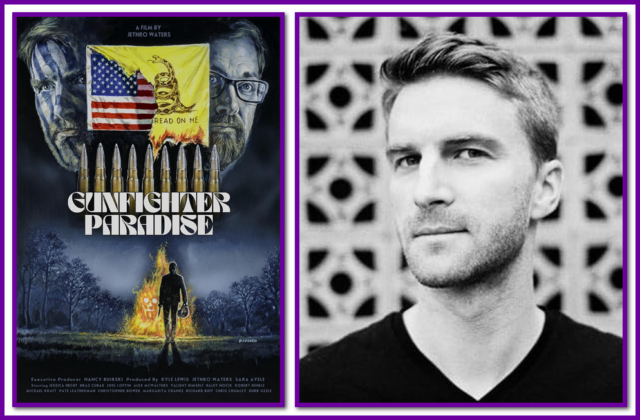
There are independent films, and then there are films like GUNFIGHTER PARADISE—the kind of deeply personal, defiantly handmade work that seems to will itself into existence through sheer creative stubbornness. In this exclusive interview, filmmaker JETHRO WATERS dives headfirst into that creative stubbornness and discusses how he willed GUNFIGHTER PARADISE into existence.
GUNFIGHTER PARADISE is the story of “a hunter named Stoner who returns home to North Carolina with a mysterious green case. Following the death of his mother, he settles back into the family home, where his mind begins to disintegrate. Stalked by divine voices and unholy visions, guided by disquiet, his mother’s handwritten riddles and strange visitors further complicate an already splintering mind. A cable man, a mummified cat, zealous neighbors, and a killer swirl through this darkly comic southern gumbo.”
Written, directed, shot, edited, scored, and headlined by JETHRO WATERS, the film is a darkly comic Southern fever dream, a story about grief, faith, fear, masculinity, gun culture, and a mind coming apart, all wrapped inside imagery so vivid and specific it feels less assembled than conjured.
Waters is the first to admit that necessity, more than ego, dictated how many jobs he ended up taking on. “I did not mix the sound. Did not do the Foley,” he laughed. “There was plenty of things I didn’t do. But the necessity of not having a big budget to work with just kind of required [me] to step in there to get it made.”
That necessity turns out to be one of the film’s greatest strengths. Because GUNFIGHTER PARADISE is so dependent on visual tone, symbolic detail, and hallucinatory montage, there is a strong argument to be made that Waters was the ideal person to photograph and cut the film he wrote and directed. He clearly saw it whole before anyone else could, especially when you break down the story.
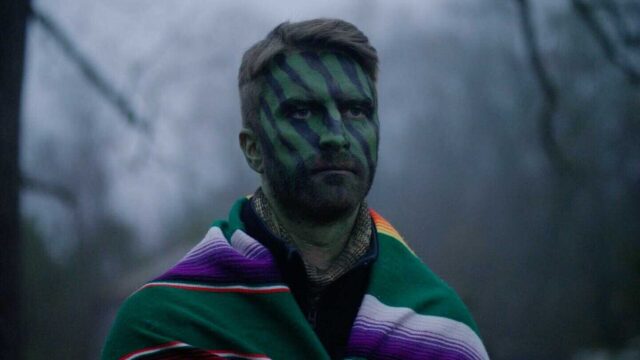
“It would be very hard to explain what we need for those kinds of shots,” he said of the film’s more surreal and hallucinogenic imagery. “Those kinds of things are a delight to do as well… having experience doing plenty of DP work is really, really fun, to go find those elements and film those elements, and know how they need to go together.”
That philosophy extends into the advice he now gives students. For Waters, editing is not merely a post-production task but a way of thinking that should begin before the camera ever rolls. “If you’re not editing, you need to be editing right now,” he said. “If you can go to set thinking like an editor… it will set you miles ahead of schedule and miles ahead of everybody else you’re working with, because you are already seeing how this is actually going to work in post.”
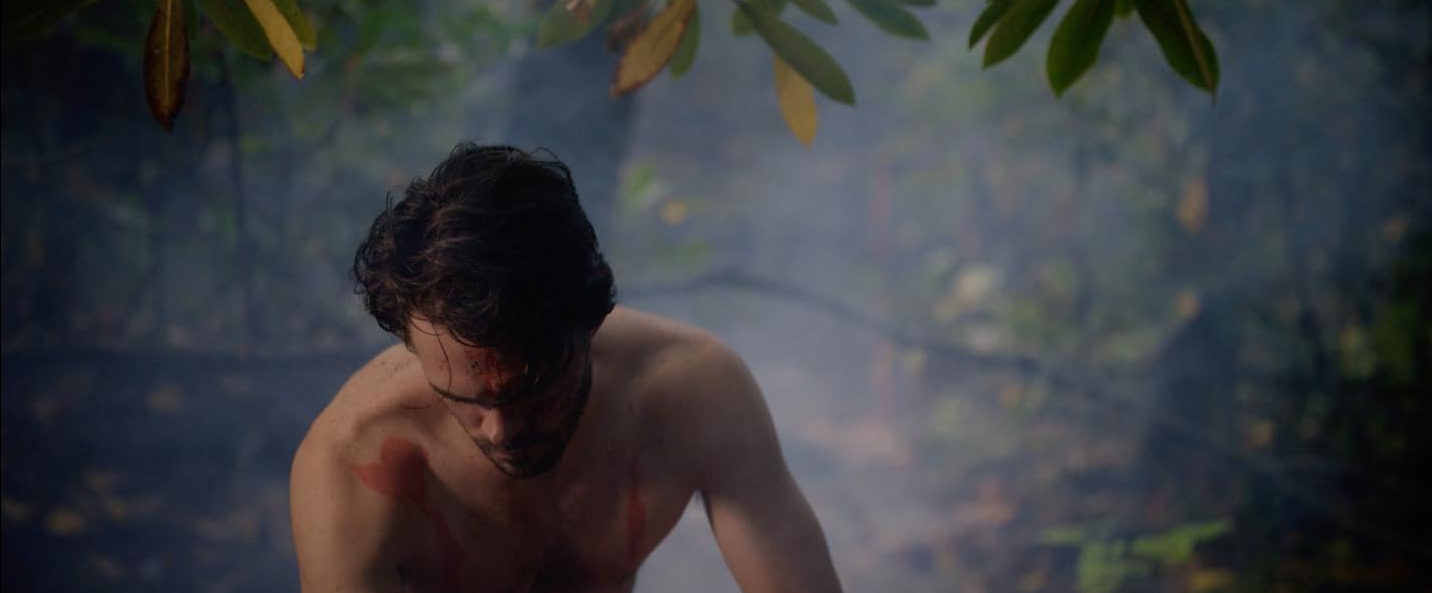
That approach is visible all over GUNFIGHTER PARADISE. The film is filled with carefully chosen inserts, visual motifs, macro close-ups, abrupt tonal pivots, and lyrical montage passages that feel planned from the inside out. Waters does not just capture scenes; he captures fragments, textures, and sensory details that build an entire psychological world. A pair of jeweled cat eyes, bacon gripped in vice grips, the texture of weathered wood, the awful familiarity of a pine-tree air freshener, the waft of frankincense—everything matters.
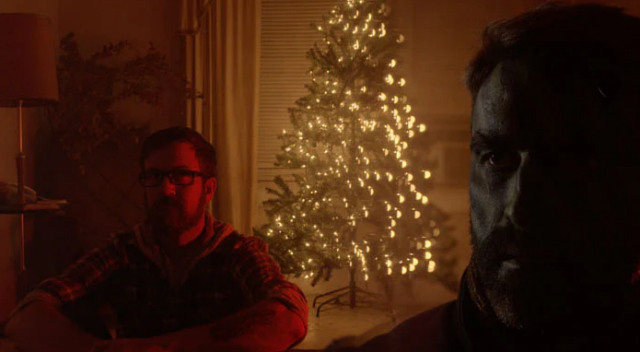
And everything begins with a script that is doing far more than telling a story. Waters’ screenplay wrestles with patriotism, religion, fatherhood, masculinity, violence, and Southern identity, yet avoids reducing itself to a single blunt thesis. Instead, it functions, as he puts it, like “a puzzle box.”
“There’s so much lived experience,” he said, explaining that he grew up in the South and knows that world intimately. “My family is split right down the middle on the political spectrum. So I can definitely navigate both of those worlds very easily.” That personal proximity gave him access to the material, but it also forced him to proceed carefully. “How do I ask a lot of questions in this film without beating people over the head with literal statements? How do I ask the questions about why our country is spiraling downward because of all these different elements, without alienating people in the South and folks who are Christian?”
That balance was delicate by design. “I really wanted it to be a puzzle box,” he said. “There are plenty of statements being made, but… I wanted to make something that was explorable.” The ideas had been simmering for about a year before Waters finally isolated himself in North Carolina and wrote in earnest. “I had note cards… on the wall. And I just locked myself away for three weeks… coffee, food, and nothing else. And I spoke to my wife, and there was no one else.”
The result is a film that feels dense with meaning without ever closing itself off. Its mysteries are not there to obscure so much as to invite engagement. Even its recurring puzzle imagery—the scattered jigsaw pieces, the cryptic notes, the layered clues—echoes Waters’ larger ambition to create something audiences could revisit and unpack from different angles.
The voiceover structure was part of that architecture from the beginning. GUNFIGHTER PARADISE is a film that lives inside the head of its protagonist, Stoner, and Waters knew early that voiceover would be essential. “I’m such a fan of voiceover in narrative features when it’s done right,” he said. “Especially when it doesn’t just spell things out.” He cited the Coen Brothers as one influence and described the voiceover here as a guide, something that could ground viewers as the film moved through nonlinear memories, psychological slippage, and psychedelic flashbacks.
Just as important, the voiceover allows Waters to avoid exposition-heavy scenes while playing Stoner’s inner truth against contradictory images onscreen. “I don’t like spelling things out for folks,” he said. “I think audiences… are very intelligent.” That intelligence is something GUNFIGHTER PARADISE trusts completely. It is unafraid to let voice and image diverge, to let Stoner narrate one thing while the visuals suggest another, to let us feel both the certainty and instability of his mind at once.
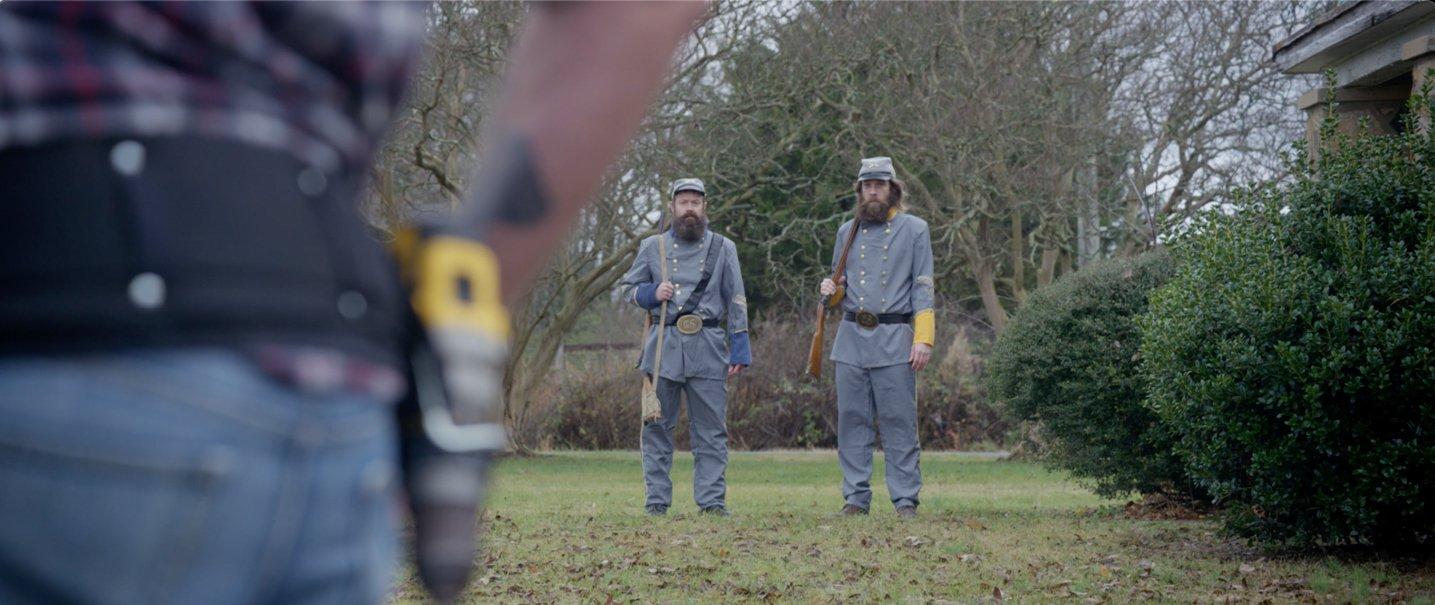
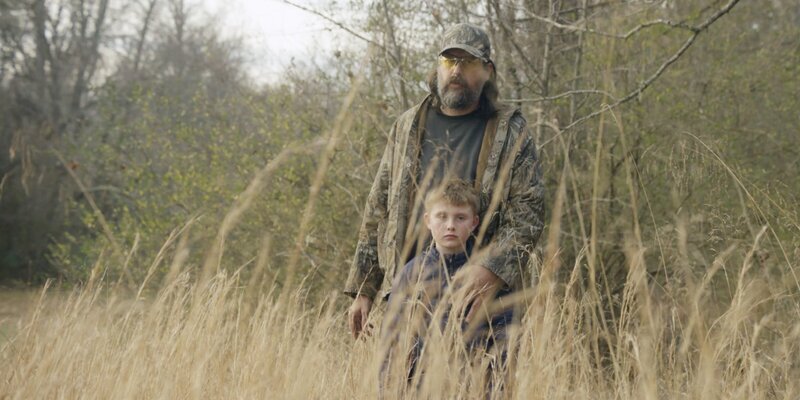
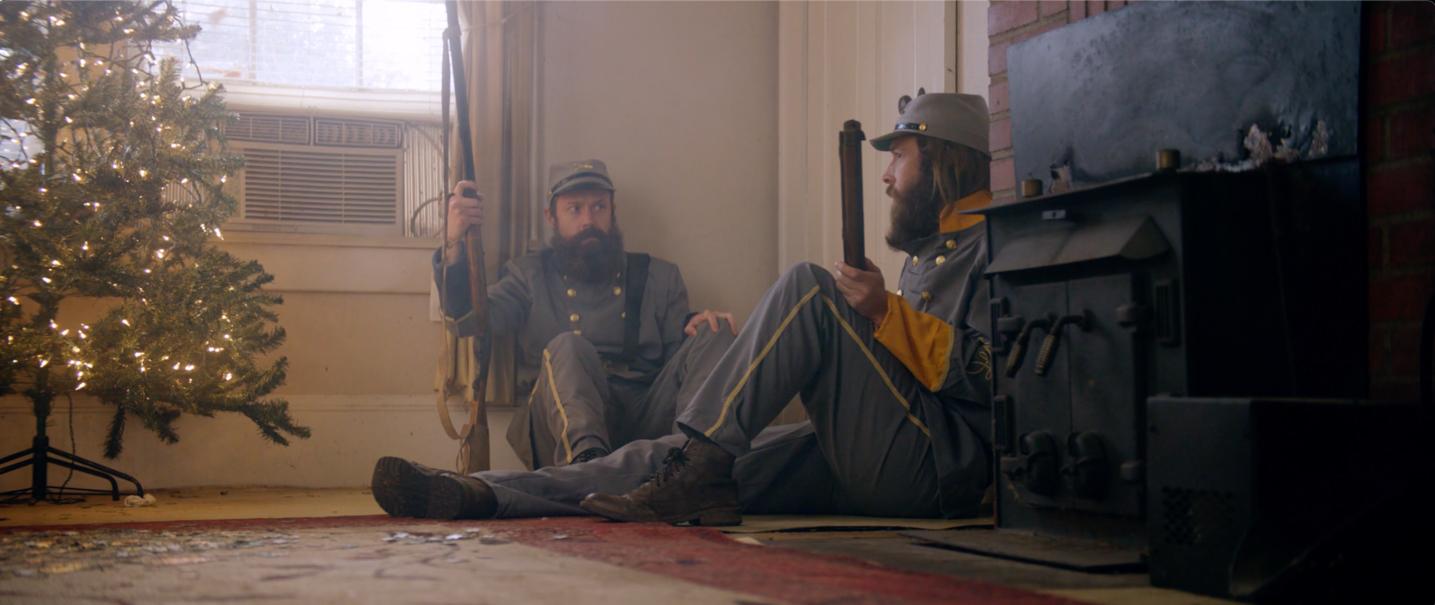
That instability finds one of its most memorable embodiments in Eugene, the mummified cat with jeweled eyes—a detail so absurd that it initially seems like a joke, until it becomes something much stranger and creepier. Waters understood the risk. “When you put a mummified cat into a film, you really question, okay, … is anyone ever going to speak to me ever again?” he joked. But he also trusted that the absurdity would curdle into something psychologically revealing. “The more that I watched it, the more I realized that it should be there. It would make perfect sense with this character as he degenerates.”
That willingness to go over the top, visually and tonally, is part of what makes the film so distinctive. Waters loves “playful things that are almost bordering on surreal,” and he delights in showing audiences images they may never have seen before. “I’ve yet to see a mummified cat,” he said. “There’s a lot of things in that film where they might exist in the history of cinema that I just haven’t seen them. But I really like the idea of going over the top and going for it.”
The film’s visual logic is not just striking but controlled. Waters understands how to move from a wider setup into a progressively more invasive close-up, how to create tension through repetition and escalation, how to build a visual tonal bandwidth that mirrors the emotional one. And he attributes much of that to his devotion to detail. “I really love details in films,” he said. “I get so tired of films that are shot where it’s just a two-shot or a one-shot with the lens wide open and the background is blurred. We have whole films and whole series… where 90% of what we’re seeing on screen is just that.”
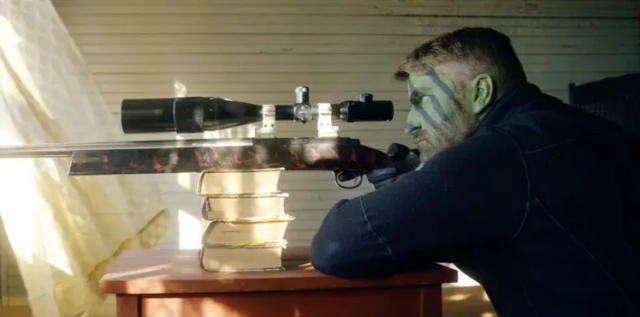
For Waters, cinema lives in the specifics. “The veins in a person’s hand say a lot. The profile of someone’s face says a lot. Little bitty details are very, very loud when you amplify them.” That principle governs the whole film. What some directors might treat as cutaways become, in GUNFIGHTER PARADISE, emotional and thematic anchors.
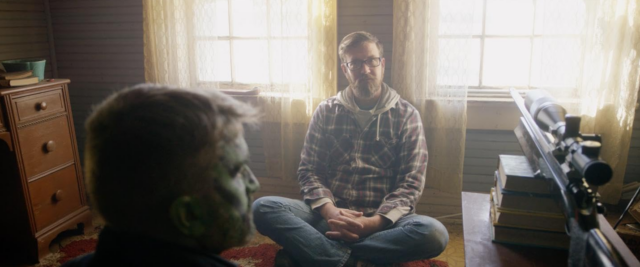
One particularly strong example comes in the “Divine Arch” section, where Waters uses close-up after close-up of a gun—trigger guard, slide stop, safety, sight alignment, trigger pull—to create not only procedural specificity but a meditative pause within the film. The sequence is tactile, deliberate, and quietly provocative, giving the audience time to sit with the machinery and symbolism of gun culture without resorting to polemic. Waters’ film is filled with those kinds of passages—moments in which image, rhythm, and accumulation do the argument for him.
The use of color is equally specific and symbolic. Rich, vivid, gorgeous, and vibrant, color speaks loudly in beautiful, metaphoric montages of sin.
Music is another essential part of that tonal architecture. Waters collaborated with longtime friend Brian Black, drawing on a shared musical history that goes back to high school bands and dreams of rock-and-roll glory. “We spent a bunch of years in a shag-carpeted van from the mid-’70s,” he said, laughing. “We were obviously very poor.” Their early band ambitions may not have made them stars, but that bond became invaluable here.
When the time came to score the film, Waters knew he wanted something that nodded toward the Western. “I want this to feel somewhat like a Western,” he said, invoking “classic spaghetti westerns” with whistling and Spanish-style guitar. At the same time, the score had to be able to pivot into eerier territory, using synthesizers and horror textures when the film takes a more sinister turn. The result is a score that can evoke both Sergio Leone and Southern Gothic nightmare, often in the same stretch of film.
Waters’ love of Leone runs deep enough that it also shaped the film’s poster art. He spoke proudly of securing legendary poster artist Renato Casaro to paint the key art for GUNFIGHTER PARADISE. “Because of Sergio Leone… I looked him up and was like, ‘Man, if I can get that guy to paint our movie poster, this will be something really special’.” Casaro, whose iconic work spans fantasy and action classics, completed the piece shortly before his death, making the poster itself a kind of tribute.
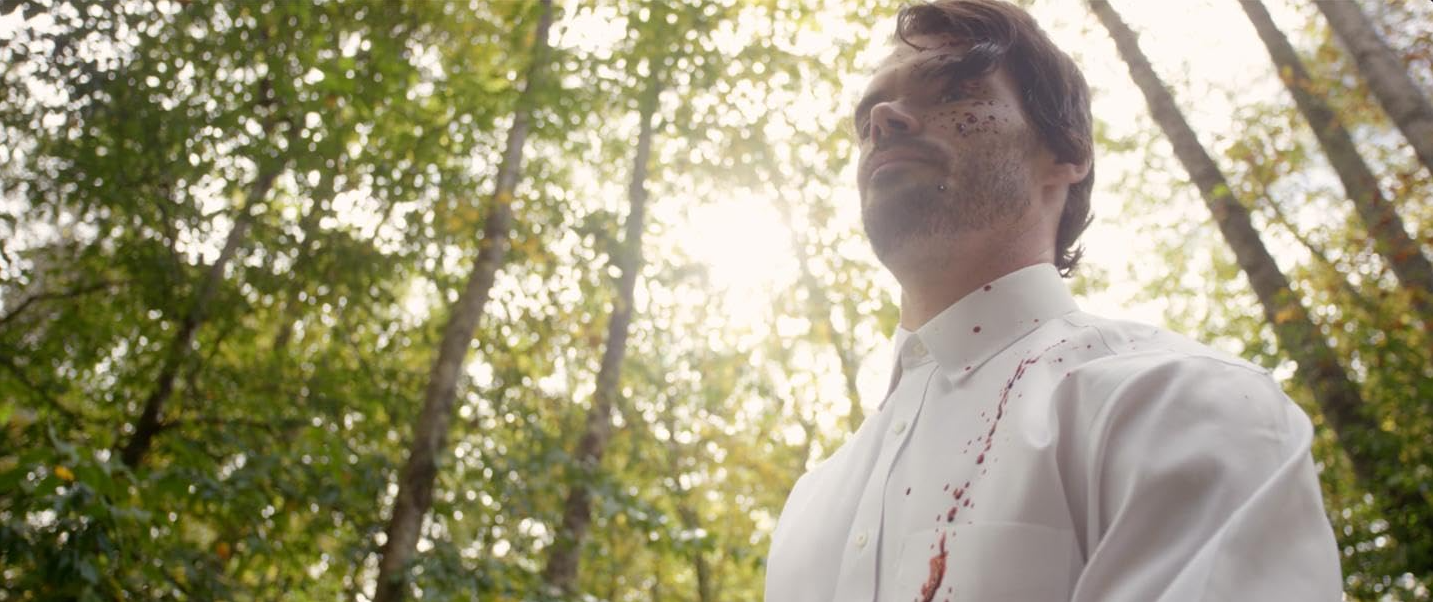
If fear is one of the film’s dominant themes, it is most powerfully expressed in the hallucinatory sequences built around sin, religion, and Stoner’s unraveling psyche. Waters spoke at length about growing up in a version of Christianity he experienced as fear-based, one obsessed less with grace than with punishment. “It was a fear-based religion,” he said. “They keep you in there based on fear of the afterlife.” That experience informed Stoner’s inner life and the imagery Waters used to represent it.
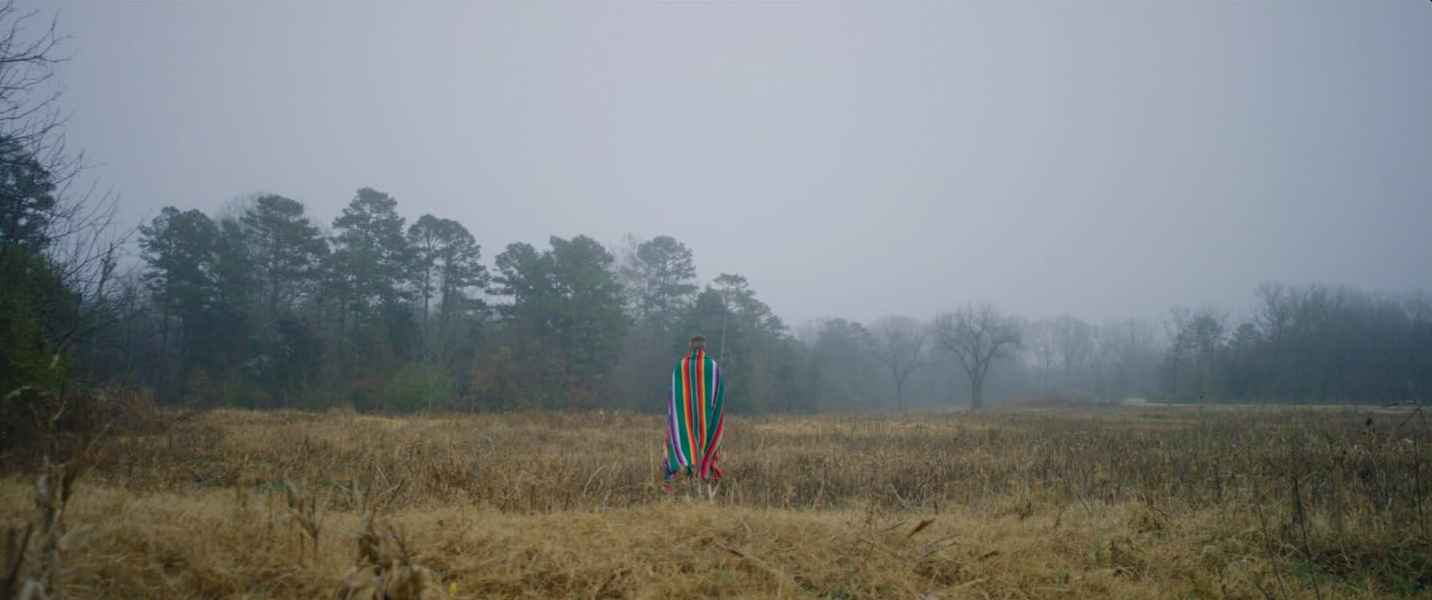
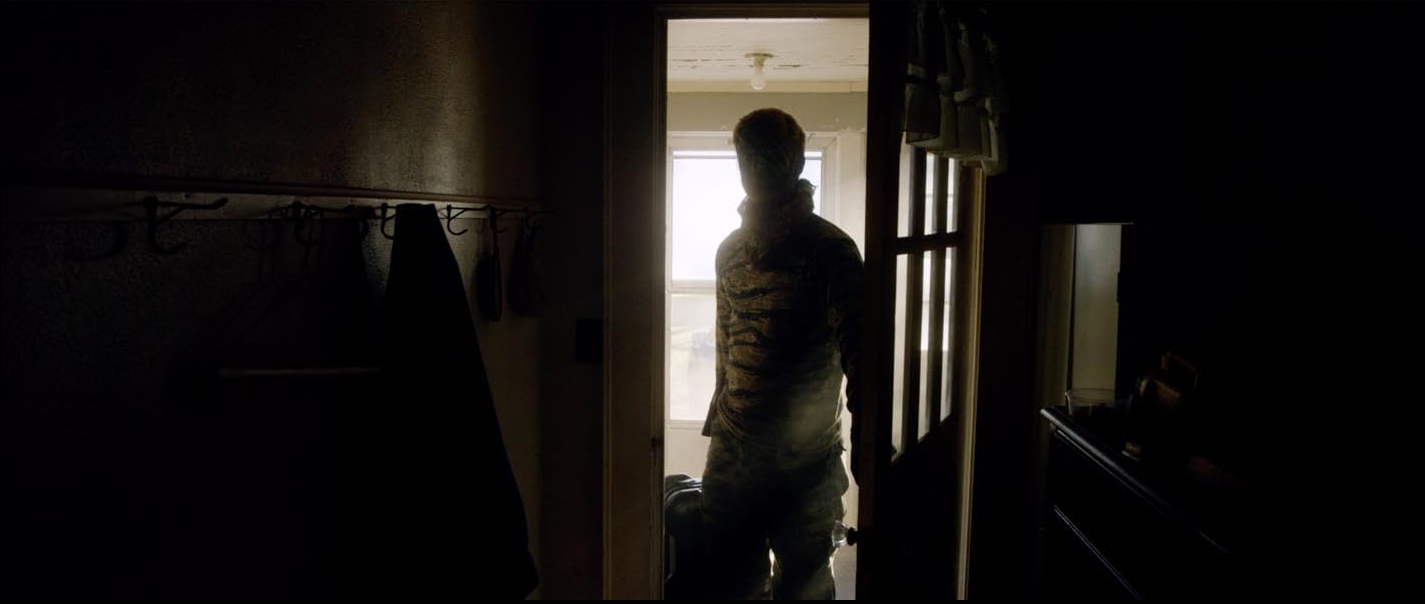
He wanted audiences to feel what it is like when existential terror suddenly hits in the middle of the night—those moments when mortality, guilt, and dread come crashing in all at once. “How do I make that into something that people can feel when they watch it?” he said. That question led to some of the film’s most vivid visual passages, full of color, fabric, glow, and symbolic fragmentation. A recurring yellow cloth functions almost like a private religious icon or warning flare. Waters likes that it resists a fixed interpretation. “It can represent a lot of things,” he said, though it clearly belongs to the film’s larger motif of fear, sin, and spiritual destabilization.
Casting the film presented another layer of challenge, especially because most of the people onscreen had never acted before. In fact, Waters had not intended to act in the film himself. He had cast a friend as Stoner, only to lose him when production dates collided with the birth of a child. “So I just had to jump in,” he said. He gave himself two weeks to test whether the arrangement would work. If not, he planned to stop and recast. Instead, he pushed forward.
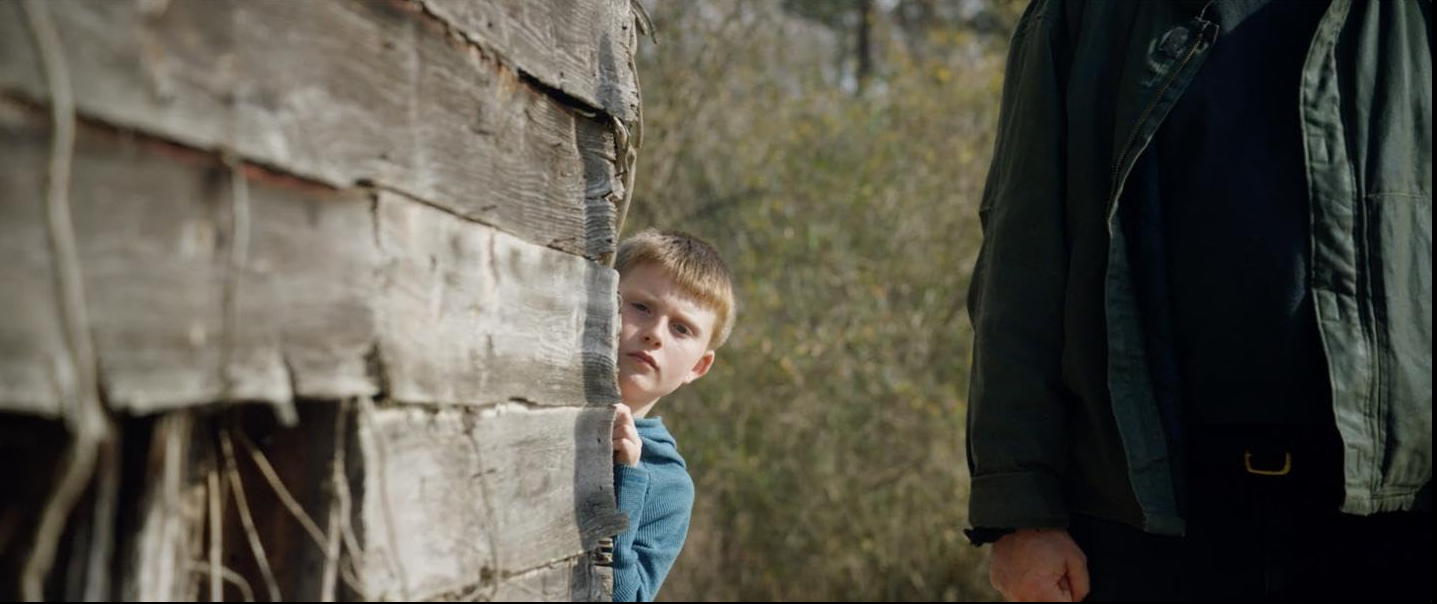
Aside from Jessica Hecht, nearly everyone in the film was a first-time actor, many of them musicians and lifelong friends. That personal connection was the key to making it work. “Every single person in that film is a lifelong friend of mine,” Waters said. “So I know them up and down.” Rather than force them into rigid performances, he wrote around their personalities. “You’re just going to be you, but you’re going to be this person in this film.” If a line did not sound like something they would naturally say, he changed it. “That’s how it works.”
The result is a cast that feels wonderfully unvarnished, full of oddball specificity and lived-in rhythms. Even the film’s more eccentric side characters never feel overly manufactured. They belong to Waters’ world because, in some way, they came from it.
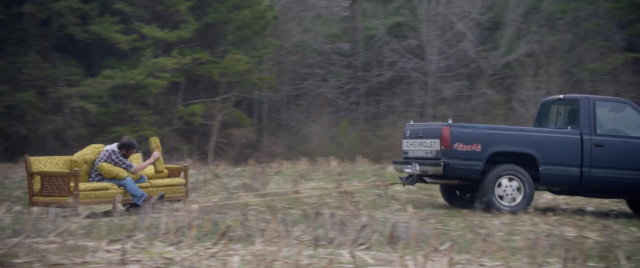
For a long time, Waters kept his own starring role a bit of a secret, even claiming during the festival run that he had found a doppelgänger: “this crazy bow hunter from South Texas that I had met that looks a little bit like me.” He delighted in sustaining the bit, even with executive producer Nancy Buirski, before finally confessing. Her response, he recalled fondly, was, “You little shit.”
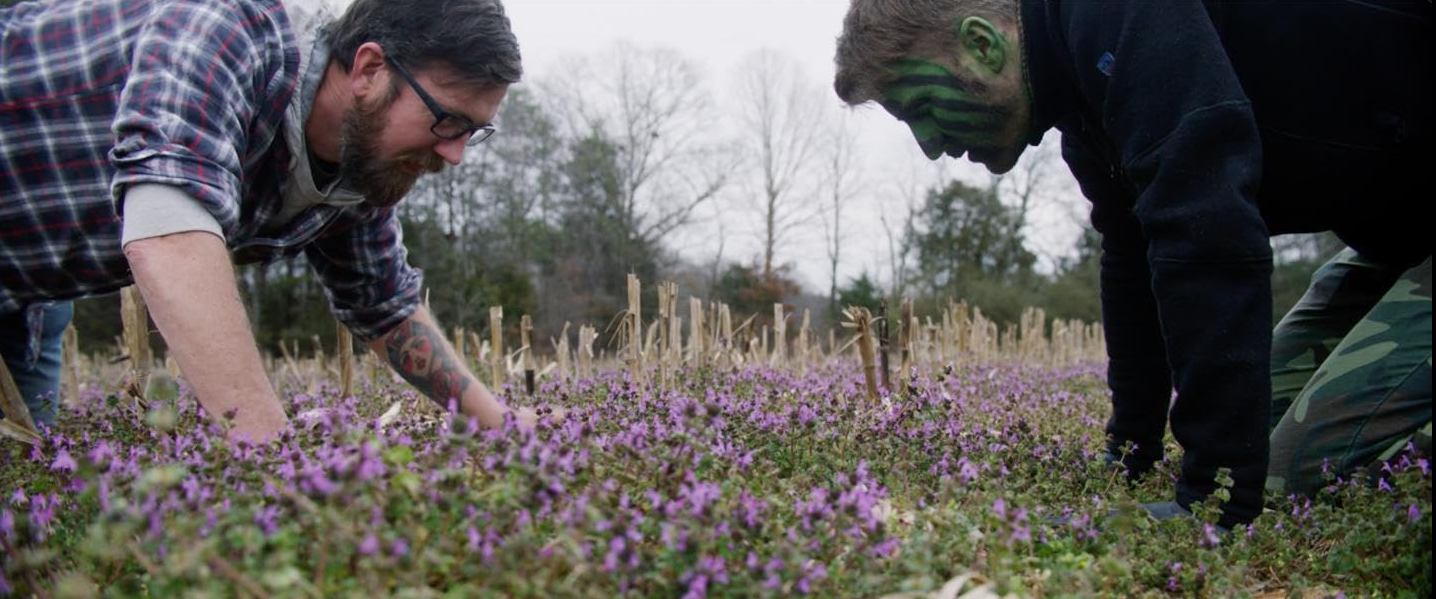
Stepping in front of the camera while also directing, shooting, and editing proved exactly as chaotic as it sounds. “It was absolutely a circus,” Waters said. Wearing the heavy green-and-black makeup helped create enough separation between himself and the character that he could disappear into the role a little more easily. But the process itself was relentless: apply the makeup, frame the shot, get someone to hit record, jump into the scene, perform, then step back out and try to evaluate the take objectively. “Actor Jethro and director Jethro… had lots of internal conflict,” he admitted. Asked whether director Jethro would ever hire actor Jethro again, he laughed: “I don’t think so.”
Even so, the experience changed him. He had more fun acting than he expected and now says he would happily take another acting opportunity if it came along. But for GUNFIGHTER PARADISE, that convergence of necessity and invention feels singular, part of the film’s DNA rather than a repeatable production model.
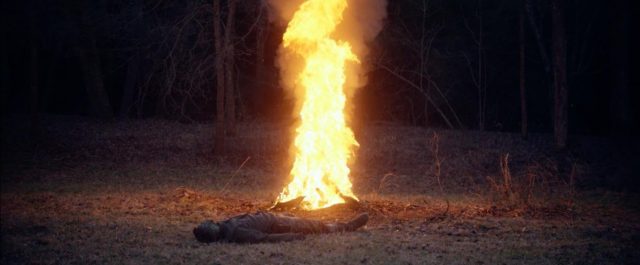
The needle drops and live musical moments are equally personal. Margarita Cranke, who played Rhoda, and Joel Loftin came to the production with genuine gospel backgrounds. “Margarita… is actually a true blue gospel singer for her church,” Waters said, while Joel grew up singing in church as well. Waters leaned on their instincts, asking them to choose songs that felt authentic. The hallway harmonies were captured live. “That was the actual audio from the hallway,” he said. “It was a really special moment.” For all the film’s satire, absurdity, and darkness, these sequences are allowed to exist with sincerity and beauty. Waters clearly respects the faith and musical traditions he is engaging, even as he interrogates the fear structures that can accompany them.
By the end of the conversation, Waters returned to the question at the center of the entire production: Could he actually do it? Could he take a wild, deeply personal, surreal narrative script, combine it with a group of largely non-actor friends, and make a feature that audiences would understand, wrestle with, laugh at, and be unsettled by?
“I kind of just learned that you can make it work,” he said. More specifically, “I guess I learned I could make it work.” The festival response and thoughtful audience engagement have given him confidence, but the achievement goes deeper than reception. GUNFIGHTER PARADISE proved something to him about himself. “Can I actually pull this off? Can I go make a narrative feature? And the answer for me is yes.”
That confidence feels earned. GUNFIGHTER PARADISE is not the kind of film that plays it safe or begs for broad approval. It is too odd, too specific, too visually committed, too willing to be funny and grotesque and disquieting all at once. But that is precisely why it works.
Jethro Waters did not just make a feature; he made a film with a voice, a texture, and a worldview all its own. And yes, it also has a mummified cat with jewels in its eyes. What more could you ask for?
by debbie elias, Exclusive Interview 02/19/2026