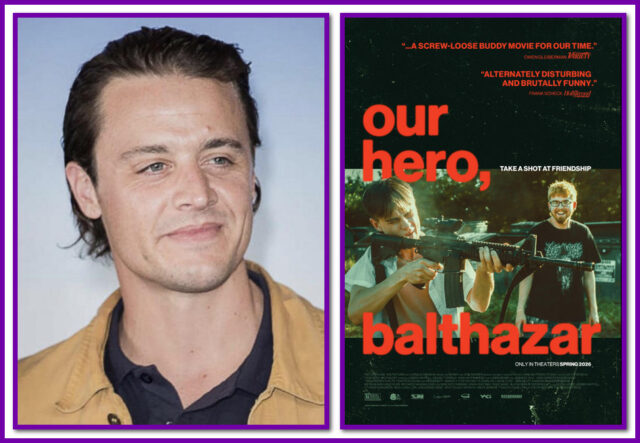
Director and co-writer OSCAR BOYSON discusses his feature directorial debut – OUR HERO, BALTHAZAR.
SYNOPSIS: A headlong race through a world where success is measured in engagement and tragedy has become content, OUR HERO, BALTHAZAR follows two neglected teens brought together by a chance online encounter. Privileged yet lonely New Yorker Balthy (Jaeden Martell) dreams of becoming a hero, while struggling Texan Solomon (Asa Butterfield) seeks recognition through increasingly alarming online behavior. When Balthy travels to Texas in a misguided attempt to intervene, both boys find connection—but also push each other closer to the brink of disaster.
**********
Sometimes the most compelling stories don’t just reflect the world around us—they hold up a mirror and dare us not to look away.
That’s exactly what writer/director OSCAR BOYSON does with OUR HERO, BALTHAZAR, a film that dives headlong into the volatile intersection of youth, loneliness, online culture, and the dangerous allure of performative heroism. What begins as a seemingly simple premise—a chance online encounter between two teenage boys—quickly spirals into something far more complex, unsettling, and emotionally raw.
As Boyson explains in this exclusive interview, at the center of it all are two transformative performances from Jaeden Martell and Asa Butterfield—roles that push both actors far beyond anything audiences have seen from them before. For Boyson, that was entirely the point.

“With Jaeden, we’re really looking at the birth of a movie star,” he says. “He’s got tremendous ambition and a lot inside him that audiences haven’t seen yet.”
Martell’s Balthazar is a study in contradiction—privileged yet starved for attention, emotionally performative yet deeply hollow. It’s a role that demands not just emotional vulnerability, but physical commitment as well, particularly in moments where Balthy’s self-manufactured exhibitionism becomes almost grotesque in its desperation for validation.
Butterfield, meanwhile, delivers a startling turn as Solomon—a frenetic, volatile young man whose rapid-fire energy masks a deeper emotional fracture. As Boyson notes, the goal was to subvert the warmth audiences typically associate with Butterfield’s screen persona. “I wanted him to go to a nastier place,” Boyson explains. “He can get away with more than other actors because audiences trust him.”
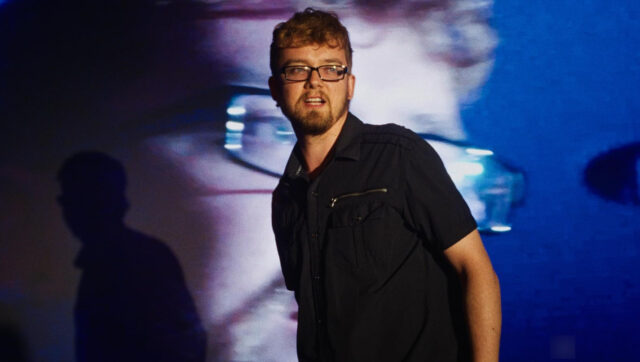
That trust becomes a powerful tool, especially as Solomon’s motivations come into sharper focus. Once we meet his father—played with striking presence by Chris Bauer—the emotional underpinnings of Solomon’s behavior snap into place, transforming him from a figure of unease into one of unexpected heartbreak.
The chemistry between Martell and Butterfield is electric, grounding the film’s more volatile elements in something deeply human. Despite their vastly different backgrounds, both characters are united by a profound sense of isolation—each searching for connection in a world that has largely ignored them.
That search for connection is what initially sparked the story.
Boyson and co-writer Ricky Camilleri drew inspiration from real-world events, particularly instances of online threats being dismissed as attention-seeking behavior—until they weren’t. “There were people messaging strangers online with violent threats, and others would just respond with ‘oh cool,’ assuming it wasn’t real,” Boyson says. “We started asking—who would actually take that seriously and do something about it?”
That question became the foundation for Balthazar—a young man raised to believe he could change the world, armed with the privilege and resources to act, but lacking the emotional grounding to understand the consequences. Layered into that are themes of performative culture, exploitation, and the increasingly blurred line between authenticity and content. Balthy’s actions are not just driven by a desire to help, but by a need to be seen helping—a subtle but crucial distinction that fuels the film’s tension.
Visually, Boyson reinforces these themes through a carefully constructed grammar developed with cinematographer Chris Messina. Eschewing overly polished or clinical techniques, the film instead adopts a more immersive, human approach—placing the audience directly alongside its characters. “I didn’t want to feel like a distant observer,” Boyson explains. “I wanted the audience to feel like they’re right there with these boys.”
That philosophy extends to the way scenes are shot. Rather than breaking sequences into rigid, pre-planned coverage, Boyson and Messina often allow the camera to move fluidly within a scene, capturing performances in real time. “The actors don’t know when the camera is on them,” he says. “So everyone has to stay present. There’s an energy that comes from that—it’s like playing jazz.”
The result is a sense of unpredictability that mirrors the characters’ emotional states. The camera feels alive, responsive, and at times almost intrusive—forcing the audience to remain engaged, even when the story veers into deeply uncomfortable territory.
That same attention to detail carries through in the film’s design elements. Costume designer Emily Constantino and production designer Steven Phelps create two distinctly different worlds for Balthy and Solomon—one defined by polished, glass-and-chrome affluence, the other by cluttered, chaotic realism.
As Balthy descends further into Solomon’s world, those visual distinctions begin to blur. His wardrobe subtly shifts, reflecting not just a change in environment but a deeper psychological transformation. It’s a nuanced evolution that underscores the film’s exploration of identity and influence.

At its core, OUR HERO, BALTHAZAR is a film about connection—how desperately we seek it, how easily we misinterpret it, and how dangerous it can become when filtered through the distorted lens of modern culture. It’s also a film that refuses to offer easy answers.
Boyson doesn’t judge his characters, nor does he provide clear moral resolution. Instead, he invites the audience to sit with the discomfort, to question their own reactions, and to confront the unsettling reality that the line between heroism and harm is often thinner than we’d like to believe. And perhaps most impressively, he does so while keeping the film grounded in performance, collaboration, and a deeply human perspective.
With OUR HERO, BALTHAZAR, Oscar Boyson delivers a film that is as thought-provoking as it is emotionally gripping—a bold, unflinching look at a generation navigating a world where attention is currency, identity is performance, and the stakes are all too real.
by debbie elias, exclusive interview 03/19/2026
OUR HERO, BALTHAZAR opens in NY theaters Friday, March 27th, and in LA on April 3rd.