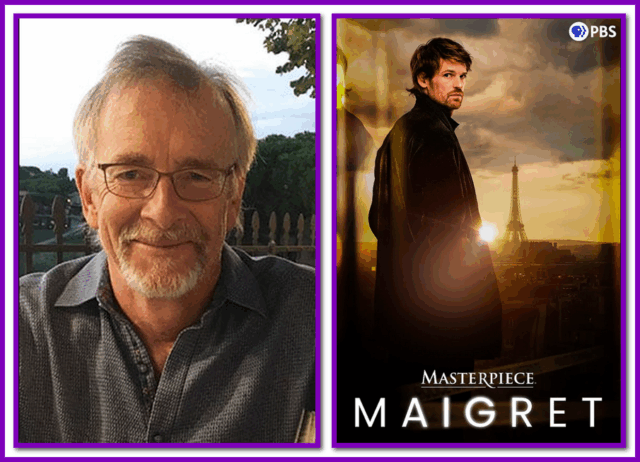
An exclusive interview with executive producer, writer, and director PATRICK HARBINSON discussing his contemporized series adaptation of Georges Simenon’s iconic detective novel series, MAIGRET.
SYNOPSIS: Reimagined for a global audience, the iconic MAIGRET returns, his signature coat and pipe in hand, but with a fresh and invigorated lens. Young and idealistic, Maigret must navigate the gritty banlieues of modern-day Paris to the glamorous circles of the wealthy and influential. The new spin on the timeless masterpiece blends moments of humor and empathy with high-stakes cases and moral complexities, all while seamlessly fusing the rich depth of Simenon’s legendary novels with a present-day pace and sharp wit.
Follow along as Chief Inspector Maigret (Benjamin Wainwright) and his team of maverick but loyal detectives, “Les Maigrets,” solve a series of complex crimes in Paris. Maigret’s unconventional methods and unique sense of justice put him at odds with his superiors and the judicial system he is supposed to represent. Maigret must outwit some of Paris’s most cunning and violent criminals while dealing with his own troubled past.
MAIGRET is executive produced and written by PATRICK HARBINSON, with episodes one and two directed by Harbinson, and stars Benjamin Wainwright, Stefanie Martini, Blake Harrison, Reda Elazouar, Kerrie Hayes, Shaniqua Okwok, Rob Kazinsky, and Nathalie Armin.
As you will hear in this exclusive interview, PATRICK HARBINSON is articulate, passionate, and charming as he discusses MAIGRET.
Detective Jules Maigret is a beloved character both on the pages of Georges Simenon’s 75 novels, and on the big and small screens with some 30 adaptations as far back as the 1930s. So one must ask PATRICK HARBINSON, why do another television adaptation and why now?
As Harbinson tells it, the inspiration for reimagining MAIGRET came from a deep appreciation and fascination with the original novels. He was particularly struck by the unique perspective and soul of Maigret—a detective more interested in understanding the person behind the crime than just solving cases. A specific line about tragedy being commonplace, as well as evocative early passages from the books, captured his imagination and set the tone for the adaptation. This reimagination was driven by a desire to explore these character-driven elements and bring emotional depth and empathy to both the detective and those involved in his cases. Of course, then the question became, which books do you adapt? For Harbinson, the decision on which MAIGRET books to adapt involved reading through many of the 75 original novels—starting from the beginning and noting stories that stood out. Drawn to specific lines and images that captured Maigret’s essence, especially those that gave insight into his character’s soul, helped him hone in on his selections. Notably, for episodes one and two, a poignant line about tragedy in “The Lazy Burglar” helped determine its adaptation. After narrowing down potential choices and reading 15–20 books, the final selection was also endorsed by Patrick’s collaborators.
As Patrick discusses the adaptation, from the outset, he chose a contemplative style which proved to be both a goal and a challenge, demanding a careful balance between introspective moments and compelling storytelling. His biggest concern was that the series might become “too contemplative” or slow, especially when compared to previous adaptations. The key challenge was finding the right balance: honoring Maigret’s introspective and thoughtful nature while keeping the plot moving and engaging. To achieve this, Patrick worked closely with Ben Wainwright, who plays Maigret, encouraging him to “brood quickly”—to let the character think deeply, but without dragging the pacing. The writing process involved creating moments where the audience could share Maigret’s reflective mindset, but ensuring these were carefully placed so as not to slow down the narrative. Describing it as a “continuous juggle” to find that balance, Patrick admits he is still perfecting it, feeling the show found a particularly effective rhythm by episodes five and six.
While admitting that the casting process was a “nightmare”, albeit rewarding and enjoyable, they auditioned more than 130 actors for the role of Maigret before deciding on Wainwright. The supporting roles brought their own difficulties, especially given the need for genuine chemistry between the characters. With the cast in place, Harbinson found that the actors brought new depth to their roles, which then allowed him to adapt the script to showcase their individual talents.
With MAIGRET, Patrick found himself venturing into new territory: that of a director. Not unfamiliar with directing and having been executive producer on countless acclaimed series like “24”, “Law & Order: SUV”, “Homeland”, as well as writer for “Homeland”, “The Tower”, and “Fearless”, to name a few, he decided to direct the first two episodes because there was an unexpected change just four days before shooting began, leaving the team without a director. After a “brief consideration”, he felt it was the most sensible solution, given his deep familiarity with the scripts and the cast. While it was intimidating, Patrick found the experience clarifying and ultimately rewarding.
And with directing comes developing the visual grammar and emotional tonal bandwidth of the show. Calling on the collaborative talents of cinematographers Adam Fillenz and Emily Barr, they focused on intimacy and point-of-view, especially by keeping the camera close to Maigret to let viewers see the world through his eyes. Wide shots were used sparingly, primarily to maintain a sense of closeness and emotional connection within the team and between Maigret and his wife, Louise. It was agreed to prioritize Maigret’s perspective, selecting interesting and dynamic angles to reflect both the beauty and grittiness of the city (Budapest standing in for Paris). The goal was always to ensure the visuals supported the emotional depth and storytelling, with camera movement and shot selection serving to amplify the series’ tone and closeness rather than distract from it.
Described by Patrick as “challenging and introspective”, with the editing process with MAIGRET, as both director and writer, he found himself more defensive of the material compared to previous experiences as a showrunner. Normally, he would have distanced himself from the material before reviewing a director’s cut, but this time, he was directly involved. This led him to personally re-edit the first episode months later, continually seeking to get it right. A key takeaway was the importance of staying true to the characters and ensuring all dialogue felt authentic and real. The process was one of ongoing revision and self-reflection, but ultimately aimed at delivering a story and performances that felt genuine and believable.
TAKE A LISTEN. . .
by debbie elias, exclusive interview 10/15/2025
New episodes of MAIGRET air Sundays through November 9 at 9/8c on MASTERPIECE Mystery! on PBS. Episodes are also available to stream via PBS and PBS MASTERPIECE on Prime Video.