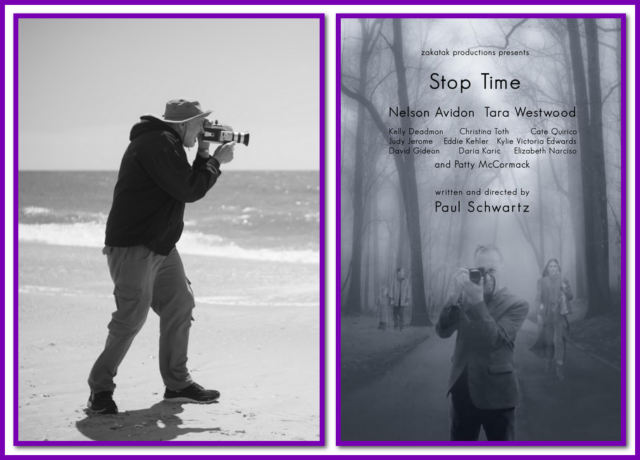
An in-depth exclusive interview with writer, director, editor, and cinematographer PAUL SCHWARTZ discussing the exquisite and quietly elegant and emotional film, STOP TIME.
SYNOPSIS: STOP TIME tells the intertwined stories of Peter de Vries, a photographer, and Adrianna Maier, a theatrical lighting designer. Both are carrying heavy burdens of sadness: burdens that mutual friends of theirs believe each could lighten for the other. Over the course of 24 hours in New York City, their lives circle, until they meet at the opening of Peter’s gallery show, which leads them both down an unexpected path.
Written and directed by PAUL SCHWARTZ, STOP TIME stars Nelson Avidon, Tara Westwood, Patty McCormack, Kelly Deadmon, Christina Toth, Catherine Quirico, and Daria Karic.
***
Written, directed, shot, and edited by Paul Schwartz, STOP TIME is a film of quiet precision and emotional restraint—one that unfolds not through dramatic incident, but through accumulation, rhythm, and memory. Shot in luminous black and white, with fleeting, carefully motivated intrusions of color and textured Super 8mm footage, the film observes grief the way a dancer moves through space: with deliberation, balance, and grace.
STOP TIME intertwines the stories of Peter de Vries, a photographer still suspended in mourning after the death of his wife, and Adrianna Maier, a theatrical lighting designer carrying her own quietly weighted past. Over the course of a single day in New York City, their lives circle one another, guided by well-meaning friends who sense that each might offer the other a way forward. When they finally meet at the opening of Peter’s gallery show, the encounter nudges both toward an unexpected emotional alignment.
Schwartz originally conceived STOP TIME as a 44-minute film focused solely on Peter. That earlier version already took place over a single 24-hour period and contained the film’s essential emotional architecture. But the impulse behind it was deeply personal.
The idea emerged in the aftermath of Schwartz’s wife’s breast cancer diagnosis and treatment. At the time, his previous feature, The Seasons – four love stories, had just begun its festival run. Life, however, came to a halt.
“I dropped everything,” Schwartz recalls. “We spent the next eight months of me just basically taking care of her through chemo and surgery and radiation and the whole thing.” When that chapter ended, he found himself in a profound creative paralysis. “The blank screen went nowhere.”
The breakthrough came unexpectedly in early 2024, when Nelson Avidon—who plays Peter—called and asked about an old idea Schwartz once mentioned, a story about a photographer. That simple nudge unlocked something. Within two weeks, Schwartz had written the entire 44-minute version of STOP TIME, composed exclusively of Peter’s storyline.
That short film might have remained complete unto itself were it not for a question posed at a cast screening. Avidon’s wife, Rachel, zeroed in on a single line spoken by Adrianna: “You and I both have histories. Some of yours is sad, mine too.” Her response was immediate and incisive: What’s Adrianna’s story?
Schwartz realized the answer could transform the film.
Expanding STOP TIME into a feature was not a matter of rebuilding, but of interweaving. Schwartz committed to preserving the original structure—still one day, still Peter’s arc—but now counterbalanced by Adrianna’s own 24-hour journey. The challenge lay in constraint: giving Adrianna a meaningful emotional past—adoption, displacement, her relationship with her grandmother—without making it so overwhelming that it would collapse the film’s fragile equilibrium or strain plausibility.
After editing the original 44-minute cut to completion, Schwartz shot four new Adrianna-centered scenes. In the edit, he quite literally cut into the finished film, inserting her story beat by beat, adjusting overlaps of sound and image so seamlessly that the expansion feels organic, inevitable. The result is not a stitched-on addition, but a true two-hander—two lives in parallel, finally allowed to converge.
One of the film’s quiet triumphs is the casting of Patty McCormack as Adrianna’s mother. Schwartz calls her involvement “a real godsend,” praising not only her emotional authority but her technical precision. Despite just having turned 80, McCormack was, as he puts it, “textually perfect”—fully present, rock-solid on her lines, and utterly dependable. Having worked with actors well into their nineties, Schwartz understands the risks that can accompany age; with McCormack, there were none.
STOP TIME’s black-and-white cinematography is central to its emotional grammar. For Schwartz, it was never an aesthetic affectation, but a motivated choice. Peter is a black-and-white photographer—and, more importantly, he is living in black and white after his wife’s death. Color exists only in memory or renewal: in dreams, in home movies, and in the slow emotional reawakening that occurs when Peter finally connects with Adrianna.
“I had this idea that Peter is living in black and white,” Schwartz explains. “And the color only appears when he’s remembering when his wife was alive… and then in the final sequence, once he and Adrianna connect, his world bleeds gradually from black and white into color.”
That gradual tinting—never abrupt, never declarative—mirrors emotional shifts rather than narrative beats. The film breathes in shades of gray, contrast, and texture, allowing feeling to rise without being dictated.
Schwartz’s love of black-and-white cinema runs deep, but here it becomes something more: a visual embodiment of grief, memory, and healing. Many of the photographs seen in Peter’s gallery are Schwartz’s own stills, further binding the character’s inner life to the film’s visual language and to the grainy Super 8mm footage that surfaces throughout.
Rather than simulate memory digitally, Schwartz shot key material on actual Super 8 film. The home movies and Adrianna’s flashbacks carry the heavy grain, flicker, and fragility of real antiquated stock. These memories feel physically aged, as though the past itself were being projected—always at risk of burning out.
The editing echoes this tactile intimacy. Schwartz favors dissolves, superimpositions, and temporal overlap over hard cuts. In one striking sequence, Peter hangs his gallery photographs while Adrianna prepares for the opening, their actions unfolding in layered simultaneity. The effect is less cinematic coverage than choreography—movement, pause, and convergence shaped by rhythm.
Sound, too, is sculpted with musical sensitivity. A former record producer, Schwartz designs STOP TIME’s soundscape directly in the edit, layering ambience, effects, and score before handing the track to longtime collaborator Alan Douches for final mix. At Coney Island, waves, wind, birds, and children’s voices coexist without hierarchy; at a dinner scene, clinking glasses and room tone wrap the characters in lived-in space.
The score—anchored by intimate jazz piano—never announces itself. It glides beneath scenes like a shared heartbeat, reinforcing emotion rather than underlining it. Music, like light and image, adheres to Schwartz’s guiding principle: less is more.
Working in concert, the monochrome imagery and carefully modulated soundscape give STOP TIME the sensation of existing outside ordinary clocks. Time does not stop so much as soften—allowing grief, memory, and connection to occupy the same suspended space. By the time Peter and Adrianna’s paths finally align, it feels as though the world has briefly paused, granting them the grace to step forward together.
TAKE A LISTEN. . .
by debbie elias, exclusive interview 01/13/2026
STOP TIME had its World Premiere at Dances With Films NY on January 17, 2026, and is currently on the festival circuit.