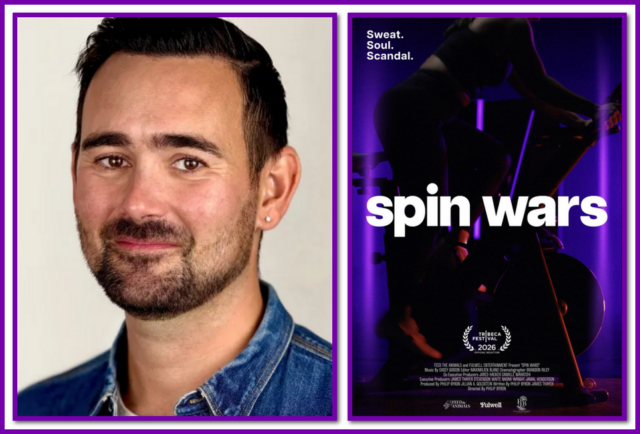
Philip Byron used to teach 6 a.m. spin classes. I exercise by perfectly balancing a glass filled with ice while lifting it from the bar.
And yet, somewhere between SoulCycle, Flywheel, Peloton, ambition, betrayal, toxic sweat, and a killer playlist, SPIN WARS found common ground for both of us.
Making its world premiere at the 2026 Tribeca Festival, SPIN WARS marks the feature directorial debut of five-time Emmy Award-winning producer Philip Byron, who, along with co-writer James Thayer, takes us on a high-energy ride through the rise, rivalry, and darker side of the billion-dollar boutique fitness industry.
Beginning with the aerobics explosion of the 1980s before moving through the emergence of spinning in the 1990s and into the increasingly competitive and cutthroat boutique fitness wars of the 2000s, SPIN WARS traces the evolution of a cultural phenomenon through the titans of SoulCycle, Flywheel, and Peloton. Along the way, Byron assembles a colorful and eclectic chorus of insiders, journalists, instructors, devotees, celebrities, and industry pioneers, among them Ruth Zukerman, Marion Roaman, Katie Couric, Jill Kargman, Heather McMahan, Mary Beth Barone, Brandon Kyle Goodman, Ali Weiss, and more.
For Byron, however, SPIN WARS was more than an interesting documentary subject. He had lived it.
A veteran documentary producer, Byron spent years producing films and series while moonlighting as an indoor cycling instructor, teaching classes at 6 a.m. before heading to his day job in television. When the idea for SPIN WARS began taking shape at his former company, the project immediately spoke to him on a personal level.
“I used to moonlight as an indoor cycling instructor before my day job as a TV producer, so I would teach in the mornings at like 6 a.m. and then sometimes on the weekends. I loved boutique fitness in general, and especially spin classes.”
Initially, the plan was the familiar one: develop the project and bring in a director. But something kept happening during meetings with potential filmmakers. They didn’t get it. “They were like, ‘Never done SoulCycle,’ or ‘I don’t get how there’s a story here,’ or ‘I don’t know if I’m the right person for the job.’”
Byron, meanwhile, could already see the film in his head. “It was this kind of moment where I was like, ‘Well, I see this so clearly.’”
And suddenly the veteran producer found himself stepping into the director’s chair for the first time.
“It was one of those ‘Oh, shoot’ moments when they said yes. I was like, ‘Oh, now I guess I’m doing this.’”
The project became an obsession, one Byron admits “really should have died many times,” but he refused to let that happen. The deeper he went, the more personal the film became and the more he embraced the minutiae of directing that he had not necessarily experienced in the same way as a producer.
“I frickin’ loved it.”

That enthusiasm is palpable in SPIN WARS, as is Byron’s intimate understanding of the culture he is documenting. But personal experience could only provide the broad strokes. The texture, detail, emotional complexity, and, yes, scandal, emerged through research and interviews.
At the foundation of the film are two women whose lives intersect with the histories of the three cycling giants: Ruth Zukerman and Marion Roaman. Zukerman’s story particularly resonated with Byron.
“I just found the theme of getting fucked over to be so relatable. Many of us have been fucked over in life, professionally or personally.”
Hearing the emotion with which Zukerman recounted her experiences immediately convinced him of her importance to the film. Then came Roaman, whose own history provided another extraordinary connective thread.
“To have two women who had touched all three of the titans of indoor cycling, I was like, ‘What a dream come true. How can we use them as the foundation of the movie?’”
Around them, Byron built what he calls a “great chorus” of journalists, employees, writers, instructors, celebrities, and devotees, many of whom could occupy multiple perspectives simultaneously. Katie Couric, for example, brings not only the perspective of a journalist but that of a celebrity and someone who experienced New York at the height of the boutique fitness explosion.
What emerges is far more than a chronology of exercise trends. SPIN WARS exposes a world in which the public promise of “mind, body, soul” wellness existed alongside ambition, betrayal, rivalry, and some decidedly toxic sweat.
As I noted to Byron, Legally Blonde taught us that exercise gives you endorphins and endorphins make you happy. Apparently, some of the people running the boutique fitness industry missed that memo.
For all the darker material, however, Byron discovered something essential during the interview process: the film needed to be funny.
“I remember interviewing Jill Kargman, and I was just like peeing my pants. When that interview was done, I was like, ‘We need this thing to be funny.’ This is such a funny thing that we went through as a culture.”
That humor provides an essential counterbalance to the darker side of wellness culture and helps give SPIN WARS its irresistible energy.
But one of the most impressive aspects of the documentary is its construction.
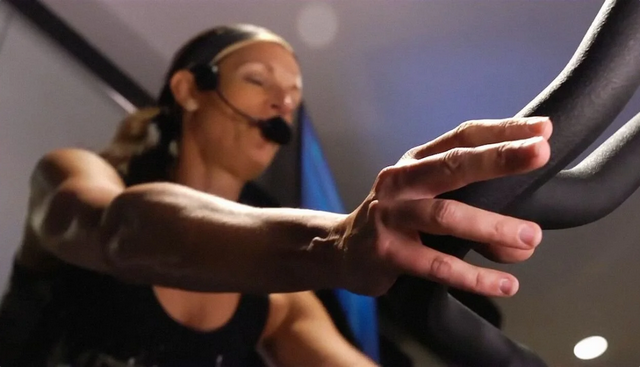
Condensing approximately two decades of history into 88 minutes while juggling three major companies, multiple personalities, corporate rivalries, cultural shifts, scandal, archival material, and the rise of social media is no small feat. Although SPIN WARS moves backward and forward in time, the structure never becomes confusing. When the film steps backward chronologically, it often plays almost like a footnote to the present, adding information and context before propelling us forward again.
That clarity is a testament to Byron’s vision and the work of editor Maximilien Blanc.
“Max had a very hard job.” That may be an understatement.
With an embarrassment of archival riches—from traditional media coverage and old interviews to headlines, social media posts, and material generated during the explosion of Facebook and Instagram—Blanc had an enormous amount of footage to wrangle. The solution was initially to build “pods” around specific stories: Flywheel, for example, or the relationship between instructors and riders. From there, Blanc shaped the film’s larger rhythm.
And that rhythm was crucial because Byron wanted SPIN WARS to feel like something very specific.
A spin class.
“We always talked about wanting the film to feel like a spin class and to have those peaks and valleys and moments of cooling down and being introspective, and then moments of a fast sprint where you’re just gunning through it.”
Blanc achieves exactly that. The pacing can be fast and exhilarating when necessary, but the film also knows when to breathe. Rather than simply cutting everything with the relentless speed of a TikTok reel, the editing creates its own workout, building momentum, easing back, and then accelerating again.
Adding another layer of visual wit is the archival material assembled by archival producer Jared Hacker and researcher Shaun Assael, including vintage black-and-white footage used as humorous visual punctuation. When the arrangement of spin bikes is compared to a chorus line, for example, the film cuts to vintage footage of women dancing in formation.
It is an inspired touch that elevates the film beyond straightforward documentary construction and adds to its sense of playfulness.
“Debbie, you’re literally catching all the things that I’m like, ‘Do people notice this stuff?’” Byron laughed when I brought it up.
Yes, Philip. Some of us notice.
That same attention to detail carries into the film’s contemporary interviews. Rather than visually flattening its eclectic collection of personalities with repetitive setups, each interview has its own distinctive look. It struck me as an almost metaphorical extension of the boutique fitness companies themselves: businesses that often borrowed from or competed with one another while carefully cultivating their own individual branding and identity.
Byron credits production designer Mike Mills and cinematographer Brandon Riley with bringing that vision to life.
“Mike Mills, our production designer, really had not done much boutique fitness. He just brought my vision to life in a way I could never have expected. And then Brandon, the way he shot them and lit them…a lot of time and energy went into the post.” It shows.
And then there is the music.
You cannot make a documentary about spin culture without a killer playlist.
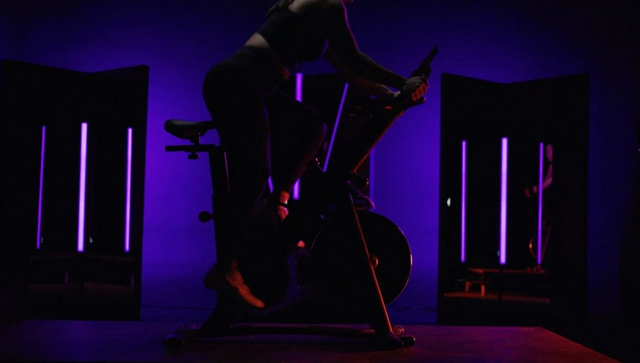
Again and again, SPIN WARS’ interview subjects talk about the importance of music to the experience. A spin class is not merely people pedaling stationary bicycles in a darkened room. The playlist drives the energy, emotion, rhythm, and communal experience. The documentary therefore needed music capable of doing the same thing.
There was only one problem. Music is expensive.
Independently financed, SPIN WARS could not simply fill its soundtrack with 15 major needle drops. But for Byron, settling for only two recognizable songs would have been equally impossible.
“That would be such a letdown for an audience. You go into a spin class, and it is wall-to-wall pop music for 45 minutes.”
Ultimately, the film found its balance through six needle drops, Casey Gibson’s original score, and music from Byron’s longtime friend, singer-songwriter Nikki Sorrentino, who gave him access to approximately 25 songs that she fully owned.
“We used like seven of them, and you can’t even tell. They really work so well.”
Composer Casey Gibson, meanwhile, helped evoke the various musical eras through which the documentary travels, while the carefully selected needle drops provide instant cultural and emotional recognition.
One song became unavoidable after Mary Beth Barone recalled hearing Zedd’s “Clarity” in a spin class for the first time and considering it life-changing. “When she said that in the interview, I was like, ‘Oh shit. Well, now we’ve got to get “Clarity” by Zedd.’”
Beyond its ubiquity in spin classes, the song provided Byron with something even better: a double meaning and the perfect final resolution for a film looking back on the rise, fall, and evolution of an industry. “Getting clarity on, like, where are we now.”
For a first-time feature director, Byron displays remarkable confidence and command of an unwieldy amount of material. Yet when I asked what directing SPIN WARS taught him that he could carry forward, his answer returned to the very thing that made him the right filmmaker for the project in the first place.
Knowing the story inside and out.
As a producer, he explained, his job often involved hiring the right people, solving problems, staying on budget, and helping steer the creative ship, even when he did not possess encyclopedic knowledge of every subject.
Directing was different.
“I just had to know every nook and cranny of the story.”
Already having lived through much of the boutique fitness phenomenon gave him a head start, but directing SPIN WARS sent him deeper. “I just became fully obsessed, reading and listening to any and everything. And the best part is that it never felt like work.”
That may be the most telling thing Philip Byron said during our conversation.
SPIN WARS feels like the work of someone who needed to tell this story. Someone who understood the culture from the inside, knew where the bodies were buried—or perhaps where the abandoned spin bikes were stored—and had the curiosity, humor, and filmmaking instincts to turn two decades of ambition, betrayal, cultural obsession, and toxic sweat into one hell of an entertaining ride.
And he did it without ever convincing me to get on a bike.
Now that is a directorial achievement.
Directed by Philip Byron
Written by Philip Byron and James Thayer
by debbie elias, exclusive interview 06/16/2026
SPIN WARS premiered at Tribeca Film Festival 2026.