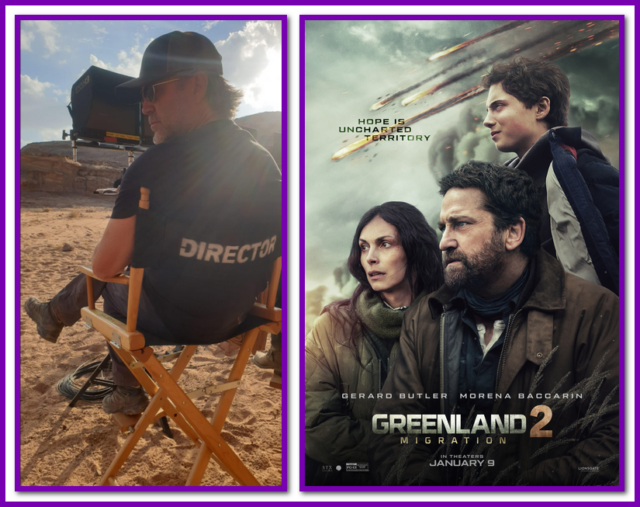
For Ric Roman Waugh, GREENLAND 2: MIGRATION (“Migration“)was never conceived as a sequel in the traditional sense. “I never felt like this was going to be a sequel,” Waugh says. “Yeah, we call it that—but for me, it was the next chapter.” That distinction matters. From the outset, Waugh approached Migration not as an escalation of spectacle, but as a continuation of emotional and philosophical inquiry—what happens after survival becomes routine, when the world doesn’t end, but refuses to heal cleanly.
The first GREENLAND introduced us to the Garrity family at a moment of fracture. They were in conflict, distracted by everyday resentments, until the reality of extinction clarified everything. “The first movie was about meeting a family in conflict,” Waugh explains, “and then realizing there are much bigger stakes—life and death, survival. And how quickly we forget the things that were tearing us apart when everything’s on the line.”
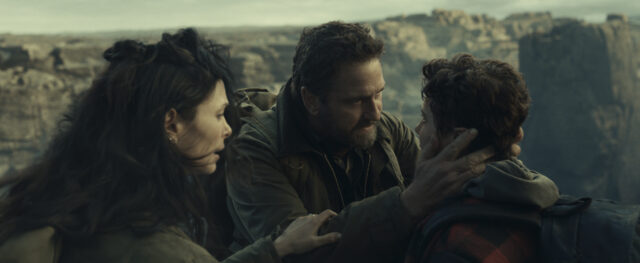
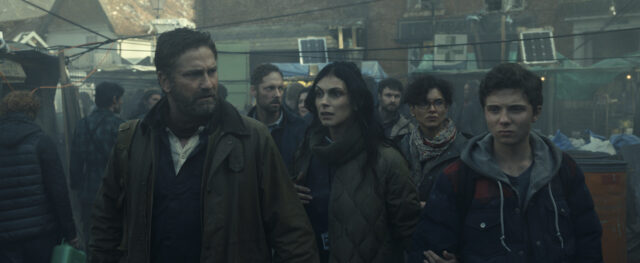
Migration picks up five years later, in the aftermath. John and Allison Garrity have rebuilt their bond. Their son Nathan, however, has spent half his life underground—growing up in confinement, shaped by a world that no longer exists. “This time, it was about coming to a new place with that family,” Waugh says. “A new bond between a husband and wife and a child who’s missed half his life underground—and letting their love endure that.” That endurance becomes the emotional spine of the film.
Thinking in Chapters, Not Installments
Ric’s reference points weren’t typical sequel templates. Instead, he looked to films and franchises that treat continuation as evolution. “I loved how the new Top Gun evolved the Cruise character into the next generation,” he says. “It wasn’t just, ‘Hey, let’s do another one.’ It was an evolution.” He also thought deeply about Star Wars—not as mythology, but as structure. “You’re learning about Luke Skywalker, then Leia and Han, and then you watch the evolution of those characters and the younger generation,” Waugh says. “That’s what I wanted this to feel like.”
When he first read Chris Sparling’s script, what resonated most wasn’t the apocalypse—it was the people living inside it. “I loved this family,” Waugh says. “This family is my family. It’s any of our families. It’s who we are. The people they come across represent us as human beings—all the shades of gray we deal with in life.” That grounding principle allowed Migration to operate on a generational axis. Nathan’s coming-of-age is not a subplot; it’s the point.
Legacy as the Film’s Philosophical Engine
As the film moves beyond immediate survival, its questions widen. The threat is no longer just cosmic or geological—it’s existential. “What we’re all striving for is, what is our legacy,” Waugh reflects. “Whether we’re parents thinking about our children’s legacy, or us as human beings—what’s our legacy to leave this planet in a different place, in better shape, when it’s been destroyed, and we’re starting back from scratch?” That idea reframes everything. “All of the modern conveniences we had,” he adds, “they’re gone.” The sequel’s true tension lies in what replaces them.
Building a World That Has Already Ended
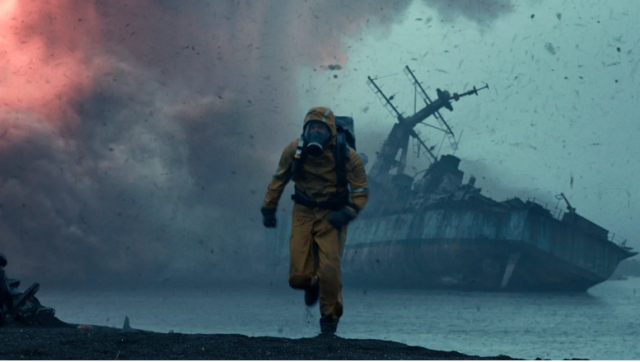
Visually, GREENLAND 2: MIGRATION presented a far greater challenge than its predecessor. The first film unfolded in a recognizable present-day reality. This one had to convince audiences that the world was not merely damaged, but fundamentally altered—and only beginning to rebound. “With this one,” Waugh says, “every single frame of the movie—once you leave that bunker—had to represent that we weren’t lying to you. The world was destroyed.”
To achieve that honesty, Waugh and his team immersed themselves in real-world devastation and recovery. They studied the Australian bushfires, the Paradise fires in Northern California, and Chernobyl’s Red Forest. “It was about how fast Mother Nature rebounded when it was scorched completely black,” he explains. “How fast green started coming back? What happens when safeguards are gone? What does vegetation look like? What happens to humans and their own mortality?” The result is a world that feels bruised but not theatrical—hope emerging slowly, almost reluctantly.
Color becomes a narrative tool. Life in the bunker is rendered in oppressive grays, sickly greens, and yellowed skin tones. The air feels dense. Outside, the world remains muted at first. But as the Garritys move forward, the atmosphere begins to clear.
“By the time you get to Clarke Crater,” Waugh says, “you start clearing out the air—clearing out the message of what you’re trying to say.”
Cinematography Rooted in Restraint and Intimacy
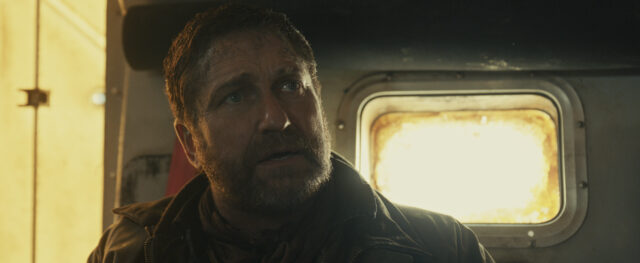
That visual progression is inseparable from Ric’s collaboration with cinematographer Martin Ahlgren. A Scandinavian DP deeply fluent in low-light environments, Ahlgren embraced darkness and minimal contrast—particularly in Iceland, where much of the film was shot. Though Migration utilized Sony Venice and Venice 2 cameras, Waugh is quick to downplay technology in favor of intent. “It’s about the glass,” he says. “It’s about how close you stay to people. This always had to be character-driven.”
The film constantly oscillates between scale and intimacy: wide shots of a ravaged planet counterbalanced by close, tactile moments—hands touching, faces partially lit, quiet gestures that reinforce how tightly bound the Garrity family remains. “You feel how glued together they are,” Waugh notes. “That was intentional.”
Production Design That Rhymes, Not Repeats
Longtime collaborator Vincent Reynaud extends those ideas through production design. Bunker corridors visually echo the Maginot Line–style war passage later in the film, creating a deliberate rhyme that reinforces themes of entrapment, endurance, and passage. Other environments—Laurent’s mail facility, Mackenzie’s hospital—strike a balance between ruin and warmth. Even at the end of the world, people carve out spaces of humanity.
Practical Destruction and Embedded Cameras
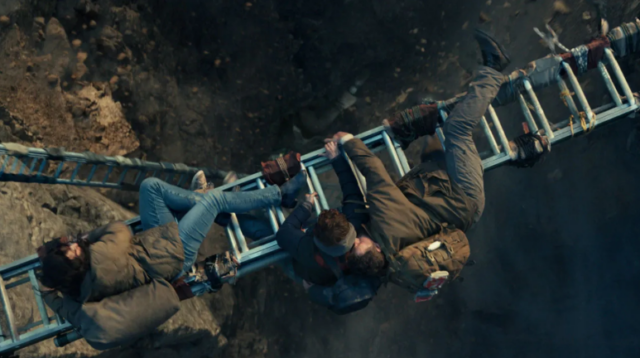
One of Migration’s most demanding sequences—a large-scale war set piece—was shot night-for-night, relying heavily on practical explosions designed by longtime collaborator Terry Glass. These blasts function not just as spectacle, but as primary light sources, immersing the camera in chaos.
The lens lives inside the destruction: debris crossing the frame, dirt on the glass, explosions landing dangerously close to actors. Visual effects are used surgically—wire removal, debris extension—always in service of maintaining physical reality.
One moment intentionally breaks from the noise. A quiet beat centered on Nathan reveals a suddenly clear night sky—the Milky Way and Andromeda visible in stark clarity. Awe replaces terror, reframing what survival is actually for.
Editing a Film That Isn’t Finished Yet
That insistence on realism comes at a cost in post-production. “There are always challenges when you’re dealing with so many visual effects,” Waugh says. “When you’re making a practical movie, you can advance the editorial part a long, long way, and then all the cool cosmetic stuff comes in.” Migration didn’t allow that luxury.
“When you’re dealing with real stuff—the ocean, the boats, the tsunamis—those are huge things that take a lot of time in visual effects just to evolve to a place where you can actually understand them.” Until those sequences arrived in near-final form, Waugh and his editorial team were working in abstraction. “You’re kind of flying by the seat of your pants,” he admits. “It’s not until that stuff locks in that you really understand your pacing and your flow.”
The process becomes, in his words, a constant cycle of momentum and restraint. “It’s a hurry-up-and-wait situation. You do the best you can—cutting in previs, post-vis—but a lot of that is smoke and mirrors and bullshit until you see the real thing. Then you start evolving it.”
Score as Emotional Architecture
That late-arriving clarity ripples directly into the music.
Waugh’s longtime collaborator, composer David Buckley, delivers what the director considers their most emotionally ambitious score to date—but the realities of VFX-heavy post-production often mean Buckley is composing against moving targets. “I don’t know how many movies we’ve done together now,” Waugh says, “but David just keeps blowing himself off the map with new scores and emotional rides that blow my mind. He’s just extraordinary.” Still, timing is unforgiving.
“Sometimes I’m having to say, ‘By the way, we need this next week,’ because we just got the sequence in and he’s finally seeing what it really is.” It’s a familiar challenge on films that demand visual credibility at scale. “That puts everybody behind a bit,” Ric says. “But that’s nothing new. When you’re trying to make stuff look as real as possible, that stuff takes time. It always does.”
From Survival to Living
Ultimately, GREENLAND 2: MIGRATION shifts its focus from man versus nature to something more unsettling.
“It wasn’t just about the comet anymore,” Waugh says. “It was man versus man. When it’s life or death, will you be selfless or selfish? Will you help others, or only take care of yourself?” That moral question fuels the film’s central transformation—the move from surviving to living. “How do you go from surviving to living again?” Waugh asks. “Very much like we all did during COVID.”
A Story Still Unfolding
Ric Roman Waugh always envisioned the GREENLAND films as a single narrative, told in chapters. “I wanted the movies to be something you could watch in a four-hour run,” he says, “and feel like—yeah, they’re two chapters—but they’re the same story. You’re just seeing the final act.”
In GREENLAND 2: MIGRATION, that act is not about destruction, but responsibility—what we inherit, what we protect, and what we choose to leave behind.
It isn’t a film about the end of the world.
It’s about whether we deserve the one that comes next.
by debbie elias, exclusive interview 12/10/2025
GREENLAND 2: MIGRATION opens in theatres on January 9th, 2026.