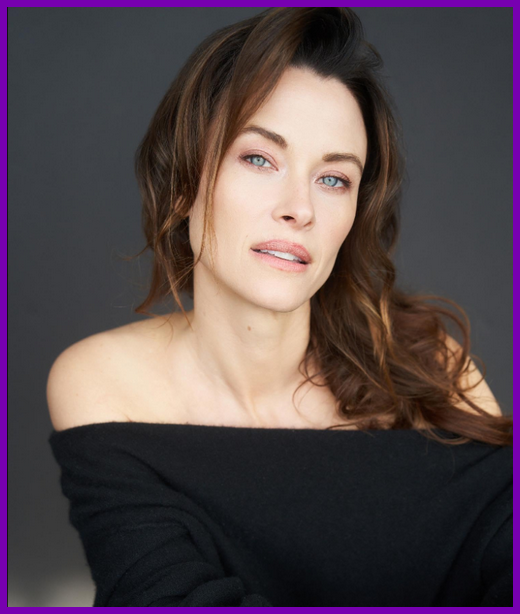
In Isaac Florentine’s HELLFIRE, SCOTTIE THOMPSON doesn’t just pour drinks in a dusty bar. As Lena, she quietly becomes the film’s beating heart—its conscience, its courage, and, by the end, its embodiment of freedom.
Florentine himself wanted “real people rather than poster faces,” and he singled her out for bringing what he called a “fully lived in character” to the screen. For Thompson, that meant finding the humanity underneath the genre fireworks.
“They did play with this angel idea,” she says of Lena, a Vietnam-era war widow, “and I felt that when I was working with her and building the character, that she is this guiding light within the town. You know, [Stephen Lang’s character] is the one who comes in and brings the external wings, encapsulates us, and we need that, we need that masculine figure. But what is so great about Lena and exploring her as a character, she does carry this grounded heart, connected to the roots of the town…that gives her courage.”
The setting is 1988 in a small border town under cartel pressure. Lena runs the bar, cares for her disabled veteran father, keeps her head down, and survives. That alone could have made her just another background player in an action film. Thompson saw more.
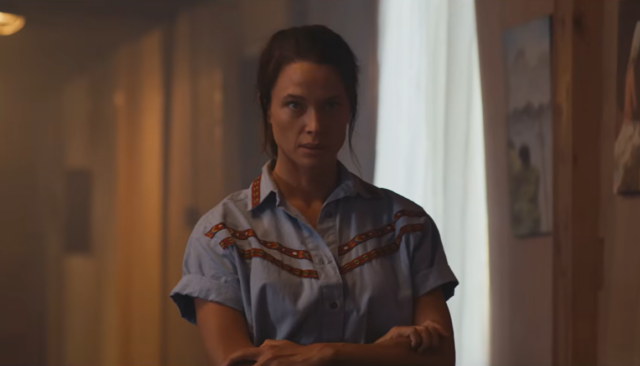
“It’s not just a shoot ’em up,” she insists. “That’s why I liked the story so much, and why I liked the character. The community factor…I really felt resonated—[the] importance of coming together as a community, and the real people are the ones who are really our heroes.”
When she speaks of Lena, Scottie talks about her in almost poetic, physical terms.
“I was really…fascinated by butterflies in the journey,” she says. “It was really fun to play with building that arc from being sort of in that cocoon space that’s not, unfortunately, in this case, a particularly safe cocoon, but that feeling contained and you can’t move.” That idea shaped how she carried herself in the early part of the film.
“I tried to be more, not so big in her movements,” she explains. “Again, that’s Ross [Clarkson, DP] and Isaac capturing just eye movements and subtle gestures, as opposed to, like, the bigness of things. So that when I get to the freedom at the end, it feels earned and expansive, and that it’s shown on screen as well.”
The final images of Lena, walking away into wide open spaces under clear blue skies, hit Thompson as strongly as they do the audience. “It was really a beautiful understanding on everyone’s part in regards to that arc,” she says. “And it’s so nice when that work that you do on a character internally gets to be translated visually. Because, again, that does not always happen.”
One of the subtler but significant choices in HELLFIRE is what Lena isn’t: she’s not the grizzled drifter’s love interest.
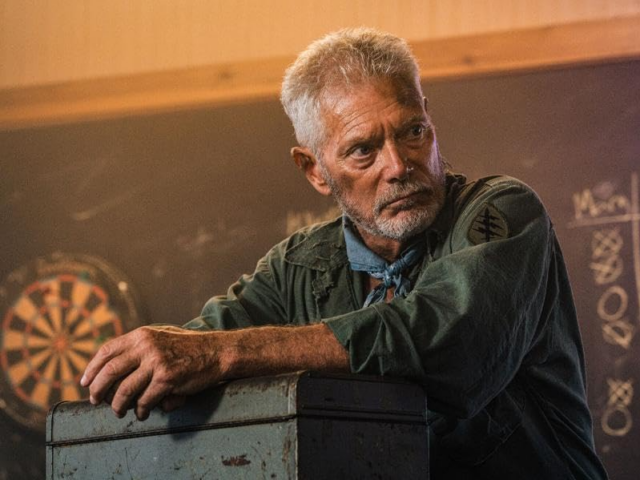
“It was actually, I think, originally going to be a much younger character,” Thompson reveals, “and there was going to be a love interest to it. But I think it’s so special that it’s not. And that the film still works.” She cherishes the platonic yet intimate dynamic that developed between Lena and Stephen Lang’s character.
“I loved the dynamic between her and ‘Slang’ because of the fatherly figure,” she says. “There is a protector figure. And…that the film still works [without romance]. I think it’s a cool story to be putting out there in that regard.”
In a genre that often defaults to pairing a much older male lead with a younger woman romantically, Thompson recognized how refreshing it was to be allowed to exist as her own person, with her own arc, without being defined by a love story.
Working opposite Stephen Lang was, at first, daunting.
“I was intimidated by him,” Thompson admits with a laugh. “Because he’s Stephen Lang, and then I have this difficult language.”
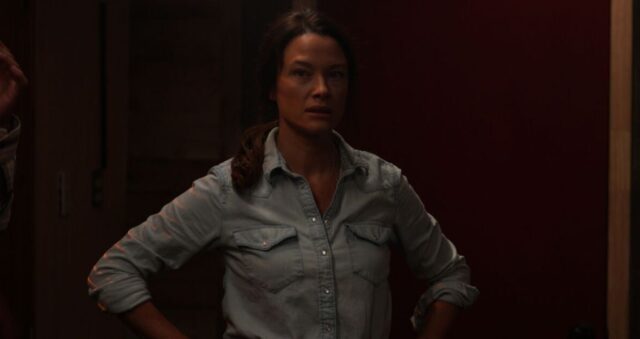
His discipline quickly turned that intimidation into inspiration. “His discipline is an inspiration,” she says. “You know, he’s, I don’t know, he’s like 70 when we were shooting this, and his daily routine and physical practices were no messing around.” One early bar scene, soon after his character arrives in town, became a key moment for both actors.
“I had advocated for changing [the dialogue] around,” Thompson recalls. The script by Richard Lowry features moments of heightened language, and Thompson, committed to truth, worried about making those lines feel grounded. “Sometimes that’s the fear with heightened language,” she says, “that you aren’t as grounded in your truth.” Then Lang offered a different approach.
“It was actually Slang who was like, ‘Well, why don’t we just try it like it is,’” she says. Because she already trusted both Lang and Florentine, she agreed to take the risk.
“I felt you could…you know, those scenes when you can feel it when you’re doing it?” she remembers. “It was one of those moments where I know, ‘Oh, we are in this, and we’re present.’ And I felt like, if I fall, Isaac will nudge me in the right direction, and also, if I flip there’s Slang to catch me.” The resulting scene showcases exactly what Thompson and Florentine both value: truth humming underneath stylized words.
HELLFIRE also lets Thompson stretch physically.
“When I was younger, I was a dancer,” she says. Years of dance training gave her an instinctive understanding of how to use her body in space—an instinct she brings into Lena’s reluctant evolution as an action participant.
“One thing I liked about this character, for me,” she explains, “was that I got to do some of the action, but I’m not like, I’m the action hero. I’m sort of being pushed into it and getting to discover those legs, if you will, in the journey of Lena. Like, oh, stuff is happening, shit’s going down, we are in this hellfire, and I actually have these abilities, and I can keep up with it.”
But she is careful about how she frames Lena.
“I’m not rolling in like Uma Thurman in Kill Bill,” she laughs. “I’m not…an assassin. I’m getting to do the action without being the centralized action figure…It was really fun to do that dance in the way in which I got to do it.” What made it even more satisfying was the chance to do the physical work herself.
“I was so stoked to be able to do that,” she says. “It was so fun to be able to do my own action stuff…And I loved watching the team. That stunt team was so skilled. They’re so incredible. They were basically making two movies at once. It was wild.”
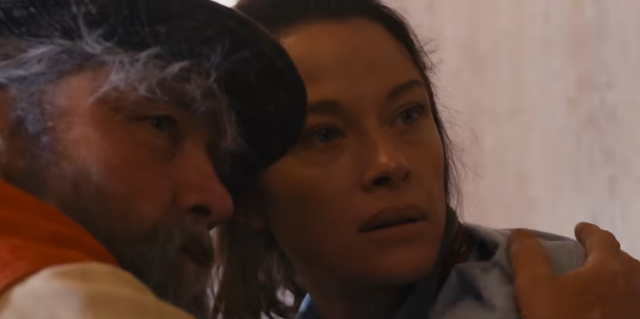
On screen, the camera doesn’t hide her; as a viewer, you can see it’s Thompson in the thick of the sequences, not a double. That was important to her.
At the center of it all is director Isaac Florentine, whose reputation in action circles preceded him. Thompson came away calling him “such a good director” and “certainly one of the best directors I’ve had a chance to work with.”
“What I loved in working with him,” she says, “is that he…encouraged the humanness above all else.”
And Florentine was flexible when needed—especially around language. “If I couldn’t quite wrap my brain around [a line], Isaac worked with me to keep it, keep the essence, and slightly change this if we needed to,” Thompson explains. “He was open to that, which I appreciated…because that’s not always the case.”
Crucially, scheduling delays before production allowed for deeper collaboration. “Because we got delayed a few days,” she says, “I got extra time to go through the script with him and really build [Lena] from a deeply rooted place with his support and guidance. I really trust him. I really felt held and supported by him, that he wouldn’t let a false moment slip by.”
Florentine’s long-time collaborators—DP Ross Clarkson and editor Paul Harb—added to that sense of security.
“When you know your team, and you know what they’re capable of,” Thompson says, “and you can be like, ‘All right, I’m seeing this edit, and the editor knows what I’m seeing, and the cinematographer and I speak the same language’…that trust piece…I really felt held and supported by him.” That trust extended to the film’s bold use of silence. Florentine and Ross often let the camera linger on Thompson’s face in tense scenes, allowing internal beats and wordless reactions to do as much storytelling as any fight or gunshot. “It’s such a gift to be able to…stay connected to that human that’s on and off screen,” she says. “And that’s a really rare occurrence, I think.”
“I remember when Handmaid’s Tale first came out,” she says. “Elizabeth Moss is an amazing actress, hands down. I also think the way that show was shot, where it was very much allowing for so many moments with her internally that you didn’t see on the screen, elevates anybody’s performance.” Scottie notes the danger of that where “you can take it too far and it becomes masturbatory”, but insists that when it’s done right, it “builds character.”
“For me as the actor,” she says, “I’ve certainly been on films where I’ve built whole stories, but they’re not catching any of the looks. They’re just jumping to the next thing, especially in an action film. I knew on set working with [Isaac], ‘Oh, I’m in such good hands,’ because he really understands that, and he is giving me a chance to let those moments breathe, discover those looks in the journey.”
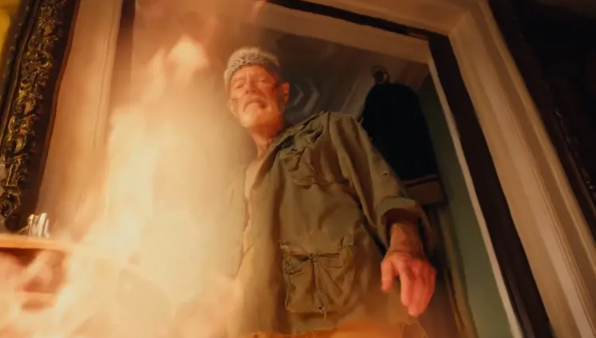
In HELLFIRE, SCOTTIE THOMPSON gets to be many things at once: a saloon keeper in modern clothing, a reluctant fighter, a moral compass, and a butterfly finally breaking out of her cocoon. Under Isaac Florentine’s watchful eye—and alongside Stephen Lang—she proves exactly what he said about her: she is, indeed, “the real thing.”
by debbie elias, Exclusive Interview 02/27/2026
HELLFIRE is available on Digital and On Demand.