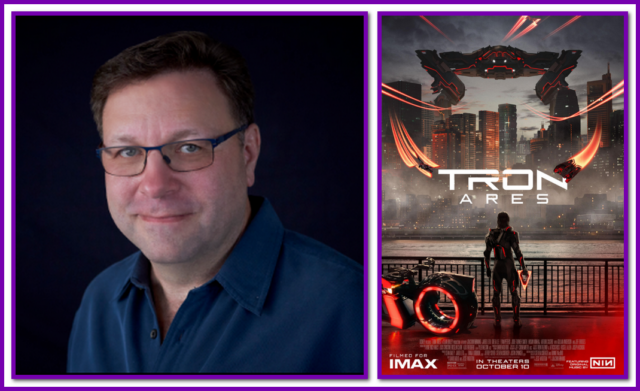
In TRON: ARES, sound is not simply layered onto spectacle—it defines it. For two-time Academy Award-winning re-recording mixer RON BARTLETT, the film demanded an approach that treated sound not as a single continuum, but as three distinct yet interdependent realities: the grounded chaos of the real world, the razor-edged abstraction of The Grid, and a serene, reverential space tied directly to the film’s 1982 legacy. Each world required its own sonic language, yet none could exist in isolation.
“From day one, we treated TRON: ARES like three overlapping movies,” Bartlett explains. “Each one needed its own sonic identity, but they also had to talk to each other so the audience always feels where they are and what’s at stake.”
That philosophy shaped every creative and technical decision, from dialogue treatment and score integration to cross-departmental collaboration and multi-format mastering.
Three Worlds, Three Sonic Systems
Bartlett approached the soundtrack as an exercise in sonic architecture. The real world is dense, physical, and weighty—anchored by engines, crowds, traffic, and environmental grit. It is designed to feel tangible and familiar, grounding the audience in physical reality. In contrast, the Grid is sharply stylized and hyper-designed: electronic textures dominate, voices are processed, and sound behaves less like physics and more like code.
“The Grid is almost a living operating system,” Bartlett says. “Voices start more mechanical and processed, especially for Ares, and then gradually shed that treatment as he becomes more human.”
To support that evolution, Bartlett and his team built individual sub-mixes and plugin chains for major characters, allowing their sonic identity to change alongside their narrative arc. Placement, processing, and frequency treatment all reinforced hierarchy and transformation within The Grid itself—ideas that are felt intuitively by the audience, even if not consciously registered.
The third world—the 1982 space associated most strongly with Jeff Bridges—was treated as something almost sacred. Stripped of density and aggression, it exists in a cleaner, purer sonic register.
“The 1982 world is almost a spiritual space,” Bartlett explains. “Very clean, glistening ambiences, long rolling reverbs on the voices—it’s like being in a cathedral with Jeff Bridges as this god-like presence.”
That restraint is deliberate. By removing clutter and emphasizing reverberant space, Bartlett created a stark emotional contrast with the Grid and the real world, honoring the original TRON while giving its legacy a mythic resonance.
Living in the Seams
What makes TRON: ARES particularly complex is not the creation of these worlds, but the transitions between them. As Grid technology invades the real world—light cycles tearing through city streets, recognizers looming over physical spaces—the sound must negotiate two conflicting sets of rules.
“The real challenge is when those two start to bleed together,” Bartlett says. “What keeps this believable as reality, and what keeps it recognizably Tron?”
Often, the solution lay in gradual exchanges: musical textures borrowing from sound design, ambiences shifting spectral density, or voice processing easing in or out before the audience realizes a transition has occurred. In other moments, contrast was emphasized intentionally, allowing abrupt sonic shifts to reinforce narrative stakes.
Bartlett describes much of the work as “living in the seams”—where music, effects, and dialogue continuously trade roles in guiding the audience’s emotional and spatial awareness.
Dialogue as the Non-Negotiable Constant
Despite the density of sound design and the power of Trent Reznor and Atticus Ross’s score, Bartlett’s guiding principle never changed.
“For me, dialogue is non-negotiable,” he says. “If you can’t clearly understand what they’re saying, you blow what the actor is trying to do.”
That philosophy governed every mix pass and every format. On the Grid, voices could be aggressively processed, but intelligibility—particularly consonant clarity and midrange presence—was always protected. In action-heavy sequences, Bartlett used frequency carving, momentary ducking, and dynamic trade-offs to ensure speech cut through without neutering impact.
The light cycle chases proved especially demanding. With bass-heavy music, highly stylized vehicle sounds, and critical dialogue all competing for space, some sequences required three or four full mix passes.
“A lot of the bike sounds had to live more in the mid and high ranges so they wouldn’t fight the score,” Bartlett explains. “And then we’d trade off—duck the music for a split second or ease back the effects—so every line still punches through.”
At the opposite extreme, the 1982 “temple” sequence presented a different challenge: preserving clarity in a hushed, reverential environment. Here, Bartlett relied on subtle reverbs and delays that expanded voices spatially without obscuring intelligibility, supported by uncluttered ambiences and delicate score textures.
“It’s meant to feel like you’re standing in a church,” he says, “hearing this revered figure speak—and yet every word is completely intelligible.”
Collaboration Without Borders
Bartlett is quick to credit the film’s immersive cohesion to unusually deep interdepartmental collaboration. Sound did not operate downstream of picture; it evolved alongside cinematography, visual effects, makeup, and editorial.
“We were very open during the mix about each other’s departments and how they blended,” he says. “You couldn’t really tell where things crossed or not.”
Supervising sound editors Tormod Ringnes, Baard Haugan Ingebretsen, and Addison Teague worked in close dialogue with the director and other department heads, allowing sound decisions to respond directly to lighting, costume materials, character transformation, and editing rhythm.
Notably, both cinematographer Jeff Cronenweth and makeup and hair department head Donald Mowat commented that TRON: ARES set a new benchmark for interdepartmental integration—an acknowledgment Bartlett views as central to the film’s success.
The Score as a Character: Working with Trent Reznor & Atticus Ross
Bartlett’s collaboration with composers Trent Reznor and Atticus Ross was similarly hands-on and unusually integrated. Rather than receiving music late in the process, Bartlett spent three intensive days with them early on, shaping three of the film’s largest cues before the main dub began.
“They brought in these finished left–right mixes that already felt like records,” Bartlett says. “My job was to translate that into Atmos—make it huge and immersive—without breaking what they loved about their sound.”
Rather than dispersing the music indiscriminately, Bartlett kept the “band” largely anchored to the front channels, using Atmos to wrap textural and ambient elements around the audience. The goal was expansion, not dissection—preserving the integrity of the composers’ mixes while allowing them to live fully inside the film’s spatial world.
Later, Atticus Ross returned during a break in touring to sit with Bartlett cue by cue, refining dynamics, placement, and interaction with dialogue and effects.
“It was all about nuance,” Bartlett says. “How the score breathes around a line, when it dominates, when it gets out of the way.”
One Film, Many Formats
TRON: ARES was mixed first in Atmos, which served as the hero format. From there, Bartlett and his team created distinct masters for IMAX, theatrical, home Atmos, 5.1, and stereo—each requiring format-specific adjustments rather than simple downmixes.
IMAX, with its unique speaker arrays and derived subwoofer system, demanded particular attention to low-frequency management. Bass-heavy elements had to be reshaped to retain impact without overwhelming the room. Meanwhile, collapsing Atmos object-based mixes into fewer channels required careful preservation of emotional intent and dialogue clarity.
“Whether you’re in a giant IMAX auditorium or watching at home,” Bartlett says, “you’re still hearing the same story.”
Across all versions, the constant remained dialogue-first storytelling—everything else adapted around it.
Sound as Storytelling
Ultimately, Bartlett views his work on TRON: ARES less as technical problem-solving than as narrative stewardship. The mix is not about loudness or spectacle alone, but about guiding the audience through identity, transformation, and meaning—one sonic decision at a time.
By treating sound as architecture, collaboration as essential, and dialogue as sacred, Bartlett helped shape a film where every world sounds distinct, every transition carries intention, and every word matters.
by debbie elias, exclusive interview 11/14/2025