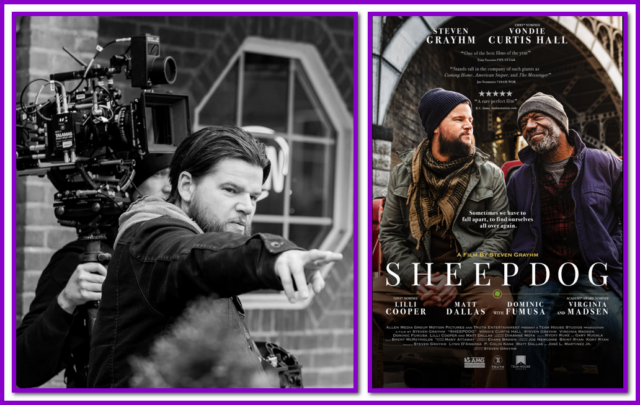
An exclusive interview with writer/director and actor STEVEN GRAYHM discussing his latest film, SHEEPDOG, one of the most important and powerful films you will see this year.
SYNOPSIS: Decorated U.S. Army combat veteran Calvin Cole (Steven Grayhm) is court-ordered into treatment and into the care of a VA trauma therapist in-training. Things become even more complicated when Calvin’s father-in-law and a retired Vietnam Veteran (Vondie Curtis Hall), shows up on his doorstep having just been released from prison. As Calvin’s plan to run from his past becomes even more challenging, he learns through the support of his community: tough love and compassion, that he must put himself back together again for his family – and for himself.
Written and directed by Steven Grayhm, SHEEPDOG stars Emmy Nominee Vondie Curtis-Hall, Academy Award Nominee Virginia Madsen, Tony Nominee Lilli Cooper, Dominic Fumusa, Matt Dallas, and Steven Grayhm.
* * *
In this exclusive interview, STEVEN GRAYHM discusses his film SHEEPDOG, an emotional powerhouse about PTSD, featuring authentic portrayals and filled with hope. The film explores the impact of PTSD over time, with characters from different eras, and the importance of seeking help. Grayhm emphasized the refinement process over 14 years, the intimate cinematic style, and the collaboration with cinematographer Evans Brown. He highlights the diverse treatment methods for PTSD, including EMDR and art therapy, and the meticulous editing and sound design. The film’s success on the festival circuit underscores its impactful storytelling.
From its first quiet moments, SHEEPDOG announces itself not as a war film, but as something more elusive and more difficult: a story about what follows long after the uniform comes off. What Grayhm achieves is thoughtful and profound, authentic and honest. In this exclusive interview, writer/director/actor Steven Grayhm speaks about the film with the care of someone who understands that stories about trauma are not just narratives—they are responsibilities.
At the center of SHEEPDOG is Calvin Cole, a decorated Army combat veteran ordered into treatment while struggling to keep his family intact. When his father-in-law, Whitney—a Vietnam veteran newly released from prison—arrives unannounced, Calvin’s attempt to outrun his past collapses under the weight of generational trauma. The film moves deliberately, less concerned with dramatizing pain than with observing how it lingers, mutates, and quietly reshapes lives over decades.
For Grayhm, that long view is essential. He was determined not to tell a PTSD story frozen in the immediate aftermath of war, but one that acknowledges how much life continues to happen around unresolved trauma. “I wanted the experience for the audience to be unique,” he explains, “in so much that we pick up… a decade after Calvin’s last deployment, and there’s so much life that’s been lived in that time.” It’s a structural choice that reflects reality more than convention—one that resists easy catharsis in favor of emotional honesty.
The title SHEEPDOG itself signals Grayhm’s intent. Drawn from Lt. Col. Dave Grossman’s book On Combat, the metaphor divides the world into sheep, wolves, and sheepdogs—those who run toward danger to protect others. But as Grayhm explains, many veterans discover that when the uniform comes off, the “wolf” follows them home in the form of guilt, memory, isolation, and unresolved trauma. This film, he stresses, is about that unseen battle—and about post-traumatic growth rather than combat heroics.
The genesis of the project was unexpectedly intimate. In 2011, Grayhm’s car broke down during a solo drive from Vancouver to Los Angeles. The tow truck driver who picked him up, recently out of the military, began to talk—about his marriage, his children, financial strain, and the medications tied to his service. What struck Grayhm most was not the content of the confession, but the context. The driver repeatedly told him he had never shared these things with his wife or therapist. “That was the seminal moment,” Grayhm recalls, “of being able to share your stories like that with a complete stranger that would listen without prejudice.”
That encounter became the emotional seed of SHEEPDOG. Later that same summer, Grayhm and actor Matt Dallas traveled across the country, sitting with veterans and their families, confirming that the tow truck driver’s story was far from unique. These conversations—often held at kitchen tables with spouses and children nearby—reshaped Grayhm’s understanding of PTSD as not just an individual burden, but a communal one. The film’s ensemble structure grew directly from that realization.
Research, for Grayhm, was not an abstract phase but an ongoing immersion. He volunteered at the Detroit VA Medical Center, observing and participating in treatments including EMDR, prolonged exposure therapy, art therapy, and tapping. He describes undergoing an early, rudimentary version of EMDR himself and witnessing its effectiveness firsthand. “I sat in on sessions, many of them with veterans,” he says, underscoring how closely the film’s therapeutic depictions are tied to lived experience.
This commitment is reflected on screen in SHEEPDOG’s refusal to present a single solution. Grayhm wanted audiences—particularly veterans and their families—to see the breadth of care that actually exists. “There are so many different therapies and methodologies,” he explains, ranging from yoga and art therapy to EMDR and even ketamine treatments where appropriate. Importantly, the film also acknowledges non-pharmaceutical paths to healing, resisting the reductive notion that medication alone defines recovery.
The script itself underwent a long process of refinement that mirrors the film’s thematic patience. The first draft ran nearly 187 pages and included full deployment sequences. Over fourteen years, Grayhm treated the screenplay as a living document—expanding through research, then relentlessly distilling. Budget constraints ultimately forced the removal of the war scenes, but Grayhm views this not as a loss. Instead, that unseen history lives inside the performances, allowing the audience to encounter Calvin only through the aftermath. By the time cameras rolled, the script was lean—under 90 pages—but still carried the weight of everything that came before.
Visually, SHEEPDOG is built on restraint. Working with cinematographer Evans Brown, Grayhm developed a classic, unobtrusive visual grammar designed to earn the audience’s trust. There is no handheld chaos, no visual shorthand to announce PTSD episodes. “It’s all behind the eyes,” Grayhm says. Shot in a 1.85:1 aspect ratio, the film keeps viewers in the room with the characters, favoring practical locations and naturalistic framing. As Calvin’s therapy deepens, the camera moves closer, narrowing the distance between viewer and subject without calling attention to itself.
That intimacy extended behind the scenes. As an actor-director on screen for most of the film, Grayhm relied heavily on Brown as his final point of contact before stepping into character. He credits Brown’s calm presence and trust as essential to allowing him to be emotionally open on camera. It’s another example of how SHEEPDOG’s collaborative process reflects its themes: healing as something made possible through support.
Casting followed the same philosophy. Grayhm set an unusually high bar for authenticity, seeking actors with lived experience or deep personal connections to the material. This is ultimately why he chose to play Calvin himself—out of a sense of responsibility to embody what he had seen, not approximate it. Matt Dallas’s performance is informed by years of shared research, while Vondie Curtis Hall and Virginia Madsen bring generational and personal ties to the military community that ground their characters in reality rather than performance.
In post-production, Grayhm describes picture, sound, and editing as a single organism. Editor Brent McReynolds helped “find the film,” even identifying a key early scene that, once removed, unlocked the pacing of the entire picture. Sound design, too, is used with surgical care—knowing when to let silence breathe and when music can deepen connection rather than soften it. These choices pull the viewer steadily inward, into Calvin’s internal world, without ever resorting to manipulation.
Ultimately, hope in SHEEPDOG is neither sentimental nor abstract. It is rooted in being heard, in community, and in the tangible reality that multiple paths to healing exist. Grayhm is clear-eyed about the difficulty of PTSD, but equally committed to showing that isolation is not the only outcome. As the film has traveled the festival circuit, its impact—particularly among veterans—has affirmed that intention.
SHEEPDOG does not offer easy answers. What it offers instead is recognition, patience, and the quiet courage it takes to begin again.
TAKE A LISTEN. . .
by debbie elias, exclusive interview 12/17/2025
SHEEPDOG is in theatres January 16, 2026.