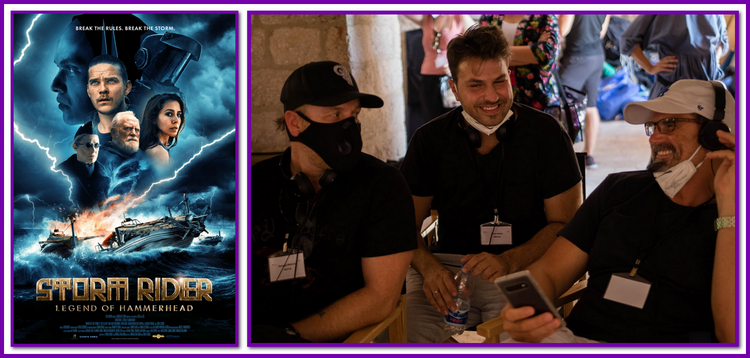
Watching STORM RIDER: LEGEND OF HAMMERHEAD was pure fun for me — a throwback genre mashup with shades of Waterworld (if you just let yourself enjoy it), hints of Tatooine landspeeder races from Star Wars, and a surprisingly emotional mythological and generational backbone. Add in standout performances from Caroline Goodall and Gilles Geary, and you’ve got something that’s both spectacle and heart.
SYNOPSIS: Three centuries after the Great Flood, the world has fractured into scattered islands, forever threatened by a colossal, unending Storm. The Islanders’ only hope for safety lies in the fortified city-state of Argos – a sanctuary reachable only through perilous trials known as Storm Riding. Yet, among them, a defiant faction believes true salvation lies not within Argos, but beyond the Storm itself. STORM RIDER: LEGEND OF HAMMERHEAD follows the audacious journey of two rebellious Islanders who dare to challenge fate—racing to breach the Storm, venture into the unknown, and uncover the secret origins of their world, guarded by the immortal rulers of Argos: the enigmatic Founders.
Co-written and co-directed by DOMAGOJ MAZURAN and ZORAN LISINAC, and produced by NEB CHUPIN, STORM RIDER: LEGEND OF HAMMERHEAD stars Marco Ilsø as Adult Neb and Billy Barratt as Young Neb, Danica Nedeljkovicina as Young Ana and Ivana Dudic as Adult Ana, Gilles Geary, Goran Bogdan, Caroline Goodall and James Cosmo.
I was originally scheduled to speak with co-writer/directors Damagoj Mazuran and Zoran Lisinac, but as I joined the team for our interview, I was happily surprised to find producer/co-writer Neb Chupin joining the conversation as well. What followed was a lively, occasionally thick-accented (Croatian/Serbian) discussion about fig jam, heritage, boats, brutal winds, and a film that was essentially shot first and story-structured later.
As we dove into the “making of” STORM RIDER: LEGEND OF HAMMERHEAD, the team discussed the film’s origins, inspired by the Adriatic coast and personal stories. The initial script, set in the U.S., evolved into a dystopian sci-fi mythological tale, with a 35-day shoot in 2018, set in and shot on the islands off the Adriatic coast of Croatia. Challenges included, among others, filming on isolated islands, using real boats, and dealing with strong winds. The editing process spanned seven years, involving multiple editors. The cast was chosen based on the younger actors, opting for lesser-known but talented individuals.
Here’s our Q&A, lightly edited for clarity:
Q: I had a lot of fun with this movie. It’s got a Waterworld vibe, land-speeder-like races straight out of Tatooine, and a rich mythology underneath it all. Plus, those performances from Caroline Goodall and Gilles Geary really anchor the drama. Where did the idea for this story come from?
Neb Chupin: I grew up on a fig island with my grandfather, and I wanted to show the world how I grew up and how beautiful the Adriatic coast is. We really covered everything from south to north — about a thousand miles of coastline — different islands, remote islands, old military submarine tunnels. We started from a script about an immigrant boy who goes to America to chase the American Dream by selling his grandfather’s fig jam recipe. Everything is around the fig. We actually plan to have the fig jam here in America, too. But beyond the product, I wanted people to see where it came from, where all three of us come from. We all spent our vacations there, grew up there.
So we took this beautiful immigrant story and decided to enrich it — put it in a different world, add sci-fi, add mythology, all the things we grew up around. The directors came in with their creativity, we replaced rowing boats with racing boats, and we replaced the United States with Argos, our own world, to keep filming on one continent. That’s how it started evolving. The first script was called THE ISLANDER, and we went to shoot in 2018.
Q: You shot for about 35 days across the Adriatic, came home with all this gorgeous footage… and then realized you didn’t really have a story. That’s not something we hear very often. What happened when you got back?
Neb Chupin: It was overwhelming. We’d covered so much territory. When we came back and looked at the material, we realized we didn’t really have a story, but we had these beautiful shots that kept us hopeful we could save the film if we made the story more compelling.
The journey really began after the shoot — asking how to save this film. And then we realized maybe we had something more than we thought, if we could reshape it. It turned into a long, long process.
Q: Most filmmakers get a few days of reshoots. You basically got to go back and re-engineer the story. The result is a very full-bodied narrative — love story, revenge, family, generational secrets. How did you approach building that multi-generational spine?
Zoran Lisinac: The family core was always the most important thing for us. We’re talking about a story that spans about 30 years and three generations. That gave us the chance to create backstory — where they all come from — and to build a universe around them. We wanted the relationships inside the family — between these three key characters — to be the spine of the script. The universe, the mythology, the boats, all of that was adopted onto that spine.
Even when parts of the story and script transformed, the core stayed: it’s a story about heritage, the weight of that heritage, and how it’s passed from generation to generation. It’s about redemption and the idea of a promise — what kind of currency that is, if it can be backed up by humans who will stand behind it no matter what.
Q: That really pays off in the film — especially the relationship between Neb and his grandfather, and then the third-act revelations about Neb’s father. And Caroline Goodall’s Baroness basically lays out the founders’ history and fills in all the gaps. That connective tissue really works emotionally. How conscious were you, in the edit, of preserving that emotional throughline?
Zoran Lisinac: Very conscious. Even when we were changing things, we always tried to protect that emotional line. That’s what gave the script a spine. The boats changed — from rowing boats to high-speed hydro-cats and these super racing boats — but we still tried to keep the mythological canon and the family complexity.
There was a point in editing where maybe 10–15% of the story was literally deciding if the movie would work or not. Once we nailed that portion, we knew we had something strong, and then we doubled down on it.
Q: Let’s talk about the shoot itself. Those locations are stunning — the tunnels, the concrete fortresses on the cliffs, the open sea. It all feels very tactile and dangerous, like we can feel the water hitting the camera lens. How difficult was it physically to capture those images?
Zoran Lisinac: Very, very challenging. The locations you’re mentioning are completely isolated, on different islands you can only reach by boat. We shot on real boats and then amplified them with CG. Shooting on boats on the open sea is really difficult. We had to adapt ourselves, and I think you can feel that in the film because we captured everything for real and then went into post-production. Those first 30 days basically determined how the movie would look.
That was the rule — we already had a visual language. We wanted to create this Mediterranean Neo-Roman universe — a Rome rising from the ashes again, with gladiator races, arenas, all those elements.
Q: And you’re hauling gear from island to island, into tunnels only reachable by boat, bringing generators, lights, everything. Plus, you’re dealing with this infamous Adriatic wind…
Neb Chupin: Those tunnels were only reachable by boat. We brought everything by boat: crew, generators, all the gear. We had an underwater crew filming under the surface. Another crew was rigging and climbing on top of real military boats. These boats go 40 knots. We found ourselves in storms a few times. We were filming three days straight in a storm. There’s a wind there called Bura that comes from the Adriatic Alps. When it hits, sometimes all traffic is forbidden. During one of those times, we took it on ourselves — we had three old military boats we converted into these “Mad Max” boats you see in the film. They were the only boats allowed out. No other boats could go. We captured all the splashes and spray you see on screen for real.
Out of five days of shooting in that period, we had three days of storm. The sun is out, so it looks nice, but the wind is incredibly strong, and it’s very cold. You can see that in the images — they’re very tactile. When you see the water hitting the lens, that’s real.
Q: I love seeing spray and drops on the lens when you’re shooting on water — it screams authenticity. But I’m assuming your poor sound team knew nothing they recorded out there was going to be usable. They just wanted to be on the boats.
Neb Chupin: Exactly. The crew loved being on the Adriatic and getting paid to be there for a month or more, but they did not love the 12–14 hour days. Everyone wanted to be on the boats — even the sound department. We would say, “We don’t need you there, your boom will fly away!” But they all wanted to be on the boats. And yes, we knew we’d be doing most of that sound in post, but they still wanted to experience it.
Also, those islands you see that look bare — that’s real. The winds are so strong they basically strip away all vegetation. It adds to that stark look.
Q: Casting is another big strength of the film. The younger actors who play Neb and Anna are terrific, and then you shift to Marco and his Anna counterpart as adults and the transition feels seamless. How tricky was it to cast across those ages?
Neb Chupin: We did it in a funny, backward way. We cast the younger actors first because at the time they had a much bigger role — like 50 minutes to an hour of screen time. So we had to cast the adults based on the kids, which is the opposite of what people usually do.
Everything on this film was done in an original and different way. But also, this is a handmade big sci-fi film. We had to choose: do we spend money on big-name stars, or do we invest in the picture, production design, and scope? We chose the latter.
So these actors are wonderful, but we knew we risked not having “A-list names.” We hoped the concept and the world would support the film when it came out.
Q: Personally, I think you made the right choice. In a film like this, audiences want the spectacle — the ships, battles, explosions, those dramatic views from the water up to the fortresses and cliffs. If the actors deliver, they don’t have to be celebrities. And here, they deliver.
Neb Chupin: From your mouth to the ears of the big streamers.
Q: Let’s get into the edit. You’ve said you had multiple editors over several years, and that the movie was essentially rewritten in the cutting room. How long did that process really take?
Zoran Lisinac: We had like three or four editors, and they burned out one after another. It was about seven years of editing and two months of shooting.
The movie was really made in the edit. The last draft of the script was essentially created there. Even that draft took many iterations. Editors would come in, full of energy — “Okay, I’ll get this film finished” — and then after six months they’d be exhausted and leave. It was a tough process for them.
At the same time, we were dealing with around 1,000 to 1,200 VFX shots, all handmade, and the CG evolved alongside the edit. We were constantly changing, hybridizing, deciding what was best for the story, for the character arcs, for the narrative. It was exhausting, but also a reinforcing process because each solution brought us closer to the film we wanted to make.
One final element of the film that I started to ask about was the music. Lior Rosner’s score is beautiful, and the chorale elements that are introduced are almost ethereal at times, while capturing the unadulterated joy and energy of the races. Unfortunately, the publicist abruptly terminated the interview with no warning because “there’s someone waiting.”
by debbie elias, exclusive interview 03/06/2026
STORM RIDER: LEGEND OF HAMMERHEAD is in theatres March 13, 2026.