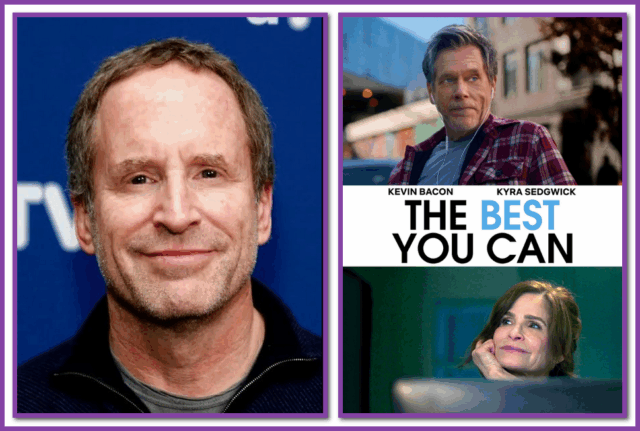
I have long admired the work of MICHAEL J. WEITHORN, best known for his decades in television as creator, executive producer, and writer of the sitcom “The King of Queens”, as well as a writer for “Family Ties”, “True Colors”, and “Ned and Stacey.” He has a gift not only for comedy, but also for the love, laughter, sorrow, and tears that come from everyday life. Although he dipped his toe into the directing waters back in 2010 with the feature “A Little Help”, in addition to an episodic here and there, Michael has more or less stayed in the writing and producing lane; that is, until now, as he picks up his pen and steps into the director’s chair with the wonderful narrative feature THE BEST YOU CAN.
A beautiful blend of comedy and drama, with THE BEST YOU CAN, Michael gives us a film filled with heart and humor, an ease of connection between the characters and the audience, and the blending of unlikely relationships that give way to some of life’s best moments. For someone with a strong television background, together with his cinematographer Andrew Wonder, Michael steps out of the traditional three-camera format (thank you Desi Arnaz) and embraces more traditional cinematic lensing with camera movement that’s looser and playful, just like the growing dynamic between our two main principals, perfectly played by Kyra Sedgwick and Kevin Bacon. THE BEST YOU CAN is warm and wonderful storytelling, especially at this holiday time of the year.
SYNOPSIS: Reuniting Kyra Sedgwick and Kevin Bacon on screen for the first time in twenty years, THE BEST YOU CAN is a sharp, touching, and laugh-out-loud exploration of change, losing our bearings, and finding connection in the most unexpected places. This character-driven comedy is a reminder that sometimes the people who understand us best are the ones who are nothing like us.
Written and directed by MICHAEL J. WEITHORN, THE BEST YOU CAN stars Kyra Sedgwick and Kevin Bacon, along with Judd Hirsch, Brittany O’Grady, Meera Kumbhani, and Olivia Luccardi.
It was a privilege and joy to speak with writer/director MICHAEL J. WEITHORN and to do so about his new narrative feature film, THE BEST YOU CAN. Written by Weithorn, it all began with a simple but insistent idea: tell a small story that feels big where it matters—in the heart. As you’ll hear him discuss, he wanted to make a film about people you could pass on the street, people carrying around quiet crises that suddenly collide in surprising, life-altering ways. Inspired by intimate character dramas like “You Can Count on Me”, Weithorn set out to explore the odd, beautiful chemistry that can spark between strangers when fate shoves them together. A urologist and a security guard might not seem like the seeds of a profound connection, yet that unlikely pairing became the story’s emotional engine. Humor and heartbreak move side by side in the film because, as Weithorn puts it, that’s how life actually works.
Modern communication fascinated him, too. The way texting lets people reveal themselves not through grand gestures, but through stray late-night messages and hesitant pauses, became a key storytelling thread. He wanted audiences to feel the intimacy growing between the characters—even when they weren’t in the same room. (And dare I say that the element of texting within this film is some of the finest I have seen, so that it feels and flows naturally and with purpose.)
Casting Kevin Bacon and Kyra Sedgwick added another layer of intrigue. At first, Weithorn resisted putting a real-life couple on screen together; he worried about unintentionally creating a “cute” meta-moment that undercut the film’s grounded tone. But Sedgwick changed his mind. Her total commitment—right down to transforming her look and crafting a character far removed from her own persona—made a powerful impression. To protect the authenticity of the performances, Weithorn gave each actor space to build their character independently and even asked them not to rehearse together. The result was a relationship that blooms organically on camera—genuine, textured, and free of the self-awareness that often sneaks into real-life pairings. Their chemistry feels lived-in because it’s rooted in the story, not their marriage license.
Visually, the film owes much of its pulse to cinematographer Andrew Wonder. Introduced by producer Victoria Hill, Wonder quickly became Weithorn’s closest creative companion. Their collaboration started long before shooting, sketching out the film’s visual language in long, exploratory sessions. Weithorn would describe an emotion—say, the boxed-in unease of Stan’s apartment—and Wonder would translate it into lenses, framing, and movement. On set, they permitted themselves to play, trying out variations on shots until they found something that clicked. The mark of a true cinematographer, Wonder wasn’t just operating the camera; he was helping define how the story felt. His instinctive understanding of nuance and mood became a cornerstone of the film’s identity.
Texting sequences received the same level of thought. Weithorn wanted to avoid the flatness of simple on-screen messages, instead crafting moments that visually track the evolution of the characters’ relationship. Early exchanges appear clipped and isolated, but as the bond deepens, the screen fills with more of their conversation, mirroring the increasing ease between them. Voiceovers add warmth and fluidity, turning what could have been static text into something that feels conversational and alive. It’s a modern kind of intimacy, and the film treats it with the same emotional weight as face-to-face dialogue.
In the editing room, Weithorn found another key collaborator in Tricia Holmes. From their first meeting, he sensed they shared a creative wavelength. Holmes’s early assembly of the film confirmed it—several scenes landed so cleanly in her first pass that they barely needed adjustments. She instinctively knew when to linger on a face, when to cut away, and how to balance the film’s delicate mix of comedy and emotion. Weithorn admits to being “precious” about comic timing—sometimes revisiting moments again and again—but he trusted Holmes completely when it came to shaping the film’s emotional spine. Her ability to calibrate tone, especially in the most vulnerable or comedic scenes, helped solidify the film’s rhythm.
For Weithorn, transitioning from the world of multi-camera sitcoms to the wide-open landscape of feature filmmaking for his sophomore film was both daunting and exhilarating. Sitcoms thrive on dialogue and performance; films demand a deeper reliance on images and atmosphere. As you’ll hear him discuss, learning to think visually—and to collaborate more intensely with his cinematographer—became an essential part of his growth. He discovered that directing a film isn’t just about telling a story; it’s about sculpting feelings out of light, sound, and silence. The shift required him to let go of old habits, trust his team, and embrace an entirely new creative vocabulary, a big part of which is in Kurt Farguhar’s score and some perfect needledrops.
Through all these evolutions—casting, collaboration, visual discovery, and narrative refinement—THE BEST YOU CAN emerged as the intimate, emotionally layered film Weithorn envisioned from the start. It’s a story about unexpected connections and the small moments that change everything, told with warmth, humor, and a quiet belief in the fragile ways people find each other.
TAKE A LISTEN. . .
by debbie elias, exclusive interview 11/17/2025
THE BEST YOU CAN is now available on digital platforms.