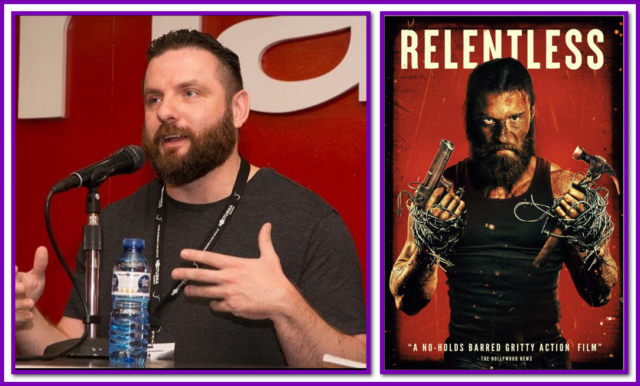
Written, directed, and edited by Tom Botchii, RELENTLESS is exactly what its title promises: a sustained assault of motion, impact, and withheld meaning. It begins as a home invasion and refuses to let go, barreling forward as a near-wordless cat-and-mouse chase that doesn’t pause to explain itself—at least not until the audience is already locked into its grip.
As he explains in this exclusive interview, from the outset, Botchii conceived RELENTLESS as an act of escalation. After becoming a father, he felt an urgency to make the kind of film he loved most—one stripped of excess, fueled by tension, and built around pursuit. In most thrillers, he notes, the cat-and-mouse portion lasts maybe ten percent of the runtime. His question was simple and radical: Why can’t that be the whole movie?
That question became the film’s engine.
Botchii built RELENTLESS as a sustained chase between two men—Teddy, a homeless drifter, and Jun, a successful businessman—layering the pursuit with ideas drawn from what he calls the “Twitter mentality.” Not Twitter as a platform, but as psychology: rage without listening, guilt assigned without process, justice declared without context.
He imagined the two characters as embodiments of that impulse—locked in a feedback loop of accusation and retaliation, each convinced of his own righteousness. Revenge becomes less about resolution than about momentum. Who decides guilt? Who gets justice? And what does it change once violence has already been unleashed?
Rather than answer those questions upfront, Botchii structures RELENTLESS to deny the audience comfort. For roughly the first 30 to 40 minutes, there is almost no meaningful dialogue—only behavior. A home invasion. A chase. A fight inside a car. A car wash sequence that stretches tension until it snaps. The audience is trained to choose sides quickly, to align with the man under attack, to accept minimal information, and move on.
Botchii uses that conditioning against us.
Only gradually do visual clues begin to surface: Teddy eating alone in his car, closing a curtain to sleep; Jun’s relationship to technology, control, and meditation. Dialogue arrives late, and when it finally erupts—around the one-hour mark—it detonates like a delayed explosive, forcing a reassessment of everything that came before. RELENTLESS transforms, in Botchii’s words, from an action film into something closer to a two-hander stage play, without ever surrendering intensity.
That transformation was intentional. Botchii wanted multiple journeys within the same film. The first is visceral: survive the pursuit. The second is moral and psychological: are we even right about who’s guilty? Each time the audience believes it understands the story, the film changes course.
The physical language of RELENTLESS is as uncompromising as its structure. Botchii comes from a deep love of action cinema but rejects elegance or choreography. The violence here is dirty, claustrophobic, and improvised—eye gouging, fingers in mouths, grappling in tight spaces. On the page, action is written in granular detail rather than shorthand. “Big fight” is never enough. Each beat is specified so actors and crew understand the brutality being pursued.
On set, safety dictated the choreography, but Botchii deliberately left the transitions messy. The goal was not clean motion but desperation—what two people might actually do when survival is the only objective.
That approach placed heavy demands on cinematographer David Christopher Pitt, whose camera work is inseparable from the film’s aggression. The opening home invasion unfolds across a multi-level house, expanding vertically as characters chase, flee, and collide through kitchens, living rooms, and stairwells. Dutch angles, shots through closet shutters, and skewed framing mirror the imbalance and chaos of the encounter. Practical destruction—doors, tables, glass—was staged with prop elements and later repaired digitally to protect the real location while preserving the feeling of violation.
To sustain the film’s relentless forward motion, Pitt and his team abandoned traditional dolly or Steadicam setups in favor of unconventional movement. Camera operator Matt Stewart rode a Segway—wearing Crocs—to achieve the immediacy of handheld work combined with explosive push-ins and pull-outs. The result is kinetic but controlled, keeping the action legible while never feeling composed.
Each major set piece is given its own visual and rhythmic identity. The opening home invasion is spatial chaos—ugly, vertical, and disorienting. The fight inside the car compresses that chaos into a vise, bodies jammed against dashboards and windows as the camera crowds the action. Much of that sequence was shot on tripod and later enhanced in post, where Botchii added micro-zooms, directional shakes, and slight speed-ups to sell impact without overcomplicating production.
The car wash sequence pivots again, becoming something almost operatic. A bright, bouncy earworm plays as soap suds and rollers envelop the car, creating a false sense of safety. Suspense replaces blunt force. Inside-the-car POVs trap the audience with the characters while exterior shots abstract the machinery into something surreal and menacing. When a lens broke mid-shoot, the team finished with a backup and leaned on post-production “cinemagic” to preserve continuity. The adversity only sharpened the sequence’s impact.
By the third act, RELENTLESS mutates once more. Physical violence gives way to sensory and psychological assault. Barbed wire—achieved through silver-sprayed shoelaces—wraps bodies. The camera drops to floor level as Jun crawls for water. Sound design strips away music and noise until only a ticking clock remains, turning time itself into a weapon. When sound and score finally slam back in, the release feels brutal.
Editing and sound were the final tools Botchii used to shape the film’s escalation. Early cuts are driven by punches and crashes. Later, they’re driven by emotional revelation. He realized in the edit that he could remove explanatory scenes and still trust the audience to follow the story through small, behavioral details. The lesson was clear: viewers don’t need to be spoon-fed—they need to be respected.
That respect extends to the film’s brutality. RELENTLESS does not ask permission. It implicates the audience first, then challenges the assumptions it knows we’ve already made. By the time answers arrive, they don’t soothe—they complicate.
For Botchii, that complication is the point. Violence here is not catharsis but exposure. And once RELENTLESS has you in its grip, it refuses to let you look away.
TAKE A LISTEN. . .
by debbie elias, exclusive interview 01/13/2026
RELENTLESS is now available On Digital and On Demand.