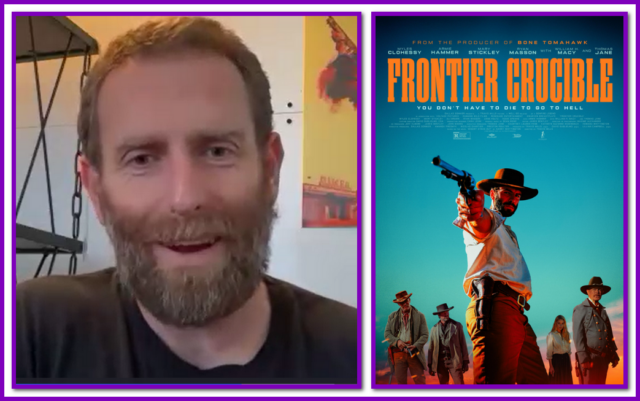
Director TRAVIS MILLS talks the wonders of the western and FRONTIER CRUCIBLE in this exclusive interview.
SYNOPSIS: A desperately needed wagon full of medical supplies falls victim to an Apache attack. The only man who can guide it through to its destination is Merrick Beckford, but in order to get there, he’ll need to enlist the help of a trio of dangerous outlaws hell-bent on survival. When they accidentally kill an Apache scout, all bets are off, and survival is the name of the game in director Travis Mills’s western thriller.
Directed by Travis Mills and written by Harry Whittington based on the novel “Desert Stake-Out”, FRONTIER CRUCIBLE stars Myles Clohessy, Mary Stickley, Eli Brown, Ryan Masson, Zane Holtz, Eddie Spears with Armie Hammer, William H. Macy and Thomas Jane.
In this exclusive conversation with writer/director TRAVIS MILLS, it becomes clear that FRONTIER CRUCIBLE was conceived as much through restraint as ambition. A filmmaker deeply versed in the Western—this marks Mills’ fifteenth entry in the genre—he approached the project not as a reinvention, but as a careful distillation of what makes the form endure: landscape, silence, and the slow encroachment of violence into beauty.
The film’s roots stretch back to Harry Whittington’s novel Desert Stake-Out, adapted so faithfully that its screenwriter chose to remain deliberately uncredited, viewing the finished script as essentially Whittington’s voice preserved on screen. According to Travis Mills, producer Dallas Sonnier had shepherded the project for years before determining that Mills was the right director to guide it across the finish line. In the same breath, Sonnier identified Miles Clohessy as the ideal embodiment of Merrick Beckford, shaping the film as a dual proving ground—for Mills’ seasoned command of the Western and Clohessy’s emergence as a quietly magnetic leading man.
Visually, FRONTIER CRUCIBLE is inseparable from its locations. Mills speaks with particular reverence about Prescott, Arizona—especially the granite dells surrounding Watson Lake—which he calls a filmmaker’s dream. The central watering hole, located just outside town, became the film’s gravitational center, both narratively and logistically. No vehicles could reach it. Every piece of equipment, every prop, every case of gear had to be hauled in by hand, day after day, across rugged terrain. Cast and crew alike shouldered the burden, turning each shooting day into a physical endurance test. Yet Mills insists the hardship only deepened the film’s authenticity; the landscape demanded respect, and in return, it delivered something elemental.
Monument Valley provides the film’s other great visual anchor, its mythic geography echoing the legacy of John Ford and classic Hollywood Westerns. For Mills, these locations were never mere backdrops. They function as characters—silent witnesses to the moral decay unfolding within them. That philosophy carried directly into his collaboration with cinematographer Maxime Alexander.
In a deliberate choice, Mills sought out a director of photography who had never shot a Western before. Maxime Alexander brought fresh eyes to the genre, while Mills supplied a deep well of reference points—from Budd Boetticher to The Tall T and Ride Lonesome. Together, they devised a disciplined visual language rooted in motivation. The camera begins largely locked-off, allowing the audience to absorb place and stillness. As tensions rise, movement gradually seeps in—first via Steadicam, then finally through handheld work as violence overtakes order. The visual progression mirrors the emotional arc of the film, culminating in a world that no longer feels stable or controllable.
That same restraint defines the film’s sound design. Mills is blunt about his philosophy: too much music can ruin a movie. Rather than blanket scenes with score, Frontier Crucible leans heavily into silence and ambient sound—wind, water, distant birds, the creak of leather, the ominous click of a holster. Influenced by 1970s Westerns like Pat Garrett and Billy the Kid and McCabe & Mrs. Miller, Mills and his collaborators treated sound as a narrative weapon. Composer Sean Rowe’s music and lyric songs appear sparingly, often serving as transitions rather than emotional signposts.
In the editing room, that philosophy was sharpened further. An initial cut running nearly two hours and forty minutes was painstakingly pared down, sometimes frame by frame, under the close collaboration of Mills, Sonnier, and editor Jared Bentley. Pacing, rhythm, and silence were treated with surgical precision, ensuring that when sound does enter, it carries real weight.
Even casting followed this ethos of intention over excess. Clohessy was “baked in” from early development, while Thomas Jane and Armie Hammer rounded out the ensemble through long-standing creative relationships rather than last-minute compromises. Mills speaks especially highly of Hammer, calling him one of his favorite collaborators to date, a seamless fit within a cast built to serve the story rather than overshadow it.
Ultimately, FRONTIER CRUCIBLE reflects Travis Mills’ confidence as a filmmaker who trusts simplicity, environment, and patience. It’s a Western shaped not by spectacle, but by accumulation—of silence, of heat, of physical effort, and of moral tension—until beauty and brutality become impossible to separate.
TAKE A LISTEN. . .
by debbie elias, exclusive interview 11/21/2025
FRONTIER CRUCIBLE In Theaters and On Digital now.