By debbie lynn elias
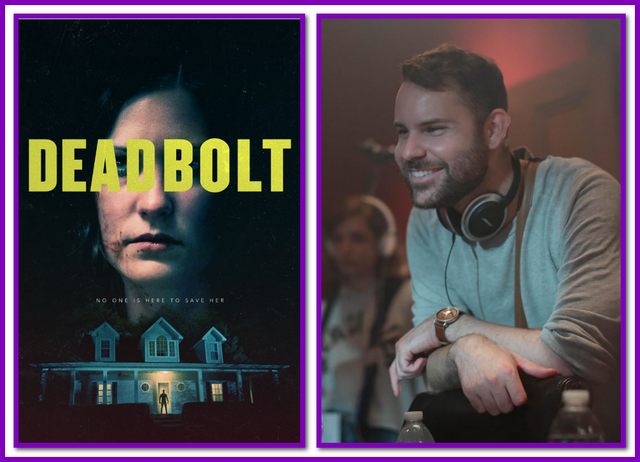
What happens when you’re alone in your own home, someone is watching you, and the one thing that connects you to the outside world is suddenly gone? It’s a deceptively simple question, but one that becomes the foundation for a taut, tense, and deliciously twisted thriller in DEADBOLT, the feature directorial debut of filmmaker Zac Coleman. Blending classic home-invasion suspense with psychological terror, political intrigue, and more than a touch of wickedly dark humor, DEADBOLT is an impressive showcase for a filmmaker with a keen understanding of cinematic visual grammar, a love of the thrillers that shaped his childhood, and an infectious enthusiasm for storytelling.
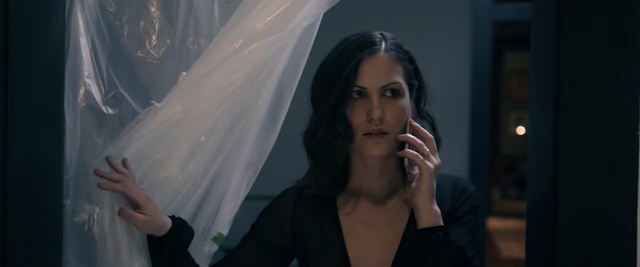
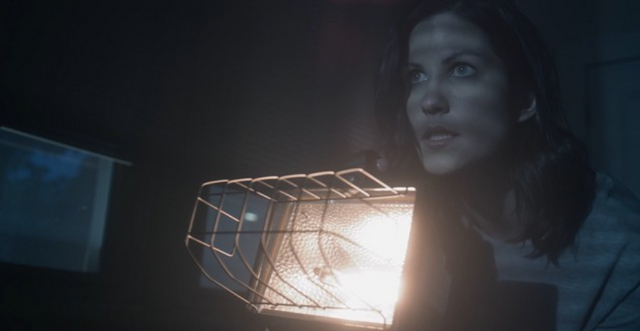
Written by Dylan Noe from a story by Craig Deering and Coleman, DEADBOLT stars Callie Deering as Anne Harrington, a woman considering a run for Congress whose seemingly secure world begins unraveling when she returns home to discover a door she knows she locked standing slightly ajar. What follows is a night of escalating terror as Anne finds herself trapped inside her own home, forced to rely on her intelligence, resourcefulness, and instincts to survive.
But DEADBOLT is far more than a conventional home-invasion thriller. With a psychotic villain who seems to relish every moment of his depravity, a trio of complex female characters, and a narrative that gradually reveals its true intentions, Coleman has crafted a film that consistently challenges expectations.
And it all began with a rather unsettling thought in the shower.
FROM A SHOWER THOUGHT TO A PSYCHOLOGICAL THRILLER
For Coleman, the original inspiration for DEADBOLT came from considering just how vulnerable modern technology has made us. We live in a world where our cell phones are seemingly permanent extensions of our bodies, providing immediate access to emergency services, family, friends, and virtually everyone else. But what happens when that connection is suddenly severed?
As Coleman explained during our exclusive conversation, the idea came to him in an unexpectedly mundane setting. “The concept itself spawned from an idea when I was taking a shower. I don’t know why I had that thought, but I was like, man, if someone were to take my phone when I’m showering, I’m completely helpless at this point. As adults that live in the 2020 era and stuff like that, I feel like everybody has this phone connected to their hip, and we wanted to create something where the phone was immediately removed from the equation because we know that’s an easy out for people. It’s a common trope where people call 911 and then they can’t get through because the service is down and stuff like that. We wanted to just completely remove all outside connections for Anne whenever we were writing the story.”
That simple premise became the starting point for a far more elaborate narrative, one that drew inspiration from real-life criminal behavior as well as the conventions of classic psychological thrillers.
Particularly intriguing to Coleman was the disturbing behavior of the Australian serial offender known as Mr. Cruel, whose violations of victims’ homes went beyond the immediate acts of violence to include seemingly mundane, deeply unsettling intrusions into their personal spaces. “We were inspired by an Australian serial killer named Mr. Cruel. He was a really strange man. Obviously, no killer is enjoyable in any kind of regard, but he would go into people’s homes and make sandwiches with their food and stuff like that. So we wanted to weave this really weird story of this crazy man, essentially Theo, who we created to haunt Anne’s character. And that’s kind of where it started. What if we just remove the phone and then keep going from there?”
But as Coleman, Deering, and Noe continued developing the story, it became clear that there was an opportunity to explore something more complicated than a woman simply trying to escape a violent intruder.
The introduction of a political dimension transformed the material, adding layers of intrigue and deception that ultimately distinguish DEADBOLT from the familiar home-invasion formula.
“We had two different endings that were completely different from where we ended up, and then we said, ‘What if we put a little bit of a political spin on this?’ That’s where I was able to loop in one of my good friends, who’s a really, really talented writer as well, Dylan Noe. I always like to say that he reminds me of Shonda Rhimes because Shonda Rhimes is very powerful when it comes to character creation and world-building. I’m going to be completely honest. He took the film and ran with it, and he’s the reason why Kathie Sinclair is the way that she is. And I won’t spoil anything, obviously, but he really took a chance on this, and we were thrilled with the result. So truthfully, it became this really interesting, intricate film that was kind of disguised as a home-invasion thriller.”
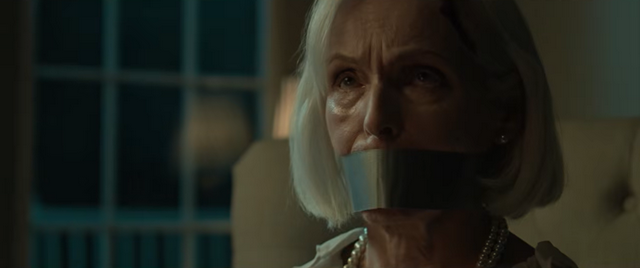
And disguised it is. From its attention-grabbing opening sequence involving an affluent older couple bound and duct-taped to chairs, DEADBOLT immediately establishes that audiences are entering a world where conventional expectations are unlikely to provide much comfort.
A LOVE LETTER TO THE THRILLERS OF THE 1990s AND 2000s
Coleman’s cinematic influences are unmistakable, but rather than simply imitate the films he admires, he has incorporated their visual and atmospheric sensibilities into a style that feels distinctly his own. Among the touchstones are What Lies Beneath, The Ring, Panic Room, and the carefully controlled visual compositions associated with David Fincher. Even the political dimension draws upon the atmosphere and visual sophistication of House of Cards.
It was a shared understanding of these influences that helped Coleman establish an immediate creative connection with cinematographer Julius Damenz.
“I was connected to Julius through one of our producers, Parker Jesse Chase. And basically, from the start, he was really intrigued. I don’t really even know why he said yes, if I could be completely honest. But I do think one of the things is that I’m pretty passionate whenever I talk about the film, and when I was trying to get people involved, they would always say, ‘I can hear the passion behind your voice.’ So I think it was just enough of me talking to Julius, talking him through it. He loved the script, and we were truly inspired by shows like House of Cards on Netflix and a lot of David Fincher cinematography. I’m sure you noticed that the house has this very warm approach to it, whereas the outside has this very blue, interesting feel to it. But it doesn’t feel icy. We wanted to create this beautiful visual that honestly was kind of a love note to 2000s cinema. I was deeply, deeply inspired by films like What Lies Beneath and The Ring and Panic Room. I think this was us trying to make a film that could easily fit into that library.”
That aspiration is apparent in the film’s visual sophistication, particularly in its carefully balanced color palettes, use of practical light, and the relationship between architecture and camera placement.
THE HARRINGTON HOUSE: A CHARACTER IN ITS OWN RIGHT
One of the most striking elements of DEADBOLT is its principal location: the Harrington house.
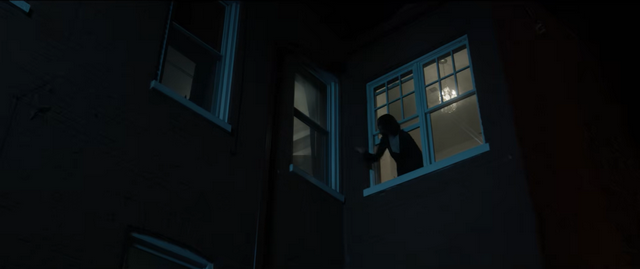
An extraordinary historic residence dating to approximately the 1860s, the house is far more than a convenient setting for a home-invasion thriller. It becomes an integral component of the storytelling, with its architectural character, intimate rooms, narrow staircases, richly detailed woodwork, and contrasting interior spaces providing Coleman and Damenz with a wealth of visual possibilities. The filmmakers take full advantage of the location, employing Dutch angles along the staircases, shooting into corners to establish spatial relationships, and using the intimacy of the rooms to create both a sense of familial warmth and an increasingly oppressive atmosphere.
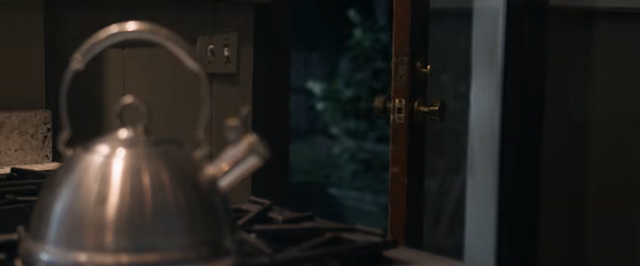
And then there are the renovations. With portions of the house covered in plastic sheeting and construction materials, the production introduces a visual and physical contrast between the polished elegance of the principal living areas and the more exposed, unfinished spaces. The basement, garage, bedrooms, and bathrooms each offer distinct environments for the escalating action.
But perhaps the most extraordinary detail is the woodwork itself. “This house was genuinely built in the 1860s, if I get that correctly. It is genuinely an older house. And the detail of the wood—the wood itself is actually not what it looks like. This was genuinely hand-painted grain on the wood, including all the stuff that was done in the living room and in the dining room. So there was a lot of love for the house regardless, and I think that’s obviously what drew us to say, well, we need to immortalize this house in a film somehow because it’s just too beautiful not to utilize. And those were the homeowners’ furnishings. The beautiful cognac couch, the glass table and glass shelving. And the tub! The tub is a very specific thing in this film as well. The owner genuinely was a person with exquisite taste, and we took a chance, reached out, and said, ‘Can we film there?’ And he graciously let us essentially invade his home for eleven days to get this film created.”
The hand-painted wood grain is particularly noteworthy, with its rich cognac and burgundy undertones creating a warmth rarely seen in contemporary interiors. That warmth is further enhanced by carefully chosen set dressing, including crystal decanters, candles, glass furnishings, and a beautifully composed fireplace.
One especially memorable composition features tiny tea lights in crystal candleholders, photographed from a low angle that allows the flickering illumination to dance across the glass surfaces. The resulting image is elegant, intimate, and quietly atmospheric.
As the action moves upstairs into the Harrington bedroom and bathroom, the visual temperature begins to shift. Cooler blues, reminiscent of the rainy exterior, subtly alter the mood, while the construction areas and garage introduce still more tonal variations.
It’s an exceptionally effective use of production design and cinematography working in concert.
For Coleman, preserving the character of the house was essential. “Everything’s kind of gray now. We wanted to really show a beautiful space, and I think the house was a no-brainer to choose as a location. We knew that we had every inch of that house to work with, and I was like, okay, let’s have fun with this. And genuinely, knowing the history of the house as well, we were like, we need to photograph this in some kind of capacity. I’m glad that you were picking up that the house feels like a character in itself. It genuinely is.”
And while the house provides the physical environment for the story, Damenz’s cinematography gives it an emotional identity.
JULIUS DAMENZ AND THE ART OF VISUAL TENSION
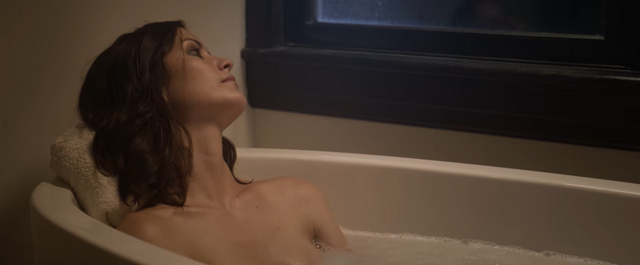
One of the most remarkable revelations about DEADBOLT is that cinematographer Julius Damenz was just 22 years old when he photographed the film. Yet there is nothing tentative about his work. His understanding of framing, light, color, and the psychological possibilities of camera placement is evident throughout.
Coleman credits their close collaboration, extensive discussions, and storyboarding with helping establish the film’s visual language.
“Julius was only 22 when he shot this film, which is mind-boggling to me. He’s from Germany, and he just knew exactly what he loved. He loves this genre. He loves these types of films. We met often at my place when I lived in St. Louis, and we would go over things and storyboard different pieces of it. He’s also just a really good person. He’s told me, ‘Listen, you’re stuck with me for life. We are doing it together.’ And honestly, I don’t have an issue with that. His wife is incredible as well. She came on as an assistant director at one point, and truly, just remarkable human beings. He was really able to make everything work.”
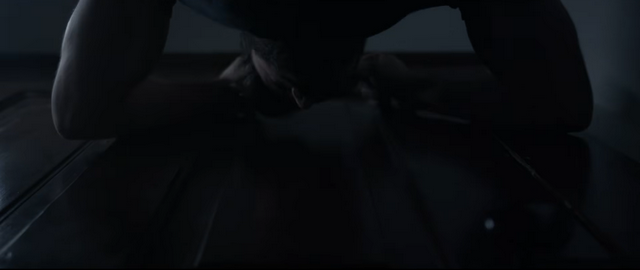
Among the film’s most arresting images is a low-angle composition of Theo, the increasingly unhinged intruder played by Matt Gorkis, pressing his forehead against a door in frustration.
With the camera positioned close to the floor and shooting upward, the angle exaggerates Theo’s facial features, creating an almost grotesque, Joker-like distortion that visually communicates his psychological instability. It is a stunning composition, simultaneously menacing and fascinating. And, as Coleman revealed, it was a deliberate homage to another master of cinematic terror.
“It was definitely an homage to The Shining, for sure. We said, listen, we’ve got to get this kind of Shining shot in there. It’s really menacing in the film. I think the trailer does a good job of highlighting it, but when you see it in its full capacity…”
The shot is emblematic of the film’s approach to visual storytelling. Rather than relying solely on frantic camera movement or rapid-fire cutting, Coleman and Damenz understand the power of a carefully composed image to generate unease. And that understanding extends to the performances.
THREE STRONG WOMEN AND ONE GLORIOUSLY UNHINGED VILLAIN
At the heart of DEADBOLT are three women whose intelligence, ambition, and individual motivations drive the narrative: Anne Harrington, Kathie Sinclair, and Sabi. Each is distinctly drawn, and Coleman is particularly proud of the fact that none exists simply to fulfill the familiar damsel-in-distress stereotype.
As Anne, Callie Deering delivers a beautifully grounded performance, balancing fear with composure, intelligence, and a deeply ingrained instinct to help others. Anne’s work with a foundation assisting women who have experienced abuse informs her responses throughout the film. Even when faced with extraordinary danger, she remains remarkably resourceful, thinking through situations rather than surrendering immediately to panic.
That characterization becomes especially important when Anne is confronted with the possibility of helping Sabi, played by Jaslene Gonzalez, despite the obvious danger involved.
Coleman understood that audiences might question Anne’s decision-making, but he was determined to keep her actions consistent with the woman established in the screenplay.
“We did want Anne to make proper decisions. We wanted her to make realistic decisions. That’s why, without spoiling anything, she does get on the phone with the police prior to doing that. I think it’s because of who Anne’s character is. We were like, I don’t know if she would watch somebody die on her front lawn. So I think that’s the one maybe mistake that she makes the entire film. But everything else, I think it’s because of who she is and how we wrote her. She’s like, I have to save this person. And you can see she’s kind of reluctant as the scene goes on. She’s questioning her in real time, and she’s trying to make sure that Sabi is in a good position. Some people would say, ‘I would definitely not do that.’ Some people would say, ‘I have to.’ And I think that’s where we were just like, we have to let her in.”
Sabi herself proves to be one of the film’s most intriguing characters, undergoing a substantial emotional and psychological evolution as the story progresses. For Gonzalez, the opportunity to explore those complexities was particularly appealing.
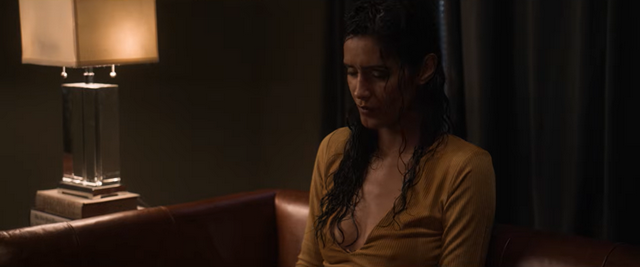
“Jaslene was another instance where she was like, ‘I need to be in this role. I genuinely feel as though I can make Sabi become a real character.’ We had such support from the actors, but specifically support from the female actors. And I think it’s because we were very gentle. Me and Dylan and Craig, we all wrote elements of this, and at the same time, we didn’t want them to be what Hollywood makes women often. We wanted them to be smart and challenge things. In Sabi’s case, she does kind of switch quickly, and we felt like we did a really good, delicate dance of making these characters that women would actually want to play and create. We don’t need people just being damsels in distress all the time. And I think that Sabi, while she kind of veers into that lane, she veers back out of it by the end of the film.”
Then there’s Adria Dawn as Kathie Sinclair. Commanding, formidable, and utterly captivating, Dawn brings a sharp-edged intensity to the character that makes every appearance memorable. Her performance becomes increasingly audacious as the film progresses, culminating in a remarkable extended monologue that demonstrates both her dramatic control and Coleman’s willingness to embrace the heightened possibilities of the material.
“Adria is just such a talented actor, and she only was on set for, I think, two days. She genuinely has a very commanding presence. When we were in the editing process, we had more scaled-down versions of her, and we were like, no, let’s just enjoy ourselves a little bit. I kind of leaned into the camp a little bit because there were some campy performances. And I don’t mean that in a negative way. I think it just makes the twist even more absurd. We really leaned into Adria’s performance because she’s diabolical. There are some really, really fun moments with her, and she did such a great job. Jaslene, too. They both did a really good job of playing these more toned-down characters in the beginning of the film, and then as the film ramps up, they both get pretty intense. I think they were both exceptional.”
Coleman was especially impressed by Dawn’s preparation and her ability to deliver substantial dramatic material without requiring extensive direction. We didn’t have tons of takes in those moments. Even Callie, I thought, did an exceptional job listening to her and reacting in the moment. But truthfully, we just let her go. Adria brought all of that on her own. There wasn’t a massive amount of direction on my side. We just said, we know how you want to do this, so let’s have fun with it. She told me privately that there aren’t a lot of roles like this, and she needed to do this role. She wanted to do this role. I genuinely think Adria completely knocks it out of the park, and I really hope this opens up way more doors for her.”
And then there’s Theo. Oh, Theo!
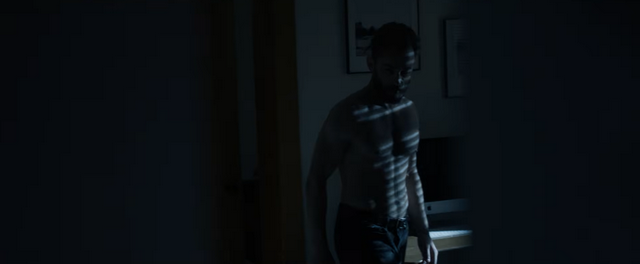
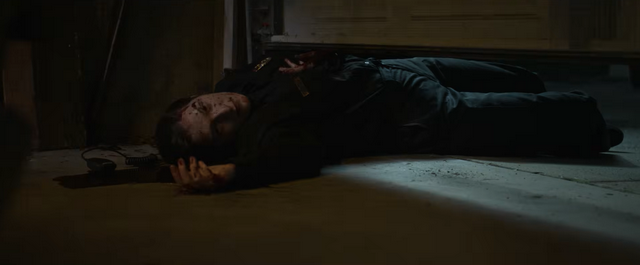
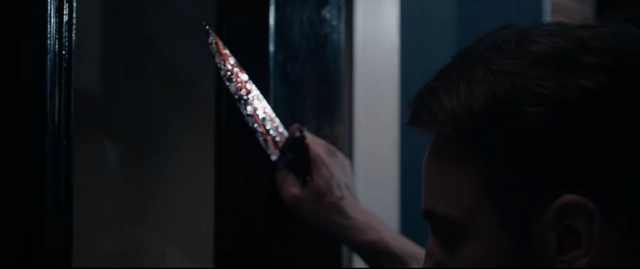
Played by Matt Gorkis, Theo is a wonderfully psychotic creation whose unpredictable behavior, bizarre mannerisms, and almost gleeful embrace of violence make him one of the film’s most entertainingly disturbing elements. Gorkis throws himself into the role with an almost feral physicality, frequently hurling his body into the action with little apparent concern for personal comfort. And his accent!
“We went to college with him, and we worked on a short film with him a long time ago. Craig was involved in that as well. We were looking for someone to fulfill this role because we had a few people in mind, and Craig was like, ‘What about Matt Gorkis? We’ve worked with him a long time ago. He’s pretty great.’ The thing that’s kind of crazy about Matt is that he really will genuinely throw his whole body into it. Physically, you saw multiple times in the film where he’s literally falling on the ground, and it’s not like he’s falling on carpet. He’s a very aggressive man, and I think that’s where it’s interesting to see how we wrote the men and how we wrote the women in this film, because he’s kind of that toxic masculinity that plagues a lot of America right now. He also created that accent. I don’t know where it came from. It was not a Missouri accent, in my opinion, because I’m from Missouri. But we just let him go into it.”
The result is a villain whose behavior is often so extreme that audiences may find themselves laughing at the sheer absurdity of his actions.
For Coleman, that response is not only acceptable but encouraged. “A lot of the crew, when we were filming it, we could not stop saying his lines on set because of how weird Matt said them. We couldn’t stop saying these really ridiculous lines. I have to give a lot of credit to Craig because he was kind of Theo’s creator. There’s a really fun backstory about what he was supposed to be back in the day, but we tweaked it. He was inspired by really weird people in real life, like Mr. Cruel, who would do weird things like invade your space and you wouldn’t even know it. He became this really, really fascinating villain. I don’t even know if we wrote Theo’s character as well as Matt made his performance.”
It’s a fascinating admission, and one that speaks to Coleman’s willingness to allow actors to expand upon the written material.
EDITING FOR TENSION, PERFORMANCE, AND A LITTLE ABSURDITY
With such heightened performances and a narrative dependent upon carefully controlled revelations, the editing of DEADBOLT becomes especially important.
Editor Craig Deering, who also shares story credit, was instrumental in shaping the film’s rhythm and maintaining its escalating suspense. Rather than relying on the rapid cutting often associated with contemporary thrillers, Deering and Coleman frequently allow shots and performances to breathe, trusting the actors and the carefully composed imagery to sustain tension.
“Honestly, it was really smooth. Craig was essentially the one who assembled everything, and he felt really confident in his direction with it. I work in editing in my day-to-day life as well, and usually we have to concoct it all around music and stuff like that. This was the first time that we were actually allowing ourselves to just let the shots breathe. And once we got the composer to come in, then I was like, okay, wait, now we’re really getting somewhere.”
But the editing process also presented Coleman with an opportunity to reconsider the film’s tonal balance. After repeatedly watching the material, he began to realize that he had perhaps been taking the project too seriously. The solution was to embrace the absurdity.
“I got to a point where I was watching it over and over and over again. I could definitely quote this film front, left, and center. And honestly, it got to a point where I was taking myself way too seriously. So I stepped back, looked at a few more performances, and again, going back to Kathy’s character, I was like, let’s just crank her to eleven. I think a lot of fun Hollywood films don’t exist anymore. Not saying that we’re the perfect film, but I think we just let ourselves enjoy the moment a little bit. One compliment that I always get about the film is that people say, ‘I started to laugh during this. Is that okay?’ And I’m like, please! Please laugh at the absurdity of the film. We wanted to have a very clear vision of what we were saying.”
That willingness to embrace humor without sacrificing suspense is one of the film’s most effective qualities. And Coleman was equally determined not to overstay his welcome.
“I kind of like that it’s short and sweet. I don’t think these films need to be three hours long, especially when it comes to a thriller. “It feels really nice. You just get in, you get out, and people have a really positive response to that.”
CODY MARTIN AND THE SOUND OF SUSPENSE
Another standout element of DEADBOLT is the score by Cody Martin, whose work avoids many of the familiar musical clichés associated with contemporary thrillers.
Rather than relying on predictable sustained tremolo or incessant musical stingers, Martin employs a more textured, atmospheric approach, with particularly effective use of violins and low, guttural string movements. The result is a score that enhances the tension without overwhelming the imagery or performances.
For Coleman, the musical inspiration once again came from the films and television programs that shaped his formative years.
“Cody is a great listener, and towards the end of the distribution process, he’s been a great partner in all of this. I do believe we’ll work with him again in the future because he was fantastic. He just said, ‘What are some of your inspirations?’ And I’m inspired by old media from the 1990s to 2000s because that’s what I grew up with. I only had access to standard TV. I didn’t have cable or anything like that, so I fell in love with scores from Batman: The Animated Series, which is very whimsical. It’s just gorgeous. I was also really entranced by The Invisible Man score because there were beautiful violins. And The Ring was another huge influence for me because that score I could listen to while I’m writing every single day.”
Coleman wanted the music to feel authentic to the visual world he and Damenz had created, evoking the atmosphere of classic thrillers without simply replicating their most recognizable musical signatures.
“I wanted something that felt not classical, but something that felt authentic to the look of what we were looking for. I think we went with a style where you could put this movie next to something like What Lies Beneath, and you could play them next to each other, and to me it would make sense. We really tried to find something that felt Hitchcockian in a way. We genuinely wanted to not create a score that would essentially be the Psycho theme song or something like that. Cody just listened to what I was asking. We really didn’t have that many changes, and he knew that I love these low, guttural violin movements, so that’s where we tried to put them in a little bit more.”
The partnership proved so successful that Coleman was particularly excited about the soundtrack receiving its own release alongside the film.
“I personally love the score. The best part about doing the end credits of the film, when I was editing all that stuff, was putting the score back into the film at the end because I was like, these are just so good. It was a really, really good partnership. We shopped around for a few different people, but Cody just really understood the assignment.”
ELEVEN DAYS, A THOUSAND EMOTIONS, AND THE REALITY OF INDEPENDENT FILMMAKING
For all the enthusiasm Coleman brings to discussing DEADBOLT, the actual experience of making the film was far from easy.
Shot over eleven days, the production required Coleman to balance the responsibilities of directing, producing, writing, production design, casting, and numerous other tasks while simultaneously managing the emotional and financial pressures of independent filmmaking. And although the finished film demonstrates considerable confidence, Coleman readily admits that the experience pushed him to his limits. His recollection of those first days on set is particularly revealing.
“I’ll be very, very candid with you because I think people need to hear this part of the story. The first seven days of the eleven days that we were filming, I would wake up in tears, and I wouldn’t know why I was crying. But it’s because this is our baby. This is what we were putting all of our effort and our time and our money into. I was still working at a marketing job, and I just took off enough time to get the film done. At one point, I even said that I would never do a film ever again because it’s so taxing to the body.”
It’s a striking admission from a filmmaker whose enthusiasm and confidence are so evident throughout our conversation. But the experience also proved transformative.
“The good news is that now I know what to do. We were all so green at the time. I’ve learned enough lessons that I definitely want to make a second one now, for sure. But it’s not an easy job, especially when you’re wearing multiple hats. There’s a lot more stuff that I’ve learned, especially in the distribution process, just to prepare yourself and say, hey, as long as you get this, this, and this on the checklist, then you’re good. There’s not as much anxiety going into the next one because we’ve learned all the mistakes and errors that we’ve made throughout the years of this. It took us a while to get to this finish line, but everybody I’ve talked to has said this is the time that it needed to come out.”
The eventual distribution partnership with Shout! Studios’ Saban Films was particularly meaningful for Coleman, whose childhood love of Power Rangers made the connection feel unexpectedly personal. His grandfather, a writer of crime novels, had encouraged his childhood enthusiasm for the franchise by giving him Power Rangers gifts at Christmas.
“I’m over the moon because I am such a huge fan of Power Rangers from when I was a kid. My grandfather used to write crime novels, and he was the one who used to give me my Christmas presents that were always Power Rangers back in the day. So it genuinely feels like I’m even closer to him in a kind of way because it feels like a full-circle moment. I’m over the moon that they’re the ones deciding to get this out there because I have nothing but the deepest respect for them and could not have asked for a better partner.”
It’s a touching connection, particularly given the genre Coleman has chosen for his first feature.
WHAT COMES AFTER DEADBOLT?
Despite the challenges of making DEADBOLT, Coleman is already looking ahead. And while he isn’t interested in limiting himself exclusively to one genre, he sees a natural connection between comedy and horror, particularly in their shared dependence on timing, surprise, and audience reaction. His next project, however, is firmly rooted in thriller territory.
“We’ve done comedies as well because Craig himself is a comedian. Callie’s actually very funny. I know she didn’t have that opportunity as much in the film to express those moments, but she has really, really good comedic timing. I think there’s a clear connection between comedy and horror, so I don’t think we’ll be completely tied to one genre. But I do know that the next film I want to do is a thriller. It’s definitely a murder mystery.”
And if Coleman has his way, Callie Deering will once again be at the center of the story.
“I do want to cast Callie again as the lead. She knows that Anne was written with her in mind, and so I think she’s essentially become my muse in a certain kind of way. We know that she can get it to exactly where we want it to be, and I think she proved it with Anne, especially her ending monologue. It’s gorgeous in my mind. She actually told me the other day, ‘You do realize that was supposed to be a voiceover, right?’ And I was like, ‘Was it?’ She said, ‘No, you walked up to me on set and said, by the way, we’re going to film this.’ And that shows her character and how she’s able to say, hey, I’m able to take this on. Let’s go for it. The next film is definitely going to include Callie in some capacity because she’s exceptional. She is a star in my eyes.”
That enthusiasm for his collaborators, his willingness to acknowledge the contributions of others, and his determination to keep learning are perhaps the most encouraging qualities Coleman brings to filmmaking.
DEADBOLT may be his first feature, but it is a film that demonstrates a genuine understanding of cinematic storytelling and a clear affection for the craft.
From the extraordinary Harrington house and Damenz’s sophisticated cinematography to Martin’s evocative score, Deering’s measured editing, and the powerhouse performances of its ensemble, DEADBOLT is a testament to what can be accomplished when passion, preparation, and collaboration come together. And for a filmmaker who once woke up in tears wondering whether he could survive the experience, Coleman has emerged with a renewed determination to keep creating.
“I need to use this as momentum right now. People are getting excited, so we’ve got to keep going for it. It’s really exciting to hear people get excited about the project because sometimes it feels like we’re just talking to our friends, and we might think, oh, this is good, but we’re just talking to ourselves. It’s nice to know that people from the outside are saying, no, you guys really did what you were supposed to do.”
And with DEADBOLT, Zac Coleman has indeed done what he set out to do. He’s opened the door to a new generation of independent thriller filmmaking. And something tells me this is one filmmaker who won’t be locking that door again anytime soon.
exclusive interview 11/06/2026
DEADBOLT is now available On Digital and On Demand