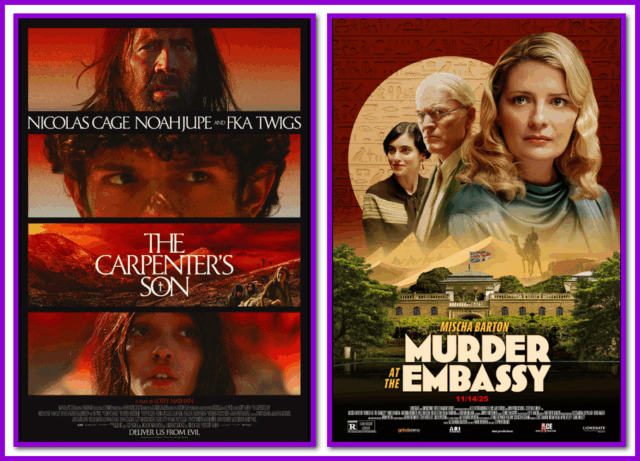
This week on BEHIND THE LENS, it’s all about mysteries thanks to director STEPHEN SHIMEK talking about MURDER AT THE EMBASSY, and writer/director LOTFY NATHAN discussing THE CARPENTER’S SON.
But first, let’s take a little trip to Cairo with director STEPHEN SHIMEK and MURDER AT THE EMBASSY.
The second film in the Miranda Greene franchise, this story is fun, and the film is as entertaining as it is beautiful, as it drenches you in the beauty and wonder of Egypt. Set in 1930s Cairo with pyramids and antiquities at the height of Egyptology and archaeology, private detective Miranda Green is called to investigate a suspicious murder inside Cairo’s seemingly impenetrable British Embassy when she discovers a second crime has been committed that could spark war across the globe. Everyone within the walls of the embassy is a suspect, but the ultimate evil force is lurking right around the corner.
Directed by STEPHEN SHIMEK and written by Mark Brennan, MURDER AT THE EMBASSY stars Mischa Barton, Mido Hamada, Kojo Attah, Nell Barlow, Raha Rahbari, Antonia Bernath, and Richard Dillane.
I love Egyptology and archaeology and everything that surrounds the history and its uncovering, the period of the 30’s, and I am a longtime lover of mysteries, which makes this the perfect film for me. Think Agatha Christie meets Indiana Jones meets Jessica Fletcher. The film is light and bright, visually and in its tone. The mystery plot works, the characters are well done with believable ambiguity and guilt spread around, performances are solid. The chemistry between Mischa Barton as Miranda and Mido Hamada as Mamoud, head of security at the British Embassy, is wonderful and fuels the development of their character arc. Supporting cast who round out potential murder suspects include a journalist, an actress, a secretary, a translator, and the ambassador and his daughter, with all cast extremely well, most notably Koijo Atah as our journalist Walter, and Antonia Bernath, who is a hoot and a holler with shades of Judy Holliday as actress Betty. And of course, there’s Miranda’s trusted companion and assistant, her dog Blunder (who is a scene stealer).
As you’ll hear Stephen discuss, being a lover of mysteries himself, shooting this film and being in Cairo was a dream come true. Of course, quite often making dreams come true is not as easy as it sounds, and that was certainly the case here. Working with cinematographer Brian Vilim, who is also a producer on the film and with whom Stephen has worked on prior films, the two developed a delightful visual grammar that showcased the region, while constantly adapting their filming techniques to the changing conditions brought by light, sand, desert winds, and heat. And how about having to worry about hydration? Tricky was the editing process to balance suspense, humor, and “information,” and for that, Stephen turned to editor Matthew Jensen, whose openness to experimentation allowed them to try various pacing and structural approaches until they found what best served the film. And how about not only working with a dog, but worrying about a handful of camels, some donkeys, and yes, live scorpions?
MURDER AT THE EMBASSY is now in theatres and available On Demand and on digital.
Now let’s switch gears and talk about another type of mystery with writer/director LOTFY NATHAN and THE CARPENTER’S SON. Not your cut-and-dry faith-based or historical religious film, Lotfy pushes the envelope here as he draws from the apocryphal Infancy Gospel of Thomas for this story. This is a film that has already drawn some ire in the Christian community as it is developed from the apocryphal Infancy Gospel of Thomas about the childhood of Jesus and fills in the New Testament canonical gospels, often clashing with some of those accepted writings. A powerful and fascinating film that is exquisitely made. And did I mention it stars Nic Cage as Jesus’ father, the carpenter Joseph?
There has long been dispute on these apocryphal gospels which number anywhere from 14 in Protestant Bibles, 11 in Catholic Bibles and possible up to 54 bits and pieces which make up the Apocrypha, all of which have long been denounced as part of the accepted biblical “canon”, in large part because of Jesus being depicted as vindictive or punishing, not to mention performing possible “miracles”. But from a historical aspect, they are quite interesting and in the case of the Infancy Gospel of Thomas, on which Lotfy bases THE CARPENTER’S SON, much light is shed on the life of a young teenage Jesus.
What Lotfy delivers is a fascinating story. I was riveted and enthralled from beginning to end. And yes, the fact that Nic Cage stars as Joseph the Carpenter adds another whole layer to the film.
Written and directed by LOTFY NATHAN, THE CARPENTER’S SON stars Nic Cage as “The Carpenter”, Noah Jupe as “The Boy” aka Jesus, and FKA Twigs as “The Mother” aka Mary.
Combining inspiration from apocryphal gospels with a focus on emotional realism and narrative depth, in this exclusive interview, Lotfy discusses drawing from non-canonical sources (particularly the Infancy Gospel of Thomas) to fill in gaps about Jesus’ youth and to imagine the dynamic between Joseph and Jesus, despite the original text’s lack of direct narrative. What can be described as an origin story, the film explores the father-son complexity, showing Joseph as a strict, deeply religious man who feels overwhelmed and sometimes confounded by the extraordinary child in his care, and Lotfy sought to ground this with believable motivations and moments of conflict and connection. The result is an immersive narrative, particularly the father-son dynamic, which is the heart and soul of THE CARPENTER’S SON.
Shot on location in Greece and Crete on 35mm, the film is visually stunning as Simon Beaufils’ cinematography is glorious. ECUs and macros abound, and work so well as connective tissue, metaphorically speaking to the wonder/importance of a thing or a moment, especially when we are talking biblically. As we dig into the “making of” THE CARPENTER’S SON, Lotfy explains the meticulous world-building process, including historical research and collaboration with his production designer Jean-Vincent Puzos and DP Beaufils.
An extremely interesting aspect of our conversation focuses on the sound design, which is impeccable and critical for the storytelling and world-building building thanks to limited dialogue. From the night wind in the desert to the clop of donkey hooves or sandaled feet walking on rocks and dry dirt to the wood door latch being not-so-quietly opened by a teen sneaking out in the night to crickets and night noise and village voices in the daytime, the ambient soundscape speaks loudly, playing a stronger narrative role and creating a vivid and visceral atmosphere. Adding to the sound design is Lorenz Dangel’s unique score, which incorporates chorale music and ambiguous instrumentation, carefully blending with the ambient elements to maintain tonal ambiguity, sometimes making the audience question whether they are hearing something good or evil.
And of course, there’s Nic Cage, and Lotfy has a lot to say about Nic and his performance as he embodied Joseph’s intense internal struggle, religious fervor, and sense of overwhelming responsibility as Jesus’ guardian. We see the internal struggles ultimately manifest in an emotional explosion of anger and frustration in the third act, as only Nic Cage can do. It is Nic Cage at his most Nic Cage. Contrasting Cage is the calm of FKA Twigs as Mary, while Noah Jupe is outstanding as the angst-filled 15-year-old Jesus who is baffled, confused, angry, tempted, and unsure of what this power is that he seems to have.
THE CARPENTER’S SON is in theatres now.
FOLLOW US ON X (formerly Twitter):
@BTLRadioShow
@moviesharkd
LIKE US ON FACEBOOK:
www.facebook.com/BTLRadioShow
FOLLOW US ON BLUESKY:
@moviesharkd.bsky.social
SUBSCRIBE ON YOUTUBE:
https://youtube.com/@behindthelensonline
#BTLRadioShow