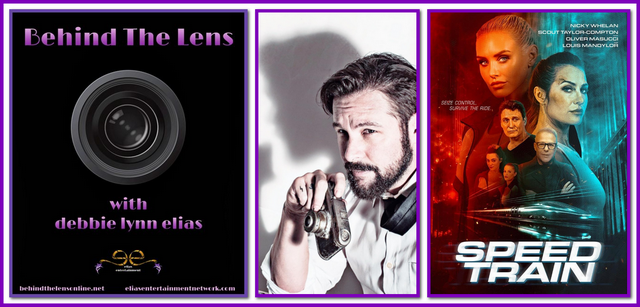
The discussion ranges widely across his recent work, touching on projects where he appeared solely as an actor or Executive Producer—Reverence, The Jurassic Games: Extinction, Trail of Vengeance, The Flood, and 3 Days in Malay—before landing squarely on the film that best captures his current creative identity: SPEED TRAIN. He also teases what lies ahead, expressing genuine excitement for two upcoming projects, Bruton and Bring the Law, both of which continue to pull him deeper into directing and producing.
SPEED TRAIN emerged not from a master plan, but from persistence. Francis had already collaborated with producer Daemon Hillin multiple times, and after several projects together, he kept pushing a simple idea: he wanted to direct. Hillin eventually handed him a script titled Speed Train, written by James Cullen Bressack with another writer. The title immediately clicked—but the script itself became a jumping-off point rather than a destination. As Ryan read, he found himself rewriting and reshaping, and finally realized he wanted to pitch something entirely new.
Keeping the title, he proposed a bold reimagining: set the story in the future, center it on a group of cheerleaders trapped aboard a hijacked bullet train, and layer in themes of artificial intelligence, control, and human dependency on technology. Hillin hesitated—after all, there was already a finished script—but ultimately gave Ryan thirty days to prove his vision. The resulting draft impressed enough that it was passed to Judah Ray, and the two writers began a rapid-fire collaboration, trading pages back and forth until the story locked into place.
Ryan wrote with specific actors in mind—people he trusted and had worked with before, including Scout Taylor-Compton, Nicky Whelan, Louis Mandylor, Mike Manning, Kristos Andrews, and the Thai team they would rely on heavily once production began. With the script in shape, the timeline compressed dramatically. Soon, the core team was on a plane to Thailand, where they would shoot a futuristic sci-fi action film in roughly ten to twelve days.
That schedule, Francis admits freely, was borderline insane.
Set in a distant future where technology reigns supreme, SPEED TRAIN follows a disgraced tech genius who hijacks a bullet train and weaponizes its brain-chipped passengers. As chaos erupts, a mismatched group—rebels, cheerleaders, and an FBI agent—must fight mercenaries and AI threats alike, racing not only to survive but to reclaim their autonomy from a world slipping deeper into digital control. Adding to the proceedings is an amazing cast, including Nicky Whelan, Scout Taylor-Compton, Oliver Masucci, Louis Mandylor, Jade Patteri, Liana Ramirez, Mike Manning, Kristos Andrews, and Devanny Pinn.
As Ryan explains, pulling that off inside a handful of narrow train cars proved to be the film’s defining challenge. Most scenes took place inside windowless spaces barely six to eight feet wide and about fifteen feet long, dressed and redressed to represent everything from control rooms to prison cars. With only three or four physical cars available, the production relied on careful blocking, handheld camera work, and two-camera setups to create variety and momentum. Fight scenes added another layer of complexity—tight quarters, limited rehearsal time, language barriers with the local stunt team, and choreography often devised the night before or on the day itself. Many of the film’s most striking physical moments were executed without wires, built through sheer ingenuity and trust on set.
Shooting in Thailand brought logistical hurdles as well. At times, the set swelled to nearly a hundred people—cast and crew combined—an enormous undertaking for an indie production moving at breakneck speed. Maintaining clarity, pace, and visual interest within what Ryan repeatedly calls a “long box” demanded constant problem-solving, from surveillance-style angles to the dark-web gamblers’ point of view, all designed to open up the film’s visual grammar.
For Ryan, having cinematographer Nico De La Fere was non-negotiable. The two shared an instinctive shorthand, built less on long theoretical discussions and more on feel, rhythm, and trust. With minimal prep time, they committed to handheld shooting and dual cameras, letting Nico’s natural responsiveness guide the action. Francis recalls moments when he started to correct a shot, only to stop himself once he saw the frame and realized it was working perfectly. Language differences only reinforced that intuitive collaboration—emotion and intent translated directly into movement and composition.
If production was daunting, post-production was terrifying. With multiple story threads unfolding at once—on the train, in control rooms, online, and in news coverage—Francis initially feared the edit might collapse under its own weight. Editor Austin Nordell proved essential, threading the narrative together with clarity, humor, and momentum. Ryan credits Nordell almost entirely for making the film work as a cohesive experience.
As you’ll hear, in looking back, Ryan is frank about the lessons learned. SPEED TRAIN was, by his own admission, too ambitious for its schedule and budget. Given the chance to do it again, he’d demand more time—at least twenty days—and a more realistic balance between scope and resources. But he also emerged with something more valuable: a reinforced belief in collaboration, in hiring the right people, and in trusting them fully.
Most importantly, the experience confirmed what Ryan Francis already suspected. Despite the pressure, the chaos, and the near-impossible logistics, directing is where he belongs. Making movies—messy, exhausting, ambitious movies—is what he loves. And after surviving SPEED TRAIN, he’s more committed than ever to staying on that track.
SPEED TRAIN is available in select theatres and On Demand.